50 Best Sights in Hungary

Background Illustration for Sights

We've compiled the best of the best in Hungary - browse our top choices for the top things to see or do during your stay.

Nagy Vásárcsarnok

South Pest Fodor's Choice

The city’s premier market hall, with a stunning gilded exterior, is a treasure chest of Hungarian produce and foodstuffs. This is the oldest (over 125 years) and largest market in town, and a great place to wander and sample specialties like Mangalica ham (Hungarian white swine), Szarvaskolbász (deer sausage), Kovászos uborka (fermented cucumber), and a variety of local handmade cheeses, honeys, Hungarian paprika, and other delectables. Follow your nose upstairs to its market eateries for lángos, a Hungarian deep-fried flatbread, and peach strudel from the popular rétes stand. You can stock your suitcase with vacuum-packed products, and look for additional souvenirs on the second floor, where you'll find a mix of lovely and kitsch Hungarian handicrafts, hand-carved chess sets, and Rubik's Cubes.

Szentendrei-sziget

Fodor's Choice

Looking for some tranquility after squeezing through the crowds in downtown Szentendre? The answer is this lush green island oasis, right across the river but surprisingly untouched and ripe for exploration. At the time of the Hungarian conquest of the Carpathian Basin in AD 896, the flat island—33 km (21 miles) long and up to 3.8 km (2.4 miles) wide—was used as pasture land. It subsequently became a key agricultural, ship-building, and fishing center that helped link the otherwise hilly Danube Bend with Buda to the south. Only after the end of the 120-year Turkish occupation of Hungary in the late 17th century did a loose-knit web of settlements develop, and from the mid-19th century on, resort districts began to spring up for city-weary Budapesters.

Most of Szentendre Island comprises nature preserves and bucolic countryside—this is a rich habitat and stopping-off point for waterfowl—but there are also four villages, from quaint Kisoroszi (with its gorgeous golden beach) on the island's northern tip, to the larger but lovely Szigetmonostor in the south. To get to the island from Szentendre, hop on a ferry from the docks, or cross the bridge at Tahitótfalu, 10 km (6 miles) north of town.

Vajdahunyad Vár

City Park Fodor's Choice

Beside the City Park’s lake stands Vajdahunyad Vár, a fantastic medley of Hungary’s historic and architectural past, starting with the Romanesque gateway of the cloister of Ják, in western Hungary. A Gothic castle whose Transylvanian turrets, Renaissance loggia, baroque portico, and Byzantine decorations are all guarded by a spooky bronze statue of the anonymous medieval “chronicler,” who was the first recorder of Hungarian history. Designed for the millennial celebration in 1896, the permanent structure was not completed until 1908. This hodgepodge houses the surprisingly interesting Mezogazdasági Múzeum (Agricultural Museum), which touts itself as Europe’s largest such museum and offers regular arts and crafts events for kids. Plan ahead for tickets to the Vajdahunyad Castle Summer Music Festival featuring some of Hungary's most popular musicians. If time permits, stroll around the castle to spot the Mermaid fountain and the bust of legendary Hollywood B-movie actor and Hungarian-American Béla Lugosi that was placed in an alcove along the southeast corner in 2003; its origins remain a mystery today.

Recommended Fodor's Video

Bazilika

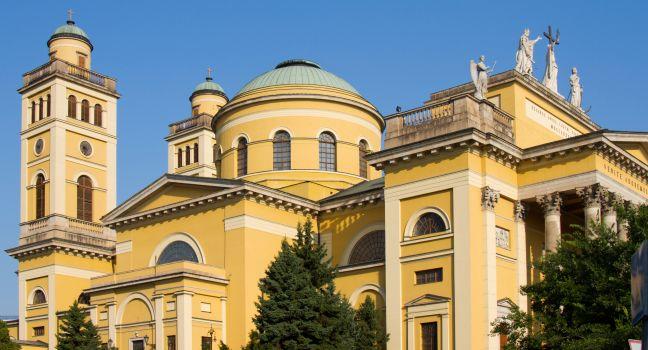
The Cathedral of Eger - this is the second largest catholic church in Hungary. It was built between 1831-1836 in classicist style.
(c) Victorua | Dreamstime.com

The grand, Neoclassical Eger Bazilika, built in the center of town early in the 19th century, is the second-largest cathedral in Hungary after Esztergom (which was built later by the same architect, József Hild). Its beautiful exterior is approached by a split stairway flanked by statues of four saints—Stephen, László, Peter, and Paul—offering views across leafy Eszterházy Square to the similarly monolithic Lyceum building. But it's the interior of the Bazilika that really takes the breath away, with its carved biblical reliefs by Italian sculptor Marco Casagrande set beneath a soaring dome. Visiting on a Sunday, June through October? Stop by for the delightful half-hour organ recital, held at 12:45 pm.

Pyrker János tér 1, 3300, Hungary
36-420--970
Sight Details
Free (suggested donation 300 HUF)

Something incorrect in this review?

Andrássy út

Parliament

Turn-of-the-century Andrássy út links Erzsébet Square with the Városliget and makes for one of Budapest's most pleasant walks, with lots of places to stop along the way. Modeled after Paris' Champs-Élysées, from its starting point at Bajcsy-Zsilinszky út, you can see all the way up to its end at Hősök tere. Lined with spectacular neo-Renaissance mansions and town houses featuring fine facades and interiors, but also shady green trees, it was recognized as a World Heritage Site in 2002. Today, it’s a high-end promenade filled with cafés and restaurants, embassies, and hotels. It's no accident that the city's oldest metro line goes all the way up it, with direct stops at the Opera House and other significant sites in its vicinity.

Andrássy út, Budapest, 1061, Hungary

Something incorrect in this review?

Avasi templomrom

These church ruins on the outskirts of Szigliget, right at the intersection with the road to Badacsony, are what is left of the village's oldest building. These Romanesque remains date back to the Árpád dynasty (855–1301), but the herringbone-like stones in the church walls suggest the site is even older, dating back to at least Roman times. Visit the Avas Church today to see the remaining 12th-century basalt tower with a stone spire.

Réhelyi út 67, 8264, Hungary

Something incorrect in this review?

Barátlakások

This network of hillside caverns, carved out of the basalt rock between the 11th and 14th centuries but only rediscovered in the 20th century, was once home to a group of Greek Orthodox hermit-monks. A mix of living quarters, chapels, and dining rooms, the caves have since been restored and stabilized with columns, making them safe to visit. You'll find them on the eastern slopes of Óvár hill; follow the green hiking route through the forest from Tihany town, or park your car at the kiinduló pont (starting point) and walk 300 meters downhill to the biggest cave.

Access is via a steep woodland path, so you'll need hiking boots and should avoid visiting during or after heavy rain.

Kecskeköröm utca 28, 8237, Hungary

Something incorrect in this review?

Bécsi kapu tér

Castle District

This lovely square (well, triangle) at the northwestern end of Castle Hill is home to some fine baroque and rococo houses. It's dominated by the enormous neo-Romanesque headquarters of the Országos Levéltár (Hungarian National Archives), a cathedral-like shrine to paperwork built in the 1910s, but there are other gems here, too: check out the house at number eight, with its pink-and-white striped facade and unusual curved windows. Nearby is the medieval stone gateway (rebuilt in 1936) that marks the northern entrance to Castle Hill, and after which the square is named. Literally translated as "Vienna Gate," the archway once sat at the end of a highway that connected Buda Castle to the Austrian capital.

Budapest, 1014, Hungary

Something incorrect in this review?

Carl Lutz Memorial

Jewish Quarter

Carl Lutz, a Swiss diplomat, is renowned for saving over 60,000 Jews during WWII. Leveraging his diplomatic status, he issued critical documents, established safe houses, and converted buildings into neutral territories, thus earning the title "Righteous Among the Nations." This striking tribute to his memory is nestled in a corner of the Jewish district, just streets away from the area's synagogues and the former ghetto. It portrays Lutz as a golden angel descending from the heavens, reaching out to rescue a victim, with an inscription that reads, "Whoever saves a life is considered to have saved an entire world."

Dob utca 12, Budapest, 1072, Hungary
Sight Details
Free

Something incorrect in this review?

Citadella

Gellérthegy

The sweeping views of Budapest from this fortress atop the hill were once valued by the Austrian army, which used it as a lookout after the 1848–49 Revolution. Some 60 cannons were housed in the citadel, and while never used on the city's resentful populace, they were briefly, ominously, pointed down towards the citizens below after the 1956 uprising. The building is closed, but you can walk around it (keep an eye out for bullet holes from the various battles it has witnessed) and the view from the hilltop still makes it a worthy visit, especially at night when the entire city and its bridges are illuminated. Avoid the tacky, overpriced tourists stalls.

Just below the southern edge of the Citadella and visible from many parts of the city, the 130-foot-high Szabadság szobor (Liberty Statue) was originally planned as a memorial to a son of Hungary's then-ruler, Miklós Horthy, whose warplane had crashed in 1942. However, by the time of its completion in 1947 (three years after Horthy was ousted), it had become a memorial to the Russian soldiers who fell in the 1944–45 siege of Budapest; and hence for decades it was associated chiefly with this.

A young girl, her hair and robe swirling in the wind, holds a palm branch high above her head. During much of the communist era, and for a couple of years after its close, she was further embellished with sculptures of giants slaying dragons, Red Army soldiers, and peasants rejoicing at the freedom that Soviet liberation promised (but failed) to bring to Hungary. Since 1992 her mood has lightened: in the Budapest city government's systematic purging of communist symbols, the Red Combat infantrymen who had flanked the Liberty Statue for decades were hacked off and carted away. A few are now on display among the other evicted statues in Szobor Park in the city's 22nd district, and what remains memorializes those who fought for Hungary's freedom.

Citadella sétány, Budapest, 1118, Hungary
Sight Details
Free

Something incorrect in this review?

Corvin tér

Castle District

This small square on Fő utca is a lovely, leafy place to take a break during a day's sightseeing. While home to a few monuments and a nice little café, Corvin tér is most notable for its eye-catching buildings at either end: to the north, a turn-of-the-20th-century masterpiece that contains the Hungarian Heritage House and Budai Vigadó concert hall; and to the south, a church that was converted from a Turkish mosque at the end of the 17th century and rebuilt in the romantic style in the mid-1800s.

Off Fő utca, Budapest, 1011, Hungary

Something incorrect in this review?

Dobó István tér

Eger's picturesque main square is marked by the dominating statue of the eponymous Baron István Dobó, hero of the 1552 Siege of Eger. Created in the early 20th century by Alajos Stróbl, the statue depicts Dobó holding a sword aloft and flanked by other defenders of Eger Castle against the Ottoman invaders. Also on the square is the beautiful, pale-pink Minorita templom. With its twin spires and finely carved pulpit, pews, and beautiful ceiling frescoes, this Minorite Church is considered one of the finest baroque buildings in Central Europe.

3300, Hungary

Something incorrect in this review?

Ferencesek utcája

This pedestrianized street in the heart of downtown Pécs is a particularly pleasant place for a stroll. Walking west to east (toward Széchenyi tér), you'll see the beautiful baroque Szent Ferenc-templom (St. Francis Church), which dates back to 1760; Memi Pasa Fürdője (Memi Pasha's Baths), the ruins of a 16th-century Turkish bathhouse; and Jókai tér, a pleasant Mediterranean-style public square with an eponymous cukrászda (cake shop)one of the city's best.

7621, Hungary

Something incorrect in this review?

Fő tér

The city's attractive main square is dominated by the early Gothic Soproni Nagyboldogasszony templom (Blessed Mary Benedictine Church), better known as the Goat Church for reasons both fantastical (it's said the church was financed with treasure found by a billy goat) and practical (goats feature on the coat of arms of the actual church financiers). It's a real mishmash of styles, with a Gothic choir, a rococo main altar, and a baroque red-marble pulpit, along with recently discovered medieval tombs. Outside stands the 18th-century Szentháromság-szobor (Holy Trinity Column), Hungary's finest plague memorial and among the first anywhere to feature a twisted column.

Facing the square are three very different but equally fascinating museums. Fabricius Ház (Fabricius House) is a beautiful baroque mansion with exhibits on ancient city history: highlights include the remains of a Roman bathhouse and the 1,200-year-old Cunpald Goblet. The Storno Ház (Storno House) is Sopron's finest Renaissance-era building with a collection of furniture, porcelain, sculptures, and paintings belonging to the Stornos, a rags-to-riches dynasty of chimney sweeps-turned-art restorers. And the Fehér Angyal Patikamúzeum (Angel Pharmacy Museum) is a real-life 17th-century apothecary that now houses a collection of period pharmaceutical tools, books, potions, and lotions.

9400, Hungary

Something incorrect in this review?

Fő tér

Fő tér is Szentendre's colorful main square, the centerpiece of which is an ornate Memorial Cross erected by Serbs grateful that their town was spared from a plague. The cross displays a painted crucifixion and stands atop a triangular pillar adorned with a dozen icon paintings. Every single house on Fő tér is a designated landmark. The Szentendrei Képtár serves as an information center and also has its own excellent collection of local contemporary artists and revolving exhibits of international art. Cross the square and check out the Kmetty Múzeum, featuring the work of János Kmetty (1889–1975), a pioneer of Hungarian avant-garde painting. Kmetty tried his hand at everything from Impressionism to Cubism, and his absorbing self-portraits utilize a fascinating mix of styles. Gracing the corner of Görög utca is the Serbian Orthodox church Blagoveštenska templom, with its elegant 18th-century edifice built on the site of a wooden church dating from the Great Serbian Migration (around AD 690). Its greatest glory—a symmetrical floor-to-ceiling panoply of stunning icons—was painted between 1802 and 1804. Behind the church lies the Szerb Egyházi Múzeum, with its exquisite assemblage of ecclesiastical art and artifacts relating to the history of the church in Hungary.

2000, Hungary

Something incorrect in this review?

Ghetto Wall Memorial

Jewish Quarter

This site pays tribute to the Jewish population herded into the ghetto during WWII, where thousands died of famine. The ghetto's walls ran along today's Rumbach, Király, Kertész, and Dohány streets. The memorial is easily accessed on the street, detailing the Jewish struggle with a map, historical summaries, and religious verses. The small section of the wall itself is located inside the apartment building's courtyard; you can try and peek at it through the gate or wait until a resident opens the door to view it.

Király utca 15, Budapest, 1074, Hungary
Sight Details
Free

Something incorrect in this review?

Gül Baba türbéje

A picturesque spot that is also one of the farthest north sites of Islamic pilgrimage in the world, this octagonal tomb houses Gül Baba, an Ottoman-era poet and dervish who took part in, and died shortly after, the Turkish conquest of Buda. He's known as 'Father of the Roses' in Hungary, hence the beautiful rose garden recently renovated using partial funding from the Turkish government.

Mecset utca 14, 1023, Hungary
1-618--3842
Sight Details
Closed Mon.

Something incorrect in this review?

Gyógy tér

The center of town is this small square, where the bubbling waters from five volcanic springs rise beneath a slim, colonnaded pavilion. The square’s centerpiece is the neoclassical Well House of the Kossuth Spring; from here you can sample the water, which has a pleasant, surprisingly refreshing taste, despite the sulfurous aroma. Note that there's a strict, 30-liters-per-person limit (good luck trying to break that rule). All the buildings on the square are pillared like Greek temples. At No. 3 is Horváth Ház, a former sanatorium that hosted the first of what was to become the Anna Ball in 1825. The ball now takes place every July in another colonnaded building on the square, and also a former sanatorium, the Anna Grand Hotel. On the north side of the square is the Füredi Panteon with aesthetically interesting tablets and reliefs honoring Hungarian and foreign notables who took the waters here. From Gyógy tér, you can stroll east along Blaha Lujza utca to see several landmarks, such as the Blaha Lujza Ház, a neoclassical villa built in 1867 (and, later, the summer home of the eponymous actress), and the sweet little 19th-century Kerek templom (Round Church).

8230, Hungary

Something incorrect in this review?

Hercules Villa

Near the main Aquincum ruins—but functioning separately—a fine third-century Roman dwelling, Hercules Villa, takes its name from the myth depicted on its beautiful mosaic floor. The ruin was unearthed between 1958 and 1967 and now stands, rather incongruously, among a large housing estate. Worth popping your head in after the Aquincum visit if you feel the need for more ruins; admission is free.

Meggyfa utca 19–21, 1033, Hungary
Sight Details
Free
Closed Mon.

Something incorrect in this review?

Hősök tere

Andrássy út

Andrássy út ends in grandeur at Heroes' Square, with Budapest's answer to Berlin's Brandenburg Gate. Cleaned and refurbished in 1996 for the millecentenary (1100th anniversary), the Millenniumi emlékmű (Millennial Monument) is a semicircular twin colonnade with statues of Hungary's kings and leaders between its pillars. Set back in its open center, a 118-foot stone column is crowned by a dynamic statue of the archangel Gabriel, his outstretched arms bearing the ancient emblems of Hungary. At its base ride seven bronze horsemen: the Magyar chieftains, led by Árpád, whose tribes conquered the land in 896.

Before the column lies a simple marble slab, the Nemzeti Háborús Emléktábla (National War Memorial), the nation's altar, at which every visiting foreign dignitary lays a ceremonial wreath.

In 1991 Pope John Paul II conducted a mass here. Just a few months earlier, half a million Hungarians had convened to recall the memory of Imre Nagy, the reform-minded communist prime minister who partially inspired the 1956 revolution. Little would anyone have guessed then that in 1995, palm trees—and Madonna—would spring up on this very square in a scene from the film Evita (set in Argentina, not Hungary), or that Michael Jackson would do his part to consecrate the square with a music video.

Hősök tere, Budapest, Hungary

Something incorrect in this review?

Jaki Chapel

City Park

Just like Vajdahunyad Castle, the portal of this church is a replica. The original, located in the village of Ják, is Hungary’s best example of a Romanesque Church from the 12th century. Featuring a gorgeous facade filled with medieval gothic biblical motifs, statues, and stonework, the chapel is a working Catholic church with regular services, concerts, and the occasional lavish wedding.

Jedlik-csobogó

This small but eye-catching drinking fountain, created by local glass artist László Hefter in 2012, depicts a turquoise soda bottle spurting water into a small tiled pool. A glance at any drinks menu in Hungary reveals an obsession with soda water, and this fountain commemorates its inventor (or, at least, the man who first mass produced it), Ányos Jedlik. The bottle itself weighs a toe-crushing 365 kilograms (804 pounds), one for each day of the year.

Jedlik Ányos utca 9, 9022, Hungary

Something incorrect in this review?

Kapisztrán tér

Castle District

This historic square at the northwestern end of Castle Hill is named after St. John of Capistrano, a 13th-century Italian friar who recruited a crusading army to fight the Turks who were threatening Hungary; you can find a statue of the honored Franciscan here. The square is also home to the remains of the 12th-century Gothic Mária Magdolna templom (Church of St. Mary Magdalene). With most of church destroyed by air raids during World War II, the main feature still standing is its tower: you can pay to climb its 172 steps for stunning city views. Also on the square is the Hadtörténeti Múzeum (Museum of Military History), set within a former barracks that still has cannonballs from the 1849 siege lodged in its walls. The exhibits, which include collections of uniforms and military regalia, trace Hungary's military history from the original Magyar conquest in the 9th century through the period of Ottoman rule to the mid-20th century.

Budapest, 1014, Hungary
Sight Details
Free (Buda Tower: 1,500 HUF)

Something incorrect in this review?

Káptalandomb

This charming neighborhood, which lies at the confluence of the three rivers, is the ancient heart of Győr. With its maze of fences and wonderfully curved gates surrounding baroque-style homes, it's a lovely area to simply stroll around, but two buildings in particular are worth a closer look. The first is the Püspökvár (Bishop’s Palace), the longtime residence of the Győr bishops. With sections that date right back to the 13th century—though it was built on the walls of an even-older Roman fort—the palace is now open as an exhibition space and lookout tower (entry costs 1,500 HUF). The second is the Székesegyház (Cathedral) with its heady mix of Romanesque, Gothic, and baroque features. Step inside to see the bishop’s throne, which was a gift from Empress Maria Theresa; the frame of a painting depicting the Blessed Virgin and infant Jesus, which is considered a rococo masterpiece; and the 15th-century bust of St. László in his namesake chapel, which is an excellent example of medieval Hungarian goldsmithery.

9021, Hungary

Something incorrect in this review?

Kerepesi Cemetery

South Pest

Kerepesi Cemetery functions as a burial ground, national memorial space, and outdoor art gallery.  Founded in 1847, this beautiful and impressive cemetery is one of the oldest in Hungary and certainly the most well-known in Budapest, being the final resting place of Hungary's greatest artists, statesmen, and inventors. Maps are available at the entrance with descriptions of the most famous residents, including Mihály Vörösmarty, Attila József, Endre Ady, Mor Jókai, Janos Arany, Lajos Kossuth, Ferenc Erkel, Gyorgy Faludy, Miklós Jancsó, and Imre Kertész, to name a few. Wander the tree-lined avenues past the ornate tombs and mausoleums of this stunning graveyard, such as the grandiose lion-guarded one for Lajos Batthyány, or the mausoleum of Ferenc Deák or Lajos Kossuth. The communist-era mausoleum for the Labour movement, designed in 1958 by Olcsai-Kiss Zoltán, may still stir conflicting feelings, but it merits a stop. At 56 hectares (138 acres), this is one of the largest National Pantheons in Europe so you'll want to spend a while. You can also visit the Salgotarjani Street Jewish Cemetery ( see its Sights listing), which occupies the eastern corner—technically part of Kerepesi Cemetery but accessible via a separate entrance.

Fiumei út 16-18, Budapest, 1086, Hungary
70-400--8632
Sight Details
Free

Something incorrect in this review?

Kisfaludy kilátó

The steep climb to the lookout tower on Mt. Badacsony’s summit is an integral part of the Badacsony experience and a rewarding bit of exercise. The trek to the tower, which climbs 455 meters—437 for the hill and a further 18 for the tower—begins behind the Kisfaludy Ház, a restaurant just above the Szegedy Róza-ház. Here stands the Rózsakő (Rose Stone), a flat, smooth basalt slab with many carved inscriptions; local legend has it that if a boy and a girl sit on it with their backs to Lake Balaton, they will marry within a year. Follow the trail marked in yellow up to the foot of the columns that stretch to the top. Steep flights of stone steps will take you through a narrow gap between rocks and basalt walls until you reach a tree-lined plateau. From here, simply follow the blue triangular markings along a path to the lookout tower. Even with time out for rests and views, the whole ascent should take less than an hour.

Margit híd

At the southern end of Margaret Island, the Margaret Bridge is the closer of the two island entrances for those coming from downtown Buda or Pest. Just north of the Chain Bridge, the bridge walkway provides gorgeous midriver views of Castle Hill and Parliament. The original bridge was built during the 1870s by French engineer Ernest Gouin in collaboration with Gustave Eiffel. Toward the end of 1944, the bridge was accidentally blown up by the retreating Nazis while crowded with rush-hour traffic. It was rebuilt in the same unusual shape—forming an obtuse angle in midstream, with a short leg leading down to the island—and has been refurbished in recent years, now sporting a bike path on the north-facing side that pedestrians, joggers, and bicyclists all share on their way to the island.

Budapest, Hungary

Something incorrect in this review?

Mária-oszlop

With its finely sculpted biblical reliefs, the column is a superb specimen of baroque design. It was erected in 1745 to mark the former site of the medieval Church of Our Lady, which was destroyed by Sopron citizens in 1632 because they feared the Turks would use its steeple as a strategic firing tower.

Várkerület 62, 9400, Hungary

Something incorrect in this review?

Monument of National Martyrs

Parliament

Erected in 2014, the Memorial for Victims of the German Occupation commemorates the Hungarian victims of the German Nazis in WWII. Germany, represented by an eagle, attacks Archangel Gabriel, Hungary's patron saint. Jewish and opposition leaders have criticized the statue as an attempt to absolve the Hungarian state and Hungarians of their collaboration with Nazi Germany and their complicity in the Holocaust. They have even created their own protest counter-memorial next to it: a collection of Holocaust original and symbolic memorabilia (shoes, suitcases, photos) and a statement in a range of languages asking people to also remember the victims of the Hungarian Arrow Cross Party (Nyilaskeresztes Párt), under whose reign in 1944-1945 thousands of civilians were murdered in Hungary and thousands more sent to concentration camps in Austria and Germany.

Szabadság tér, Budapest, 1054, Hungary
Sight Details
Free

Something incorrect in this review?

Nagyboldogasszony-székesegyház

A short walk from Vác’s main square, this 18th-century cathedral is an outstanding example of Hungarian neoclassicism. It was built between 1763 and 1777 by Archbishop Kristóf Migazzi to the designs of the Italian architect Isidor Carnevale; the most interesting features are the murals by the Austrian Franz Anton Maulbertsch, both on the dome and behind the altar. Exquisite frescoes decorate the walls inside. Due to break-ins, you can view the interior only through a locked gate, except during the twice-daily masses.

Schuszter Konstantin tér 11, 2600, Hungary
27-814--184

Something incorrect in this review?