132 Best Sights in The Rhineland, Germany

Background Illustration for Sights

We've compiled the best of the best in The Rhineland - browse our top choices for the top things to see or do during your stay.

Loreley

Fodor's choice
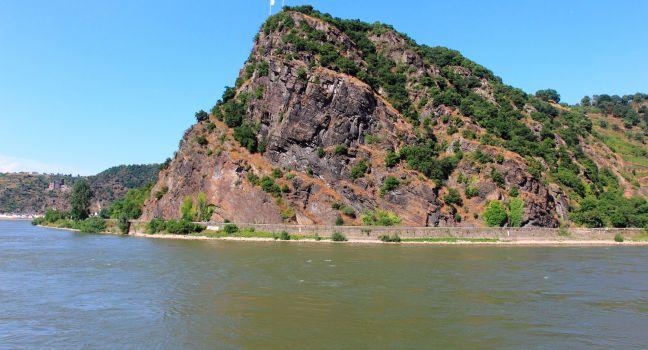
Rock hill near st. goarshausen 120 m above the waterline. Photo taken on: August 03rd, 2013
(c) Ciuciumama | Dreamstime.com

One of the Rhineland's most famous attractions lies 2½ km (1½ miles) south of St. Goarshausen: the steep (430-foot-high) slate cliff of Loreley. It's named after the beautiful blonde nymph Loreley from the story written in 1801 by author Clemens Brentano. Inspired by the sirens of Greek mythology, Brentano's poetic creation describes her sitting on the ledge, singing songs so lovely that sailors and fishermen were lured to their demise in the treacherous rapids. The rapids really are treacherous; the Rhine is at its narrowest here and the current the swiftest.

\n

You can approach Loreley from below or above. Rhine cruise ships stop beneath the rock, often playing a haunting 19th-century ballad inspired by Brentano's poem, while ramblers can tackle the steps up from the B42 to the viewpoint at the top of the rock, complete with bronze Loreley statue. Alternatively, drive up to the Parkplatz Loreley, watch the introductory film at the Tourist Information office, then follow one of the scenic paths—lined with information boards on the region's flora and fauna, geology, wine, and more—to get to the same viewpoint. Finish your trip with a hard-earned beer in the Loreley Biergarten.

Niederwalddenkmal

Fodor's choice

High above Rüdesheim and visible for miles around is Germania, a colossal female statue crowning the Niederwald Monument. This tribute to German nationalism was built between 1877 and 1883 to commemorate the rebirth of the German Empire after the Franco-Prussian War (1870–71). Germania faces across the Rhine toward its eternal enemy, France. At her base are the words to a stirring patriotic song: \"Dear Fatherland rest peacefully! Fast and true stands the watch, the watch on the Rhine!\" There are splendid panoramic views from the monument and from other vantage points on the edge of the forested plateau.

\n

You can reach the monument on foot (allow an hour), by car (via Grabenstrasse, Zum Niederwald-Denkmal, and the L-3034), or over the vineyards in the Seilbahn (cable car;  Oberstraße 37 www.seilbahn-ruedesheim.de; open mid-March through October). There's another chairlift to and from Assmannshausen, a red-wine enclave, on the other side of the hill; a \"Ringticket\" covers the cable car up from Rüdesheim to Niederwald, the cable car down from Niederwald to Assmannshausen, and the boat trip back to Rüdesheim; allow three to four hours for it all.

Eifel National Park

In the rolling hills of western Germany, Eifel National Park unfolds as a tapestry of natural splendor. This expansive haven features lush forests, tranquil volcanic lakes, and charming meadows, creating an inviting landscape for lovers of the outdoors. Explore scenic trails like the nearly 200-mile Eifelsteig trail that meanders through Monschau and the surrounding countryside. Ramble across the rolling hills, spot elusive wildlife, and soak in the serene beauty of the park's unspoiled wilderness.

Recommended Fodor's Video

Monschau Altstadt

Tucked in the heart of Monschau, the Altstadt (Old Town) is a captivating maze of narrow cobblestone streets lined with well-preserved half-timbered houses. Dating back to the medieval period, the area invites leisurely strolls past quaint shops, cozy cafes, and historic buildings. The picturesque townscape, with its vibrant façades and charming architecture, offers a delightful step back in time and a glimpse into the region’s rich heritage.

Dom

Fodor's choice
Aachener Dom, center in Aachen Germany.
(c) Kerenby | Dreamstime.com

Aachen's stunning cathedral, the \"chapelle\" of the town's earlier name of Aix-la-Chapelle, remains the single greatest storehouse of Carolingian architecture in Europe, and it was the first place in Germany to be named a UNESCO World Heritage site. Though it was built over the course of 1,000 years and reflects architectural styles from the Middle Ages to the 19th century, its commanding image remains the magnificent octagonal royal chapel, rising up two arched stories to end in the cap of the dome. It was this section, the heart of the church, that Charlemagne saw completed in AD 800. His bones now lie in the Gothic choir, in a golden shrine surrounded by wonderful carvings of saints. Another treasure is his marble throne. Charlemagne had to journey all the way to Rome for his coronation, but the next 32 Holy Roman emperors were crowned here in Aachen (with some exceptions), and each marked the occasion by presenting a lavish gift to the cathedral. In the 12th century Emperor Frederick I (aka Barbarossa) donated the great chandelier now hanging in the center of the Palatine chapel; his grandson, Friedrich II, donated Charlemagne's shrine. English-language guided tours of the cathedral are offered daily at 2.

Münsterpl., Domhof 1, Aachen, 52062, Germany
0241-477–090
Sight Details
Free; guided tours €7

Something incorrect in this review?

Kölner Dom

Altstadt Fodor's choice
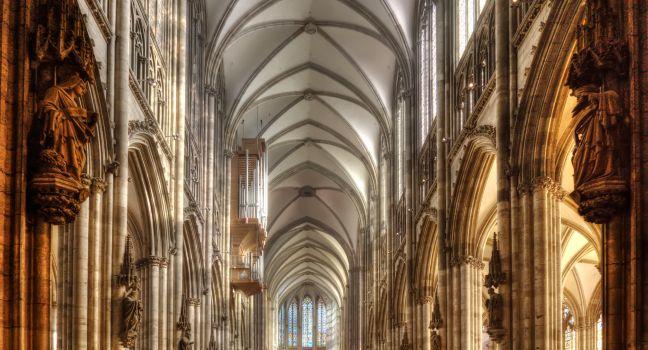
Inside the amazing gothic Cologne Cathedral in Germany. Photo taken on: September 27th, 2013
(c) Jchambers | Dreamstime.com

Cologne's landmark embodies one of the purest expressions of the Gothic spirit in Europe. The cathedral, meant to be a tangible expression of God's kingdom on Earth, was conceived with such immense dimensions that construction, begun in 1248, was not completed until 1880, after the original plan was rediscovered. At 515 feet high, the two west towers of the cathedral were briefly the tallest structures in the world when they were finished (before being eclipsed by the Washington Monument). The cathedral was built to house what are believed to be the relics of the Magi, the three kings who paid homage to the infant Jesus (the trade in holy mementos was big business in the Middle Ages—and not always scrupulous). The size of the building was not simply an example of self-aggrandizement on the part of the people of Cologne, however; it was a response to the vast numbers of pilgrims who arrived to see the relics. The ambulatory (the passage that curves around the back of the altar) is unusually large, allowing cathedral authorities to funnel large numbers of visitors up to the crossing (where the nave and transepts meet and where the relics were originally displayed), around the back of the altar, and out again.

\n

Today the relics are kept just behind the altar, in the original, enormous gold-and-silver reliquary. The other great treasure of the cathedral, in the last chapel on the left as you face the altar, is the Gero Cross, a monumental oak crucifix dating from 971. The Altar of the City Patrons (1440), a triptych by Stephan Lochner, Cologne's most famous medieval painter, is to the right. Other highlights are the stained-glass windows, some dating from the 13th century and another, designed by Gerhard Richter with help from a computer program, from the 21st; the 15th-century altarpiece; and the early-14th-century high altar, with its glistening white figures and intricate choir screens. If you're up to it, climb to the top of the bell tower to get the complete vertical experience (at the time of writing, available by guided tour only at  www.domforum.de) but be aware that viewing Cologne from the Dom itself removes the skyline's most interesting feature. The treasury includes the silver shrine of Archbishop Engelbert, who was stabbed to death in 1225.

Königsallee

Fodor's choice
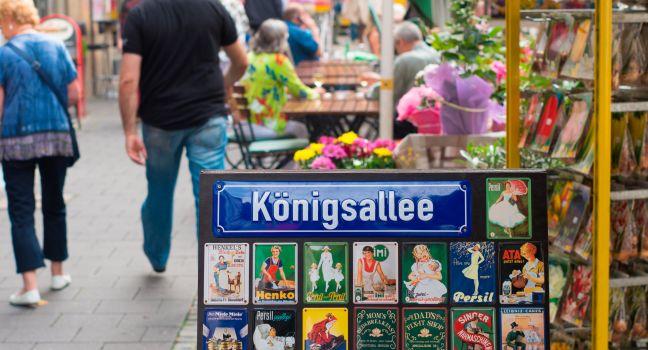
Konigsallee street name sign in dusseldorf, germany. It's famous for the fashion showrooms and luxury retail stores located along its sides.
(c) Hansenn | Dreamstime.com

Düsseldorf's main shopping avenue is a nearly mile-long stretch of designer boutiques and stores, including the Daniel Liebeskind-designed Kö-Bogen shopping mall at its northern tip. Known as \"the Kö,\" this wide, double boulevard is divided by an ornamental waterway fed by the River Düssel. Rows of chestnut trees line the Kö, shading a string of sidewalk cafés. 

Porta Nigra

Fodor's choice
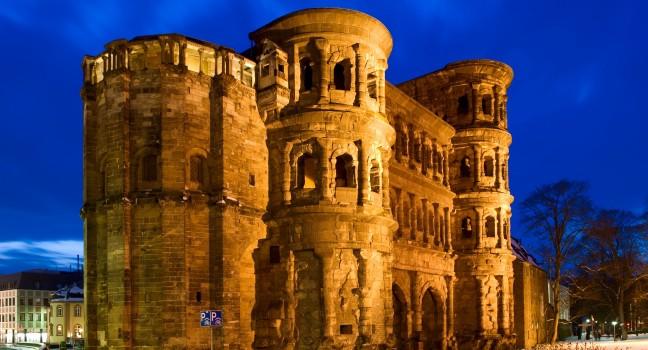
Porta Nigra of Trier, Germany; Shutterstock ID 45868624; Project/Title: Fodors; Downloader: Melanie Marin
Rainprel / Shutterstock

The best-preserved Roman structure in Trier was originally a city gate built in the 2nd century (look for holes left by the iron clamps that held the structure together). The gate served as part of Trier's defenses, and was proof of the sophistication of Roman military might and its ruthlessness. Attackers were often lured into the two innocent-looking arches of the Porta Nigra, only to find themselves enclosed in a courtyard. In the 11th century the upper stories were converted into two churches which remained in use until the 18th century. The tourist office is next door.

Schloss Johannisberg

Fodor's choice
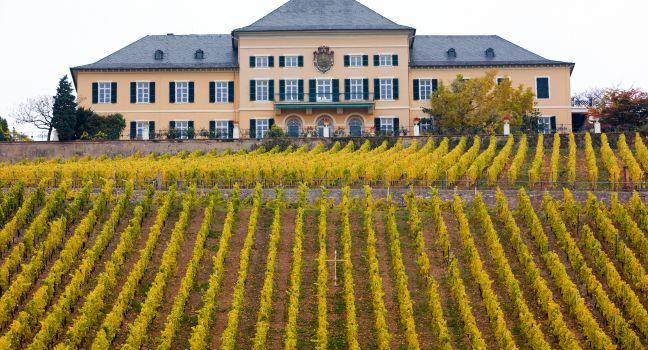
Johannisberg Castle with vineyard, Hessen, Germany.
(c) Phbcz | Dreamstime.com

The origins of this grand wine estate, high in the hills above (and slightly west of) Oestrich-Winkel, date from 1100, when Benedictine monks built a monastery and planted vines on the slopes below. The striking early-18th-century palace is closed to the public, but follow signs for the Weinprobierstand (wine tasting stand), where you can sample the local produce on a scenic terrace overlooking the vineyards. On the way, you'll pass by the beautiful, 12th-century parish church, notable for its suspended red cross. Elsewhere around the complex, you'll find a wine shop, which also offers the estate's gin, as well as Schlossschänke restaurant.

\n

Between April and October, you can book a guided cellar tour and wine tasting (in German only), or throughout the year you can opt for a pricier, exclusive individual/group wine tasting (English option). Schloss Johannisberg is a 10-minute drive or 45-minute hike from the center of Oestrich-Winkel.

Off Am Erntebringer, Geisenheim, 65366, Germany
06722-70090
Sight Details
Cellar tour with wine tasting €30
No tours Nov.--Mar.

Something incorrect in this review?

Weingut Schloss Vollrads

Fodor's choice
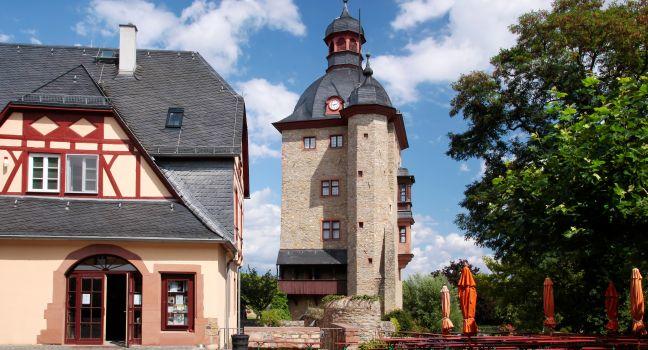
Residential tower of the Palace of Vollrads in Winkel, Rheingau, Hesse, Germany. Photo taken on: August 09th, 2011
(c) Cmfotoworks | Dreamstime.com

Built in 1211 north of town, Schloss Vollrads is the oldest of Germany's major wine estates. The tower, built in 1330 and surrounded by a moat, was the Greiffenclau residence for 350 years until the present palace was built in the 17th century. There is a popular wine shop here, and the castle's period rooms can be toured during concerts, festivals, and wine tastings—check the website for specific dates. In addition to having a meal in the somewhat pricey restaurant, you can sit outside on the patio in the warmer months and order very good flammkuchen (baked thin-crust pizza, typically with bacon and onions) and sausages from the food truck.

Amphitheater

Fodor's choice

The sheer size of Trier's oldest Roman structure (circa AD 100) is impressive; in its heyday it seated 20,000 spectators. You can climb down to the cellars beneath the arena—animals were kept in cells here before being unleashed to do battle with gladiators. Gladiatorial performances (1¼ hours) take place Friday through Sunday and holidays at 6 pm from April through October. Tickets can be booked in advance at Tourist Information.

Arp Museum Bahnhof Rolandseck

Fodor's choice
Three miles north of Remagen, via a scenic riverside promenade, the Arp Museum Bahnhof Rolandseck incorporates a 19th-century converted railway station, which hosts a world-class series of concerts, and a soaring modern building designed by renowned architect Richard Meier set on a hill high over the river. The translucent white building incorporates four levels of exhibition space to house the permanent collection focusing on the work of Dadaist Hans Arp and Sophie Taeuber-Arp in parallel with modern and contemporary works by internationally known artists and sculptors. There is also a fine collection of paintings from the Middle Ages to the present. The stylish in-house bistro is a great place to grab lunch or a snack. A train from Remagen station goes right to the museum (€5.90 round trip, about a six-minute ride), or you can take a ferry to nearby Rolandseck and walk.
Hans-Arp-Allee 1, Remagen, 53424, Germany
02228–94250
Sight Details
€9
Tues.–Sun. 11–6

Something incorrect in this review?

Burg Eltz

Fodor's choice

Situated in the middle of the Eltz forest, almost halfway from Alken to Cochem, this genuinely medieval (12th–16th century) and genuinely stunning fortification deserves as much attention as King Ludwig's trio of castles in Bavaria. Ask at the souvenir shop for the 40-minute English-language tour, which guides you through the period rooms and massive kitchen, as well as a treasure vault filled with gold and silver. Alternatively, take the English-language flyer and stroll around yourself. To get here from Alken, exit B416 at Hatzenport, proceed to Wierschem, and follow signs to the parking lot near the Kapelle St. Antonius. From here it's a 15-minute walk, or take the shuttle bus (€2 each way). Hikers can reach the castle from Moselkern, on the riverside, in about an hour.

Burg Rheinstein

Fodor's choice

North of Bingen on the road from Bacharach, this impressive castle was the home of Rudolf von Hapsburg from 1282 to 1286. To establish law and order on the Rhine, he destroyed the neighboring castles of Burg Reichenstein and Burg Sooneck and hanged their notorious robber barons from the oak trees around the Clemens Church, a late-Romanesque basilica near Trechtingshausen. The Gobelin tapestries, 15th-century stained glass, wall and ceiling frescoes, a floor of royal apartments, and antique furniture—including a rare \"giraffe spinet,\" a harpsicord which Kaiser Wilhelm I is said to have played—are the highlights of a visit here. All of this is illuminated by candlelight on some summer Fridays. Rheinstein was the first of many Rhine ruins to be rebuilt by a royal Prussian family in the 19th century.  If coming by car or boat, leave your transport at river level and prepare for a 10-minute climb up. By train, it's a 30-minute walk from Trechtingshausen station.

Festung Ehrenbreitstein

Fodor's choice

Europe's largest fortress, towering 400 feet above the left bank of the Rhine, offers a magnificent view over Koblenz and where the Mosel and the Rhine rivers meet. The earliest buildings date from about 1100, but the bulk of the fortress was constructed in the 16th century. In 1801 it was partially destroyed by Napoléon, and the French occupied Koblenz for the next 18 years. The museum has exhibits on the history of local industries, from wine growing to technology. Pride of place is given to the fortress's 16th-century Vogel Greif cannon, which has done a lot of traveling over the years. The French absconded with it in 1794, the Germans took it back in 1940, and the French commandeered it again in 1945. The 15-ton cannon was peaceably returned by French president François Mitterrand in 1984. For an introduction to the fortress and its history, head for the Besucherdienst (visitor center). English-language tours are for groups only, but you can often join a group that is registered for a tour. A Seilbahn (cable car) carries you a half mile from Konrad-Adenauer-Ufer over the river to Ehrenbreitstein, offering spectacular views of the Deutsches Eck below. Lifts can accommodate 7,000 passengers in an hour, and operate continually throughout the day from a half hour before the site opens until a half hour after it closes.

Kloster Eberbach

Fodor's choice

The former Cistercian monastery is idyllically set in a secluded forest clearing 6 km (4 miles) northwest of Eltville. Its Romanesque and Gothic buildings (12th–14th century) look untouched by time—one reason why the 1986 film of Umberto Eco's medieval murder mystery The Name of the Rose was filmed here. Pick up an English-language leaflet and take a stroll around, seeking out highlights like the vast medieval Monk's Dormitory and the beautiful Klosterkirche, both of which are regularly used for concerts because of their superior acoustics. The manor house-style Monk's Dining Room is also worth a look.

\n

The monastery's impressive collection of old winepresses bears witness to a viticultural tradition that spans nearly nine centuries. The wines can be sampled year-round in the atmospheric wine cellar (or on a roving tasting around the abbey), in the popular Klosterschänke restaurant (where you can pair the local wines with seasonal German cuisine; try the \"Klosterauszeit\" cold cuts platter), or in the vinothek (shop). In warmer months, you can also enjoy them outside at Kloster Eberbach's premier vineyard, the Steinberg, which is surrounded by a 3-km (2-mile) stone wall that dates from the 13th to 18th centuries.

Kunstsammlung Nordrhein-Westfalen: K20

Fodor's choice

Behind the sleek, polished black stone facade of K20 is a treasure trove of art (Kunst, hence the K) of the 20th century. Among the permanent collection are masterpieces by Picasso, Matisse, and Pollock, works by German artists Joseph Beuys and Gerhard Richter, plus more than 120 pieces by Paul Klee. 

Grabbepl. 5, Düsseldorf, 40213, Germany
0211-838–1204
Sight Details
From €12; free entry 1st Wed. of month
Closed Mon.

Something incorrect in this review?

Kunstsammlung Nordrhein-Westfalen: K21

Fodor's choice

Within the more conservative 19th-century architecture of K21 is some edgier fare—international contemporary art since about 1980, including the works of Thomas Ruff and Nam June Paik.

Ständehausstr. 1, Düsseldorf, 40217, Germany
0211-838–1204
Sight Details
From €12; free entry 1st Wed. of month
Closed Mon.

Something incorrect in this review?

Madame Flöck Wines

Fodor's choice

For a Winningen winery with a difference, take a trip to this natural, low-intervention wine producer set up by two North American expats: American Robert Kane and Canadian Derek-Paul Labelle. Take a tour of the 150-year-old cellar, where you can taste the excellent wine straight out of the barrel, or join one of the duo on a (steep) walking tour around the vineyards.

Friedrichstr. 1b, Winningen, 56333, Germany
0173-437--0130
Sight Details
Cellar tour and tasting €20; cellar tour, vineyard tour, and tasting €40

Something incorrect in this review?

Marksburg

Fodor's choice

This eye-catching castle sits on the eastern shore of the Rhine overlooking the town of Braubach. Built in the 13th century to protect the silver and lead mines in the area, it's the only land-based castle on the Rhine to have survived the centuries intact. Within its massive walls are a collection of weapons and manuscripts, a medieval botanical garden, and a self-service restaurant with a terrace offering stunning views. The castle can only be visited as part of a 50-minute guided tour: individual English tours take place daily during the summer months at 1 and 4 pm; call ahead if you'd like to join a pre-arranged tour at a different time. Well-behaved pets are allowed.

MedienHafen

Fodor's choice

This stylish, revamped harbor district is a mix of late-19th-century warehouses and ultramodern towers housing restaurants, bars, hotels, and the many media companies that have made this area their home. On the riverbank you'll find the Frank Gehry–designed Neuer Zollhof, a particularly striking ensemble of three organic-looking high-rises. The best way to tackle the buzzing architecture is to take a stroll down the promenade and over the pedestrian Living Bridge, which connects both sides of the harbor.

Museum Wiesbaden

Fodor's choice

This impressive city museum offers a heady mix of natural history and fine art. The permanent Aesthetics of Nature exhibition is spread across the two floors and divided into four fascinating themes: Color, Form, Movement, and Time. Expect to learn about the functional white fur of polar bears, the swimming legs of crabs, the fossils left behind from when this region was a large sea, and much more. The art collection is spread across all three floors and includes everything from the figurative paintings of Dutch Old Masters to the abstract sculptures of European and American modernism. Look out for the bright, expressionist paintings of Russian artist Alexej Jawlensky, who lived in Wiesbaden for the last 20 years of his life, and don't miss the Jugenstil exhibit, featuring more than 500 magnificent Art Nouveau paintings, furnishings, and ornaments. Temporary exhibitions focus on art and culture from around the world. Don't miss the spectacular, gold-colored mosaics on the interior of the cupola, just to the left as you enter the museum.

Friedrich-Ebert-Allee 2, Wiesbaden, 65185, Germany
0611-335–2250
Sight Details
€6 permanent collection, €12 special exhibitions
Closed Mon.

Something incorrect in this review?

Rheinisches Landesmuseum

Fodor's choice

The largest collection of Roman antiquities in Germany is housed here. The highlight is the 4th-century stone relief of a Roman ship transporting barrels of wine up the river. This tombstone of a Roman wine merchant was discovered in 1874, when Constantine's citadel in Neumagen, a village roughly halfway between Bernkastel and Trier, was excavated. Have a look at the 108-square-foot model of the city as it looked in the 4th century—it provides a sense of perspective to many of the sights you can still visit today.

Spielbank Wiesbaden

Fodor's choice

Built in 1907, the neoclassical Kurhaus is the cultural center of the city—and it's home to this beautiful, grand casino. The Klassiches Spiel (table games area: roulette, blackjack, and poker) is a magnificent wood-paneled hall known for allowing very high stakes play; it's said to have been the inspiration for Dostoevsky's novel The Gambler. Jackets are required. To play here—or in the less formal Automatenspiel (slots) in the neighboring Kolonnade—you must be at least 18 (bring your passport).

\n

Aside from the casino, the rest of the Kurhaus is given over to Thiersch-Saal, a splendid setting for concerts, and a Parisian-style bistro. The building is flanked by The Staatstheater (1894), appointed in baroque and rococo revival styles, and two beautifully landscaped parks—one with a boating pond.

Trierer Dom

Fodor's choice

The oldest Christian church north of the Alps, the Dom was commissioned by Emperor Constantine in AD 330 and built on the site of the torn-down Palace of St. Helen, his mother. While the church burned down in 336, a second, even larger one was built soon after. Parts of the foundations of this third building can be seen in the east end of the present structure (begun in about 1035).

\n

The cathedral you see today is a weighty and sturdy edifice with small round-head windows, rough stonework, and asymmetrical towers, as much a fortress as a church. Inside, Gothic styles predominate—the result of remodeling in the 13th century—although there are also many baroque tombs, altars, and confessionals. The highlight of the Schatzkammer (Cathedral Treasury) is the 10th-century Andreas Tragaltar (St. Andrew's Portable Altar), constructed of oak and covered with gold leaf, enamel, and ivory by local craftsmen. It's a reliquary for the soles of St. Andrew's sandals, as signaled by the gilded, life-size foot on the top of the altar.

Alter Markt

Altstadt
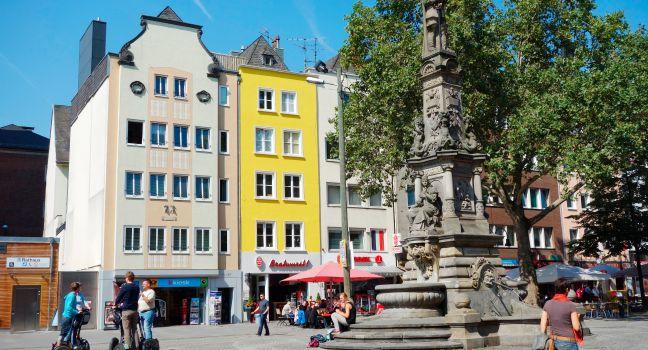
Some ancient colored houses and old fountain at Alter Markt in old town Cologne along river Rhine in North Rhine-Westphalia, Germany. Photo was taken in august 2013. Photo taken on: August 27th, 2013
(c) Gunold | Dreamstime.com

The square has an eclectic assembly of buildings, most of them postwar. However, two 16th-century houses survived the war intact—Nos. 20 and 22, which are today a Kölsch brewpub, Zum Prinzen. The oldest structure dates from 1135. In late November and December, Alter Markt is the site of one of the city's prettiest Christmas markets.

Cologne, 50667, Germany

Something incorrect in this review?

Altes Rathaus

Altstadt
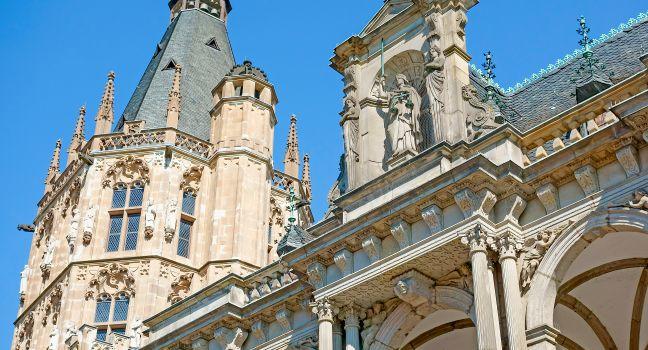
The City Hall (German: Rathaus) is a historical building in Cologne. Domicile of the city government, including the city council and offices of the Lord Mayor. Photo taken on: August 23rd, 2012
(c) Tbe | Dreamstime.com

The Rathaus is worth a look, even from the outside. It's the oldest town hall in Germany, with elements remaining from the 14th century. The famous bell tower rings its bells daily at 9, noon, 3, and 6. Standing on pedestals at one end of the town hall are figures of prophets made in the early 15th century. Ranging along the south wall are nine additional statues, the so-called Nine Good Heroes, carved in 1360.

Rathauspl. 2, Cologne, 50667, Germany
0221-2210

Something incorrect in this review?

Burg Rheinfels

Castle Rheinfels near St. Goar, Upper Middle Rhine Valley, Germany. Photo taken on: June 04th, 2015
(c) Maui01 | Dreamstime.com

The castle ruins overlooking the town bear witness to the fact that St. Goar was once the best-fortified town in the Mittelrhein. From its beginnings in 1245, it was repeatedly enlarged by the counts of Katzenelnbogen, a powerful local dynasty, and their successors, the Landgraviate of Hesse. Rheinfels was finally demolished by the French in 1797. Take time for a walk through the impressive ruins and the museum, which has a detailed model of how the fortress looked in its heyday. It's a steep ascent by foot, but during the summer taxis regularly shuttle between St. Goar and St. Elisabeth Church and the castle.

Burg Thurant

Burg Thurant, Knight's Castle, Mosel valley, Eifel, Germany. Photo taken on: May 03rd, 2008
(c) Gerardmeuffels | Dreamstime.com

Alken's undoubted highlight, this 12th-century castle towers over the village and the Burgberg (castle hill) vineyard. Castle tours include the Cologne Tower, chapel, cellar, and gardens, as well as views galore. A kiosk in the courtyard serves wine and snacks. Allow a good half-hour for the steep climb up from the riverbank. The castle even has a rental home for up to 6 people, but it requires a 5-night minimum stay.

Burg Thurant, Alken, 56332, Germany
02605-2004
Sight Details
€5
Closed mid-Nov.–Feb.

Something incorrect in this review?

Drachenfels

The town of Königswinter has one of the most visited castles on the Rhine, the Drachenfels. Its ruins crown one of the highest hills in the Siebengebirge, with a spectacular view of the Rhine. It's also part of Germany's oldest nature reserve, with more than 100 km (62 miles) of hiking trails. The castle was built in the 12th century by the archbishop of Cologne, and takes its name from a dragon said to have lived in a nearby cave. (The dragon was slain by Siegfried, hero of the epic Nibelungenlied.)

\n

The castle ruins can be reached via two different hikes, each of about 45 minutes. One route begins at the Drachenfelsbahn station, and passes the Nibelungenhalle reptile zoo along the way. The other route starts at Rhöndorf on the other side of the hill. The Siebengebirge Tourist Office can provide a map that includes these and other local hiking trails.

Königswinter, 53639, Germany
Sight Details
Free

Something incorrect in this review?