
5 Best Sights in Paris, France

Background Illustration for Sights

We've compiled the best of the best in Paris - browse our top choices for the top things to see or do during your stay.

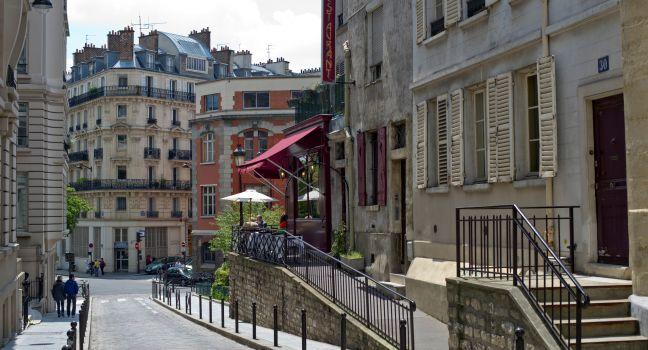
Rue Mouffetard

Latin Quarter Fodor's choice
Street, Rue Mouffetard, Paris, France
© Zach Nelson / Fodor’s Travel

This winding cobblestone street is one of the city's oldest and was once a Roman road leading south from Lutetia (the Roman name for Paris) to Italy. The upper half is dotted with restaurants and bars that cater to tourists and students; the lower half is the setting of a lively morning market, Tuesday through Sunday. The highlight of le Mouffe, though, is the stretch in between where the shops spill into the street with luscious offerings such as roasting chickens and potatoes, rustic saucisson, pâtés, and pungent cheeses, especially at Androuët (No. 134). If you're here in the morning, Le Mouffetard Café (No. 116) is a good place to stop for a continental breakfast (about €10). If it's apéritif time, head to Place de la Contrescarpe for a cocktail, or enjoy a glass of wine at Cave La Bourgogne (No. 144). Prefer to just do a little noshing? Sample the chocolates at Mococha (No. 89) or the gelato at Gelati d'Alberto (No. 45). Note that most shops are closed on Monday.
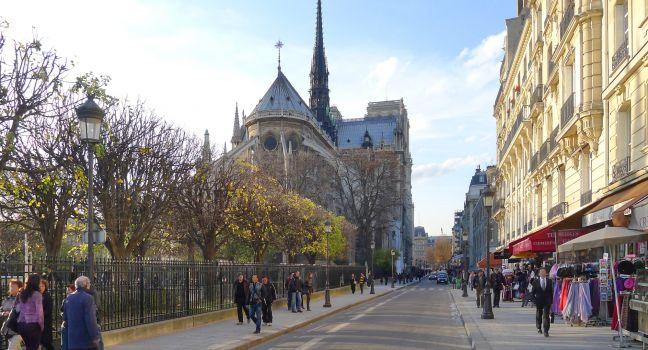
Ancien Cloître Quartier

Ile de la Cité
Rue du Cloitre-Notre-Dame
Mbzt [CC BY-SA 3.0], via Wikimedia Commons

Hidden in the shadows of Notre-Dame is an evocative, often-overlooked tangle of medieval streets. Through the years lucky folks, including Ludwig Bemelmans (who created the beloved Madeleine books) and the Aga Khan, have called this area home, but back in the Middle Ages it was the domain of cathedral seminary students. One of them was the celebrated Peter Abélard (1079–1142)—philosopher, questioner of the faith, and renowned declaimer of love poems. Abélard boarded with Notre-Dame's clergyman, Fulbert, whose 17-year-old niece, Héloïse, was seduced by the compelling Abélard, 39 years her senior. She became pregnant, and the vengeful clergyman had Abélard castrated; amazingly, he survived and fled to a monastery, while Héloïse took refuge in a nunnery. The poetic, passionate letters between the two cemented their fame as thwarted lovers, and their story inspired a devoted following during the romantic 19th century. They still draw admirers to the Père-Lachaise Cemetery, where they're interred ensemble. The clergyman's house at 10 rue Chanoinesse was redone in 1849; a plaque at the back of the building at 9–11 quai aux Fleurs commemorates the lovers.

Paris, 75004, France

Something incorrect in this review?

Bercy

Bercy

Tucked away south of the Gare de Lyon in the 12e arrondissement, blocks of stone warehouses that once stored wine are now home to Bercy Village ( 28 rue François Truffaut), a collection of boutiques and eateries that stay open unusually late for Paris. Adjacent to the shops is the tranquil Parc de Bercy, with lawns, ponds, and flower beds crisscrossed by gravel paths, and the Jardin Yitzhak Rabin, a garden named for the late Nobel Peace Prize winner. Nearby, at  51 rue de Bercy, a Cubist building by Frank Gehry houses the Cinémathèque Française, a film buff's paradise, showing classic films, many in English; there are frequent homages to directors and actors, plus a cinema bookshop and museum.

Paris, 75012, France

Something incorrect in this review?

Recommended Fodor's Video

La Défense

Western Paris

First conceived in 1958, this Modernist suburb just west of Paris was inspired by Le Corbusier's dream of tall buildings, pedestrian walkways, and sunken vehicle circulation. Built as an experiment to keep high-rises out of the historic downtown, the Parisian business hub has survived economic uncertainty to become the city's prime financial district. Today, 20,000 people live in the suburb, but 180,000 people work here and many more come to shop in its enormous mall. Arriving via métro Line 1, you'll get a view of the Seine, then emerge at a pedestrian plaza studded with some great public art, including César's giant thumb, Joan Miró's colorful figures, and one of Calder's great red "stabiles." The Grande Arche de La Défense dominates the area; it was designed as a controversial closure to the historic axis of Paris (an imaginary line that runs through the Arc de Triomphe, the Arc du Carrousel, and the Louvre Pyramide), but its top floor is no longer accessible.

Parvis de La Défense, Paris, 92800, France

Something incorrect in this review?

Rue d'Auteuil

Western Paris

This narrow shopping street escaped Haussmann's urban renovations and still retains the country feel of old Auteuil, a sedate bourgeois enclave. Molière once lived on the site of No. 2, and Racine was on nearby Rue du Buis. The pair met up to clink glasses and exchange drama notes at the Mouton Blanc Inn, now a traditional brasserie, at No. 40. Numbers 19–25 and 29 are an interesting combination of 17th- and 18th-century buildings. At the foot of the street, the scaly dome of the Église Notre-Dame d'Auteuil (built in the 1880s) is an unmistakable small-time cousin of Sacré-Coeur in Montmartre. Rue d'Auteuil is at its liveliest on Wednesday and Saturday morning, when a much-loved street market crams onto Place Jean-Lorraine.

Paris, 75116, France

Something incorrect in this review?