
6 Best Sights in Paris, France

Background Illustration for Sights

We've compiled the best of the best in Paris - browse our top choices for the top things to see or do during your stay.

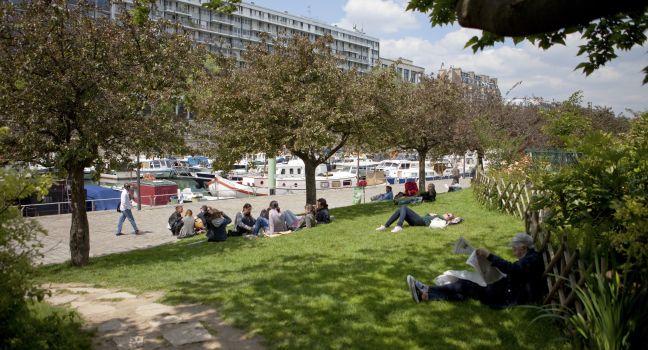
Canal St-Martin

Canal St-Martin Fodor's choice
Canal Saint Martin
© Halie Cousineau/ Fodor’s Travel

The once-forgotten canal has morphed into one of the city's trendiest places to wander. A good time to come is Sunday afternoon, when the Quai de Valmy is closed to cars and some of the shops are open. Rent a bike at any of the many Vélib' stations, stroll along the banks, or go local and cuddle quayside in the sunshine with someone special.

In 1802 Napoléon ordered the 4.3-km (2.7-mile) canal dug as a source of clean drinking water after cholera and other epidemics swept the city. When it finally opened 23 years later, it extended north from the Seine at Place de la Bastille to the Canal de l'Ourcq, near La Villette. Baron Haussmann later covered a 1.6-km (1-mile) stretch of it, along today's Boulevard Richard Lenoir. It nearly became a highway in the 1970s, before the city's urban planners regained their senses. These days you can take a boat tour from end to end through the canal's nine locks: along the way, the bridges swing or lift open. The drawbridge with four giant pulleys at Rue de Crimée, near La Villette, was a technological marvel when it debuted in 1885. In recent years gentrification has transformed the once-dodgy canal, with artists taking over former industrial spaces and creating studios and galleries. The bar and restaurant scene is hipster central, and small designers have arrived, fleeing expensive rents in the Marais. Canauxrama ( www.canauxrama.com) offers 2½-hour boat cruises through the locks (€25). Embarkation is at each end of the canal: at Bassin de la Villette or Port de l'Arsenal.
Hôtel des Invalides

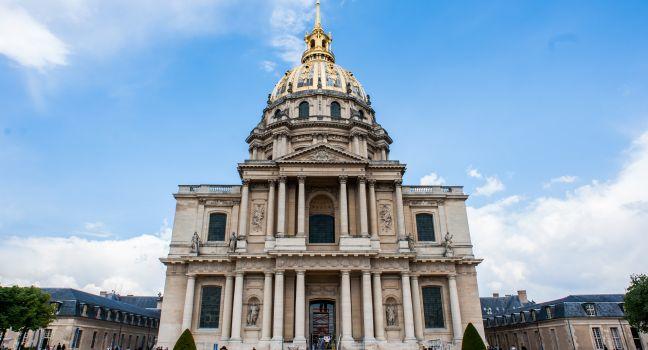
Invalides Fodor's choice
Hotel des Invalides, Paris, France
© Ross Brinkerhoff / Fodor’s Travel

The baroque complex known as Les Invalides (pronounced lehz-ahn-vah-leed) is the eternal home of Napoléon Bonaparte (1769–1821) or, more precisely, his remains, which lie entombed under the golden dome. Louis XIV ordered the facility to be built in 1670 to house disabled soldiers (hence the name), and, at one time, 4,000 military men lived here. Today, a portion still serves as a veterans' residence and hospital. The Musée de l'Armée, containing an exhaustive collection of military artifacts from antique armor to weapons, is also here.

If you see only a single sight, make it the Église du Dome (one of the two churches here) at the back of the complex. Napoléon's tomb was moved here in 1840 from the island of St-Helena, where he died in forced exile. The emperor's body is protected by no fewer than six coffins—one set inside the next, sort of like a Russian nesting doll—which are then encased in a sarcophagus of red quartzite. The bombastic tribute is ringed by statues symbolizing Napoléon's campaigns of conquest. To see more Napoléoniana, check out the collection in the Musée de l'Armée featuring his trademark gray frock coat and huge bicorne hat. Look for the figurines reenacting the famous coronation scene when Napoléon crowns his empress, Josephine. You can see a grander version of this scene by the painter David hanging in the Louvre.

The best entrance is at the southern end, on Place Vauban (Avenue de Tourville); the ticket office is here, as is Napoléon's tomb. There are automatic ticket machines at the main entrance on Place des Invalides.

Paris, 75007, France
01–44–42–38–77
Sight Details
€15 with temporary exhibitions
Last admission 30 mins before closing

Something incorrect in this review?

Les Égouts

Eiffel Tower

Leave it to the French to make even sewers seem romantic. Part exhibit but mostly, well, sewer, the 1,640-foot stretch of tunnels provides a fascinating—and not too smelly—look at the underbelly of Paris. You can stroll the so-called galleries of this city beneath the city, which comes complete with street signs mirroring those aboveground. Walkways flank tunnels of whooshing wastewater wide enough to allow narrow barges to dredge sand and sediment. Lighted panels, photos, and explanations in English detail the workings of the system. Immortalized as the escape routes of the Phantom of the Opera and Jean Valjean in Les Misérables, the 19th-century sewers have a florid real-life history. Since Napoléon ordered the underground network built to clean up the squalid streets, they have played a role in every war, secreting revolutionaries and spies and their stockpiles of weapons. Grenades from World War II were recovered not far from where the gift shop now sits. The display cases of stuffed toy rats and "Eau de Paris" glass carafes fold into the walls when the water rises after heavy rains. Buy your ticket at the kiosk on the Left Bank side of the Pont de l'Alma. Guided one-hour tours by friendly égoutiers (sewer workers) are available in French only; call or email ahead for details.

Recommended Fodor's Video

Palais de la Porte Dorée

Bois de Vincennes

If you're bound for the Bois de Vincennes, pay a visit to the Palais de la Porte Dorée, which was built for the 1931 Colonial Exhibition and is one of the best examples of Art Deco architecture in Paris. The ornate facade features bas-relief sculptures representing France's erstwhile empire. Inside, the elaborate marble, ornate metalwork, frescoes, and original lighting are all beautifully maintained. Entry to the ground floor is free. On either end are furnished salons, one representing Asia, the other Africa; peek into the central room, called the Forum, where restored Africa-inspired mosaics line the walls. The upper floors are occupied by the Musée Nationale de l'Historie de l'Immigration, a fascinating modern museum tracing the history of immigration in France through photographs, artworks, and first-person accounts. The basement contains L'Aquarium Tropical, a favorite among generations of Parisians, who all visited as kids, with a pair of rare albino alligators, plus 300 species of exotic marine life. Be sure to check out the Palais's excellent temporary exhibitions.

293 av. Daumesnil, Paris, 75012, France
01–53–59–58–60
Sight Details
Ground floor free; museum €12; aquarium €12; combined ticket €16
Closed Mon.

Something incorrect in this review?

Place de la Bastille

Bastille

Almost nothing remains of the infamous Bastille prison, destroyed in 1789, though tourists still ask bemused Parisians where to find it. Until the late 1980s, there was little more to see here than a busy traffic circle ringing the Colonne de Juillet (July Column), a memorial to the victims of later uprisings in 1830 and 1848. The opening of the Opéra Bastille in 1989 rejuvenated the area, however, drawing art galleries, bars, and restaurants to the narrow streets, notably along Rue de Lappe—once a haunt of Edith Piaf—and Rue de la Roquette.

Before it became a prison, the Bastille St-Antoine was a defensive fortress with eight immense towers and a wide moat. It was built by Charles V in the late 14th century and transformed into a prison during the reign of Louis XIII (1610–43). Famous occupants included Voltaire, the Marquis de Sade, and the Man in the Iron Mask. On July 14, 1789, it was stormed by an angry mob that dramatically freed all of the remaining prisoners (there were only seven), thereby launching the French Revolution. The roots of the revolt ran deep. Resentment toward Louis XVI and Marie-Antoinette had been building amid a severe financial crisis. There was a crippling bread shortage, and the free-spending monarch was blamed. When the king dismissed the popular finance minister, Jacques Necker, enraged Parisians took to the streets. They marched to Les Invalides, helping themselves to stocks of arms, then continued on to the Bastille. A few months later, what was left of the prison was razed—and 83 of its stones were carved into miniature Bastilles and sent to the provinces as a memento (you can see one of them in the Musée Carnavalet). The key to the prison was given to George Washington by Lafayette and has remained at Mount Vernon ever since. Today, nearly every major street demonstration in Paris—and there are many—passes through this square.

Paris, 75004, France

Something incorrect in this review?

Porte Dauphine Métro Entrance

Western Paris

Visitors come here to snap pictures of the queen of subway entrances—one of the city's two remaining Art Nouveau canopied originals designed by Hector Guimard (the other is at the Abbesses stop on Line 12). A flamboyant scalloped "crown" of patina-painted panels and runaway metal struts adorns this whimsical 1900 creation. Porte Dauphine is the terminus of Line 2. The entrance is on the Bois de Boulogne side of Avenue Foch, so take the Boulevard de l'Amiral Bruix exit.

Av. Foch, Paris, 75116, France

Something incorrect in this review?