The Louvre
While booking admission tickets online in advance is not required, it's the best way to avoid disappointment: the €22 timed entry guarantees admission, while tickets bought on-site are only sold when space is available—and given a recent decision to limit daily visitors to 30,000 (a third of the previous norm), it's unlikely that spontaneous appearances at the museum will result in a successful visit. Be aware that children under 18 get in for free. Slick Nintendo 3DS multimedia guides (€5), available at the entrance to each wing, offer a self-guided discovery of the museum in a variety of languages, and extended openings (noctournes) on Friday evening allow you to visit the museum until 9:45 pm.
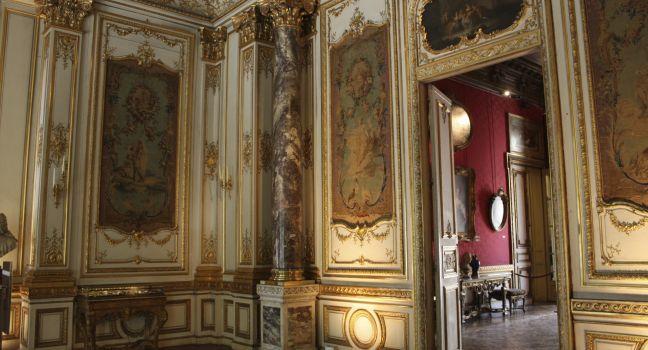
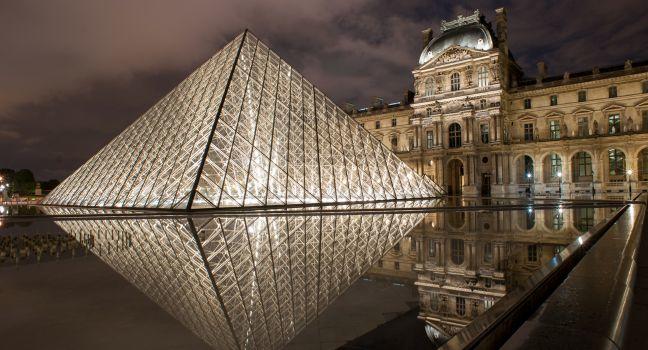
Having been first a fortress and later a royal residence, the Louvre represents a saga that spans nine centuries. Its medieval roots are on display underground in the Sully wing, where vestiges of the foundation and moat remain. Elsewhere in this wing, you can ogle the largest display of Egyptian antiques outside of Cairo, most notably the Great Sphinx of Tanis, one of the largest outside of Egypt (Salle 338). Upstairs is the armless Venus de Milo, a 2nd-century representation of Aphrodite (Salle 345). Highlights of the wing’s collection of French paintings from the 17th century onward include One Odalisque by Jean-August-Dominique Ingres (Salle 702). In the Denon wing, climb the sweeping marble staircase (Escalier Daru) to see the sublime Winged Victory of Samothrace, carved in 305 BC. This wing is also home to the iconic, enigmatic Mona Lisa (Salle des Etats); two other Leonardo da Vinci masterpieces hang in the nearby Grand Galerie. The museum’s 30,000-square-foot Arts of Islam exhibition space is here, too. Topped with an undulating golden roof evoking a flowing veil, its two-level galleries contain one of the largest collections of art from the Islamic world. After admiring it, be sure to visit the Richelieu wing and the Cour Marly, with its quartet of horses carved for Louis XIV and Louis XV. On the ground floor, the centerpiece of the Near East Antiquities Collection is the Lamassu, carved 8th-century winged beasts (Salle 229). The elaborately decorated Royal Apartments of Napoléon III are on the first floor. On the second floor, French and Northern School paintings include Vermeer's The Lacemaker (Salle 837).