15 Best Sights in Salzburg, Austria

Background Illustration for Sights

Getting to know Salzburg is not too difficult, because most of its sights are within a comparatively small area. The Altstadt (Old City) is a compact area between the jutting outcrop of the Mönchsberg and the Salzach River. The cathedral and interconnecting squares surrounding it form what used to be the religious center, around which the major churches and the old archbishops' residence are arranged (note that entrance into all Salzburg churches is free). The Mönchsberg cliffs emerge unexpectedly behind the Old City, crowned to the east by the Hohensalzburg Fortress. Across the river, in the small area between the cliffs of the Kapuzinerberg and the riverbank, is the Steingasse, a narrow medieval street where laborers, craftsmen, and traders served the salt-mining industry and travelers coming in and out of the region’s important mercantile hub. Northwest of the Kapuzinerberg lies Mirabell Palace and its manicured gardens.

It's best to begin by exploring the architectural and cultural riches of the Old City, then go on to the fortress. Afterward, cross the river to inspect the other bank. Ideally, you need two days to do it all. An alternative, if you enjoy exploring churches and castles, is to go directly up to the fortress, either on foot or by returning through the cemetery to the funicular railway.

Mirabellgarten

Fodor's Choice
SALZBURG, AUSTRIA - AUGUST 01, 2014: Baroque Mirabell Garden (Mirabellgarten) located in Salzburg, Austria
Anibal Trejo / Shutterstock

There are a choice of entrances to the Mirabell Gardens—from the Makartplatz (framed by the statues of Roman gods), the Schwarzstrasse, and Mirabell Square—but you'll want to enter from the Rainerstrasse and head for the Rosenhügel (Rosebush Hill). That way, you'll arrive at the top of the steps where Julie Andrews and her seven charges showed off their singing ability in The Sound of Music. This is also an ideal vantage point from which to admire the formal gardens and one of the best views of Salzburg, as it shows how harmoniously architects of the Baroque period laid out the city. The center of the gardens—one of Europe's most beautiful parks, partly designed by Fischer von Erlach as the grand frame for the Mirabell Palace—is dominated by four large groups of statues representing the elements water, fire, air, and earth, and designed by Ottavio Mosto, who came to live in Salzburg from Padua. A bronze version of the winged horse Pegasus stands in front of the south facade of the palace in the center of a circular water basin. The most famous part of the Mirabell Gardens is the Zwerglgarten (Dwarfs' Garden), which can be found opposite the Pegasus fountain. Here you'll find 12 statues of "Danubian" dwarves sculpted in marble—the real-life models for which were presented to the bishop by the Landgrave of Göttweig. Prince-Archbishop Franz Anton von Harrach had the figures made for a kind of stone theater below. The Heckentheater (Hedge Theater) is an enchanting natural stage setting that dates from 1700.
Hangar-7

Fodor's Choice

Red Bull founder Dietrich Mateschitz opens his fantasy toy chest for all to admire: vintage airplanes, helicopters, motorbikes, and Formula One racing cars gleam under the glass and steel of this modern multipurpose dome. The Flying Bulls, Red Bull's aerobatics experts, and their pristine fleet call this home when not circling the world on their frequent air-show tours. Watch daytime takeoffs and landings from under the shadow of a massive, silver World War II bomber at the Carpe Diem Lounge-Café or in the sunny Outdoor Lounge. The Mayday Bar is an affordable way to experience the evening atmosphere if you can't get a table at the incredibly popular Ikarus restaurant.

Gaisberg and Untersberg

The Untersberg in Salzburg
Laszlo Szirtesi / Shutterstock

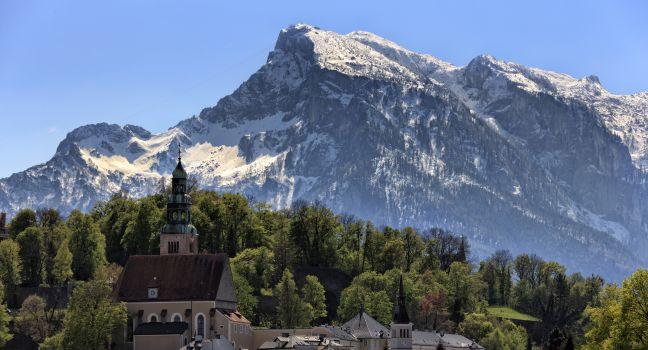
Salzburg's "house mountains" are so called because of their proximity to the city, with Gaisberg lying to the east and Untersberg to the south.

To reach Gaisberg, you can take the Albus No. 151 bus from Mirabellplatz right up to the summit of the mountain, where you'll be rewarded with a spectacular panoramic view of the Alps and the Alpine foreland. From here, there are several hiking trails and a charming little pub-restaurant with sun terrace. The bus leaves six times a day weekdays and 12 times a day weekends and takes about a half hour.

The Untersberg is the mountain Captain von Trapp and Maria climbed as they escaped the Nazis in The Sound of Music. In the film they were supposedly fleeing to Switzerland; in reality, the climb up the Untersberg would have brought them almost to the doorstep of Hitler's retreat at the Eagle's Nest above Berchtesgaden in Germany. A cable car from St. Leonhard, about 13 km (8 miles) and a 30-minute bus ride south of Salzburg, whisks you up to a height of 5,830 feet for a breathtaking view. In winter you can ski back down the Untersberg (you arrive in the village of Fürstenbrunn and taxis or buses take you back to St. Leonhard); in summer there are a number of hiking routes from the summit.

Gaisberg 32, Salzburg, A-5026, Austria

Something incorrect in this review?

Recommended Fodor's Video

Alter Markt

Right in the heart of the Old City is the Alter Markt, the old marketplace and former center of secular life in the city. The square is lined with 17th-century, middle-class houses, colorfully hued in shades of pink, pale blue, and yellow ocher. Look in at the old royal pharmacy, the Hofapotheke, whose ornate black-and-gold Rococo interior was built in 1760. Inside, the curious apothecarial smell can be traced to the shelves of Latin-labeled pots and jars. The pharmacy is still operating today and you can even have your blood pressure taken—but preferably not after drinking a doppelter einspänner (black coffee with whipped cream, served in a glass) in the famous Café Tomaselli just opposite. In warm weather, the café's terrace provides a wonderful spot for watching the world go by as you sip a melange (another coffee specialty, served with frothy milk), as does the chestnut tree-shaded Tomaselli garden at the top of the square.

Next to the coffeehouse you'll find the smallest house in Salzburg; note the slanting roof decorated with a dragon gargoyle. In the center of the square is the marble St. Florian's Fountain, dedicated in 1734 to the patron saint of firefighters.

Salzburg, A-5020, Austria

Something incorrect in this review?

Dreifaltigkeitskirche

The Makartplatz—named after Hans Makart, the most famous Austrian painter of the mid-19th century—is dominated at the top (east) end by Fischer von Erlach's first architectural work in Salzburg, built between 1694 and 1702. It was modeled on a church by Borromini in Rome and prefigures von Erlach's Karlskirche in Vienna. Dominated by a lofty, oval-shape dome—which showcases a painting by Johann Michael Rottmayr—this church was the result of the archbishop's concern that Salzburg's Neustadt was developing in an overly haphazard manner. The church interior is small but perfectly proportioned, surmounted by its dome, whose trompe-l'oeil fresco seems to open up the church to the sky above.

Dreifaltigkeitsgasse 13, Salzburg, A-5020, Austria
0662-877495

Something incorrect in this review?

Erhardkirche

Situated in the heart of Nonntal, one of Salzburg's oldest residential areas, this wonderfully colorful Italian Baroque church was built on the sight of a former hospital chapel in 1689. Fans of The Sound of Music may recognize the entrance staircase from the carriage-ride rendition of "Do-Re-Mi".

Nonntaler Hauptstrasse 12A, Salzburg, A-5020, Austria

Something incorrect in this review?

Franziskanerkirche

The graceful, tall spire of the Franciscan Church stands out from all other towers in Salzburg; the church itself encompasses the greatest diversity of architectural styles. There was a church on this spot as early as the 8th century, but it was destroyed by fire. The Romanesque nave of its replacement is still visible, as are other Romanesque features, such as a stone lion set into the steps leading to the pulpit. In the 15th century the choir was built in Gothic style, then crowned in the 18th century by an ornate red-marble-and-gilt altar designed by Austria's most famous Baroque architect, Johann Bernhard Fischer von Erlach. Mass—frequently featuring one of Mozart's compositions—is celebrated here on Sunday at 9 am.

Franziskanergasse 5, Salzburg, A-5020, Austria
0662-843629

Something incorrect in this review?

Friedhof St. Sebastian

This final resting place for many members of the Mozart family, in the shadows of St. Sebastian's Church, offers a peaceful respite from the store-lined Linzergasse. Prince-Archbishop Wolf-Dietrich commissioned the cemetery in 1600 to replace the old cathedral graveyard, which he planned to demolish. It was built in the style of an Italian campo santo (sacred field), with arcades on four sides, and in the center of the square he had the Gabriel Chapel, an unusual, brightly tiled Mannerist mausoleum, built for himself; he was interred here in 1617. Several famous people are buried in this cemetery, including the medical doctor and philosopher Theophrastus Paracelsus, who settled in Salzburg in the early 16th century (his grave is by the church door). Around the chapel is the grave of Mozart's widow, Constanze, alongside her second husband, Georg Nikolaus Nissen, and possibly her aunt Genoveva Weber (by the central path leading to the mausoleum). According to the latest research, Mozart's father, Leopold, came to rest in the unmarked community grave here, too. If the gate is closed, enter through the back entrance around the corner in the courtyard.

Linzergasse 41, Salzburg, A-5020, Austria

Something incorrect in this review?

Kapuzinerberg

To the south of the New City, facing the Mönchsberg on the other side of the river, Kapuzinerberg hill is crowned by several interesting sights. By ascending a stone staircase near Steingasse 9, you can start your climb up the peak. At the top of the first flight of steps is a tiny chapel, St. Johann am Imberg, built in 1681. Farther on are a signpost and gate to the Hettwer Bastion, part of the old city walls and one of Salzburg's most spectacular viewpoints. At the summit is the gold-beige Kapuzinerkloster (Capuchin Monastery), originally a fortification built to protect the one bridge crossing the river. It is still an active monastery, so it cannot be visited, except for the church. The road down—note the Stations of the Cross along the path—is called Stefan Zweig Weg, after the great Austrian writer and critic who rented the Paschingerschlössl house by the monastery until 1934, when he fled Austria. Continue along to the northeast end of the Kapuzinerberg road for a well-earned meal with a stunning 180-degree view from the garden of the Franziskischlössl.

Salzburg, A-5020, Austria

Something incorrect in this review?

Kollegienkirche

Completed by Fischer von Erlach in 1707, this church, sometimes called the Universitätskirche, is one of the purest examples of Baroque architecture in Austria. Unencumbered by Rococo decorations, the modified Greek cross plan has a majestic dignity worthy of Palladio.

Mozart Statue

In the center of Mozartplatz, on a marble plinth, stands this impressive bronze statue of Wolfgang Amadeus Mozart. Sculpted by Ludwig Schwanthaler and unveiled in 1842 in the presence of the composer's two surviving sons (how's that for pressure?), it was the first sign of public recognition Mozart received from his hometown since his death in Vienna in 1791. The statue, the first for a non-noble person in Austria, is very much a 19th-century stylized view of the composer, draped in a mantle and holding a page of music and a copybook.

Mozartplatz, Salzburg, A-5020, Austria

Something incorrect in this review?

Petersfriedhof

Eerie but intimate, this is the oldest Christian graveyard in Austria, dating back to 1627. Enclosed on three sides by elegant wrought-iron grilles, Baroque arcades contain chapels belonging to Salzburg's old patrician families. The graveyard is far from mournful: the individual graves are tended with loving care, decorated with candles, fir branches, and flowers—especially pansies (because the name means "thoughts"). In Crypt XXXI is the grave of Santino Solari, architect of the cathedral; in XXXIX that of Sigmund Haffner, a patron for whom Mozart composed a symphony and named a serenade. The final communal Crypt LIV (by the so-called catacombs) contains the body of Mozart's sister Nannerl and the torso of Joseph Haydn's younger brother Michael (his head is in St. Peter's church). The cemetery is in the shadow of the Mönchsberg mount; note the early-Christian tombs carved in the rock face.

Sankt-Peter-Bezirk 1, Salzburg, A-5020, Austria
0662-844–576–0

Something incorrect in this review?

Schloss Mirabell

The "Taj Mahal of Salzburg," Schloss Mirabell was built in 1606 by the immensely wealthy and powerful Prince-Archbishop Wolf-Dietrich for his mistress, Salomé Alt, and their 15 children. It was originally called Altenau in her honor. Such was the palace's beauty that it was taken over by succeeding prince-archbishops, including Markus Sittikus (who renamed the estate), Paris Lodron, and finally, Franz Anton von Harrach, who brought in Lukas von Hildebrandt to give the place a Baroque face-lift in 1727. A disastrous fire hit in 1818, but happily, three of the most spectacular set pieces of the palace—the Chapel, the Marble Hall, and the Angel Staircase—survived. The Marble Hall is now used for civil wedding ceremonies and is regarded as the most beautiful registry office in the world. Its marble floor in strongly contrasting colors and its walls of stucco and marble ornamented with elegant gilt scrollwork are splendid. The young Mozart and his sister gave concerts here, and he also composed Tafelmusik (Table Music) to accompany the prince's meals. It's open to the public for visits on weekdays, though hours are limited. The magnificent marble Angel Staircase was laid out by von Hildebrandt and has sculptures by Georg Rafael Donner. The staircase is romantically draped with white marble putti, whose faces and gestures reflect a multitude of emotions, from questioning innocence to jeering mockery. The very first putto genuflects in an old Turkish greeting (a reminder of the Siege of Vienna in 1683).

Candlelight chamber music concerts in the Marble Hall provide an ideal combination of performance and atmosphere.

Mirabellplatz 4, Salzburg, A-5020, Austria
0662-80720
Sight Details
Marble Hall closed weekends

Something incorrect in this review?

Steingasse

Stretching south from the Neustadt and walled in on one side by the bare cliffs of the Kapuzinerberg, this narrow medieval street was originally the ancient Roman entrance into the city from the south. The houses stood along the riverfront before the Salzach was regulated. Nowadays it's home to a heady mix of shops, bars, and restaurants, but with its tall houses the street still manages to convey an idea of how life used to be in the Middle Ages. Walk past the initial cluster of dining and drinking options, and beyond Das Kino movie theater, to reach the Inneres Steintor, which marks the entrance to the oldest (and most pleasantly shaded) section of the street. House number 23 on the right still has deep, slanted peep-windows for guarding the gate. Just beyond the stone gate is a lovely vantage point for the Fortress Hohensalzburg, with the light here on summer afternoons particularly striking. Continue beyond house number 31the birthplace of Josef Mohr, the poet of "Silent Night, Holy Night" fame (it's not number 9, despite what the sign there says)—and you'll pass by the occasional little bookshop, art gallery, and winery before you reach the Engelwirtsbrunnen, a decorative fountain that marks the end of the street.

Salzburg, A-5020, Austria

Something incorrect in this review?

Stiftkirche St. Peter

The most sumptuous church in Salzburg, St. Peter's is where Mozart's famed Great Mass in C Minor premiered in 1783; his wife, Constanze, sang the lead soprano role while Wolfgang directed the orchestra and choir and also played the organ. During the Salzburger Festspiele, the work is performed here during a special church-music concert. The porch has beautiful Romanesque vaulted arches from the original structure built in the 12th century. The interior was decorated in the voluptuous late-Baroque style when additions were made in the 1770s. Note the side chapel by the entrance, with the unusual crèche portraying the Flight into Egypt and the Massacre of the Innocents. Behind the Rupert Altar is the Felsengrab, a rock-face tomb where—according to a legend—St. Rupert himself was originally buried. To go from the sacred to the profane, head for the abbey's legendary St. Peter Stiftskulinarium restaurant, adjacent to the church.

Sankt-Peter-Bezirk 1, Salzburg, A-5020, Austria
0662-844576

Something incorrect in this review?