7 Best Sights in Salzburg, Austria

Background Illustration for Sights

Getting to know Salzburg is not too difficult, because most of its sights are within a comparatively small area. The Altstadt (Old City) is a compact area between the jutting outcrop of the Mönchsberg and the Salzach River. The cathedral and interconnecting squares surrounding it form what used to be the religious center, around which the major churches and the old archbishops' residence are arranged (note that entrance into all Salzburg churches is free). The Mönchsberg cliffs emerge unexpectedly behind the Old City, crowned to the east by the Hohensalzburg Fortress. Across the river, in the small area between the cliffs of the Kapuzinerberg and the riverbank, is the Steingasse, a narrow medieval street where laborers, craftsmen, and traders served the salt-mining industry and travelers coming in and out of the region’s important mercantile hub. Northwest of the Kapuzinerberg lies Mirabell Palace and its manicured gardens.

It's best to begin by exploring the architectural and cultural riches of the Old City, then go on to the fortress. Afterward, cross the river to inspect the other bank. Ideally, you need two days to do it all. An alternative, if you enjoy exploring churches and castles, is to go directly up to the fortress, either on foot or by returning through the cemetery to the funicular railway.

Fortress Hohensalzburg
Fodor's Choice
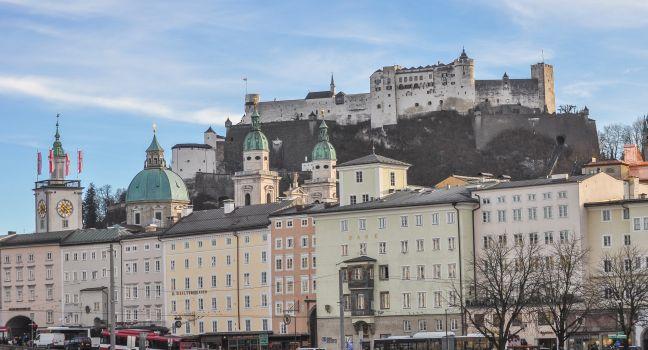
SALZBURG , AUSTRIA - 24 DECEMBER 2013 : Close up view of Hohensalzburg fortress from the opposite of old town in the afternoon.
fukez84 / Shutterstock

Founded in 1077, the Hohensalzburg is Salzburg's acropolis and the largest preserved medieval fortress in Central Europe. Brooding over the city from atop the Festungsberg, it was originally founded by Salzburg's Archbishop Gebhard, who had supported the pope in the investiture controversy against the Holy Roman Emperor. Over the centuries the archbishops gradually enlarged the castle, originally using it only sometimes as a residence, then as a siege-proof haven against invaders and their own rebellious subjects. The exterior may look grim, but inside there are lavish state rooms, such as the glittering Golden Room, the Castle Museum (dedicated to life in the fortress over the centuries), and the Rainer's Museum, with its collections honoring Salzburg's former home regiment. There's also a torture chamber not far from the exquisite late-Gothic St. George's Chapel (although the implements on view came from another castle and were not used here). The 200-pipe organ from the beginning of the 16th century, played three times daily, is best heard from a respectful distance (it's called "the Bull" for a reason). Children will also enjoy the World of Marionettes, including the chance to try their hands at being a puppeteer. To reach the fortress, walk up the zigzag path that begins just beyond the Stieglkeller on the Festungsgasse, or take the 110-year-old Festungsbahn (funicular railway) from behind St. Peter's Cemetery. A standard entry ticket (€10.80) includes access to the castle area, the museums, and a descent on the funicular; an all-inclusive ticket (€17.40) allows you to go both ways by funicular and includes access to a multimedia theater exhibition.

Climb up the 100 tiny steps to the Recturm, a grand outpost with a sweeping view of Salzburg and the mountains.

Mirabellgarten

Fodor's Choice
SALZBURG, AUSTRIA - AUGUST 01, 2014: Baroque Mirabell Garden (Mirabellgarten) located in Salzburg, Austria
Anibal Trejo / Shutterstock

There are a choice of entrances to the Mirabell Gardens—from the Makartplatz (framed by the statues of Roman gods), the Schwarzstrasse, and Mirabell Square—but you'll want to enter from the Rainerstrasse and head for the Rosenhügel (Rosebush Hill). That way, you'll arrive at the top of the steps where Julie Andrews and her seven charges showed off their singing ability in The Sound of Music. This is also an ideal vantage point from which to admire the formal gardens and one of the best views of Salzburg, as it shows how harmoniously architects of the Baroque period laid out the city. The center of the gardens—one of Europe's most beautiful parks, partly designed by Fischer von Erlach as the grand frame for the Mirabell Palace—is dominated by four large groups of statues representing the elements water, fire, air, and earth, and designed by Ottavio Mosto, who came to live in Salzburg from Padua. A bronze version of the winged horse Pegasus stands in front of the south facade of the palace in the center of a circular water basin. The most famous part of the Mirabell Gardens is the Zwerglgarten (Dwarfs' Garden), which can be found opposite the Pegasus fountain. Here you'll find 12 statues of "Danubian" dwarves sculpted in marble—the real-life models for which were presented to the bishop by the Landgrave of Göttweig. Prince-Archbishop Franz Anton von Harrach had the figures made for a kind of stone theater below. The Heckentheater (Hedge Theater) is an enchanting natural stage setting that dates from 1700.

Schloss Hellbrunn

Fodor's Choice
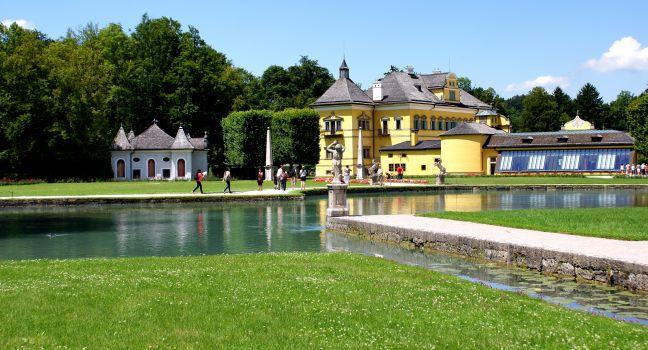
SALZBURG,AUSTRIA - JULY 16, 2014. Hellbrunn Pallace and his gardens.Hellbrunn Palace,an early early Baroque villa,built in 1613, used as a day residence in summer.
ELEPHOTOS / Shutterstock

Just 6 km (4 miles) south of Salzburg, Schloss Hellbrunn was the prince-archbishops' pleasure palace. It was built early in the 17th century by Santino Solari for Markus Sittikus, after the latter had imprisoned his uncle, Wolf-Dietrich, in the fortress. The castle has some fascinating rooms, including an octagonal music room and a banquet hall with a trompe-l'oeil ceiling. Look out for the homemade "unicorn." Hellbrunn Park became famous far and wide because of its Wasserspiele, or trick fountains. In the formal gardens (a beautiful example of the Mannerist style) owners added an outstanding mechanical theater that includes exotic and humorous fountains spurting water from strange places at unexpected times. You will probably get doused, so bring a raincoat. A visit to the gardens is highly recommended: nowhere else can you experience so completely the realm of fantasy in which the grand Salzburg archbishops indulged. The Monatsschlösschen, the old hunting lodge, contains an excellent folklore museum. Following the path over the hill you find the Steintheater (Stone Theater), an old quarry made into the earliest open-air opera stage north of the Alps. The former palace deer park has become a zoo featuring free-flying vultures and Alpine animals that largely roam unhindered. You can get to Hellbrunn by Bus 25, by car via the B150, or by bike or on foot along the beautiful Hellbrunner Allee past several 17th-century mansions. On the estate grounds is the little gazebo filmed in The Sound of Music ("I am 16, going on 17")—though the doors are now locked. To reach Schloss Hellbrunn from Salzburg Altstadt, take bus 25.

Consider going one stop further on the bus to the zoo; there's a lovely walk from here through the park into the palace gardens.

Recommended Fodor's Video

Hangar-7

Fodor's Choice

Red Bull founder Dietrich Mateschitz opens his fantasy toy chest for all to admire: vintage airplanes, helicopters, motorbikes, and Formula One racing cars gleam under the glass and steel of this modern multipurpose dome. The Flying Bulls, Red Bull's aerobatics experts, and their pristine fleet call this home when not circling the world on their frequent air-show tours. Watch daytime takeoffs and landings from under the shadow of a massive, silver World War II bomber at the Carpe Diem Lounge-Café or in the sunny Outdoor Lounge. The Mayday Bar is an affordable way to experience the evening atmosphere if you can't get a table at the incredibly popular Ikarus restaurant.

Mozart-Wohnhaus

Fodor's Choice

The Mozart family moved from its cramped quarters in Getreidegasse to this house on the Hannibal Platz, as it was then known, in 1773. Wolfgang Amadeus Mozart lived here until 1780, his sister Nannerl stayed here until she married in 1784, and their father Leopold lived here until his death in 1787. The house is accordingly referred to as the Mozart Residence, signifying that it was not only Wolfgang who lived here. During the first Allied bomb attack on Salzburg in October 1944, the house was partially destroyed, but was reconstructed in 1996. Mozart composed the "Salzburg Symphonies" here, as well as all five violin concertos, church music, and some sonatas, and parts of his early operatic masterpieces, including Idomeneo. Take the informative audio tour for an introduction to the museum's interesting collection of musical instruments—like his own pianoforte in the Dance Master Hall—as well as books from Leopold Mozart's library, family letters, and portraits. Before you leave, take a peek inside the Mozart Audio Visual Collection, an archive of thousands of Mozart recordings as well as films and video productions, all of which can be listened to or viewed on request.

Makartplatz 8, Salzburg, A-5020, Austria
0662-874–227–40
Sight Details
€12; combined ticket with Mozarts Geburtshaus €18.50

Something incorrect in this review?

Keltenmuseum

It's not all about salt: the town of Hallein is also home to one of the largest Celtic art and history museums in Europe, spread across three floors. The first (ground) floor has a fascinating permanent exhibition on the prehistory of Salzburg and the origins of Celts in Central Europe, with helpful English-language captions. The next two floors delve deeper into the town's salt history (okay, so it's mostly about salt), but most of these exhibits are in German only, with just the odd laminated sheet offering dry and truncated English-language information. Still, the whole museum is worth exploring for eye-catching visual exhibits like the creepy Bone Lab. Note that the museum is cash-only, and backpack-carriers will need a spare euro coin for a locker.

Spielzeugmuseum

On a rainy day the Toy Museum, partly set in a 14th-century burghers' house, is delightful diversion for both young and old. There's an interactive collection of historical dolls and teddy bears, themed soft play areas (choose between a knights' castle and a Viking longship), a blocks and bricks zone, and a children's library with comfy sofas. Punch and Judy–style Kasperltheater puppet shows leave everyone laughing, with performances held every Wednesday at 3 pm, and there's a children's cinema, too.