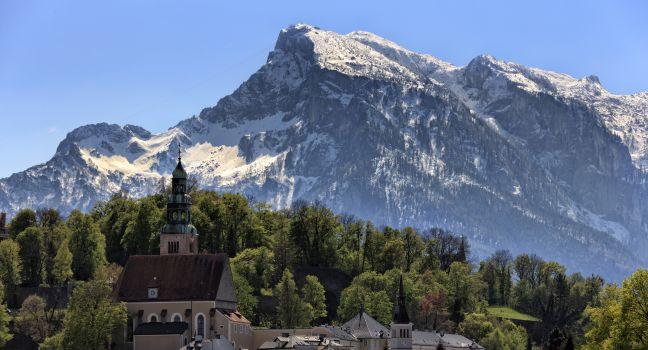
33 Best Sights in Salzburg, Austria

Background Illustration for Sights

Getting to know Salzburg is not too difficult, because most of its sights are within a comparatively small area. The Altstadt (Old City) is a compact area between the jutting outcrop of the Mönchsberg and the Salzach River. The cathedral and interconnecting squares surrounding it form what used to be the religious center, around which the major churches and the old archbishops' residence are arranged (note that entrance into all Salzburg churches is free). The Mönchsberg cliffs emerge unexpectedly behind the Old City, crowned to the east by the Hohensalzburg Fortress. Across the river, in the small area between the cliffs of the Kapuzinerberg and the riverbank, is the Steingasse, a narrow medieval street where laborers, craftsmen, and traders served the salt-mining industry and travelers coming in and out of the region’s important mercantile hub. Northwest of the Kapuzinerberg lies Mirabell Palace and its manicured gardens.

It's best to begin by exploring the architectural and cultural riches of the Old City, then go on to the fortress. Afterward, cross the river to inspect the other bank. Ideally, you need two days to do it all. An alternative, if you enjoy exploring churches and castles, is to go directly up to the fortress, either on foot or by returning through the cemetery to the funicular railway.

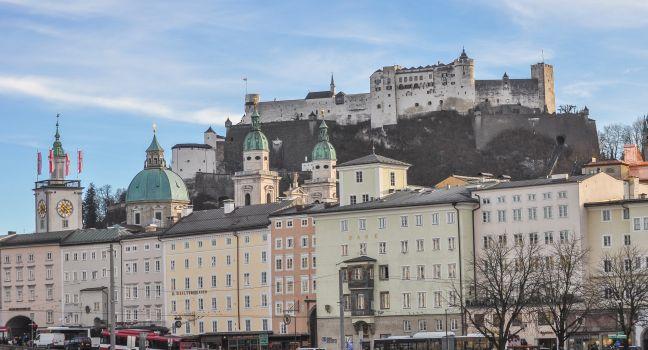
Fortress Hohensalzburg
Fodor's Choice
SALZBURG , AUSTRIA - 24 DECEMBER 2013 : Close up view of Hohensalzburg fortress from the opposite of old town in the afternoon.
fukez84 / Shutterstock

Founded in 1077, the Hohensalzburg is Salzburg's acropolis and the largest preserved medieval fortress in Central Europe. Brooding over the city from atop the Festungsberg, it was originally founded by Salzburg's Archbishop Gebhard, who had supported the pope in the investiture controversy against the Holy Roman Emperor. Over the centuries the archbishops gradually enlarged the castle, originally using it only sometimes as a residence, then as a siege-proof haven against invaders and their own rebellious subjects. The exterior may look grim, but inside there are lavish state rooms, such as the glittering Golden Room, the Castle Museum (dedicated to life in the fortress over the centuries), and the Rainer's Museum, with its collections honoring Salzburg's former home regiment. There's also a torture chamber not far from the exquisite late-Gothic St. George's Chapel (although the implements on view came from another castle and were not used here). The 200-pipe organ from the beginning of the 16th century, played three times daily, is best heard from a respectful distance (it's called "the Bull" for a reason). Children will also enjoy the World of Marionettes, including the chance to try their hands at being a puppeteer. To reach the fortress, walk up the zigzag path that begins just beyond the Stieglkeller on the Festungsgasse, or take the 110-year-old Festungsbahn (funicular railway) from behind St. Peter's Cemetery. A standard entry ticket (€10.80) includes access to the castle area, the museums, and a descent on the funicular; an all-inclusive ticket (€17.40) allows you to go both ways by funicular and includes access to a multimedia theater exhibition.

Climb up the 100 tiny steps to the Recturm, a grand outpost with a sweeping view of Salzburg and the mountains.

Mirabellgarten

Fodor's Choice
SALZBURG, AUSTRIA - AUGUST 01, 2014: Baroque Mirabell Garden (Mirabellgarten) located in Salzburg, Austria
Anibal Trejo / Shutterstock

There are a choice of entrances to the Mirabell Gardens—from the Makartplatz (framed by the statues of Roman gods), the Schwarzstrasse, and Mirabell Square—but you'll want to enter from the Rainerstrasse and head for the Rosenhügel (Rosebush Hill). That way, you'll arrive at the top of the steps where Julie Andrews and her seven charges showed off their singing ability in The Sound of Music. This is also an ideal vantage point from which to admire the formal gardens and one of the best views of Salzburg, as it shows how harmoniously architects of the Baroque period laid out the city. The center of the gardens—one of Europe's most beautiful parks, partly designed by Fischer von Erlach as the grand frame for the Mirabell Palace—is dominated by four large groups of statues representing the elements water, fire, air, and earth, and designed by Ottavio Mosto, who came to live in Salzburg from Padua. A bronze version of the winged horse Pegasus stands in front of the south facade of the palace in the center of a circular water basin. The most famous part of the Mirabell Gardens is the Zwerglgarten (Dwarfs' Garden), which can be found opposite the Pegasus fountain. Here you'll find 12 statues of "Danubian" dwarves sculpted in marble—the real-life models for which were presented to the bishop by the Landgrave of Göttweig. Prince-Archbishop Franz Anton von Harrach had the figures made for a kind of stone theater below. The Heckentheater (Hedge Theater) is an enchanting natural stage setting that dates from 1700.

Schloss Hellbrunn

Fodor's Choice
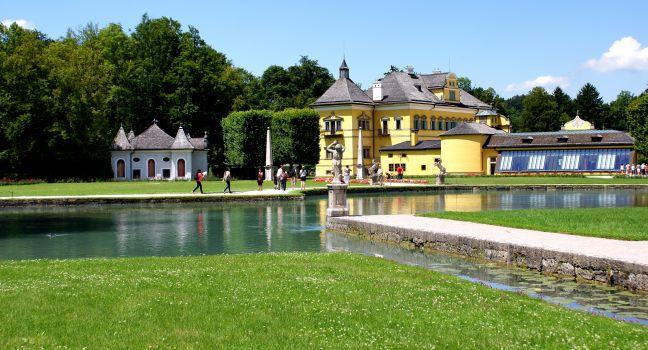
SALZBURG,AUSTRIA - JULY 16, 2014. Hellbrunn Pallace and his gardens.Hellbrunn Palace,an early early Baroque villa,built in 1613, used as a day residence in summer.
ELEPHOTOS / Shutterstock

Just 6 km (4 miles) south of Salzburg, Schloss Hellbrunn was the prince-archbishops' pleasure palace. It was built early in the 17th century by Santino Solari for Markus Sittikus, after the latter had imprisoned his uncle, Wolf-Dietrich, in the fortress. The castle has some fascinating rooms, including an octagonal music room and a banquet hall with a trompe-l'oeil ceiling. Look out for the homemade "unicorn." Hellbrunn Park became famous far and wide because of its Wasserspiele, or trick fountains. In the formal gardens (a beautiful example of the Mannerist style) owners added an outstanding mechanical theater that includes exotic and humorous fountains spurting water from strange places at unexpected times. You will probably get doused, so bring a raincoat. A visit to the gardens is highly recommended: nowhere else can you experience so completely the realm of fantasy in which the grand Salzburg archbishops indulged. The Monatsschlösschen, the old hunting lodge, contains an excellent folklore museum. Following the path over the hill you find the Steintheater (Stone Theater), an old quarry made into the earliest open-air opera stage north of the Alps. The former palace deer park has become a zoo featuring free-flying vultures and Alpine animals that largely roam unhindered. You can get to Hellbrunn by Bus 25, by car via the B150, or by bike or on foot along the beautiful Hellbrunner Allee past several 17th-century mansions. On the estate grounds is the little gazebo filmed in The Sound of Music ("I am 16, going on 17")—though the doors are now locked. To reach Schloss Hellbrunn from Salzburg Altstadt, take bus 25.

Consider going one stop further on the bus to the zoo; there's a lovely walk from here through the park into the palace gardens.

Recommended Fodor's Video

Dom zu Salzburg

Fodor's Choice

Set within the beautiful Domplatz with the Virgin's Column in its center, this gorgeous cathedral is considered to be the first early-Italian Baroque building north of the Alps. Its facade is of marble, its towers reach 250 feet into the air, and it holds 10,000 people. There has been a cathedral on this spot since the 8th century, but the present structure dates from the 17th century. The cathedral honors the patron saint of Salzburg, St. Rupert, who founded Nonnberg Abbey around 700, and also the Irish St. Virgil, the founder of the first cathedral, consecrated in 774, whose relics lie buried beneath the altar. Archbishop Wolf-Dietrich took advantage of the old Romanesque-Gothic cathedral's destruction by fire in 1598 to demolish the remains and make plans for a huge new structure facing onto the Residenzplatz to reaffirm Salzburg's commitment to the Catholic cause. His successor, Markus Sittikus, and the new court architect, Santino Solari, started the present cathedral in 1614; it was consecrated with great ceremony in 1628 during the Thirty Years' War. The church's simple sepia-and-white interior, a peaceful counterpoint to the usual Baroque splendor, dates from a later renovation. To see remains of the old cathedral, go down the steps from the left-side aisle into the crypt where the archbishops from 1600 on are buried. Mozart's parents, Leopold and Anna-Maria, were married here in 1747 and Mozart was christened, the day after he was born, at the 14th-century font. He later served as organist here from 1779 to 1781 and wrote some of his compositions such as the Coronation Mass specifically for the cathedral. It was a good fit, as this is the only house of worship in the world with five independent fixed organs. Today, they are sometimes played together during special church-music concerts.

On Sunday and all Catholic holidays, mass is held at 10 am—the most glorious time to experience the cathedral's full splendor.

DomQuartier

Fodor's Choice

For the first time since the early 1800s, you can look down on the original heart of Salzburg as once only the powerful archbishops could, as you walk the top-floor corridors surrounding the Domplatz that connect the Residenz (palace), Dom (cathedral), and St. Peter's Abbey. In the Residenz, see the magnificent State Rooms, including the Kaisersaal (Imperial Hall) and the Rittersaal (Knight's Hall). Of particular note are the frescoes by Johann Michael Rottmayr and Martino Altomonte depicting the history of Alexander the Great. Upstairs on the third floor is the Residenzgalerie, a princely art collection specializing in 17th-century Dutch and Flemish art and 19th-century paintings of Salzburg. On the State Rooms floor, Mozart's opera La Finta Semplice premiered in 1769 in the Guard Room. Also included is the fascinating Dommuseum, with cathedral art from the 8th to 18th centuries, as well as the Museum St. Peter with valuable art treasures from the monastery's collections. You'll also enjoy a beautiful balcony view of the cathedral interior, as well as expansive vistas of the city. The interior walkways make it particularly appealing on one of Salzburg's frequent rainy days.

Residenzplatz 1/Domplatz 1a, Salzburg, A-5020, Austria
0662-804–221–09
Sight Details
€13
Closed Tues.

Something incorrect in this review?

Hallein Salt Mine

Fodor's Choice

The second-largest town of the region, 15 kilometers (10 miles) south of Salzburg and at least 1,000 years older, Hallein was once famed for its caves of "white gold"—or salt. "Hall" is the old Celtic word for salt, and this treasure was mined in the neighboring Dürrnberg mountain, which you can now visit in the form of Hallein Salt Mine. It's the oldest salt mine in the world and probably also the most fun: you get to explore the subterranean world by foot, boat, and even slide. Your ticket also includes access to the Celtic Mountain exhibition, which includes a replica of a Celtic village. You can get to Hallein by regular bus, by car, or by bicycle alongside the River Salzach, then it's a lovely, 40-minute walk (or seven-minute taxi) up to the mine. 

Take your passport, as while underground you'll cross from Austria into Germany and back.

Hangar-7

Fodor's Choice

Red Bull founder Dietrich Mateschitz opens his fantasy toy chest for all to admire: vintage airplanes, helicopters, motorbikes, and Formula One racing cars gleam under the glass and steel of this modern multipurpose dome. The Flying Bulls, Red Bull's aerobatics experts, and their pristine fleet call this home when not circling the world on their frequent air-show tours. Watch daytime takeoffs and landings from under the shadow of a massive, silver World War II bomber at the Carpe Diem Lounge-Café or in the sunny Outdoor Lounge. The Mayday Bar is an affordable way to experience the evening atmosphere if you can't get a table at the incredibly popular Ikarus restaurant.

Mozart-Wohnhaus

Fodor's Choice

The Mozart family moved from its cramped quarters in Getreidegasse to this house on the Hannibal Platz, as it was then known, in 1773. Wolfgang Amadeus Mozart lived here until 1780, his sister Nannerl stayed here until she married in 1784, and their father Leopold lived here until his death in 1787. The house is accordingly referred to as the Mozart Residence, signifying that it was not only Wolfgang who lived here. During the first Allied bomb attack on Salzburg in October 1944, the house was partially destroyed, but was reconstructed in 1996. Mozart composed the "Salzburg Symphonies" here, as well as all five violin concertos, church music, and some sonatas, and parts of his early operatic masterpieces, including Idomeneo. Take the informative audio tour for an introduction to the museum's interesting collection of musical instruments—like his own pianoforte in the Dance Master Hall—as well as books from Leopold Mozart's library, family letters, and portraits. Before you leave, take a peek inside the Mozart Audio Visual Collection, an archive of thousands of Mozart recordings as well as films and video productions, all of which can be listened to or viewed on request.

Makartplatz 8, Salzburg, A-5020, Austria
0662-874–227–40
Sight Details
€12; combined ticket with Mozarts Geburtshaus €18.50

Something incorrect in this review?

Mozarts Geburtshaus

Fodor's Choice

This homage to Salzburg's prodigal son offers fascinating insights into his life and works, with carefully curated relics of Mozart's youth, listening rooms, and models of famous productions of his operas. As an adult, the great composer preferred Vienna to Salzburg, complaining that audiences in his native city were no more responsive than tables and chairs. Still, home is home, and this was Mozart's—when not on one of his frequent trips abroad—until the age of 17. Mozart was born on the third (in American parlance, the fourth) floor of this tall house on January 27, 1756, and his family lived here in the front apartment, when they were not on tour, from 1747 to 1773. As the child prodigy composed many of his first compositions in these rooms, it is fitting and touching to find Mozart's tiny first violin on display. Buy a combination ticket and you can also visit the Mozart-Wohnhaus (his onetime residence) across the river.

Getreidegasse 9, Salzburg, A-5020, Austria
0662-844313
Sight Details
€12; combined ticket with Mozart-Wohnhaus €18.50

Something incorrect in this review?

Salzburg Museum

Fodor's Choice

Encompassing six different buildings, the Salzburg Museum's largest location is the 17th-century Neue Residenz. This building was Prince-Archbishop Wolf-Dietrich's "overflow" palace—he couldn't fit his entire archiepiscopal court into the main Residenz across the plaza—and as such, it features 10 state reception rooms that were among the first attempts at Renaissance-style design in the North. The permanent exhibition focuses on the city’s artistic, cultural, and historical development. The Mirror Hall contains an archaeological collection including remains of the town's ancient Roman ruins. The Panorama Passage, lined with archaeological excavations from the Neue Residenz, leads to the Panorama Museum, home to the spectacular Sattler Panorama. One of the few remaining 360-degree paintings in the world, it shows the city of Salzburg in the early 19th century. The Art Hall hosts three major special exhibitions a year.

Gaisberg and Untersberg

The Untersberg in Salzburg
Laszlo Szirtesi / Shutterstock

Salzburg's "house mountains" are so called because of their proximity to the city, with Gaisberg lying to the east and Untersberg to the south.

To reach Gaisberg, you can take the Albus No. 151 bus from Mirabellplatz right up to the summit of the mountain, where you'll be rewarded with a spectacular panoramic view of the Alps and the Alpine foreland. From here, there are several hiking trails and a charming little pub-restaurant with sun terrace. The bus leaves six times a day weekdays and 12 times a day weekends and takes about a half hour.

The Untersberg is the mountain Captain von Trapp and Maria climbed as they escaped the Nazis in The Sound of Music. In the film they were supposedly fleeing to Switzerland; in reality, the climb up the Untersberg would have brought them almost to the doorstep of Hitler's retreat at the Eagle's Nest above Berchtesgaden in Germany. A cable car from St. Leonhard, about 13 km (8 miles) and a 30-minute bus ride south of Salzburg, whisks you up to a height of 5,830 feet for a breathtaking view. In winter you can ski back down the Untersberg (you arrive in the village of Fürstenbrunn and taxis or buses take you back to St. Leonhard); in summer there are a number of hiking routes from the summit.

Gaisberg 32, Salzburg, A-5026, Austria

Something incorrect in this review?

MönchsbergAufzug

SALZBURG, AUSTRIA - SEPTEMBER 26: An elevator called Monchsbergaufzug in the city center of Salzburg on September 26, 2009. Salzburg is the capital of the federal state of Salzburg.
Oscity / Shutterstock

Just around the corner from the Pferdeschwemme horse fountain, at Anton-Neumayr Platz, you'll find the Mönchsberg elevator, which carries you up 60 meters through solid rock in less than 30 seconds. At the top, you'll find not only the Museum der Moderne but also some lovely wooded paths that are great for walking and gasping—there are spectacular vistas of Salzburg. In summer, the elevator is a marvelous (and quick) way to escape the tiny, crowded streets of the Old City.

Alter Markt

Right in the heart of the Old City is the Alter Markt, the old marketplace and former center of secular life in the city. The square is lined with 17th-century, middle-class houses, colorfully hued in shades of pink, pale blue, and yellow ocher. Look in at the old royal pharmacy, the Hofapotheke, whose ornate black-and-gold Rococo interior was built in 1760. Inside, the curious apothecarial smell can be traced to the shelves of Latin-labeled pots and jars. The pharmacy is still operating today and you can even have your blood pressure taken—but preferably not after drinking a doppelter einspänner (black coffee with whipped cream, served in a glass) in the famous Café Tomaselli just opposite. In warm weather, the café's terrace provides a wonderful spot for watching the world go by as you sip a melange (another coffee specialty, served with frothy milk), as does the chestnut tree-shaded Tomaselli garden at the top of the square.

Next to the coffeehouse you'll find the smallest house in Salzburg; note the slanting roof decorated with a dragon gargoyle. In the center of the square is the marble St. Florian's Fountain, dedicated in 1734 to the patron saint of firefighters.

Salzburg, A-5020, Austria

Something incorrect in this review?

Dreifaltigkeitskirche

The Makartplatz—named after Hans Makart, the most famous Austrian painter of the mid-19th century—is dominated at the top (east) end by Fischer von Erlach's first architectural work in Salzburg, built between 1694 and 1702. It was modeled on a church by Borromini in Rome and prefigures von Erlach's Karlskirche in Vienna. Dominated by a lofty, oval-shape dome—which showcases a painting by Johann Michael Rottmayr—this church was the result of the archbishop's concern that Salzburg's Neustadt was developing in an overly haphazard manner. The church interior is small but perfectly proportioned, surmounted by its dome, whose trompe-l'oeil fresco seems to open up the church to the sky above.

Dreifaltigkeitsgasse 13, Salzburg, A-5020, Austria
0662-877495

Something incorrect in this review?

Erhardkirche

Situated in the heart of Nonntal, one of Salzburg's oldest residential areas, this wonderfully colorful Italian Baroque church was built on the sight of a former hospital chapel in 1689. Fans of The Sound of Music may recognize the entrance staircase from the carriage-ride rendition of "Do-Re-Mi".

Nonntaler Hauptstrasse 12A, Salzburg, A-5020, Austria

Something incorrect in this review?

Franziskanerkirche

The graceful, tall spire of the Franciscan Church stands out from all other towers in Salzburg; the church itself encompasses the greatest diversity of architectural styles. There was a church on this spot as early as the 8th century, but it was destroyed by fire. The Romanesque nave of its replacement is still visible, as are other Romanesque features, such as a stone lion set into the steps leading to the pulpit. In the 15th century the choir was built in Gothic style, then crowned in the 18th century by an ornate red-marble-and-gilt altar designed by Austria's most famous Baroque architect, Johann Bernhard Fischer von Erlach. Mass—frequently featuring one of Mozart's compositions—is celebrated here on Sunday at 9 am.

Franziskanergasse 5, Salzburg, A-5020, Austria
0662-843629

Something incorrect in this review?

Friedhof St. Sebastian

This final resting place for many members of the Mozart family, in the shadows of St. Sebastian's Church, offers a peaceful respite from the store-lined Linzergasse. Prince-Archbishop Wolf-Dietrich commissioned the cemetery in 1600 to replace the old cathedral graveyard, which he planned to demolish. It was built in the style of an Italian campo santo (sacred field), with arcades on four sides, and in the center of the square he had the Gabriel Chapel, an unusual, brightly tiled Mannerist mausoleum, built for himself; he was interred here in 1617. Several famous people are buried in this cemetery, including the medical doctor and philosopher Theophrastus Paracelsus, who settled in Salzburg in the early 16th century (his grave is by the church door). Around the chapel is the grave of Mozart's widow, Constanze, alongside her second husband, Georg Nikolaus Nissen, and possibly her aunt Genoveva Weber (by the central path leading to the mausoleum). According to the latest research, Mozart's father, Leopold, came to rest in the unmarked community grave here, too. If the gate is closed, enter through the back entrance around the corner in the courtyard.

Linzergasse 41, Salzburg, A-5020, Austria

Something incorrect in this review?

Glockenspiel

This famous carillon bell tower is perched on top of the Neue Residenz (New Residence), Prince-Archbishop Wolf-Dietrich's government palace. The carillon is a later addition, brought from today's Belgium in 1695 and finally put in working order in 1704. The 35 bells play classical tunes (usually by Mozart or Haydn) with charm and ingenuity at 7 am, 11 am, and 6 pm (well, usually a few minutes after the hour, once the city's other church bells have finished ringing). On Sunday at 11:45 am, musicians perform in the "Trumpeter Tower" at Hohensalzburg Fortress, and their Baroque fanfares can be heard across the Old City. Details about the music selections are listed on a notice board across the square on the corner of the Residenz building.

Kapuzinerberg

To the south of the New City, facing the Mönchsberg on the other side of the river, Kapuzinerberg hill is crowned by several interesting sights. By ascending a stone staircase near Steingasse 9, you can start your climb up the peak. At the top of the first flight of steps is a tiny chapel, St. Johann am Imberg, built in 1681. Farther on are a signpost and gate to the Hettwer Bastion, part of the old city walls and one of Salzburg's most spectacular viewpoints. At the summit is the gold-beige Kapuzinerkloster (Capuchin Monastery), originally a fortification built to protect the one bridge crossing the river. It is still an active monastery, so it cannot be visited, except for the church. The road down—note the Stations of the Cross along the path—is called Stefan Zweig Weg, after the great Austrian writer and critic who rented the Paschingerschlössl house by the monastery until 1934, when he fled Austria. Continue along to the northeast end of the Kapuzinerberg road for a well-earned meal with a stunning 180-degree view from the garden of the Franziskischlössl.

Salzburg, A-5020, Austria

Something incorrect in this review?

Keltenmuseum

It's not all about salt: the town of Hallein is also home to one of the largest Celtic art and history museums in Europe, spread across three floors. The first (ground) floor has a fascinating permanent exhibition on the prehistory of Salzburg and the origins of Celts in Central Europe, with helpful English-language captions. The next two floors delve deeper into the town's salt history (okay, so it's mostly about salt), but most of these exhibits are in German only, with just the odd laminated sheet offering dry and truncated English-language information. Still, the whole museum is worth exploring for eye-catching visual exhibits like the creepy Bone Lab. Note that the museum is cash-only, and backpack-carriers will need a spare euro coin for a locker.

Kollegienkirche

Completed by Fischer von Erlach in 1707, this church, sometimes called the Universitätskirche, is one of the purest examples of Baroque architecture in Austria. Unencumbered by Rococo decorations, the modified Greek cross plan has a majestic dignity worthy of Palladio.

Mozart Statue

In the center of Mozartplatz, on a marble plinth, stands this impressive bronze statue of Wolfgang Amadeus Mozart. Sculpted by Ludwig Schwanthaler and unveiled in 1842 in the presence of the composer's two surviving sons (how's that for pressure?), it was the first sign of public recognition Mozart received from his hometown since his death in Vienna in 1791. The statue, the first for a non-noble person in Austria, is very much a 19th-century stylized view of the composer, draped in a mantle and holding a page of music and a copybook.

Mozartplatz, Salzburg, A-5020, Austria

Something incorrect in this review?

Museum der Moderne

There are two branches of the Museum der Moderne in Salzburg: Mönchsberg and Rupertinum. The former enjoys one of Salzburg's most famous scenic spots, atop the sheer cliff face of the Mönchsberg. Clad in minimalist white marble, the modern art museum has three exhibition levels, with graphics and paintings by Austrian and international artists like Oskar Kokoschka and Erwin Wurm, and a focus on large-scale installations and sculptural works. In the Altstadt below, the Rupertinum offers changing exhibitions of modern graphic art and interactive special exhibits within a lovely early-Baroque-era building. Both branches have superb dining options, but the Mönchsberg restaurant edges it out for the spectacular city views (come in the evening to see the city illuminated).

Am Mönchsberg 32, Salzburg, A-5020, Austria
0662-842220
Sight Details
€13 for both museums
Closed Mon. except during Salzburg Festival

Something incorrect in this review?

Petersfriedhof

Eerie but intimate, this is the oldest Christian graveyard in Austria, dating back to 1627. Enclosed on three sides by elegant wrought-iron grilles, Baroque arcades contain chapels belonging to Salzburg's old patrician families. The graveyard is far from mournful: the individual graves are tended with loving care, decorated with candles, fir branches, and flowers—especially pansies (because the name means "thoughts"). In Crypt XXXI is the grave of Santino Solari, architect of the cathedral; in XXXIX that of Sigmund Haffner, a patron for whom Mozart composed a symphony and named a serenade. The final communal Crypt LIV (by the so-called catacombs) contains the body of Mozart's sister Nannerl and the torso of Joseph Haydn's younger brother Michael (his head is in St. Peter's church). The cemetery is in the shadow of the Mönchsberg mount; note the early-Christian tombs carved in the rock face.

Sankt-Peter-Bezirk 1, Salzburg, A-5020, Austria
0662-844–576–0

Something incorrect in this review?

Pferdeschwemme

If Rome had fountains, so, too, would Wolf-Dietrich's Salzburg. The city is studded with them, and none is so odd as this monument to all things equine. You'll find it if you head to the western end of the Hofstallgasse on Herbert-von-Karajan-Platz, named after Salzburg's second-greatest musical son, the legendary conductor who was the music director of the Salzburg Festival for many decades. On the Mönchsberg side of the square is the Pferdeschwemme—a royal trough, constructed in 1695, where prize horses used to be cleaned and watered; as they underwent this ordeal they could delight in the frescoes of their pin-up fillies on the rear wall. The Baroque monument in the middle represents the antique legend of the taming of a horse, Bellerophon and his mount, Pegasus.

Herbert-von-Karajan-Platz 11, Salzburg, A-5020, Austria

Something incorrect in this review?

Rathaus

Where Sigmund-Haffner-Gasse meets Kranzlmarkt you will find the Rathaus. Despite the tall tower, it's a relatively insignificant building in the Salzburg skyline—no doubt reflecting the historical weakness of the burghers vis-à-vis the Church, whose opulent monuments are evident throughout the city. On the other hand, this structure is a prime example of the Italian influence in Salzburg's architecture. Originally this was a family tower (and the only one still remaining here), but it was sold to the city in 1407.

Rathausplatz and Kranzlmarkt, Salzburg, A-5020, Austria

Something incorrect in this review?

Residenz

At the very heart of Baroque Salzburg, the Residenz overlooks the spacious Residenzplatz and its famous fountain. The palace in its present form was built between 1600 and 1619 as the home of Wolf-Dietrich, the most powerful of Salzburg's prince-archbishops. See inside with a visit to the DomQuartier. The palace courtyard has been the lovely setting for Salzburg Festival opera productions since 1956—mostly the lesser-known treasures of Mozart.

Residenzplatz 1, Salzburg, A-5020, Austria

Something incorrect in this review?

Schloss Mirabell

The "Taj Mahal of Salzburg," Schloss Mirabell was built in 1606 by the immensely wealthy and powerful Prince-Archbishop Wolf-Dietrich for his mistress, Salomé Alt, and their 15 children. It was originally called Altenau in her honor. Such was the palace's beauty that it was taken over by succeeding prince-archbishops, including Markus Sittikus (who renamed the estate), Paris Lodron, and finally, Franz Anton von Harrach, who brought in Lukas von Hildebrandt to give the place a Baroque face-lift in 1727. A disastrous fire hit in 1818, but happily, three of the most spectacular set pieces of the palace—the Chapel, the Marble Hall, and the Angel Staircase—survived. The Marble Hall is now used for civil wedding ceremonies and is regarded as the most beautiful registry office in the world. Its marble floor in strongly contrasting colors and its walls of stucco and marble ornamented with elegant gilt scrollwork are splendid. The young Mozart and his sister gave concerts here, and he also composed Tafelmusik (Table Music) to accompany the prince's meals. It's open to the public for visits on weekdays, though hours are limited. The magnificent marble Angel Staircase was laid out by von Hildebrandt and has sculptures by Georg Rafael Donner. The staircase is romantically draped with white marble putti, whose faces and gestures reflect a multitude of emotions, from questioning innocence to jeering mockery. The very first putto genuflects in an old Turkish greeting (a reminder of the Siege of Vienna in 1683).

Candlelight chamber music concerts in the Marble Hall provide an ideal combination of performance and atmosphere.

Mirabellplatz 4, Salzburg, A-5020, Austria
0662-80720
Sight Details
Marble Hall closed weekends

Something incorrect in this review?

Spielzeugmuseum

On a rainy day the Toy Museum, partly set in a 14th-century burghers' house, is delightful diversion for both young and old. There's an interactive collection of historical dolls and teddy bears, themed soft play areas (choose between a knights' castle and a Viking longship), a blocks and bricks zone, and a children's library with comfy sofas. Punch and Judy–style Kasperltheater puppet shows leave everyone laughing, with performances held every Wednesday at 3 pm, and there's a children's cinema, too.

Steingasse

Stretching south from the Neustadt and walled in on one side by the bare cliffs of the Kapuzinerberg, this narrow medieval street was originally the ancient Roman entrance into the city from the south. The houses stood along the riverfront before the Salzach was regulated. Nowadays it's home to a heady mix of shops, bars, and restaurants, but with its tall houses the street still manages to convey an idea of how life used to be in the Middle Ages. Walk past the initial cluster of dining and drinking options, and beyond Das Kino movie theater, to reach the Inneres Steintor, which marks the entrance to the oldest (and most pleasantly shaded) section of the street. House number 23 on the right still has deep, slanted peep-windows for guarding the gate. Just beyond the stone gate is a lovely vantage point for the Fortress Hohensalzburg, with the light here on summer afternoons particularly striking. Continue beyond house number 31the birthplace of Josef Mohr, the poet of "Silent Night, Holy Night" fame (it's not number 9, despite what the sign there says)—and you'll pass by the occasional little bookshop, art gallery, and winery before you reach the Engelwirtsbrunnen, a decorative fountain that marks the end of the street.

Salzburg, A-5020, Austria

Something incorrect in this review?