Fodor's Expert Review St. Peter's, Their Majesties Chappell
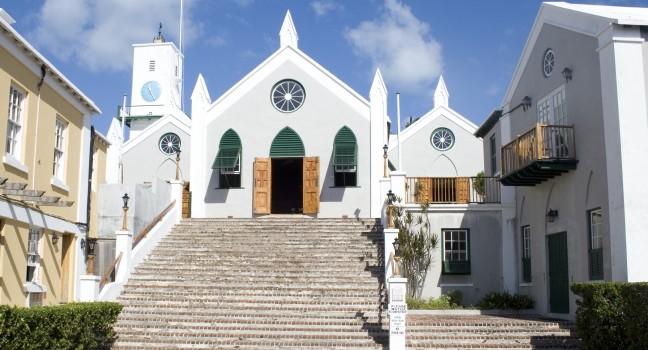
Because parts of this whitewashed stone church date back to 1620, it holds the distinction of being the oldest continuously operating Anglican church in the Western Hemisphere. Befitting its age, St. Peter's has many treasures. The red cedar altar, carved in 1615 under the supervision of Richard Moore (a shipwright and the colony's first governor) is the oldest piece of woodwork in Bermuda.
\nThe late-18th-century bishop's throne is believed to have been salvaged from a shipwreck, and the baptismal font, brought to the island by early settlers, is an estimated 900 years old. There's also a fine collection of Communion silver from the 1600s in the vestry. Nevertheless, it's the building itself that leaves the most lasting impression. With rough-hewn pillars, exposed cedar beams, and candlelit chandeliers, the church is stunning in its simplicity.
\nAfter viewing the interior, walk into the churchyard to see where prominent Bermudians, including Governor Sir Richard Sharples,... READ MORE
Because parts of this whitewashed stone church date back to 1620, it holds the distinction of being the oldest continuously operating Anglican church in the Western Hemisphere. Befitting its age, St. Peter's has many treasures. The red cedar altar, carved in 1615 under the supervision of Richard Moore (a shipwright and the colony's first governor) is the oldest piece of woodwork in Bermuda.
\nThe late-18th-century bishop's throne is believed to have been salvaged from a shipwreck, and the baptismal font, brought to the island by early settlers, is an estimated 900 years old. There's also a fine collection of Communion silver from the 1600s in the vestry. Nevertheless, it's the building itself that leaves the most lasting impression. With rough-hewn pillars, exposed cedar beams, and candlelit chandeliers, the church is stunning in its simplicity.
\nAfter viewing the interior, walk into the churchyard to see where prominent Bermudians, including Governor Sir Richard Sharples, who was assassinated in 1973, are buried. A separate graveyard for enslaved and free Blacks (to the west of the church, behind the wall) is a reminder of Bermuda's segregated past.
READ LESS