22 Best Sights in Hue, The Central Coast

Background Illustration for Sights

We've compiled the best of the best in Hue - browse our top choices for the top things to see or do during your stay.

The Citadel

Fodor's Choice
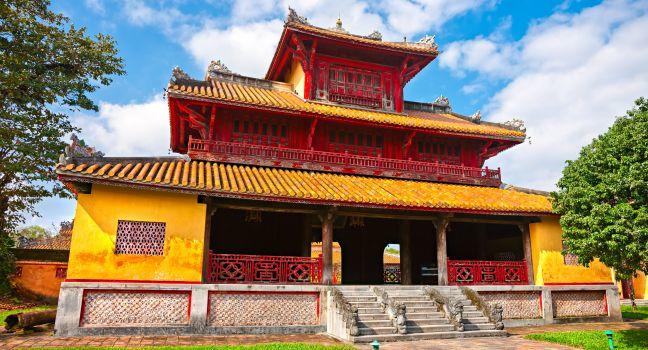
Entrance of Citadel, Hue, Vietnam. Unesco World Heritage Site.
Luciano Mortula / Shutterstock

If there is only one sight you visit in Hue, make sure this is it. Constructed in 1805 under the rule of Emperor Gia Long, this fortress is sheltered by an outer wall spanning 10 km (6 miles). The wall’s design was inspired by the work of Sébastien Le Prestre, a renowned French military engineer of the 17th century. Marking its entry are the Nine Holy Cannons and a flag that stands 170 feet high, the tallest in the country. Inside the sprawling complex are the Imperial City, Imperial Academy, and the Secret Institute paying tribute to the past. On the main gate of the Imperial City, bullet holes on the stone entrances leave traces of a battle during the American (Vietnam) War. Inside the Imperial City, something of an eyesore are the scaffoldings of sections still being restored from the severe damage caused during the 1947 and 1968 battles.
North Bank, Hue, Vietnam
Sight Details
Free

Something incorrect in this review?

Tomb of Khai Dinh

Fodor's Choice

An unbelievable concoction of glitzy Vietnamese and French colonial elements, the Tomb of Khai Dinh, completed in 1931, is a contender for Hue's most impressive mausoleum. Khai Dinh became emperor in 1916 at the age of 31 and died in 1925. The entrance is guarded by four rows of impressive stone royal officers, imperial soldiers, horses and elephants. A climb up a steep flights of steps, flanked by dragons, takes you to a surprisingly colorful tomb heavily decorated with tile mosaics. Scenes from the four seasons welcome you into the central compartment of the building. It's best to visit this tomb by car, since it's not directly on the river.

Climb to the top for some incredible views of the countryside and the Annamite Range.

Hue, Vietnam
Sight Details
150,000d

Something incorrect in this review?

Tomb of Tu Duc

Fodor's Choice

The Tomb of Tu Duc, one of Hue's most visited tombs, has its own lake and pine forest, and is easily accessed by bike. Built in 1864–67 by thousands of laborers, the tomb was once the summer palace of Tu Duc, emperor from 1848 to 1883. Despite having more than 100 wives and concubines, he had no children. Tu Duc sometimes escaped here to relax and write poetry accompanied by his wives and royal officers. Further along is Hoa Khiem Temple where Tu Duc and the Empress Le Thien Anh were worshipped. Behind is an old theater, now home to a vast wardrobe of imperial dress and some interesting props for photo opportunities. One of Tu Duc's favorite spots was the Xung Khiem Pavilion on the pond filled with lotus blossoms and koi fish. If your schedule allows, stop by the Vong Canh Hill top to enjoy the stunning view of Huong River and the mountains at sunset.

Hue, Vietnam
No phone
Sight Details
150,000d

Something incorrect in this review?

Recommended Fodor's Video

Tombs of the Emperors

Ming Mang tomb with blue sky at Hue
siripong panasonthi / Shutterstock

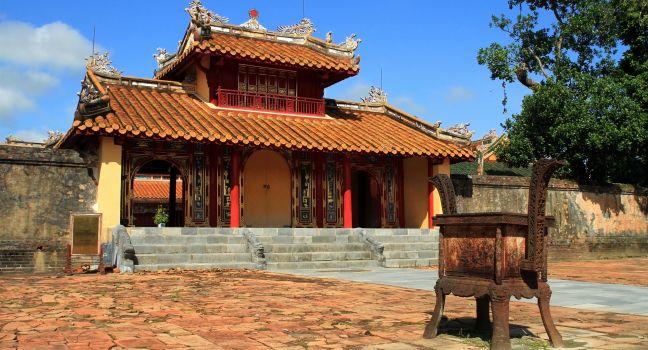
South of Hue along the Perfume River, these scattered tombs—the ego-boosting mausoleums erected by emperors in the early 1800s and early 1900s—can easily be explored in a day, although it's likely you'll experience tomb-overload by your second site—visually and historically they are a lot to absorb. The most impressive one is the Tomb of Khai Dinh due to its ornate architecture reflecting Buddhist imagery. Between 1920 and 1931, the tomb was built with money from a 30% land tax increase forced on the people of central Vietnam. To construct the final mosaics surrounding the tomb, fine china and ceramics were broken into pieces. Take note of the dragon eyes made from Champagne bottles, and the flower petals made from ceramic spoons. The most respected emperor was Thieu Tri, remembered for his compassion for the people, evidenced by his unadorned 1848 tomb. If you plan to see the Tomb of Tu Duc, Thieu Tri's son, allow plenty of time to explore the grounds, which once housed 50 buildings in a sprawling lakefront compound. The Tomb of Gia Long is 20 km (12½ miles) outside the city, which means you're likely to have the place entirely to yourself.

Hue, Vietnam
Sight Details
From 50,000d per tomb; discounted packages are available for multiple tomb touring at Citadel or Tomb ticket offices

Something incorrect in this review?

Bach Ma National Park

With its temperate climate, rich biodiversity, and exquisite views, Bach Ma National Park is a must-see for wildlife lovers and those who want a break from Vietnam's heat. In 1932, the French built a hill station around the summit of Bach Ma with 139 villas, a post office, and a market, all 1,450 meters (4,757 feet) above sea level. Today it's the ultimate getaway for trekking in the jungle, swimming in pristine streams, showering under the 300-meter-high Do Quyen Waterfall, and admiring stunning sunsets or sunrises from Hai Vong Dai on Bach Ma's summit. The ultimate experience at Bach Ma is a private tour with Mr. Cam, the king of birds, who can call and talk to more than 100 types of birds.

Loc Tri Commune, Phu Loc District, Phu Loc, Vietnam
Sight Details
65,000d

Something incorrect in this review?

Cot Co (Citadel Flag Tower)

This 170-foot structure, Vietnam's tallest flagpole, is one of the symbols of Hue. It was originally built in 1807 and served as the Imperial Palace's central observation post. Like much of Hue, it has a history of being destroyed. The Flag Tower was toppled during a typhoon in 1904 and rebuilt, then destroyed again in 1947, and rebuilt anew in 1948. When the North Vietnamese occupied the city during the Tet Offensive of 1968, the National Liberation Front flag flew from the Flag Tower. Visit the first tier of the flag tower for a great view of the main gate, Ngo Mon, in the North as well as Phu Van Lau (the Imperial Announcement Pavilion), the Perfume River, and Mount Ngu Binh in the South. The higher tiers are not open to the public.

In front of 23 Thang 8 St., Hue, Vietnam
Sight Details
Free

Something incorrect in this review?

Forbidden Purple City

Built at the beginning of the 19th century, the Forbidden Purple City, inside the Imperial City, was almost entirely destroyed during the Vietnam War; now it's slowly being restored to its former glory. The preserved open corridors, which were used to connect the main palaces in the Forbidden Purple City together, are ornately adorned with lavish red and gold paint. Paintings and photographs about Nguyen Dynasty and old Hue are also exhibited in these open corridors. In its glory days the Forbidden Purple City housed members of the Imperial family and the concubines and eunuchs who served them. Anyone else who entered was executed. After the 1968 Tet Offensive, only the Royal Theater on the right-hand side and the intimate and restored Royal Library remained intact.

At the end of the Forbidden Purple City stands the magnificent Kien Trung Palace. Surprisingly, this East-meets-West building is a remake and has been open to visitors of the Imperial City since February 2024 after five years of reconstruction. The opulent palace was built in 1921-1923 and was where the last king of Vietnam, Bao Dai, lived with his wife and children until 1945.

Hue, Vietnam
Sight Details
200,000d admission to Imperial City includes Forbidden Purple City

Something incorrect in this review?

Hue Museum of Royal Antiquities

The reason to visit this museum is to see the beautiful wooden structure that houses the antiques, rather than the displays themselves. Built in 1845, the grand panel house is an architectural wonder, with walls inscribed with Emperor Thieu Tri's poetry and ceilings festooned with beautiful carvings. Inside there are miscellaneous royal knickknacks, such as wooden incense boxes, many inlaid with mother-of-pearl, plus statues, old weapons, and jewelry. Unfortunately, the whole experience is let down by lackluster guides and limited information available.

3 Le Truc, Thuan Thanh Ward, Hue, Vietnam
Sight Details
50,000d

Something incorrect in this review?

Huong River Antique Pottery Museum

More than 3,000 artifacts of pottery recovered from the rivers in Hue are exhibited in this private museum. Its mammoth collection has been collected by Dr. Thai Kim Lan and her late brother since the early 1980s. Some of the earthenware items date back thousands of years. The museum, located in a verdant garden by the Perfume River, is a part of the Thai family’s property, which includes traditional panel houses used as the family’s ancestral temple and Dr. Lan’s residence. It’s a special experience to meet this knowledgeable owner and indulge in her beautiful stories about pottery, culture, and the lifestyle of Hue.

120 Nguyen Phuc Nguyen St., Hue, Vietnam
Sight Details
120,000d
Closed between 11:30 am and 1:30 pm for lunch

Something incorrect in this review?

Huyen Khong Son Thuong

Nestled at the foot of Hon Vuon Hill, Huyen Khong Son Thuong is a monastery and the serene home of about 60 Theravada monks. Founded by Ven. Gioi Duc (Silaguna) in 1989, the monastery sits in a beautiful garden with five water lily and lotus ponds and is surrounded by pine trees. Unlike the majority of Buddhist temples in Hue in which designs are influenced by the Nguyen Dynasty’s royal style, its architecture is simpler and is decorated with calligraphy poems that are composed by the monks and written in Vietnamese rather than traditional Chinese characters. Apart from beautiful bonsai trees, hundreds of orchid plants bloom here year round. If you’d like to venture further, take a one-hour hike to the top of Hon Vuon Hill, where you'll get a stunning view of hills, lakes, the iconic Huong River, and Hue’s cityscape expanding into the horizon.

Dong Cham, Huong Ho Ward, Huong Tra Township, Hue, Vietnam
Sight Details
Free

Something incorrect in this review?

Imperial City

The Imperial City, also known as the Imperial Enclosure, was once a complex of palaces and pavilions where civil and religious ceremonies took place. Inside it was the Forbidden Purple City, where the royal family lived. Now the Imperial City has buried the few remnants of its past glory beneath the sporadic vegetation that has taken over the ruins, but restoration work is in progress and the site still conveys a sense of splendor. There are four gateways into the enclosure: the Gate of Peace (Cua Hoa Binh), the Gate of Humanity (Cua Hien Nhan), the Gate of Virtue (Cua Chuong Duc), and the South Gate (Ngo Mon). You can only get to the Imperial City after you have entered the citadel.

Hue, Vietnam
Sight Details
200,000d
Discounted tickets for multiple sites are available at ticket office

Something incorrect in this review?

Lebadang Memory Space

Established in the memory of artist Le Ba Dang, who was born in nearby province Quang Tri and became successful in Paris, Lebadang Memory Space is one of the country’s best art museums. The main building of this private contemporary space, located on 4 acres near Thien An Hill, is modeled after one of the artist's paper works. The museum showcases Le Ba Dang's varied talents, from painting to sculpture to paper-cutting and printing.

Kim Son Hamlet, Thuy Bang Commune, Hue, Vietnam
081-727–5252
Sight Details
269,000d
Closed Mon.

Something incorrect in this review?

Nine Dynastic Urns

Each of these urns within the Imperial Enclosure, weighing approximately 5,000 pounds and cast in 1835--1937, is dedicated to a ruler of the Nguyen dynasty. The central urn, the most elaborately decorated of the nine, features Emperor Gia Long, the founder of this dynasty. Nature motifs cover the urns, including the sun and moon, rivers and mountains, and one or two bullet pocks. Every urn has a name transcribed in traditional Chinese characters.

Hue, Vietnam
Sight Details
200,000d admission to Imperial City includes Nine Urns

Something incorrect in this review?

Royal Library

The Royal Library, a wooden structure east of the Forbidden Purple City, is one of the few largely intact buildings in the Imperial City. The delicately carved architecture has survived, although there are no books or other library-like objects left. 

Hue, Vietnam
Sight Details
200,000d admission to Imperial City includes Royal Library

Something incorrect in this review?

Thanh Toan Bridge

Resembling Hoi An's Japanese Bridge, this covered walkway was built in 1776 and today houses a shrine to the local Tran Thi Dao, who bequeathed her life savings for its construction. Childless, she offered her funds to the Thanh Toan Village for a new bridge to connect villagers on both sides of the canal. In 1925, Emperor Khai Dinh had an altar set up in her honor in the center of the bridge, which is still used by villagers who come to show their respect. Located 8 km (5 miles) outside Hue, this bridge is reached by way of the peaceful countryside, making it a pleasant escape from the bustling city. On the far side of the bridge is a small museum displaying villagers' used farming equipment.

If you visit independently, park your bike at the market 100 meters from the bridge.

Thuy Thanh Commune, Huong Thuy District, Hue, Vietnam
Sight Details
Free

Something incorrect in this review?

Thien Mu Pagoda

Overlooking the Perfume River, this pagoda constructed in 1601 under Lord Nguyen Hoang has impressive Buddha statues, a seven-tiered monument, a two-ton bronze bell, and a marble turtle dating back to 1715. Take note of the engraved graffiti covering the turtle's shell, most of which dates back to the 1950s, when refugees from northern Vietnam inscribed notes of their whereabouts. As Hue's oldest pagoda, this structure still functions as a monastery. Housed inside the grounds is the Austin car once used by Buddhist monk Thich Quang Duc, who lit himself on fire in protest of the persecution of Buddhists by the South Vietnamese president Ngo Dinh Diem in 1963. The best way to reach this official symbol of Hue is by boat up the Perfume River.

3½ km (2 miles) west of Phu Xuan Bridge, Hue, Vietnam
Sight Details
Free

Something incorrect in this review?

Thuan An Beach

For now, Thuan An Beach, which lies out on a peninsula 14 km (8 miles) from central Hue, has only one beach resort, leaving an unspoiled, long, sandy stretch of coconut- and casuarina-tree-lined beach all but empty. In the summer months the tranquil turquoise sea and gentle breeze make for the most idyllic break from the city, while in winter it makes for wildly romantic walks, with scatterings of family temples, fishing villages, and Vietnam's largest lagoon to explore. Amenities: food and drink. Best for: walking; swimming; sunset.

Hue, Vietnam

Something incorrect in this review?

Tinh Tam Lake

For much of the year Tinh Tam Lake is hardly worth the bother, but during the spring and summer months this little lake in the citadel comes alive with lotus flowers that cover it entirety. Do as the emperors once did and walk across one of the bridges to the island for a brief respite. The best way to see it (and find it) is by asking your driver to include it in a cyclo tour of the citadel.

Hue, Vietnam

Something incorrect in this review?

Tomb of Dong Khanh

Dong Khanh was a despised puppet emperor of the Nguyen Dynasty who died during the French rule at the age of 24. This tomb complex, originally built for his father, took over 35 years and four kings to complete. The result is a unique fusion of traditional imperial Vietnamese and colonial design.

Emperor Dong Khanh's final resting place was built near Ngung Hy Temple, an elaborate triple temple complex typical of the citadel. Look for the well-preserved lacquer art and Chinese calligraphy that adorn the walls, and the illustrations featuring the 24 filial sons and daughters taken from the Chinese story Nhi Thap Tu Hieu. The surrounding area is the colonial-style graveyard that was constructed between 1916 and 1923.

Hue, Vietnam
Sight Details
100,000d

Something incorrect in this review?

Tomb of Gia Long

When his beloved Queen Thua Thien passed away in 1814, Emperor Gia Long, the founder of Nguyen Dynasty, built a grave for her at this magnificent location surrounded by 42 hills and mountains. As a symbol of their love, he then had his grave built less than a foot away from hers. Apart from commemorating Emperor Gia Long and his first queen, this 7,100-acre compound also serves as the eternal home of his second queen, Emperor Minh Mang’s mother, plus his mother and other family members. It is a delightful surprise to run into the beautiful rice fields scattering this solemn tomb complex. A 5-km (3.1-mile) stone-paved lane snakes around the tombs, pine hills, and the Long Lake, allowing guests to have a leisurely walk or cycle in this scenic grand tomb complex. You can rent a bicycle with the price from 10,000d/hour at the ticket booth.

Huong Tho Commune, Hue, Vietnam
Sight Details
150,000d

Something incorrect in this review?

Tomb of Minh Mang

A Hue classic, the Tomb of Minh Mang, emperor from 1820 to 1841, was completed in 1843 by his successor. His tomb is one of the most palatial, with numerous pavilions and courtyards in a beautiful pine forest. The burial site is modeled after the Ming tombs in Beijing. Sculptures of royal officers, elephants, and horses line the route to the burial site. The mountainous backdrop and crumbling structure make it one of the most eerie, yet beautiful, tombs to visit.

Hue, Vietnam
Sight Details
150,000d

Something incorrect in this review?

Tu Hieu Pagoda

One of Hue's most beautiful and peaceful pagodas is accessed via a junglelike path off the road, past a half-moon-shape pool. Built in 1843, the temple houses a large Buddha and it is the root pagoda of Zen master Thich Nhat Hanh. It's a good place for quiet meditation. The monks live in simple rooms off to the side and hold services several times a day. At the far corner of the pagoda is a cemetery for the Nguyen Dynasty's eunuchs who made contribution to building and renovating the pagoda.

Hue, Vietnam
Sight Details
Free

Something incorrect in this review?