6 Best Sights in Hue, The Central Coast

Background Illustration for Sights

We've compiled the best of the best in Hue - browse our top choices for the top things to see or do during your stay.

Tomb of Khai Dinh

Fodor's Choice

An unbelievable concoction of glitzy Vietnamese and French colonial elements, the Tomb of Khai Dinh, completed in 1931, is a contender for Hue's most impressive mausoleum. Khai Dinh became emperor in 1916 at the age of 31 and died in 1925. The entrance is guarded by four rows of impressive stone royal officers, imperial soldiers, horses and elephants. A climb up a steep flights of steps, flanked by dragons, takes you to a surprisingly colorful tomb heavily decorated with tile mosaics. Scenes from the four seasons welcome you into the central compartment of the building. It's best to visit this tomb by car, since it's not directly on the river.

Climb to the top for some incredible views of the countryside and the Annamite Range.
Hue, Vietnam
Sight Details
150,000d

Something incorrect in this review?

Tomb of Tu Duc

Fodor's Choice

The Tomb of Tu Duc, one of Hue's most visited tombs, has its own lake and pine forest, and is easily accessed by bike. Built in 1864–67 by thousands of laborers, the tomb was once the summer palace of Tu Duc, emperor from 1848 to 1883. Despite having more than 100 wives and concubines, he had no children. Tu Duc sometimes escaped here to relax and write poetry accompanied by his wives and royal officers. Further along is Hoa Khiem Temple where Tu Duc and the Empress Le Thien Anh were worshipped. Behind is an old theater, now home to a vast wardrobe of imperial dress and some interesting props for photo opportunities. One of Tu Duc's favorite spots was the Xung Khiem Pavilion on the pond filled with lotus blossoms and koi fish. If your schedule allows, stop by the Vong Canh Hill top to enjoy the stunning view of Huong River and the mountains at sunset.

Hue, Vietnam
No phone
Sight Details
150,000d

Something incorrect in this review?

Tombs of the Emperors

Ming Mang tomb with blue sky at Hue
siripong panasonthi / Shutterstock

South of Hue along the Perfume River, these scattered tombs—the ego-boosting mausoleums erected by emperors in the early 1800s and early 1900s—can easily be explored in a day, although it's likely you'll experience tomb-overload by your second site—visually and historically they are a lot to absorb. The most impressive one is the Tomb of Khai Dinh due to its ornate architecture reflecting Buddhist imagery. Between 1920 and 1931, the tomb was built with money from a 30% land tax increase forced on the people of central Vietnam. To construct the final mosaics surrounding the tomb, fine china and ceramics were broken into pieces. Take note of the dragon eyes made from Champagne bottles, and the flower petals made from ceramic spoons. The most respected emperor was Thieu Tri, remembered for his compassion for the people, evidenced by his unadorned 1848 tomb. If you plan to see the Tomb of Tu Duc, Thieu Tri's son, allow plenty of time to explore the grounds, which once housed 50 buildings in a sprawling lakefront compound. The Tomb of Gia Long is 20 km (12½ miles) outside the city, which means you're likely to have the place entirely to yourself.

Hue, Vietnam
Sight Details
From 50,000d per tomb; discounted packages are available for multiple tomb touring at Citadel or Tomb ticket offices

Something incorrect in this review?

Recommended Fodor's Video

Tomb of Dong Khanh

Dong Khanh was a despised puppet emperor of the Nguyen Dynasty who died during the French rule at the age of 24. This tomb complex, originally built for his father, took over 35 years and four kings to complete. The result is a unique fusion of traditional imperial Vietnamese and colonial design.

Emperor Dong Khanh's final resting place was built near Ngung Hy Temple, an elaborate triple temple complex typical of the citadel. Look for the well-preserved lacquer art and Chinese calligraphy that adorn the walls, and the illustrations featuring the 24 filial sons and daughters taken from the Chinese story Nhi Thap Tu Hieu. The surrounding area is the colonial-style graveyard that was constructed between 1916 and 1923.

Hue, Vietnam
Sight Details
100,000d

Something incorrect in this review?

Tomb of Gia Long

When his beloved Queen Thua Thien passed away in 1814, Emperor Gia Long, the founder of Nguyen Dynasty, built a grave for her at this magnificent location surrounded by 42 hills and mountains. As a symbol of their love, he then had his grave built less than a foot away from hers. Apart from commemorating Emperor Gia Long and his first queen, this 7,100-acre compound also serves as the eternal home of his second queen, Emperor Minh Mang’s mother, plus his mother and other family members. It is a delightful surprise to run into the beautiful rice fields scattering this solemn tomb complex. A 5-km (3.1-mile) stone-paved lane snakes around the tombs, pine hills, and the Long Lake, allowing guests to have a leisurely walk or cycle in this scenic grand tomb complex. You can rent a bicycle with the price from 10,000d/hour at the ticket booth.

Huong Tho Commune, Hue, Vietnam
Sight Details
150,000d

Something incorrect in this review?

Tomb of Minh Mang

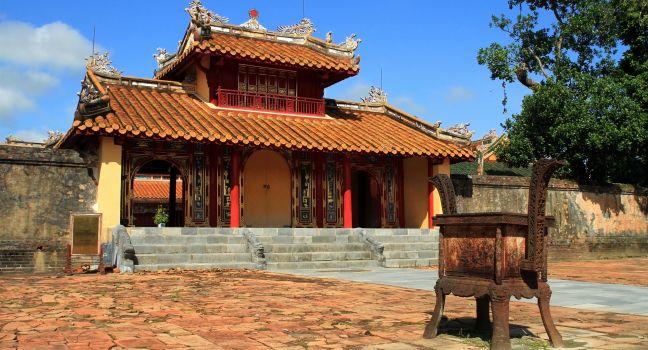
A Hue classic, the Tomb of Minh Mang, emperor from 1820 to 1841, was completed in 1843 by his successor. His tomb is one of the most palatial, with numerous pavilions and courtyards in a beautiful pine forest. The burial site is modeled after the Ming tombs in Beijing. Sculptures of royal officers, elephants, and horses line the route to the burial site. The mountainous backdrop and crumbling structure make it one of the most eerie, yet beautiful, tombs to visit.

Hue, Vietnam
Sight Details
150,000d

Something incorrect in this review?