133 Best Sights in Hong Kong, China

Background Illustration for Sights

We've compiled the best of the best in Hong Kong - browse our top choices for the top things to see or do during your stay.

Hong Kong UNESCO Global Geopark

Fodor's Choice

Spanning across 150 square km of the New Territories, the Geopark consists of two geological regions: the Sai Kung Volcanic Rock Region and the Northeast New Territories Sedimentary Rock Region. The sites comprise islets, sea caves, and villages, but the star may be on the honeycomb-shape columns formed by volcanic eruptions 140 million years ago, the most dramatic of which can be witnessed on the coast of High Island. The Volcanic Discovery Centre located in downtown Sai Kung provides helpful information about the area and serves as the gateway to the Geopark. Tours by Recommended Geopark Guides (R2G)---a number of which are available through the Volcanic Discovery Centre---is the best way to experience the park.
M+

Tsim Sha Tsui Fodor's Choice

Located in the West Kowloon Cultural District, M+ is Hong Kong's first global art museum. With 17,000 square meters of exhibition space across 33 galleries, three cinema houses, a roof garden, and other state-of-the-art facilities, M+ has undoubtedly been the most highly anticipated art addition of this decade. There are four permanent collections, as well as an ongoing roster of special exhibits spanning Chinese, Asian, and international art across different media and genres. There are multiple onsite dining options, including Mosu Hong Kong, a sophisticated Korean restaurant. The M+ Shop is an excellent place to pick up an artsy souvenir.

Avenue of Stars

Tsim Sha Tsui

You have to look down to appreciate the city's walk of fame. Countless local film stars have pawed the wet concrete—you may not recognize many names unless you're a fan of Hong Kong films, but the homage shows how big the local film industry is.  Visit the avenue at 8 pm for the Symphony of Lights, a quirky show in which more than 40 skyscrapers light up on cue as a commentator introduces them in time to a musical accompaniment.

Recommended Fodor's Video

West Kowloon Promenade

Tsim Sha Tsui

This spacious promenade overlooks Victoria Harbour and offers a dazzling view of Hong Kong Island's skyline. The promenade is grass-lined—a rare sight in the city—and has ample space for walking, jogging, biking, and picnicking. Though it's a lot quieter than the Avenue of Stars and the TST East Promenade, it does get crowded on the weekends.

Chi Lin Nunnery

Fodor's Choice
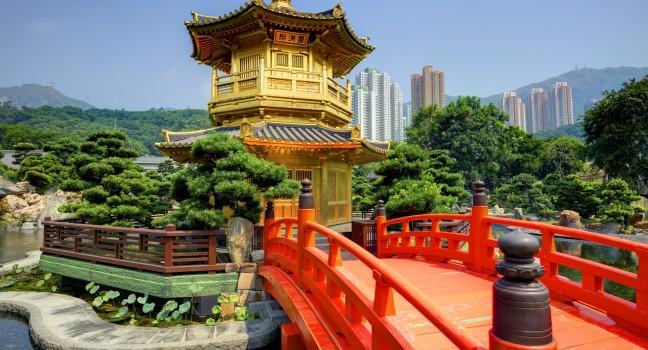
Golden Pavilion of Chi Lin Nunnery in Hong Kong, S.A.R.
SeanPavonePhoto / Shutterstock

This nunnery was founded in 1934 as a retreat for Buddhist nuns. In the 1990s, the complex was rebuilt with traditional Tang Dynasty architectural techniques involving wooden dowels and brackets, which work to hold everything together without a single nail. Most of the 15 cedar halls house altars to bodhisattvas (those who have reached enlightenment)—bronze plaques explain each one. The Main Hall is the most imposing—and inspiring—part of the monastery. Overlooking the smaller second courtyard, it honors the first Buddha, known as Sakyamuni. The soaring ceilings are held up by cedar columns that support the roof. The principles of feng shui governed all construction: buildings face south toward the sea, to bring abundance; they're backed by the mountain, a provider of strength and good energy. The temple's clean lines are a vast departure from most of Hong Kong's colorful religious buildings. If there's time, take a stroll around nearby Nan Lian Garden.

5 Chi Lin Dr., Kowloon, Hong Kong
Sight Details
Free

Something incorrect in this review?

Happy Valley Racecourse

Causeway Bay Fodor's Choice
Happy Valley night view
(c) Nohead | Dreamstime.com

The biggest attraction east of Causeway Bay for locals and visitors alike is this local legend, where millions of Hong Kong dollars make their way each year. The exhilarating blur of galloping hooves under jockeys dressed in bright silk jerseys is a must-see. The races make great Wednesday nights out on the town. Aside from the excitement of the races, there are restaurants, bars, and even a racing museum to keep you amused. The public entrance to the track is a 20-minute walk from Causeway Bay MTR Exit A (Times Square), or simply hop on the Happy Valley tram, which terminates right in front.

\n

Every Wednesday night during race season (September to mid-July), the first of about eight races kicks off at 7:15.

Sports Rd. at Wong Nai Chung Rd., Hong Kong, Hong Kong
Sight Details
HK$10

Something incorrect in this review?

Hong Kong Heritage Museum

Fodor's Choice
Models of old grocery store in Hong Kong Heritage Museum.
(c) Au_yeung225 | Dreamstime.com

This history-meets-culture museum is Hong Kong's largest, yet it still seems a well-kept secret: chances are you won't have much company throughout its 11 massive galleries. The galleries ring an inner courtyard, which are benefitted by exquisite natural light flowing into the entry hall. Although many of the galleries focus on ancient Chinese art and heritage, the museum recently energized its offerings with an exhibition that displays changing exhibits of Hong Kong's pop culture. The T.T. Tsui Gallery of Chinese Art, exquisite antique Chinese glass, ceramics, and bronzes, fill hushed second-floor rooms. In spite of the museum's imposing size, the curators have gone for quality over quantity. Look for the 3½-foot-tall terra-cotta Horse and Rider, a beautiful example of the figures enclosed in tombs in the Han Dynasty (206 BC–AD 220). The Cantonese Opera Heritage Hall is all singing and dancing, and it's utterly hands-on. The symbolic costumes, tradition-bound stories, and stylized acting of Cantonese opera can be impenetrable; fortunately, there are well-done descriptions for even the most esoteric works.

1 Man Lam Rd., New Territories, Hong Kong
2180–8188
Sight Details
Permanent exhibitions, free; special exhibitions, admission varies
Closed Tues.

Something incorrect in this review?

Hong Kong Museum of Art

Tsim Sha Tsui Fodor's Choice
Tourists visit the Museum of Art in Kowloon. Established in 1962, the art collections now are in excess of 15,800 objects. May 29, 2007 in Hong Kong, China.
claudio zaccherini / Shutterstock

An extensive collection of Chinese art is packed inside this landmark art museum, which emerged from a years-long face-lift with new exhibitions and experiences. The collections include a heady mix of Qing ceramics, ancient calligraphic scrolls, bronze, jade, lacquerware, textiles, and contemporary canvases. It's all well organized into thematic galleries. The museum sits on the Tsim Sha Tsui waterfront in Kowloon, a few minutes from the Star Ferry and Tsim Sha Tsui MTR stop.

10 Salisbury Rd., Kowloon, Hong Kong
2721–0116
Sight Details
Free (except special exhibitions)
Closed on Thurs. (except public holidays) and the first 2 days of the Lunar New Year

Something incorrect in this review?

Hong Kong Park

Central Fodor's Choice
Hong Kong Park in Hong Kong, China.
Sean Pavone / Shutterstock

One of the prettiest parks in the city proper is a sloping arrangement of rock gardens, water features, and leafy pathways. It's common to stumble on locals practicing tai chi or reading in a secluded spot. This welcome respite from the surrounding skyscrapers occupies the site of a former garrison called the Victoria Barracks, and some buildings from 1842 and 1910 are still standing.

\n

The park is home to the Flagstaff House Museum of Tea Ware. With its simple white facade, wooden monsoon shutters, and colonnaded verandas, the house is the earliest surviving example of colonial Greek revival architecture in Hong Kong. Built in 1846 as the office and residence of the Commander of the British forces, it now serves as a museum dedicated to the art of tea, exhibiting hundreds of delicate tea sets from the Tang (618–907) through the Qing (1644–1911) dynasties. Look out for the understated beauty of Yixing teapots, crafted from unadorned brownish-purple zisha clay, where perfection lies in their flawless form and the subtle, tactile texture of the clay. You will also be able to find the Edward Youde Aviary, containing hundreds of tropical birds. A raised boardwalk gets you close to the ornithological action.

\n

The Peak Tram has its lower terminus just beyond the park's northwest exit.

Sik Sik Yuen Wong Tai Sin Temple

Fodor's Choice
Sik Sik Yeun Wong Tai Sin Temple, Hong Kong.
stunnedmullet / Shutterstock

There's a practical approach to prayer at one of Hong Kong's most exuberant places of worship. Here the territory's three major religions—Taoism, Confucianism, and Buddhism—are all celebrated under the same roof. You'd think that ornamental religious buildings would look strange with highly visible vending machines and LCD displays in front of them, but Wong Tai Sin pulls it off in cacophonous style. The temple was established in the early 20th century, on a different site on Hong Kong Island, when two Taoist masters arrived from Guangzhou with the portrait of Wong Tai Sin—a famous monk who was born around AD 328—that still graces the main altar. In the '20s the shrine was moved here and expanded over the years.

\n

Start at the incense-wreathed main courtyard, where the noise of many people shaking out chim (sticks with fortunes written on them) forms a constant rhythm. After wandering the halls, take time out in the Good Wish Garden—a peaceful riot of rockery—at the back of the complex. At the base of the complex is a small arcade where soothsayers and palm readers are happy to interpret Wong Tai Sin's predictions for a small fee. At the base of the ramp to the Confucian Hall, look up behind the temple for a view of Lion Rock, a mountain in the shape of a sleeping lion.

\n

If you feel like acquiring a household altar of your own, head for Shanghai Street in Yau Ma Tei, the Kowloon district north of Tsim Sha Tsui, where religious shops abound.

Tian Tan Buddha

Fodor's Choice
Tian Tan Giant Buddha
alkkdsg / Shutterstock

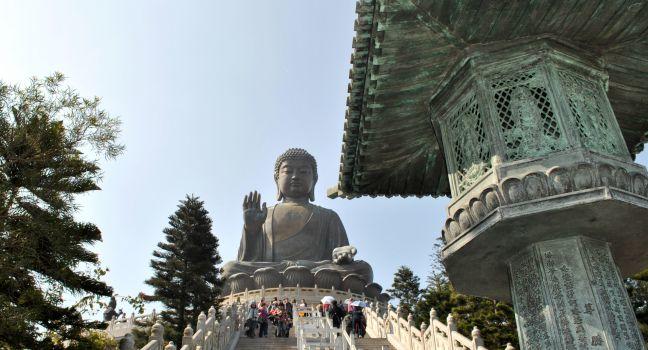
The Tian Tan Buddha, also known as the Big Buddha, is the world's largest seated, outdoors bronze Buddha. It's fair to say that the vast silhouette is impressive. Its 268 steep steps lead to the lower podium, allowing you to stare up at all 202 tons of Buddha as you ascend. At the summit, cool breezes and fantastic views over Lantau Island await. Nearby, the Wisdom Path runs beside 38 halved tree trunks arranged in a hillside infinity loop. Each trunk is carved with Chinese characters that make up the Heart Sutra, a 5th-century Buddhist prayer that expresses the doctrine of emptiness. The idea is to walk around the path—which takes five minutes—and reflect. Follow the signposted trail to the left of the Big Buddha.

Victoria Peak

Central Fodor's Choice
Tourist tram at the Peak, Hong Kong.
leungchopan / Shutterstock

Whatever the time, whatever the weather, be it your first visit or your 50th, Victoria Peak is Hong Kong's one unmissable sight. Soaring just over 1,805 feet above sea level, Hong Kong Island’s highest hill looks out over a forest of skyscrapers, the glittering harbor beyond and—on a clear day—Kowloon's eight mountains. On rainy days wisps of clouds catch on the buildings' pointy tops, and at night both sides of the harbor burst into color. The best views are to be had from Sky Terrace 428, a ticketed attraction on top of the Peak Tower (the anvil-shape building, which also serves as the upper terminus of the Peak Tram). But you get almost as good a view for free from Lion Pavilion outside, a short walk along Findlay Path.

\n

Well-signed nature walks around Victoria Peak offer wonderful respites. You'll be treated to spectacular views in all directions on the Peak Circle Walk, an easygoing 40- to 60-minute paved path that begins and ends at the Peak Tram Upper Terminus. Before buying a return ticket on the tram or on a bus, consider walking back downhill to Central, either along the tree-shared Morning Trail or via the short and steep Old Peak Road.

\n

The Peak Tram, Asia’s first funicular railway, has been rumbling up the steep inclines of Victoria Peak since it opened in 1888; before that, the only way up was to walk or take a bumpy ride in a sedan chair. The Lower Terminus starts just up past St. John's Cathedral on the opposite side of Garden Road. Sit on the right hand side of the tram carriage for the best views. Several buses go direct from the Central Bus Terminal near the Star Ferry Pier to the Peak Tram Lower Terminus. Bus 15 goes all the way to the top of the Peak, and is a good option on busy weekends when wait times for the Peak Tram can be over an hour.

Dialogue in the Dark Exhibition

Mei Foo Fodor's Choice

A truly unique way to experience Hong Kong, the Dialogue in the Dark Ehibition is a simulated tour of the city from the perspective of the visually impaired. The walk covers five iconic scenes of the city, including a ride on the Star Ferry and a trip to the market. The whole tour is conducted in pitch-black darkness, allowing visitors to experience their surroundings through their other senses.

Dragon's Back

Southside Fodor's Choice

The eighth, final, and most famous stage of the 50-km (31-mile) Hong Kong Trail is known as the Dragon's Back, and is easily done as a day hike, taking around three hours to cover the 7.5-km (4.7-mile) route, which climbs over a mountain ridge with glorious sea views on both sides. The trail starts at the Tei Wan bus stop on SheK O Road (take Bus 9 from Shau Kei Wan MTR station) and finishes at Big Wave Bay, where you can grab refreshments then hire a bodyboard and hit the waves.

SheK O Rd., Hong Kong, Hong Kong
Sight Details
Free

Something incorrect in this review?

MacLehose Trail

Fodor's Choice

Named after a former Hong Kong governor, the 97-km (60-mile) MacLehose Trail is the grueling course for the annual MacLehose Trailwalker charity event. Top teams finish the hike in an astonishing 15 hours. Mere mortals should allow three to four days or simply tackle one section on a day hike.

\n

This isolated trail starts at Tsak Yue Wu, beyond Sai Kung, and circles High Island Reservoir before breaking north. A portion takes you through the Sai Kung Country Park and up a mountain called Ma On Shan. Turn south for a high-ridge view, then walk through Ma On Shan Country Park. From here, walk west along the ridges of the mountains known as the Eight Dragons, which gave Kowloon its name.

\n

After crossing Tai Po Road, the path follows a ridge to the summit of Tai Mo Shan (Big Hat Mountain), which, at 3,140 feet, is Hong Kong's tallest mountain. Continuing west, the trail drops to Tai Lam Reservoir and Tuen Mun, where you can catch public transport back to the city. To reach Tsak Yue Wu, take the MTR to Diamond Hill, then Bus 92 to Sai Kung Town. From Sai Kung Town, take Bus 94 to the country park.

\n

An easier way to access Tai Mo Shan is via an old military road. En route you'll see the old British barracks, now occupied by the People's Liberation Army. Take the MTR to Tsuen Wan and exit the station at Shiu Wo Street, then catch Minibus 82.

Hong Kong

Something incorrect in this review?

Man Mo Temple

Western Fodor's Choice

No one knows exactly when Hong Kong Island's most atmospheric Taoist temple was built, but the consensus is sometime between 1847 and 1862. The temple is dedicated to the gods of literature and war: Man, who wears green robes and carries a writing brush, and Mo, dressed in red with a sword. The temple bell, cast in Canton in 1847, and the drum next to it are sounded to attract the gods' attention when a prayer is being offered.

Ocean Park

Southside Fodor's Choice

Built on 170 hilly acres overlooking the sea just east of Aberdeen, this theme park, water park, zoo, and aquarium complex has something for all ages. Older thrill-seekers can take on the gravity-defying Hair Raiser coaster, while younger kids are catered for with slower rides and a huge adventure playground. Pandas are the highlight of the zoo area, and the Grand Aquarium is home to over 5,000 marine animals.  Be aware that the Ocean Theatre has performing dolphins and seals. Water World (open seasonally; check website for exact dates) comes with slides and an all-weather indoor wave pool, and requires a separate ticket. Ocean Park has its own dedicated MTR stop, taking around 10 minutes to reach from Admiralty station.

Sai Kung Country Park

Fodor's Choice

To the east of Sha Tin, the Sai Kung Peninsula is home to one of Hong Kong's most beloved nature preserves, Sai Kung Country Park. It has several hiking trails that wind through majestic hills overlooking the water. The hikes through the hills surrounding High Island Reservoir are also spectacular. Seafood restaurants dot the waterfront in Sai Kung Town as well as the tiny fishing village of Po Toi O in Clear Water Bay. At Sai Kung Town you can rent a sampan that will take you to one of the many islands in the area for a day at the beach. 

Sam Tung Uk Museum

Fodor's Choice

A walled Hakka village dating from 1786 was saved from demolition to create this museum. It's just east of Tsuen Wan MTR, adjoining giant apartment complexes and a small park. Indeed, the quiet courtyards and small interlocking chambers contrast with the nearby residential towers. The structure looks more like a large home than a village—not surprisingly, the name translates as \"Three Beam House.\" Rigid symmetry dictated the construction: the ancestral hall and two common chambers form a central axis flanked by private areas. Traditional furniture and farm tools are on display, as well as temporary exhibits.

Tai Kwun

Central Fodor's Choice

Hong Kong's colonial-era police HQ has been reborn as a stylish cultural complex, where you can browse law-and-order museum exhibits and contemporary art exhibitions, as well as drink and dine at glam restaurants and cocktail bars. Tai Kwun, meaning \"big station\" in Cantonese, is a sprawling complex and one of Central’s top sights. The best place to start is the Barracks Block, the handsome colonial building on the south side of the central parade ground. Here you’ll find the visitor centre and an exhibition on Tai Kwun’s history. Then explore the Central Magistracy with its restored courtrooms, before heading to the claustrophobic concrete cells of Victoria Prison. Art fans should make a beeline for JC Contemporary at the rear of the complex, a three-story art gallery by architects Herzog de Meuron. Among the many places to eat and drink are the upscale Magistracy Dining Room, housed in a beautifully restored courtroom, and stylish speakeasy 001. Free English-language guided tours of Tai Kwun can be reserved online via the website.

Temple Street Night Market

Yau Ma Tei Fodor's Choice

Each evening, as darkness falls, the lamps strung between the stalls of this Yau Ma Tei street market slowly light up, and the air fills with aromas wafting from myriad food carts. Hawkers try to catch your eye by flinging up clothes; Cantonese opera competes with swelling pop music and the sounds of spirited haggling; fortune-tellers and street performers add another element to the sensory overload. Granted, neither the garments nor the cheap gadgets sold here are much to get excited about, but it's the atmosphere people come for—any purchases are a bonus. The market stretches for almost a mile and is one of Hong Kong's liveliest nighttime shopping experiences. Fortune-tellers, open-air cafés, and street doctors also offer their services here.

Nathan Road

Tsim Sha Tsui
HONG KONG - AUGUST 01: signs, people and bus at night on Nathan Road in Kowloon, Hong Kong on August 02, 2012. Nathan Road is the main street in Kowloon and is lined with shops and restaurants; Shutterstock ID 114047152; Project/Title: Hong Kong city app;
Eddy Galeotti / Shutterstock

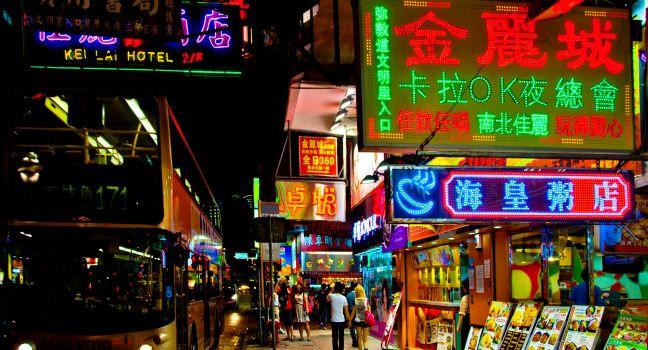
Running for several miles, this street is filled with hotels, restaurants, malls, and boutiques—retail space is so costly that the southern end is dubbed the Golden Mile. The mile's most famous tower block is ramshackle Chungking Mansions, packed with cheap hotels and Indian restaurants. The building was a setting for local director Wong Kar-Wai's film Chungking Express. To the left and right are mazes of narrow streets with even more shops selling jewelry, electronics, clothes, souvenirs, and cosmetics.

Nathan Rd., Kowloon, Hong Kong

Something incorrect in this review?

University Museum and Art Gallery

Western
Annie Wong Gallery in the Fung Ping Shan Building (Bronx Room)
By University Museum and Art Gallery (The University of Hong Kong) [CC-BY-SA-3.0], via Wikimedia Commons

Set inside a heritage building, this museum and gallery is filled with a small but excellent collection of Chinese antiquities. On view are ceramics and bronzes, some dating from 3,000 BC, as well as paintings, lacquerware, and carvings in jade, stone, and wood. The museum also has the world's largest collection of Nestorian crosses, dating from the Mongol Period (1280–1368). There are usually two or three well-curated temporary exhibitions on view; contemporary artists who work in traditional media are often featured. The museum is a seven-minute walk from Sai Ying Pun MTR station.

90 Bonham Rd., Hong Kong, Hong Kong
2241–5500
Sight Details
Free
Closed Mon.

Something incorrect in this review?

Aberdeen Harbour

Southside

Until the 1970s, Aberdeen's harbor was home to a flotilla of junks, sampans, and houseboats sheltering a community of thousands of water-dwelling fisherfolk. You'll still see a handful of houseboats moored along Aberdeen Promenade, some selling locally caught fish. Head to Pier 6 on the promenade to visit a houseboat turned harbor history museum and gift shop. Sign up for a sampan tour of the harbor inside the museum, or eat a tasty bowl of \"sampan noodles\" served by a roving kitchen boat. You can also take a ferry from Aberdeen Harbour to Lamma and Cheung Chau islands.

Hong Kong, Hong Kong

Something incorrect in this review?

Ap Lei Chau Island

Southside

A road bridge connects Aberdeen with Ap Lei Chau (Duck's Tongue Island), a residential area where many of the former boat-dwellers have been rehoused. You can also cross by sampan from Aberdeen Promenade. A small Tin Hau temple and the Ap Lei Chau Cooked Food Market, known for its seafood feasts, are the main reasons to visit. On the south side of the island, Horizon Plaza is an outlet mall selling cut-price designer homewares and fashion.

Hong Kong, Hong Kong

Something incorrect in this review?

Asia Society Hong Kong Center

Central

Nestled in a pocket of lush hillside, this heritage site was once a store for British Army explosives, and now hosts exhibitions, film screenings, and lectures pertaining to Asian countries and cultures. The complex, designed by acclaimed NYC architects Tod Williams and Billie Tsien, adds contemporary design to the 19th-century compound, incorporating sleek glass-and-metal structures with green terraces. Views from the lush roof garden are spectacular; a walk on the grounds is a must. The Center's AMMO (Asia, Modern, Museum, Original) restaurant and bar is a lovely spot for lunch or a drink. Check the website for heritage tours in English.

Bank of China Building

Central

The Art Deco building at the southern end of Statue Square (beside the HSBC Building) is the former headquarters of the Bank of China built in the 1950s. The building now houses offices, as well as the members-only, colonial-chic China Club restaurant. Don't confuse it with the newer Bank of China Tower, one of the most iconic skyscrapers in the city, just down the street on Garden Road. Completed in 1990 and designed by I.M. Pei, this imposing structure is said to resemble bamboo—a symbol of the city's strength, growth, and enterprising nature.

2A Des Voeux Rd. Central, Hong Kong, Hong Kong

Something incorrect in this review?

Béthanie

Southside

One of Hong Kong's few examples of French colonial architecture, Béthanie was built in 1875 by the French Mission as a sanatorium for priests and missionaries recovering from tropical diseases. The Hong Kong Government took over the building in the 1970s and leased it to the University of Hong Kong; and at the turn of the 21st century, the property was extensively restored and was subsequently declared a historic monument. Béthanie houses a photogenic neo-Gothic chapel—a popular wedding venue—a theater, a small basement museum, an exhibition hall, and facilities for the School of Film and Television. Guided tours are available for booking via Cityline ( www.cityline.com) and last about 30 minutes.

139 Pok Fu Lam Rd., Hong Kong, Hong Kong
2584--8633
Sight Details
Tour HK$37

Something incorrect in this review?

Big Bus Tour

These double-decker tourist buses cover three routes—Hong Kong Island, Kowloon, and Stanley—with recorded commentary in ten languages. Tourists can hop on or off at any stop along the way to take in the neighborhood sights. There's also a night-time bus tour that takes visitors through the neon-lit streets of Tsim Sha Tsui, Mong Kok, and Yau Ma Tei.

Hong Kong, Hong Kong
2723–2108

Something incorrect in this review?

Bishop's House

Central

Formerly the campus of St. Paul's College, Bishop's House dates back to 1843. This historic Victorian building, which is a pale shade of yellow, served as the official residence of the Anglican bishop.

1 Lower Albert Rd., Hong Kong, Hong Kong

Something incorrect in this review?