9 Best Sights in Hong Kong, China

Background Illustration for Sights

We've compiled the best of the best in Hong Kong - browse our top choices for the top things to see or do during your stay.

Sik Sik Yuen Wong Tai Sin Temple
Fodor's Choice
Sik Sik Yeun Wong Tai Sin Temple, Hong Kong.
stunnedmullet / Shutterstock

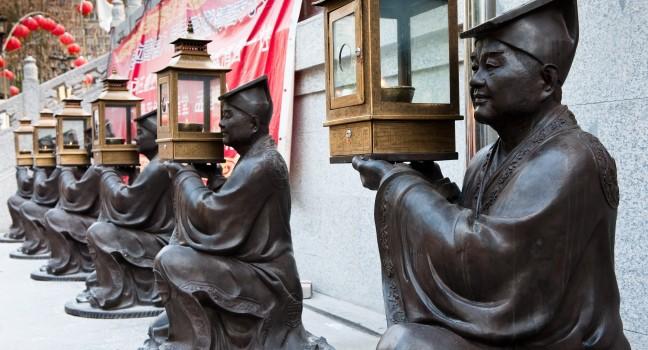
There's a practical approach to prayer at one of Hong Kong's most exuberant places of worship. Here the territory's three major religions—Taoism, Confucianism, and Buddhism—are all celebrated under the same roof. You'd think that ornamental religious buildings would look strange with highly visible vending machines and LCD displays in front of them, but Wong Tai Sin pulls it off in cacophonous style. The temple was established in the early 20th century, on a different site on Hong Kong Island, when two Taoist masters arrived from Guangzhou with the portrait of Wong Tai Sin—a famous monk who was born around AD 328—that still graces the main altar. In the '20s the shrine was moved here and expanded over the years.

\n

Start at the incense-wreathed main courtyard, where the noise of many people shaking out chim (sticks with fortunes written on them) forms a constant rhythm. After wandering the halls, take time out in the Good Wish Garden—a peaceful riot of rockery—at the back of the complex. At the base of the complex is a small arcade where soothsayers and palm readers are happy to interpret Wong Tai Sin's predictions for a small fee. At the base of the ramp to the Confucian Hall, look up behind the temple for a view of Lion Rock, a mountain in the shape of a sleeping lion.

\n

If you feel like acquiring a household altar of your own, head for Shanghai Street in Yau Ma Tei, the Kowloon district north of Tsim Sha Tsui, where religious shops abound.

Man Mo Temple

Western Fodor's Choice

No one knows exactly when Hong Kong Island's most atmospheric Taoist temple was built, but the consensus is sometime between 1847 and 1862. The temple is dedicated to the gods of literature and war: Man, who wears green robes and carries a writing brush, and Mo, dressed in red with a sword. The temple bell, cast in Canton in 1847, and the drum next to it are sounded to attract the gods' attention when a prayer is being offered.

Ching Chung Koon Taoist Temple

This temple has room after room of altars filled with the heady scent of incense. On one side of the main entrance is a cast-iron bell with a circumference of about 5 feet—all large monasteries in ancient China rang such bells at daybreak to wake the monks and nuns for a day of work in the rice fields. On the other side of the entrance is a huge drum that was used to call the workers back in the evening. Inside, some rooms are papered with small pictures; the faithful pay to have these photos displayed so they can see their dearly departed while praying. Dwarf shrubs, ornamental fishponds, and pagodas bedeck the grounds. The temple sits adjacent to the Ching Chung MTR Light Rail station near the town of Tuen Mun. The entrance isn't obvious, but it's located on Tsing Lun Rd.

Tsing Chung Koon Rd., New Territories, Hong Kong
2462–1507

Something incorrect in this review?

Recommended Fodor's Video

Man Mo Temple

Close to Tai Po Market, this temple was built in 1892 to commemorate the establishment of the town of Tai Po. As you draw near, you'll feel the incense offered by worshipers. The name comes from the Cantonese words for the Taoist gods of literature, Man Cheong, and martial arts, Mo Tai.

Fu Shin St., New Territories, Hong Kong
Sight Details
Free

Something incorrect in this review?

Pak Tai Temple

This temple (also known as Yuk Hui Temple) on Cheung Chau is dedicated to Pak Tai, the god of the sea, who is supposed to have rid the island of pirates. The renovated temple originally dates to 1783, when an image of Pak Tai was brought to appease the spirits of people killed by pirates, thought to be the source of bubonic plague outbreaks. According to legend, he did the trick: he remains the island's favorite deity. Beside the main altar are four whale bones salvaged from nearby.

End of Pak She St., New Territories, Hong Kong
2981–0663
Sight Details
Free

Something incorrect in this review?

Po Lin Monastery

Built in 1906, this peaceful Buddhist monastery is located adjacent to the Tian Tan Buddha. The grounds feature stately halls with many intricate statues, carvings, and paintings, as well as landscaped gardens with koi fish ponds. The Grand Hall of Ten Thousand Buddhas houses, like its name, 10,000 golden buddha statues and is a sight to behold. There is a popular vegetarian restaurant on-site.

Ngong Ping, Lantau Island, Hong Kong
2985--5248
Sight Details
Free

Something incorrect in this review?

Ten Thousand Buddhas Monastery

You climb some 400 steps to reach this temple, but look on the bright side: for each step you get about 32 Buddhas. The uphill path through dense vegetation is lined with 500 life-size golden Buddhas in all kinds of positions. Be sure to bring along water and insect repellent. And once you get to the top, prepare to be dazzled: the walls of the main temple are stacked with gilded ceramic statuettes. There are nearly 13,000 here, made by Shanghai artisans and donated by worshippers over the decades. Kwun Yam, goddess of mercy, is one of several deities honored in the crimson-walled courtyard.

\n

Look southwest on a clear day and you can see nearby Amah Rock, which resembles a woman with a child on her back. Legend has it that this formation was once a faithful fisherman's wife who climbed the mountain every day to wait for her husband's return, not knowing he'd drowned. Tin Hau, goddess of the sea, took pity on her and turned her to stone.

\n

The temple is in the foothills of Sha Tin, in the central New Territories. Take Exit B out of Sha Tin station, walk down the pedestrian ramp, and take the first left onto Pai Tau Street. Keep to the right-hand side of the road and follow it around to the gate where the signposted path starts.

\n

Don't be confused by the big white buildings on the left of Pai Tau Road. They are ancestral halls, not the temple.

221 Pai Tau Village, New Territories, Hong Kong
2691–1067
Sight Details
Free

Something incorrect in this review?

Tin Hau Temple

Yau Ma Tei

This incense-filled site is dedicated to Taoist sea goddess Tin Hau, queen of heaven and protector of seafarers. The crowds here testify to her being one of Hong Kong's favorite deities—indeed, this is one of over 100 temples dedicated to her. Like all Tin Hau temples, this one once stood on the shore. Kowloon reclamation started in the late 19th century, and now the site is more than 3 km (2 miles) from the harbor. The main altar is hung with gold-embroidered cloth and usually piled high with offerings. There are also two smaller shrines inside the temple honoring earth god Tou Tei and city god Shing Wong. Surrounding Temple Street night market is a fortune-telling hot spot: you may well be encouraged to have a try with the chim. Each stick is numbered, and you shake them in a cardboard tube until one falls out. A fortune-teller asks you your date of birth and makes predictions from the stick based on numerology. Alternatively, you could have a mystically minded bird pick out some fortune cards for you.

Agree on a price before your fortune, as bargaining with fortune-tellers is common.

56--58 Temple St., Kowloon, Hong Kong
2385–0759

Something incorrect in this review?

Wan Chai Pak Tai Temple

Wan Chai

Pak Tai Temple in Wan Chai (not to be confused with Pak Tai Temple in Cheung Chau) is the largest temple on Hong Kong Island and a reminder of Wan Chai's early development. Built in 1863 by the local community, the Taoist shrine honors Pak Tai, the Supreme Emperor of the Dark Heaven. Its colorful, intricate carvings, imposing statues of deities, and handcrafted ceramics roof make it well worth a visit. Conveniently, the temple is located close to other attractions like Blue House and Wan Chai Market. 

2 Lung On St., Hong Kong, Hong Kong

Something incorrect in this review?