


30 Best Sights in Hong Kong, China

We've compiled the best of the best in Hong Kong - browse our top choices for the top things to see or do during your stay.
West Kowloon Promenade
This spacious promenade overlooks Victoria Harbour and offers a dazzling view of Hong Kong Island's skyline. The promenade is grass-lined—a rare sight in the city—and has ample space for walking, jogging, biking, and picnicking. Though it's a lot quieter than the Avenue of Stars and the TST East Promenade, it does get crowded on the weekends.
Hong Kong Park
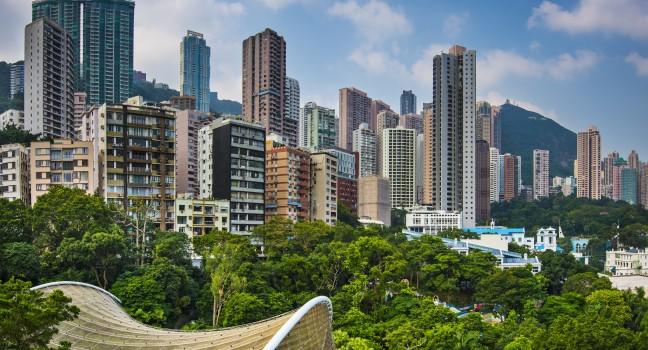
The park is home to the Flagstaff House Museum of Tea Ware. With its simple white facade, wooden monsoon shutters, and colonnaded verandas, the house is the earliest surviving example of colonial Greek revival architecture in Hong Kong. Built in 1846 as the office and residence of the Commander of the British forces, it now serves as a museum dedicated to the art of tea, exhibiting hundreds of delicate tea sets from the Tang (618–907) through the Qing (1644–1911) dynasties. Look out for the understated beauty of Yixing teapots, crafted from unadorned brownish-purple zisha clay, where perfection lies in their flawless form and the subtle, tactile texture of the clay. You will also be able to find the Edward Youde Aviary, containing hundreds of tropical birds. A raised boardwalk gets you close to the ornithological action.
\nThe Peak Tram has its lower terminus just beyond the park's northwest exit.
Recommended Fodor's Video
Tian Tan Buddha
Dragon's Back
Man Mo Temple
Sai Kung Country Park
To the east of Sha Tin, the Sai Kung Peninsula is home to one of Hong Kong's most beloved nature preserves, Sai Kung Country Park. It has several hiking trails that wind through majestic hills overlooking the water. The hikes through the hills surrounding High Island Reservoir are also spectacular. Seafood restaurants dot the waterfront in Sai Kung Town as well as the tiny fishing village of Po Toi O in Clear Water Bay. At Sai Kung Town you can rent a sampan that will take you to one of the many islands in the area for a day at the beach.
Sam Tung Uk Museum
A walled Hakka village dating from 1786 was saved from demolition to create this museum. It's just east of Tsuen Wan MTR, adjoining giant apartment complexes and a small park. Indeed, the quiet courtyards and small interlocking chambers contrast with the nearby residential towers. The structure looks more like a large home than a village—not surprisingly, the name translates as \"Three Beam House.\" Rigid symmetry dictated the construction: the ancestral hall and two common chambers form a central axis flanked by private areas. Traditional furniture and farm tools are on display, as well as temporary exhibits.
University Museum and Art Gallery
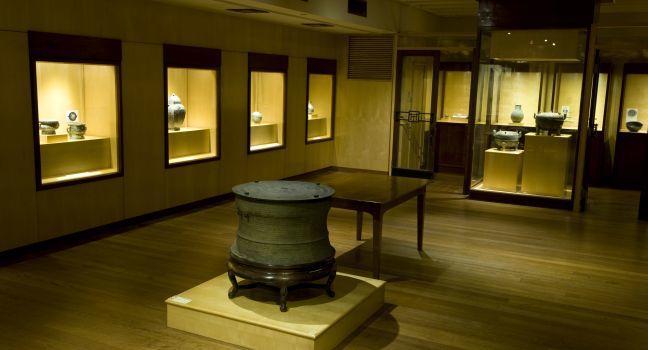
Set inside a heritage building, this museum and gallery is filled with a small but excellent collection of Chinese antiquities. On view are ceramics and bronzes, some dating from 3,000 BC, as well as paintings, lacquerware, and carvings in jade, stone, and wood. The museum also has the world's largest collection of Nestorian crosses, dating from the Mongol Period (1280–1368). There are usually two or three well-curated temporary exhibitions on view; contemporary artists who work in traditional media are often featured. The museum is a seven-minute walk from Sai Ying Pun MTR station.
Central Market
Once a bustling commercial market selling meat and produce, Central Market is today one of Hong Kong’s rare heritage success stories. Rather than tearing down the 1939 building---one of the city’s few surviving structures designed in the art deco--adjacent Streamline Moderne style---it has been redeveloped into a tourist-focused hub of market-style shops selling old-timey souvenirs, a food court, and areas for art exhibitions. The architecture is certainly worth admiring, and a small museum exhibit downstairs tells the story of the market of yesteryear.
Central--Mid-Levels Escalator
Cheung Chau
Located just off the southern coast of Lantau Island, the 2½-km-long (1½-mile-long) Cheung Chau Island was once a haven for pirates like the notorious Cheung Po Tsai, whose treasure cave is reportedly on the island's southwest tip. These days, it is most famous for the centuries-old tradition called the Bun Festival, which celebrates Buddha's purported birthday in April/May. Residents live mostly on the sandbar connecting the two hilly tips of this dumbbell-shape island. The town harbor is lined with seafood restaurants and shops. A 35-minute fast ferry departs from Central's Pier 5 outside Two IFC shopping plaza.
\nOn sunny weekends, Cheung Chau's Tung Wan beach is so crowded that its sweep of golden sand is barely visible. At one end of the beach is the Warwick Hotel, and plenty of nearby restaurants offer food, refreshments, and shade. Apart from emergency vehicles, no private cars are allowed on this island. Among the tourist attractions, find the striking Pak Tai Temple, one of the oldest in Hong Kong, as well as a cave that allegedly housed the hidden treasures of pirate Cheung Po Tsai.
Cheung Sha Beach
Three kilometers (2 miles) of golden sand make Cheung Sha Beach one of Hong Kong's longest stretches of sand. It gets breezy at this spot 8 km (5 miles) southwest of Mui Wo, so it's popular with windsurfers. From April through October, there are also lifeguards around, so you can swim with a bit more peace of mind. Upper Cheung Sha Beach is equipped for barbecues, and there is also a refreshment stand. Witnessing a sunset here is a swell end to a sun-drenched day.
The Chinese University of Hong Kong Art Museum
Located in the Institute of Chinese Studies building, the museum is home to more than 15,000 historical objects, including well-respected collections of bronze seals, classical paintings, calligraphy, Yixing earthenware, and Lingnan school paintings. Considering the breadth of history in the region, it is helpful to take a guided tour with a docent.
Ching Chung Koon Taoist Temple
This temple has room after room of altars filled with the heady scent of incense. On one side of the main entrance is a cast-iron bell with a circumference of about 5 feet—all large monasteries in ancient China rang such bells at daybreak to wake the monks and nuns for a day of work in the rice fields. On the other side of the entrance is a huge drum that was used to call the workers back in the evening. Inside, some rooms are papered with small pictures; the faithful pay to have these photos displayed so they can see their dearly departed while praying. Dwarf shrubs, ornamental fishponds, and pagodas bedeck the grounds. The temple sits adjacent to the Ching Chung MTR Light Rail station near the town of Tuen Mun. The entrance isn't obvious, but it's located on Tsing Lun Rd.
Dr Sun Yat-Sen Museum
The life of Sun Yat-Sen, the revolutionary who helped overthrow the Qing dynasty in 1911 and usher in China’s first Republic, is examined in detail at this museum in the Mid-Levels. The building itself is a handsome colonial-era mansion that belonged to the brother of a prominent Eurasian businessman. Dr Sun spent significant time in Hong Kong, and you can follow in his footsteps by walking the Dr Sun Yat Sen Historical Trail, a self-guided tour available for free by downloading a smartphone app called iM Guide. The walk starts at Hong Kong University in Western and finishes in Central, stopping at 16 waypoints connected to Dr Sun.
Hong Kong Zoological and Botanical Gardens
A verdant holdover from colonial times, Hong Kong's Botanical Gardens opened back in 1864, and remain a delightful showcase of subtropical Asian flora, with bamboo groves, towering banyans, and groves of colorful rhododendrons. The fauna arrived much later and is a garden highlight: Lemurs, sloths, meerkats, and all manner of acrobatic monkeys swing about in well-tended enclosures. A menagerie of colorful birdlife includes flamingos housed in an aviary. The walk from the Central MTR stop is long and uphill, so consider taking a bus or taxi. Buses 1A, 3, and 22 go there from Central Ferry Pier.
Kowloon Mosque and Islamic Centre
Hong Kong's largest Islamic worship center stands in front of Kowloon Park. Visitors can call ahead to arrange for a tour or simply drop by the building, which was designed by noted Indian architect I. M. Kadri. In addition to prayer halls, the complex includes a medical clinic and a library.
Lantau Peak
The most glorious views of Lantau—and beyond—are from atop the 3,064-foot Lantau Peak. The ascent up the mountain that locals call Fung Wong Shan requires a strenuous 7½-mile hike west from Mui Wo, or you can begin at the Po Lin Monastery—from where the voyage is still a demanding two hours. The most striking views are at sunrise, particularly between December and February, when the air is dry and the sky is clear.
Man Mo Temple
Close to Tai Po Market, this temple was built in 1892 to commemorate the establishment of the town of Tai Po. As you draw near, you'll feel the incense offered by worshipers. The name comes from the Cantonese words for the Taoist gods of literature, Man Cheong, and martial arts, Mo Tai.
Mui Wo
Mui Wo is a sleepy little town, but it has some good waterfront restaurants. Silvermine Bay Beach, a pleasant sandy stretch, is a half-mile northeast of the ferry pier. It has lifeguards every month save for December--February. A gentle uphill trail leads to the Silvermine Caves and Waterfall, the small 19th-century mine that gave the bay its English name. Given its relatively secluded location, and lower-than-expected vehicular traffic, it's a quality area to go for a bike ride.
Pak Tai Temple
This temple (also known as Yuk Hui Temple) on Cheung Chau is dedicated to Pak Tai, the god of the sea, who is supposed to have rid the island of pirates. The renovated temple originally dates to 1783, when an image of Pak Tai was brought to appease the spirits of people killed by pirates, thought to be the source of bubonic plague outbreaks. According to legend, he did the trick: he remains the island's favorite deity. Beside the main altar are four whale bones salvaged from nearby.
Po Lin Monastery
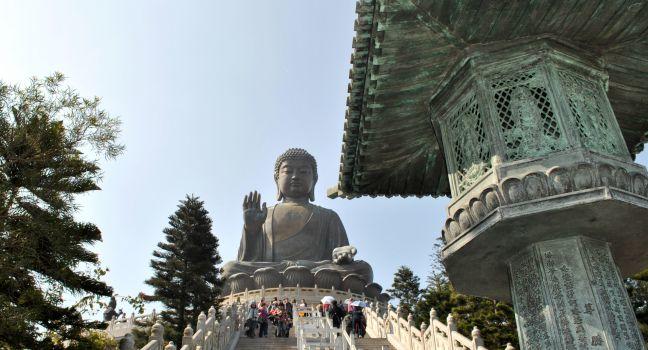
Built in 1906, this peaceful Buddhist monastery is located adjacent to the Tian Tan Buddha. The grounds feature stately halls with many intricate statues, carvings, and paintings, as well as landscaped gardens with koi fish ponds. The Grand Hall of Ten Thousand Buddhas houses, like its name, 10,000 golden buddha statues and is a sight to behold. There is a popular vegetarian restaurant on-site.
Tai Mo Shan Country Park
The name means Big Hat Mountain, and at 3,140 feet this volcanic outcropping is Hong Kong's highest point. Due to particularly mercurial weather, the peak, often called \"Foggy Mountain,\" is covered in clouds almost daily. But when the mist—and pollution—clears, the view stretches all the way to Hong Kong Island. Trails to the peak pass by caves created by Japanese soldiers during World War II and countless wild tea bushes.
Tai O
Tucked away on the western end of Lantau, this fishing village inhabited largely by the shuishangren, literally \"people on the water,\" some of whom continue to live in stilts houses. There's a temple dedicated to Kwan Tai, god of war, that was established in the 15th century. Remains of salt pans line part of the shoreline, and a glance beyond the coast sometimes rewards you with a sighting of a rare Hong Kong pink dolphin. The 1902 Tai O Police Station, on the village's southwest tip, has been restored and converted into the Tai O Heritage Hotel, a great place for tea, or a continental meal.
Tai Po Market
The name means \"big market,\" which it more than lives up to. In the heart of the region's breadbasket, this utilitarian town's main open-air market is a feast for the eyes, with baskets of lush green vegetables, freshly cut meat hanging from racks overhead, fish swimming in tanks awaiting selection, and all types of baked and steamed treats. The ground floor is a wet market, the first floor has dried goods, and the second floor is all about hawker stands.
Ten Thousand Buddhas Monastery
You climb some 400 steps to reach this temple, but look on the bright side: for each step you get about 32 Buddhas. The uphill path through dense vegetation is lined with 500 life-size golden Buddhas in all kinds of positions. Be sure to bring along water and insect repellent. And once you get to the top, prepare to be dazzled: the walls of the main temple are stacked with gilded ceramic statuettes. There are nearly 13,000 here, made by Shanghai artisans and donated by worshippers over the decades. Kwun Yam, goddess of mercy, is one of several deities honored in the crimson-walled courtyard.
\nLook southwest on a clear day and you can see nearby Amah Rock, which resembles a woman with a child on her back. Legend has it that this formation was once a faithful fisherman's wife who climbed the mountain every day to wait for her husband's return, not knowing he'd drowned. Tin Hau, goddess of the sea, took pity on her and turned her to stone.
\nThe temple is in the foothills of Sha Tin, in the central New Territories. Take Exit B out of Sha Tin station, walk down the pedestrian ramp, and take the first left onto Pai Tau Street. Keep to the right-hand side of the road and follow it around to the gate where the signposted path starts.
\nDon't be confused by the big white buildings on the left of Pai Tau Road. They are ancestral halls, not the temple.
Tung Chung Fort
All that remains of the old Tung Chung village is the hulking granite Tung Chung Fort. Considering how this neighborhood has become absolutely overcome with housing developments and shopping, that any vestige of pre-British remains makes it that much more fascinating. The first fortification on this spot was built during the Song Dynasty, some time in the late 1100s CE; the current structure dates from 1832, although it was refurbished in 1988.
Wilson Trail
The 78-km (48-mile) trail runs from Stanley Gap on the south end of Hong Kong Island, through rugged peaks that have a panoramic view of Repulse Bay and the nearby islands, and to Nam Chung in the northeastern New Territories. You have to cross the harbor by MTR at Quarry Bay to complete the entire walk. The trail is smoothed by steps paved with stone, and footbridges aid with steep sections and streams. Clearly marked with signs and information boards, this popular walk is divided into 10 sections, and you can easily take just one or two (figure on three to four hours per section); traversing the whole trail takes about 31 hours.
\nSection 1, which starts at Stanley Gap Road, is only for the very fit. Much of it requires walking up steep mountain grades. For an easier walk, try Section 7, which begins at Sing Mun Reservoir and takes you along a greenery-filled, fairly level path that winds past the eastern shore of the reservoir in the New Territories and then descends to Tai Po, where there's a sweeping view of Tolo Harbour. Other sections will take you through the monkey forest at the Kowloon Hill Fitness Trail, over mountains, and past charming villages. To reach Section 7, take the MTR to Tsuen Wan, then catch Minibus 82. Get off at the bus terminus and walk for 15 minutes toward the main eastern dam. Turn left where the dam ends and you'll find the start of the trail.
Yuen Yuen Institute
These pavilions and prayer halls, founded in 1950, bring together the three streams of Chinese thought: Buddhism (which emphasizes nirvana and physical purity), Taoism (nature and inner peace), and Confucianism (following the practical and philosophical beliefs of Confucius). The main three-tier red pagoda is a copy of the centuries-old Temple of Heaven in Beijing, and houses 60 statues representing the full cycle of the Chinese calendar—you can look for the one that corresponds to your birth year and make an incense offering. To reach the institute from Tsuen Wan MTR, head to Shiu Wo Street and take the #81 minibus.


