


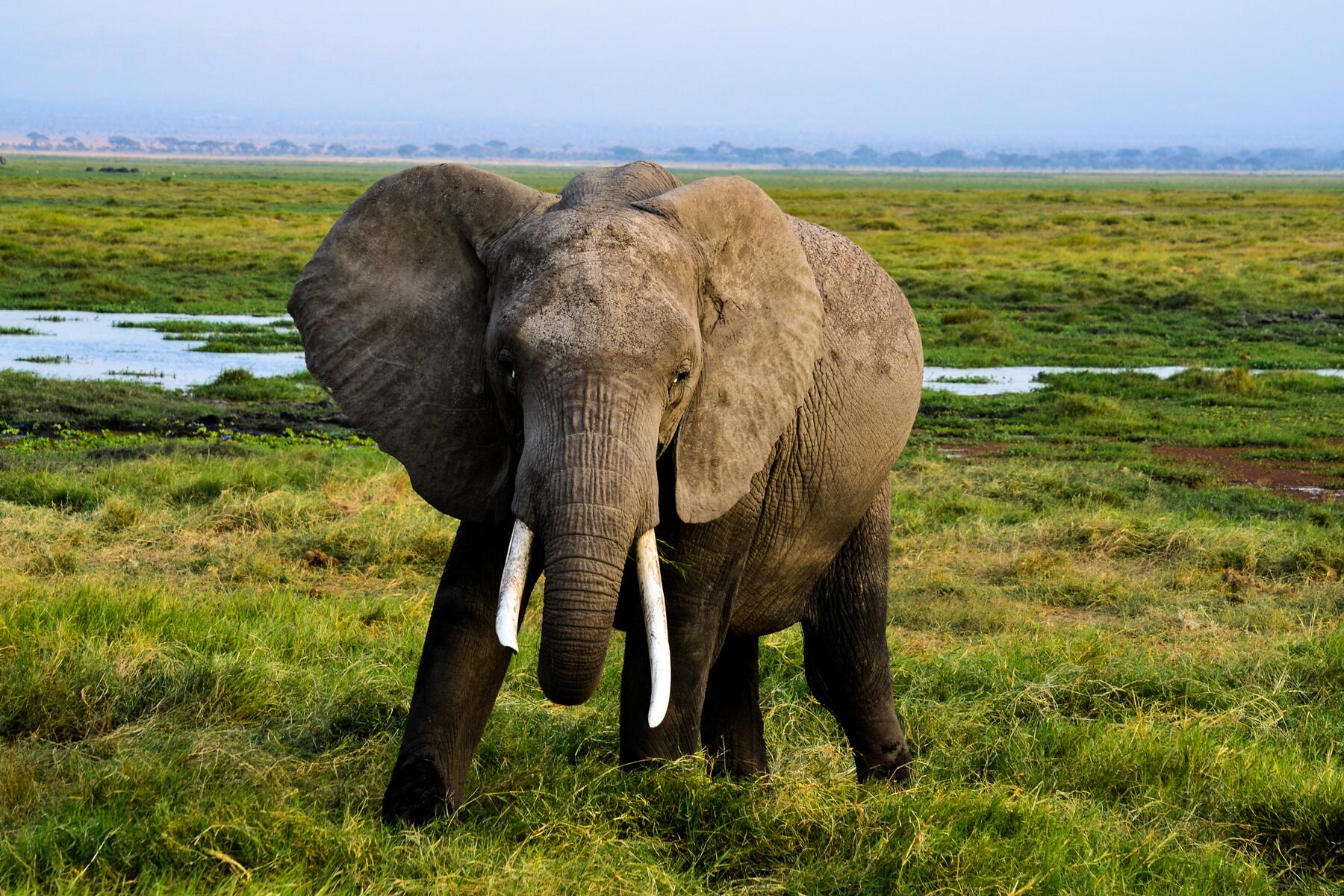

Since you can't outrun elephants, it’s important to read warning signs early.
For many people with a safari-topped bucket list, this type of trip conjures up images of fireside sundowners and pools overhanging (but safely distanced from) lion-dotted grasslands. I was somewhere in the middle when I did my first one. My mother taught English in a village near Tanzania’s Mount Kilimanjaro (and had experienced several terrifying encounters with big cats), and my sister had done some cheap-and-cheerful safaris in remote areas of Zambia. I wasn’t totally clueless about what safaris entailed and felt somewhat smug when, moments after arriving at my camp in Zimbabwe’s Mana Pools National Park, my safari guide, Honest, reeled off memorable questions from previous guests, including a lady who, during a moonlit safari, spotted a lion and expressed her shock that someone had clearly forgotten to lock this particular big cat up for the night.
We dropped off our bags and headed straight out in the Jeep, edging past a wildebeest sniffing around the dining tent as low-flying vultures strafed the sky. A few miles from the camp, Honest stopped the car and suggested we go for a stroll through the bush.
We were told to walk in a single file line with Honest at the front. Perhaps it was the jet lag, but I only realized an enormous elephant had lumbered into view when my companions started frantically attaching telephoto lenses to their camera in order to bag a shot of the creature as it paused by an acacia tree.
Top Picks for You



Recommended Fodor’s Video
Standing there, I realized I had no idea what to do if it charged. Having only just arrived at the camp and being keen to make the most of the fading light, our group hadn’t had our full safety briefing, although one thing Honest had told us was that running away was the worst thing to do if charged–the animal would see you as prey, and chase you. Perhaps I shouldn’t admit this, but this is why I’d already singled out the person I suspected would be the slowest runner. As the saying goes, “You don’t have to run faster than the bear to get away. You just have to run faster than the guy next to you.” Though, in my case, it would be an elephant.
Honest paused, turned around, and put his fingers to his lips to request total silence. We spent a few minutes watching the elephant enjoy an impromptu exfoliation, rubbing his rear against the rough bark. Tree-twerking episode over, the elephant looked our way before taking a few steps towards us. And then, without warning, he charged, powering towards us in a cloud of dust before hitting the brakes 60 feet away. What followed was a stand-off of movie-worthy proportions–I’m pretty sure some tumbleweed even rolled past. I was picturing multiple scenarios and none were ideal: the elephant snapping Honest’s rifle (carried to fire warning shots if needed) like a matchstick or Honest killing an elephant on our first day.

So when Honest turned slowly to face us, I was expecting him to announce that this wasn’t part of the plan; this elephant clearly wasn’t having a good day and we should walk slowly back to the Jeep. Or worse, run. Instead, he said with a grin, “Want to get closer?” So we crept forward, maintaining single file formation as Dumbo eyed us wearily. And then, unsurprisingly, he charged again, slashing the space between us to around 40 feet. After a short pause, he treated us to a final charge. When the elephant was 15 feet away, Honest raised his rifle and issued a short and sharp verbal rebuke which stopped him in his tracks. And then he turned tail and trundled into the bush, presumably satisfied with what I later learned was a mock charge, but which was one of the scariest experiences of my life.
Since then, I’ve learned about rangers’ ability to read animals. I’ve known guides who’ve deduced an animal’s age by sniffing its dung and who can tell from a lion’s behavior that it’s returning to feast on a previous kill. And I’ve learned about mock charges and how to tell if an elephant’s a real threat or if they’re simply providing a gentle reminder about who’s boss. I might not be able to tell a wildebeest’s age from its dung, but I’m aware of certain warning signs.
“During a mock charge, which is very common and designed to keep you at distance, an elephant will have its ears fanned, to look larger,” says Jacob Shawa, one of Zambia-based Green Safaris’ most experienced guides. “It will move from side to side while doing so-called displacement activities, such as uprooting bushes to create dust clouds.” Jacob’s advice? “Stay calm, don’t run, and show you’re not a threat by keeping your distance.” As for the real thing? “Real charges are rare,” says Jacob. “Ears will be pinned back, and the trunk curled inwards. There won’t be any displacement activities, and it may lower its head before approaching without hesitation.”
Reasons for real charges include male elephants being in musth–a period of heightened aggression caused by testosterone surges–or the recent presence of poachers, which could prompt an elephant to see humans as a threat. Female elephants will often charge to protect their calves.
Jacob admits that in the case of real charges, options are limited. “Since you can’t out-run elephants, it’s important to read warning signs early on and give plenty of space. If an elephant continues to come towards you, start shouting and try not to look scared. Try to put a large object between you and the animal. Don’t run, and avoid climbing trees unless they’re huge–elephants can destroy smaller ones.”
That night, as I relaxed outside my tent, I spotted an elephant wandering past. Unable to reach my camera in time, I pulled out my phone, held it up, and turned on its selfie mode, spending a few seconds changing the settings before snapping a photo of myself with the elephant in the distant background. Later, I noticed that in one shot, clouds of dust were mushrooming around its feet. When I’d first raised the phone, I’d snapped a few accidental shots but had been focusing on tweaking the settings rather than what was going on in the background–in this case, an elephant reminding me to keep my distance with a short, sharp mock charge, which I’d accidentally captured on camera. It was the second charging of the day.
