


All the stories we heard involved flat tires, sandstorms, or running out of gas.
“You won’t be the same person when you come back.”
This was what our driver from the Windhoek airport said when I told him that my friend Ali and I would be road-tripping around Namibia for two weeks. One could argue that you are never the same person twice, but I was skeptical of this idea of radical transformation. The only person I wanted to be in two weeks was the version of myself who had survived this road trip.
I was unfamiliar with Namibia when Ali suggested it as a destination, so I was amazed when I saw photos of the mysterious, shape-shifting dunes of Sossusvlei blazing fiery orange against a fantastic blue sky. Apart from the aesthetics, Namibia is also on point when it comes to logistics—the country is peaceful and well-developed with a stable government. The road system is rugged but comprehensive. Tourism is thriving, offering accommodations and tour options that range from basic to luxury, and English is widely spoken.
We decided to experience Namibia on a self-drive, an upmarket phrase for what is essentially a road trip. Ali and I were both nervous about navigating the roads—we would be driving on the opposite side and through a country so desolate that you could be hours from civilization in any direction. All of the stories we heard involved flat tires, sandstorms, or running out of gas. We had resolved to watch “How to change a tire” videos before we arrived, which neither of us did. When we told others of our plan, they were worried, and we wondered if we had missed something. You can’t always know if you are being adventurous or foolish; sometimes, the only real difference between the two is the outcome.
Top Picks for You


Recommended Fodor’s Video

Ten minutes after we picked up the rental, a brand-new, behemoth Toyota 4Runner, I dropped Ali off on the side of the road to locate a restaurant. When I went to find parking, I backed the car into a metal pole. After I finished raging at myself and surveying the damage (minimal but obvious), I saw that I had received a panic text from Ali; she was in the dark and afraid. We pulled ourselves together, and over dinner, we decided we both needed to calm down before hitting the road the next morning.
Sossusvlei
The Namib Desert is the oldest desert on Earth and is home to the highest dunes in the world. Leaving our hotel before dawn, we headed straight for Big Daddy, the sizable father of all dunes, towering at a height of 1,000 feet. The sky was mottled gray as we began the hike along the crest of the dune’s ridge, its fine point having been dulled by a parade of clumsy footsteps. From the view at the top, dunes carpeted the expanse of the desert, each pointy mound divided by a precise, meandering line drawn on impulse by the wind.
At the steep edge of the monstrous dune, Ali and I hesitated, intimidated by the angle of the slope. When we took off downhill, it was a strange sensation, our bare feet pedaling back and forth under the cool sand, the motion gliding us forward. Clusters of light broke through cracks in the clouds, sliding like shadows across the sand. By the time we reached Deadvlei at the bottom, the clouds had burned off, and the sun was bleaching the weathered clay pan a bright white and staining the dunes in vermilion. In Deadvlei, trees that have been dead for over 600 years remain rooted and upright in the desiccated clay, forming a sparse ghost forest of gnarled gray tree spooks, their twisted arms outstretched as though they are haunting the dunes.
The park’s loose sand roads were an opportunity for Ali and me to test out the car’s 4×4 capabilities. My fear of getting stuck merged with my desire to always go fast, and I gunned the engine as we skidded toward Sossusvlei.
Without water, the fine clay on the salt pan of Sossusvlei had contracted, fragmenting itself into a crumbly, earthen jigsaw puzzle. Around the pan, the branches of sweet thorn acacias were overloaded with fuzzy yellow blooms, and thorny white poppies had dried to a crisp, tinkling when the breeze rattled their spiky pods against one another. Small, sandy-colored birds darted in and out of their magnificent communal nest, an avian condominium built and maintained by creatures so perfectly named Sociable weavers.
At some point, the sky had turned a radiant blue, and the clouds spread out in tiny white puffs. It is easy to snap a good photo in Sossusvlei, the dunes being as photogenic as they are—the stark color contrast of the red sand against a deep blue sky, the imposing yet pleasing geometry, the precise division between dark and light. But the landscape has a dynamism that photos don’t quite capture. The progression of time is visible, nature creating and destroying at its own tempo, free from the imposition of human timelines. Animals trudging through soft, wet clay leave behind imprints that, months later, are still stamped into the ground in the absence of rain.
Walking on the dunes, my footsteps disappeared behind me, and the windblown sand filled in the depressions, eliminating all traces of where I had been only minutes prior. The rawness of the land amplifies nature’s patterns and processes, and I felt comforted to see that not every place on earth has yet come under the thumb of human design.
Swakopmund
The desert is a trippy place, and after hours of high-velocity driving and focusing my gaze on an indefinite distance, the stationary world began to wobble. The clouds expanded without changing size, and the speedometer swelled within the confines of its dial. Silvery mirages rippled and floated above the ground, severing the mountains from where they touched the earth. Things got real again along the coast from Walvis Bay to Swakopmund, and there was no disputing what lay before us. On the right side of the road was the windswept expanse of the Namib Desert, and on the left, the frigid, churning waves of the Atlantic Ocean.

These two mighty forces are engaged in a constant elemental exchange that is both a battle for dominance and doing each other a solid. The sea pushes cold, dense fog over the desert, nourishing life for plants and animals among the dunes. When the winds change course, the desert blasts sand and dust into the ocean, serving up nutrients to the smallest ocean creatures. Plopped right there in the middle of these two brutes is the peculiar but quaint oasis town of Swakopmund, where leafy palm trees and brightly painted, German-style colonial buildings line strangely desolate streets.
Our plan was to spend three days cramming in as many activities as possible, starting with the “Living Desert” tour, a guided venture into the desert where the “little five” animals are tracked and gently extracted from their sandy hideaways for up-close viewing. “Little five” is more or less a marketing term deployed to get people excited about tiny desert animals, but it wasn’t difficult to get excited about adorable translucent rainbow geckos and color-changing chameleons darting their bulbous 360-degree eyeballs in every direction.
The Catamaran Dolphin Cruise was only two minutes out of the dock when a seal jumped on board, flopping its ridiculous body across the floor of the boat. It lurched at the heels of the captain, who would occasionally fling a few fish down its throat. Ali and I had no idea that seals were part of the tour, and we were surprised when people started to pet the seal and even more surprised when the seal loved it, its energetic disposition similar to that of a dog. Sensing fish, a cartoonish and rotund Great White Pelican swooped overhead and landed on the boat. Its resting face was one of amusement and curiosity, and he waddled around as if he were the MC of the tour, wanting to know how everybody was doing and if, by chance, they had any fish.
When the captain scooted behind Ali, waving his bucket, the seal to jumped on top of her to be embraced in a full bear hug. It was wonderful to see, and I was racked with jealousy. When the seal lumbered off, I turned to Ali, desperate, my eyes wild, “I have to cuddle the seal!”
As I was plotting my next move, the seal tottered over and submitted itself into my arms, no fish anywhere in sight. Moments later, the pelican sauntered up behind me, and there I was, surrounded by the beautiful creatures who had chosen me. Our connection transcended raw fish, and I imagined that we were communicating on a vibrational level as they ushered me into my sea witch era.
The catamaran moved farther out to sea, and the dolphins made an appearance, as advertised. The seal colony was audible before it came into full view, and there were hundreds of seals romping and bobbing around on the sandbar or thrashing together in the water. The sounds were not only loud, but funny and oddly human, each seal belting out its own unrestrained series of moans and burps and grunts, as if they had just spent the past few hours skulling beers at the bar in the bowling alley.
One advantage of a volatile ocean bordering an intense desert is the ability to cuddle seals in the morning and then zoom over dunes on an ATV in the afternoon, which is exactly what Ali and I did. We chose the combination ATV and sand boarding tour, and spent an hour four-wheeling ourselves amongst the dunes with our super nice guide Kevin leading the way. When we arrived for the sandboarding, I assessed that I couldn’t participate due to an arm injury. Kevin was not having it, insisting that I ride with him on top of his back. That was how I ended up sliding a Namibian guy all the way down a sand dune.
Khowarib
There is a feeling in Namibia that is not easy to find in modern times, and that is spaciousness. There is no jostling in crowds or dodging heavy breathing. Namibia is noticeably light on humans, and it feels pretty good. Despite the low population density, there are people who have lived and thrived in these lands for thousands of years.

The Himba are a semi-nomadic tribe of cattle herders that live in and around small mud hut villages throughout the Kunene region in northwest Namibia. They continue to practice their ancestral culture but with a few modern twists, mostly related to the procurement of water, a scarce resource in this part of the country. The Himba are expert herders, raising robust and productive goats whose chocolate-brown hides gleam in spite of the dusty conditions.
In addition to their distinguishing cultural practices, the tribe is known for their manner of dress, every element of their appearance infused with practicality or cultural significance. The women wear their hair in long braids wrapped in red clay, and their bodies are decorated with ornate jewelry made from ostrich shells and copper wire. Their skin is shaded a deep reddish color from a daily application of red ochre, and their heads are crowned with elaborate, beaded leather headdresses.
Beyond the Himba settlements, only wildlife ranges through the remote, untouched wilderness of craggy mountains and vast deserts that extend all the way to the Skeleton Coast, a slick name for a rough place. The uninhabited beachfront of the Skeleton Coast is littered with atrophied hulls of wrecked ships, standing upright and abandoned, like decaying tombstones lodged into the sand.
Ali and I were the only people at our hotel, an outpost of tidy bungalows surrounded on all sides by steep, low mountains. Ours had a small deck overlooking a riverbed that was bone dry except for a small trail of water trickling over the rocks. In the late afternoon, I had laid across the wooden slats to observe a hornbill bobbing and clucking loudly in a tree when four serious-looking baboons sauntered down the riverbed, their heavy brows casting a shadow over their close-set eyes, their gait intimidating in its confidence. After the baboons, a herd of cows came trudging along, content and familiar with the journey. After they passed, I heard bellowing, and a cow that had been trailing the herd galloped by to catch up with the others, mooing wildly as it went, upset that nobody had waited for him. These creatures did not appear to detect my presence, and I felt as though I had spied on them, my covert vantage point granting me a glimpse into how they behave when they aren’t preoccupied with humans.
Etosha
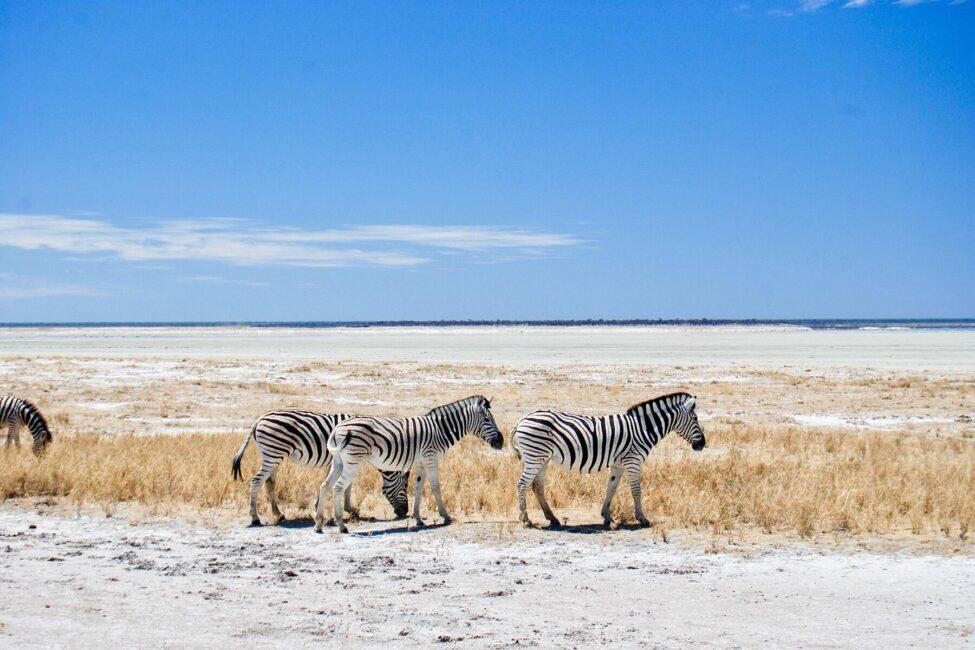
Our last stop was Etosha National Park, which is known as a prime safari destination due to its watering holes, a feature that makes it easier to find and observe wild animals who spend most of their days venturing to and from water. At the heart of this 8,500 square-mile park is the Etosha Pan, the largest salt pan in Africa, which is so large that it can be seen from space. Ali and I hopped on a safari game drive, during which we laughed at giraffes doing splits, watched a family of elephants evict the zebras from the watering hole, observed a rhino and her baby looking like dinosaurs, and admired a bushy-maned male lion in regal repose.
Windhoek
On the drive to Windhoek, Ali and I patted ourselves on the back for our performance over the past two weeks. We had monitored the tire pressure and kept the gas tank full. I was so good at driving on the other side of the road that I couldn’t remember how I drove before. In four hours, we could celebrate our enviable Namibian driving record.
About two hours into the drive, we came to a checkpoint on the highway, and the policewoman waved us to a stop. “Where are you going?” she asked. I told her Windhoek. “Can you give my friend a ride?” On the side of the road was a woman looking over at us. I didn’t know if we had a choice in this situation since she was the police, but her friend was a woman, so we said yes. She climbed into the car, thanked us, and said, “You have to be very careful in Namibia; you cannot trust anybody.”
We arrived without incident at the rental agency. There was still the matter of the dent I had made in the bumper. I was embarrassed, and I felt bad that the car was so quickly marred under my tutelage. Scratching my head in disbelief, I showed the woman the damage. I offered a vague explanation, implying that maybe another vehicle had backed into us, a preposterous suggestion in a country where, most of the time, you cannot find another human within a hundred miles. She waved it off, unconcerned. “Everything on these cars is made of plastic nowadays.”
The same fellow who had picked us up from the airport was there to drive us back to catch our flight. When we first met, he and I had a long and friendly conversation, so I greeted him warmly, but this time, he was subdued. A few minutes later, he looked at me in surprise and said, “Oh, it’s you! Has it been two weeks already?” It turned out that he had been right about us not coming back the same people we were when we left. He hadn’t recognized us at all.