



This particular family tree is more than four million years in the making.
Before the mid-19th century, the concept of human evolution—hell, the concept of any evolution—wasn’t widely accepted. Every now and again, a quarry worker or naturalist would pull fossils from a cave in Germany or China that didn’t exactly look human—but if they weren’t, then what were they? No one really knew. By the 1960s, though, enough skull and bone from Africa, Asia, the Middle East, and Europe had been revealed that a clear family tree began to emerge, pushing man’s origins back over four million years ago. From the Cradle of Civilization in East Africa to the islands of Indonesia to the Chilean coast, track the path of human evolution at these 16 sites around the world.
INSIDER TIPSome of the destinations on this list may be unsafe for traveling. Prior to making any trips, check government travel advisories and respect local entry requirements.
Top Picks for You




Hadar
WHERE: Ethiopia
A three million-year-old fossilized shin bone was the first evidence paleoanthropologists found of early human ancestors at Hadar, Ethiopia on the southern edge of East Africa’s Great Rift Valley in 1971. The specimen was far older than anything researchers had ever found before but it was just a harbinger of what was yet to come. Three years later, in 1974, researchers stumbled on something at the bottom of a dry gully that would change history forever. Poking out of the rock was Lucy, or at least what was left of her—a three-foot-seven-inch female who, at her death, would have weighed around 64 pounds. Named after the Beatles “Lucy in the Sky With Diamonds,” Lucy and her species, Australopithecus afarensis, lived in Africa between 3.9 and 2.9 million years ago. And although they had only chimpanzee-sized brains, their remarkably human-like pelvis and leg bones would have allowed A. afarensis to walk fully upright on the African plains. Lucy remains one of the oldest and most complete human ancestors ever found, bested only by Ardi, a 4.4 million-year-old female Ardipithecus ramidus, discovered in Ethiopian badlands near the north-eastern village of Aramis.
INSIDER TIPSince returning from her first world tour in 2013, Lucy resides at the National Museum of Ethiopia in Addis Ababa where she holds court seven days-a-week.
Taung
WHERE: South Africa
Decades before work began at the two most famous sites of human evolution, Tanzania’s Olduvai Gorge and Kenya’s Lake Turkana, a worker at a limestone quarry near the town of Taung in northwestern South Africa unearthed a child’s skull. The cranium, though, seemed somehow not quite human. In fact, the first descriptions of the so-called Taung Child in 1925 referred to the creature as “an extinct race of apes.” No, the three-year-old wasn’t human, but it was something special. Investigations revealed not only that the Taung Child had a relatively large brain and less pronounced brow ridge than an ape, due to the placement of its spinal cord, but the boy had also walked fully upright. Neither ability, unfortunately, helped the Taung Child to survive. He was killed, eaten and left scattered in the rocks by a large predator, possibly a bird of prey, around 2.8 million years ago.
Recommended Fodor’s Video
Lake Turkana
WHERE: Kenya
The arid outcroppings of basalt around Kenya’s Lake Turkana are like the Hollywood Hills of early human evolution. Anyone who was anyone on the human family tree lived here. Ancient specimens found around the lake, the largest permanent desert lake in the world and the fourth-largest salt lake by volume, span millions of years of hominin history, including around 230 individuals from seven different species which were freed from the rocky soils at Koobi Fora on the lake’s eastern shore. They came here for the climate, which, millions of years ago, would have been a wet-ish, green oasis around a much larger body of water. Among Turkana’s most famous early residents were KNM-ER 1470, a 1.9 million-year-old Homo rudolfensis skull with a protruding face and ape-like features, and Turkana Boy, a 1.5 to 1.6 million-year-old Homo ergaster specimen who, despite having a larger brain, would have still had the low sloping forehead and protruding eyebrow ridges of his predecessors.
Olduvai Gorge
WHERE: Tanzania
In another corner of the Great Rift Valley sits Olduvai Gorge, the 30-mile-long remains of a deep prehistoric lake on the eastern Serengeti Plains of Tanzania. Like Lake Turkana, Olduvai Gorge is one of the most revealing paleoanthropological sites in the world. Homo habilis, believed to be the first human species (as opposed to Australopithecines, who were human-like hominins), lived here around 1.9 million years ago, followed by Homo erectus at 1.2 million years ago and eventually Homo sapiens, who lived here a relatively recent 17,000 years ago. Stone tools that date to before the evolution of Homo habilis have also been found among the basalt, sandstone, and ash that form the gorge—though the jury’s still out on whether early hominins actually hunted animals or mostly scavenged their dead.
INSIDER TIPThe new Olduvai Gorge Museum is laid out like a Maasai “boma,” a rounded enclosure where a community and their livestock were protected from outsiders.
Dmanisi
WHERE: Georgia
While paleoanthropologists were busily revealing the secrets of evolution in Africa as early as the 1920s, there was very little evidence to suggest that early human ancestors had ever left the continent. Then, beginning in 1991, fossils from a 1.8 million-year-old Homo erectus began to pop up near the medieval town of Dmanisi in Georgia. By the early 2010s, researchers had uncovered five skulls and four skeletons which, until a new Chinese find in 2018 was dated to 2.1 million years old, had the distinct honor of being the oldest human ancestors to be found outside of Africa. But Dmanisi hasn’t revealed all its secrets yet. The last ancient skull discovered, Skull 5 or D4500, is at the center of a controversy. Whereas current scientific thought agrees that there were several early Homo species, including Homo rudolfensis, Homo habilis, and Homo erectus, some researchers believe that the fossils from Dmanisi prove that they were all part of a single species that was continuously evolving around two million years ago.
INSIDER TIPMuch, much, much later, Dmanisi was an important 9th century commercial center. Its castle and the town that surrounded it are now an open-air museum, the Dmanisi Historic and Architectural Museum-Reserve.
Sangiran
WHERE: Indonesia
In the 1930s, a German-Dutch anthropologist, Gustav Heinrich Ralph von Koenigswald, began excavations in the rocky layers of a tectonically active region of lush Central Java in Indonesia. Within just a few years, he’d uncovered the remains of dozens of early human ancestors, some of whom had lived more than a million years ago. Since then, the bones of more than 100 Homo erectus individuals have been found at Sangiran, along with stone tools and the remains of the animals that they apparently hunted. Some of the oldest human ancestors to be found outside of Africa, in 1996 Sangiran was added to the UNESCO World Heritage List for what it revealed about the mysteries of human evolution. The on-site Museum of Ancient Man, which includes an impressive diorama recreating Central Java’s former volcanic glory, is open Tuesday through Sunday.
Zhoukoudian
WHERE: China
Local quarry workers hollowing out the caves beneath Zhoukoudian in the early 20th century noticed a bizarre abundance of fossils captured in the quartz. Assuming they were the remains of rodents, the men didn’t give the bones much thought until the anthropologists arrived. Turns out, what the quarry workers had misidentified as rats, were, in fact, the remains of human ancestors hundreds of thousands of years old. They called the species “Peking Man” and by the mid-‘30s, they’d found more than 40 of their kind. But as researchers worked steadily to uncover more fossils at the remote site, the world was on the brink of war. In 1937, the Japanese invaded China and brutally tortured and killed several Zhoukoudian researchers. Most of the fossils remained safe, but not for long. In 1941, while being transported to a more secure location, the precious bones, which dated to between 700,000 and 200,000 years old, disappeared and were never found again.
Atapuerca
WHERE: Spain
No one realized the importance of the Atapuerca Mountains to the story of human evolution until crews began construction on a new railway line through northern Spain in the mid-20th century. Reshaping the region for modern transportation meant slicing through its rock and, as they did, paleoanthropologists began to take notice. Early archaeologists had already found artifacts in Atapuerca dating to between 12,000-6,000 years old but excavations in the 1970s pushed the dates of human occupation back by hundreds of thousands of years when a jaw fragment belonging to Homo heidelbergensis was discovered. The fossil, along with a portion of a skull found in the ‘90s, was dated to between 600,000 and 400,000 years old. Since then, thousands of ancient bone fragments have been found at Atapuerca in the Sima de los Huesos (Pit of Bones) and other nearby pits and caves, including a number that show evidence of cannibalism.
Jebel Irhoud
WHERE: Morocco
In the remnants of a limestone cave near the Moroccan coast, 30 miles from the city of Safi, paleoanthropologists discovered a Homo sapien fossil so old that not even they thought it was a Homo sapien. Initially believed to be Neanderthal, as the evidence accumulated and new fragments of skulls, jaws, and limbs were pulled from the rock, researchers began to realize that the fossils were utterly human—an early version of modern man. Scientific dating pegged the remains at 280,000 to 350,000 years old, providing evidence that modern humans may have been spreading across the African continent 100,000 years earlier than anyone had previously thought. If correct, this plausible-but-yet-unproven theory suggests that modern humans didn’t develop in East Africa then spread out to other regions, but evolved simultaneously throughout the continent. To date, the Jebel Irhoud fossils are the oldest Homo sapiens ever discovered so far from the Cradle of Civilization, thousands of miles to the southeast.
Qesem Cave
WHERE: Israel
Routine road construction led to an extraordinary find outside of Tel Aviv in October 2000 when crews busted through the roof of a limestone cave in the Samaria Hills. In the rubble, researchers discovered a treasure trove of ancient stone tools and the remains of the horses, deer, and even a rare rhinoceros that they had butchered and eaten as early as 420,000 years ago. Early hominins sheltered in this cave near the Mediterranean for at least 200,000 years, apparently bringing the prey they hunted to cook over a fire and share with their kin. Remains of Qesem’s hearth are among the earliest pieces of evidence for cooking in the world.
Shanidar Cave
WHERE: Iraq
Shanidar Cave is one of many in the Middle East and Europe where the remains of Neanderthals have been discovered. But what makes this cavern on Bradost Mountain in Iraqi Kurdistan so important is not how the bushy-eyebrowed human-adjacent species lived, but how they dealt with illness and death. The first to be found at Shanidar was “Nandy,” a 30 to 45-year-old male, elderly for his time, who was partially blind, partially deaf, had an unusable right arm and walked with a painful limp. On his own, Nandy likely never could have survived. The fact that he lived until the ripe old age of at least 30, suggests that Neanderthals shared the traits of empathy and humility with modern humans. What stunned researchers when they excavated Shanidar Cave in 1960, though, was the discovery of another “elderly” male (30-45 years old) who had apparently been buried ceremonially in a fetal position and surrounded by flowers. While there is now some debate over whether the flowers were placed there intentionally, paleoanthropologists still believe that Shanidar was a sort of mausoleum for the region’s Neanderthal community between 70,000 and 35,000 years ago.
Denisova Cave
WHERE: Russia
Through the maw of this cave in the Altai Mountains of Russian Siberia, paleoanthropologists made a once-in-a-lifetime discovery in 2008. From a trench in the cavern near the border of Kazakhstan and China came a single human-like finger bone. Expecting it to belong to a Neanderthal, a species known to inhabit this region around 50,000 years ago, DNA tests instead revealed that the finger belonged to an entirely different, never-before-discovered species of human ancestor. They named her X-woman and called her species the Denisovans, who like Neanderthals, would have been burly with heavy brows and interbred with modern humans. Even today, three to six percent of the DNA of aboriginal Australian, Melanesian, and Papuan people can be traced straight to the Denisovans.
Neander Valley
WHERE: Germany
When the first Neanderthal remains were found in the rugged canyons of Neander Valley, Germany, the world was still three years away from the publication of Darwin’s bombshell Origin of the Species, a treatise which elevated the concept of evolution from fiction to fact in 1859. But German anthropologist Hermann Schaaffhausen didn’t need Darwin to tell him that the bones pulled from Feldhofer Cave weren’t quite human: The brow ridge was too heavy, the bones too thick, the forehead too low. Schaafhausen hypothesized that the remains, which he dubbed Neanderthal 1, belonged to a native tribe that existed in Germany before modern humans came to town and actually, the anatomy professor wasn’t too far off. Anthropologists now know that Neanderthals (Homo sapiens neanderthalensis), a separate species, arrived in Germany before the more successful Homo sapiens sapiens, though the two species lived side-by-side and even interbred for several thousand years.
INSIDER TIPAlthough Feldhofer Cave no longer exists due to quarrying operations, a museum and an Ice Age Animal Park, are open to visitors at the discovery site near Düsseldorf.
Liang Bua
WHERE: Indonesia
Just when it seemed that man’s evolutionary tree was coming into focus, an unexpected discovery emerged from Indonesia in 2003. In the limestone cave of Liang Bua just north of the town of Ruteng on the island of Flores, anthropologists found the partial skeletons of nine tiny people who had lived there between 100,000 and 60,000 years ago. The dwarf species, nicknamed the hobbit, was around three-and-a-half feet tall with a brain more similar to a chimpanzee than a modern Homo sapien. Despite its diminutive features, though, Homo floresiensis shared a number of similarities with modern humans, including the ability to build and use fires and to make stone tools. And while some researchers theorize that Homo floresiensis was not a unique species at all but an isolated, disease-ridden modern human population, for now, Indonesia’s hobbits are in a category all their own.
Monte Verde
WHERE: Chile
For our human ancestors, the Americas were the last frontier. In fact, until recently, paleoanthropologists and archaeologists believed that the first human species of any kind to come to the Americas, Homo sapiens sapiens, crossed the Bering land bridge from Siberia to arrive only around 12,500 years ago. But at the site of Monte Verde near Puerto Montt, more recent evidence is challenging the scientific consensus. Their archaeologists have found tent-stakes, ropes, human feces, a child’s footprint and a variety of other artifacts that may be as old as 18,500 years, suggesting that the first people to arrive in the Americas likely traveled a coastal route south with the help of boats. Though the theory is still somewhat controversial, evidence continues to mount not just from Monte Verde but from two other sites in the Americas, one near the Savannah River in South Carolina, and the other located in Brazil’s Serra de Capivara National Park.
Lascaux Caves
WHERE: France
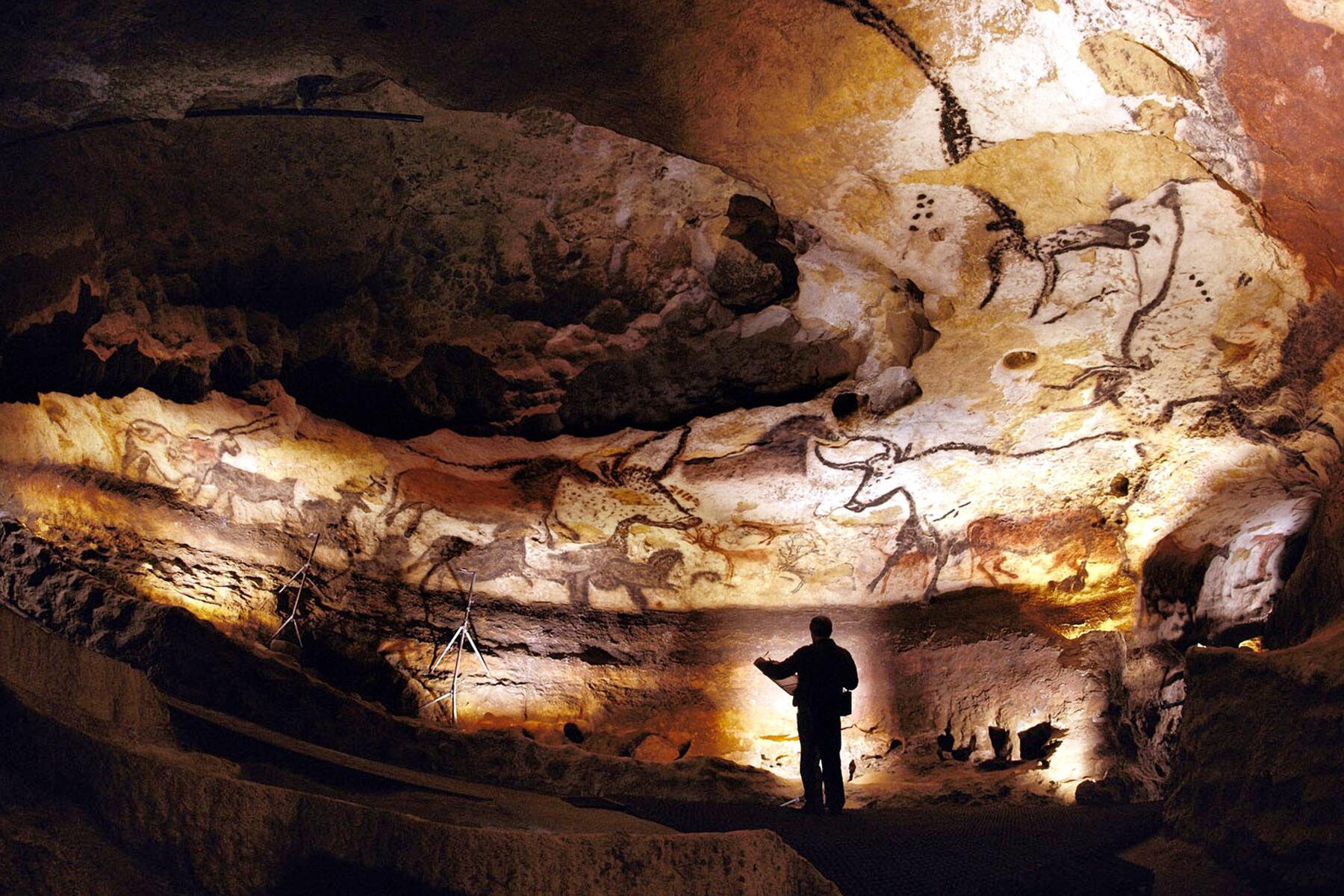
It was Robot the Dog, who first discovered Lascaux in 1940—or so the legend goes—disappearing down a hole after a rabbit, four French teenagers trailing behind him. But at the bottom of the shaft, 50 feet below ground at the edge of the forest outside the southwestern village of Montignac, France, the kids found more than just their pet: More than 6,000 paintings of animals, human figures and abstract symbols decorated the cave walls, a spectacular stone canvas in shades of red, yellow and black. Included among the images, which are estimated to be around 17,000 years old, are the paintings of 364 horses, 90 stags, seven felines, a bear and a rhinoceros. Opened to the public in 1948, the combined carbon dioxide, heat, and contaminants produced by 1,200 visitors per day had damaged the paintings so badly that authorities decided to shut down the caves. Lascaux has been sealed to the public since 1963.