


Trip Report, Peru Part 3: Ayacucho
 Dec 10th, 2024 | 03:04 PM
#1
Original Poster
Joined: Apr 2022
Posts: 202
Likes: 0
Trip Report, Peru Part 3: Ayacucho
Trip Report, Peru Part 3: Ayacucho (Three full days during the final week of October, 2024)
Introduction
My report is not comprehensive, for a health issue thst struck while I was in the city put some serious limits on how much I could get around. Had I been visiting a well-known toruist destination I probably wouldn’t have bothered with a report at all; but since Ayacucho gets little mention either on this site, or in the world of tourism generally, it seemed that that if this great colonial city were to get the mention that I believe it merits, it was either going to be the report that follows, or nothing. The “photo-essay” that follows the report may compensate somewhat for the its enforced incompleteness — or for that matter, it’s length.
(Note: Before mine below, the most recent Trip Peport on this site that covers Ayacucho appears to be “Praise for Peru” — a sentiment I can agree with — posted by “kja” in July 2018, and which I can strongly recommend. The Ayacucho section is found deep, deep down into a long, long thread of interweaving report-and-response, but if you’re interested in Peru, it’s all worth reading in its entirety, or even just skipping around in.)
HUAMANGA
The city I am about to discuss was once called Huamanga, and often still is. The colonial Spaniards, who had a flair for names, called it San Juan de la Frontera de Humanga, and so it remained until 1825, when the great liberator, Simon Bolívar, renamed it Ayacucho. This Quechua name is usually translated “corner of the dead” (though it may be a little more subtle than that), and at first glance it may not seem like the kind of name a city would want to have, but Bolívar chose it to commemorate those who fell in the final battle for Peruvian independence, which was fought nearby in 1824. (And yet during my visit I got the impression, accurate or not, that Huamanga is still preferred by many.)
Ayacucho doesn’t turn up much in tourism literature and internet sites, which for me was one of its attractions. On this “off-season” trip it struck me, to my satisfaction, as being nearly as tourist-free, except for me, as on my first visit (also “off-season”), and it was still the same beautiful colonial city I remembered from my first visit 20 years earlier.
(Note that Ayacucho is about 9000 feet in altitude, nearly 2750 meters, and some visitors may feel altitude sickness here. Speak with your doctor, and look into professional health sources — Centers for Disease Control, British National Health Service — if you think you may be susceptible, or have no idea yet.)
I won’t engage in trite tourism clichés like “the real Peru,” but during my three full days in Ayacucho I had the gratifying feeling that I was really “in there.” On this visit to Ayacucho, as on my earlier one, simply taking in the ambience of this unique historic city, part indigenous and part Spanish-colonial, I sometimes felt that I might be one of the first few foreign tourists to discover the place — though of course I wasn’t. (And apart from the Sacred Valley — Cusco to Machu Picchu — and maybe a couple other oft-visited sites, the vastness of Peru offers ample opportunites for travel experiences like this one.)
And in fact, any feeling of having “discovered” Ayacucho would have vanished at the Via Via cafe, where, apart from one small group at my hotel, I spotted the few obvious foreign visitors I would see. And you should, in fact, check out the Via Via; its balcony seating on the upper level (“primer piso” here; “second floor” to North Americans), overlooking the central plaza, is a great place to dine.
On my first visit, Ayacucho impressed me as a city still proud of its indigenous, Quechua heritage, where you could encounter Quechua on the streets and even on written signs and notices; and insofar as I could judge during my recent three-day visit, that has not changed — I even spotted Quechua on an ATM! But of course Spanish is the primary language here, and you can get by perfectly well in it.
And if fact you’ll realize that you’re in a different kind of place if you take note of a statue that you’ll pass should you stroll down to the Barrio (neighborhood) of Santa Ana, the traditional Quechua quarter of Ayacucho — a statue not of any president or general, but of a humble Runa woman in traditional attire. (“Runa” is the term Quechua-speakers use to refer to themselves; “Runasimi” — the “mouth” of the Runa — is their own name for their language.) And there’s a good reason to stroll down here, for Barrio Santa Ana is known a good place to buy authentic traditional artefacts, though on my weekday afternoon visit, it seemed rather quiet and subdued. (To get to Santa Ana, walk a block west of the central plaza, then south several blocks down Miguel Grau Street.)
I contentedly wandered around Ayacucho as well as I still could, in my usual flâneur style, to take in the unique ambience of this historic city, though for the reasons I mentioned at the start, I did not get into Ayacucho’s main points of interest. But by way of information they include:
The House Museum (Casa Museo) of Joaquín Lopez Antay, which displays his colorful versions of his Peruvian folk art;
The Hipolito Unanue Regional History Museum (Museo Historical Regional), devoted to the local ancient cultures, notably the Huari; and
The House Museum of Andrés Cáceres, wno served as Peru’s president during the 1890s, but is best known for his leadership of Peru’s forces in the war against Chile (1879-1883), which nonetheless went rather badly for Peru (and even worse for Peru’s ally Bolivia.)
Several impressive colonial churches -- 33, we're told.
During the 1980s Ayacucho was an epicenter for the Shining Path (“Sendero Luminoso”) rebellion, in many ways among the worst of Latin America’s 20th-century revolutions. It was led by Abimael Guzman, a young philosophy professor at Ayacucho’s San Cristóbal University, a specialist on Immanuel Kant, who originally bore an odd resemblance to reporter Clark Kent from the old Superman shows. After a gradual transformation into revolutionary, Professor Guzman adapted Mao Tse Tung’s theory of communist peasant rebellion to the central Andes, and over the course of the 1980s his movement terrorized a large part of central and southern Peru, and eventually Lima itself.
(At first, the “Shining Path” was officially the “Communist Party of Peru.” Though “Shining Path” may sound like something Mao might have coined, it was actually a phrase by which the Peruvian literary critic and political theorist Jose Mariátegui — who had died in 1930 — once described the way pioneered by Marx and Lenin.)
In a trip report like this I can’t go into the deep background of the shining Path years, which includes earlier indigenous rebellions; Guzman’s transformation from Kantian to Maoist; or Peru’s unique version of socialist thought, with its religious, indigenous, and even messianic undercurrents. (Little of any of this would become widely known outside of Peru, much less make it into the world’s media.) But for over a decade the Peruvian army led a counter-insurgency as violent as the insurgency itself, committing frequent atrocities in the process; yet in the end it was not military might but careful detective work that brought the Shining Path down: in 1992, after twelve years of militant counter-insurgency, Guzman was traced to his mistress’ apartment in the middle-class Surquillo section of Lima — not an ideal place for a Maoist revolutionary to be found — and arrested, whereupon his movement basically imploded. A couple of his lieutenants tried to carry the rebellion forward for a few years more, but essentially it was over with; and the Shining Path has long ceased to be a threat. (Guzman died in prison in 2021.)
The Museum of Memory in Ayacucho preserves the story of the Shining Path years. Many of the displays are personal reminiscences by victims, or by the relatives of victims, of abuse, assault and torture carried out by insurgents and by the military. Victims of the decade-long war included those had committed themselves neither to the Shining Path nor to the counter-insurgency; and many others who were forced to cooperate with one — army or rebellion — and thus risked retribution from the other. In 2004, a Truth and Reconciliation Commission established by Peru’s President, Alejandro Toledo, estimated that the Shining Path was responsible for about 54% of the killings and disappearances associated with the war years, but that the police and army were responsible for a great majority of the rapes and cases of torture — these findings remain “official” but have been challenged.
Other displays in the museum include art works that convey the experience of those years; contemporary photos; an historical timeline of the Shining Path years; and a several other momentos, such as clothing retrieved from the dead. Nearly all wall texts, personal accounts, and item tags (including the historical time-line) are accompanied by English translations. Overall there is a somewhat rough-hewn look to the museum, but this is not a criticism; in fact I felt that the museum, just as it is, communicated a stark immediacy that might have been lost in a slicker, more sanitized presentation — the museum was clearly set up by people who believed deeply in its message. (The museum is located near the north end of Jirón Libertad. Take a mototaxi — “tuk-tuk” — or walk two blocks west of the central plaza to Libertad, then north for approximately 20 minutes.)
A few blocks south from the museum on Jirón Garcilaso de la Vega you will find a monument dedicated to journalists who lost their lives covering the early war years. It appears in the middle of a traffic circle, the “Ovalo de los Periodistas.”
There are two historic places to visit just outside Ayacucho that are easily reached by public transportation, though the health issues that I mentioned at the start prevented me from seeing them this time. (I did visit the second of them in 2004; for more recent personal commentary on both, see the informative trip report on this forum, “Praise for Peru” by “kja,” July 2018.) The first, about 13 road miles north of Ayacucho, is the archaeological site representing one of the main centers of the Huari civilization (pronounced, and often spelled, Wari), which dominated a large part of Peru from the 6th through the 9th centuries CE. (Many scholars believe that the later Incas learned much of their stuff from the Huari.) The Huari were the second of what scholars call the three "horizons" of Peruvian history, or periods of relative cultural or political uniformity -- the first was Chavín, first millennium BCE, while the third was, of course, the Inca empire. Beyond Huari, another 10 miles along the same highway, is the town of Quinua, and the nearby pampa, or high-altitude plain, on which the Battle of Ayacucho, the decisive battle for Peruvian independence, was fought on 9 December, 1824.
Quinua is one of the places I most regret not being able to visit this time, for the Quinua I visited 20 years earlier was a charming little historic town also known as an arts-and-crafts center. There was a small museum devoted to the final (and successful) battle for independence fought just a short walk away. The museum was hardly what you would call “world class,” but its theme was impiortant to Peru, and that was sufficient for me.
And I still recall, as I left the small museum, seeing the young attendant running out after me to make sure I hadn’t missed the Surrender Room. In fact I had missed it, and I was grateful to her for calling my attention to it. (When I left the famous Prado art museum in Madrid, no one ran after me to make sure I hadn’t overlooked the Goyas.) A few doors down from the museum, this was the room where the Spanish general José de Canterac surrendered to Antonio de Sucre, thus assuring Peru’s independence. The room was completely empty, and I could imagine some casual tourists brushing it off as “not worth it.” But then, hundreds, maybe thousands of people visit the Smithsonian Institution in Washington every day to see a humble wooden table. There’s nothing visually spectacular about it at all — but it happens to be the table over which Robert E. Lee surrendered to Ulysses Grant at Appomatox Court House. Is it “worth it”? Anyway, I would very much have liked to find out whether Quinua had changed since 20 years ago — perhaps someone who has been there recently can comment below.
The battlefield itself was -- and I'm sure still is -- an easy walk from Quinua. At the time of my visit it was a spare, eerie looking plain set amidst the mountains, empty apart from a giant white obelisk that looked as if it might have landed from space. It had actually been commissioned in the early 1970s to commemorate the 150th anniversary of the battle, and it is now a local landmark -- rather to Ayacucho, what the Eiffel Tower is to Paris.
Finally, note that Quinua is yet another 1800 feet higher than Ayacucho — if you do have altitude-sickness concerns, perhaps spend a couple of days in Ayacucho in order to acclimatise before heading to Quinua.
Note, too, than an Inca site, Vilcashuamán, is located about 65 miles south of Ayacucho.
(Photos will follow below, if I can still figure out how to get them in)
Introduction
My report is not comprehensive, for a health issue thst struck while I was in the city put some serious limits on how much I could get around. Had I been visiting a well-known toruist destination I probably wouldn’t have bothered with a report at all; but since Ayacucho gets little mention either on this site, or in the world of tourism generally, it seemed that that if this great colonial city were to get the mention that I believe it merits, it was either going to be the report that follows, or nothing. The “photo-essay” that follows the report may compensate somewhat for the its enforced incompleteness — or for that matter, it’s length.
(Note: Before mine below, the most recent Trip Peport on this site that covers Ayacucho appears to be “Praise for Peru” — a sentiment I can agree with — posted by “kja” in July 2018, and which I can strongly recommend. The Ayacucho section is found deep, deep down into a long, long thread of interweaving report-and-response, but if you’re interested in Peru, it’s all worth reading in its entirety, or even just skipping around in.)
HUAMANGA
The city I am about to discuss was once called Huamanga, and often still is. The colonial Spaniards, who had a flair for names, called it San Juan de la Frontera de Humanga, and so it remained until 1825, when the great liberator, Simon Bolívar, renamed it Ayacucho. This Quechua name is usually translated “corner of the dead” (though it may be a little more subtle than that), and at first glance it may not seem like the kind of name a city would want to have, but Bolívar chose it to commemorate those who fell in the final battle for Peruvian independence, which was fought nearby in 1824. (And yet during my visit I got the impression, accurate or not, that Huamanga is still preferred by many.)
Ayacucho doesn’t turn up much in tourism literature and internet sites, which for me was one of its attractions. On this “off-season” trip it struck me, to my satisfaction, as being nearly as tourist-free, except for me, as on my first visit (also “off-season”), and it was still the same beautiful colonial city I remembered from my first visit 20 years earlier.
(Note that Ayacucho is about 9000 feet in altitude, nearly 2750 meters, and some visitors may feel altitude sickness here. Speak with your doctor, and look into professional health sources — Centers for Disease Control, British National Health Service — if you think you may be susceptible, or have no idea yet.)
I won’t engage in trite tourism clichés like “the real Peru,” but during my three full days in Ayacucho I had the gratifying feeling that I was really “in there.” On this visit to Ayacucho, as on my earlier one, simply taking in the ambience of this unique historic city, part indigenous and part Spanish-colonial, I sometimes felt that I might be one of the first few foreign tourists to discover the place — though of course I wasn’t. (And apart from the Sacred Valley — Cusco to Machu Picchu — and maybe a couple other oft-visited sites, the vastness of Peru offers ample opportunites for travel experiences like this one.)
And in fact, any feeling of having “discovered” Ayacucho would have vanished at the Via Via cafe, where, apart from one small group at my hotel, I spotted the few obvious foreign visitors I would see. And you should, in fact, check out the Via Via; its balcony seating on the upper level (“primer piso” here; “second floor” to North Americans), overlooking the central plaza, is a great place to dine.
On my first visit, Ayacucho impressed me as a city still proud of its indigenous, Quechua heritage, where you could encounter Quechua on the streets and even on written signs and notices; and insofar as I could judge during my recent three-day visit, that has not changed — I even spotted Quechua on an ATM! But of course Spanish is the primary language here, and you can get by perfectly well in it.
And if fact you’ll realize that you’re in a different kind of place if you take note of a statue that you’ll pass should you stroll down to the Barrio (neighborhood) of Santa Ana, the traditional Quechua quarter of Ayacucho — a statue not of any president or general, but of a humble Runa woman in traditional attire. (“Runa” is the term Quechua-speakers use to refer to themselves; “Runasimi” — the “mouth” of the Runa — is their own name for their language.) And there’s a good reason to stroll down here, for Barrio Santa Ana is known a good place to buy authentic traditional artefacts, though on my weekday afternoon visit, it seemed rather quiet and subdued. (To get to Santa Ana, walk a block west of the central plaza, then south several blocks down Miguel Grau Street.)
I contentedly wandered around Ayacucho as well as I still could, in my usual flâneur style, to take in the unique ambience of this historic city, though for the reasons I mentioned at the start, I did not get into Ayacucho’s main points of interest. But by way of information they include:
The House Museum (Casa Museo) of Joaquín Lopez Antay, which displays his colorful versions of his Peruvian folk art;
The Hipolito Unanue Regional History Museum (Museo Historical Regional), devoted to the local ancient cultures, notably the Huari; and
The House Museum of Andrés Cáceres, wno served as Peru’s president during the 1890s, but is best known for his leadership of Peru’s forces in the war against Chile (1879-1883), which nonetheless went rather badly for Peru (and even worse for Peru’s ally Bolivia.)
Several impressive colonial churches -- 33, we're told.
During the 1980s Ayacucho was an epicenter for the Shining Path (“Sendero Luminoso”) rebellion, in many ways among the worst of Latin America’s 20th-century revolutions. It was led by Abimael Guzman, a young philosophy professor at Ayacucho’s San Cristóbal University, a specialist on Immanuel Kant, who originally bore an odd resemblance to reporter Clark Kent from the old Superman shows. After a gradual transformation into revolutionary, Professor Guzman adapted Mao Tse Tung’s theory of communist peasant rebellion to the central Andes, and over the course of the 1980s his movement terrorized a large part of central and southern Peru, and eventually Lima itself.
(At first, the “Shining Path” was officially the “Communist Party of Peru.” Though “Shining Path” may sound like something Mao might have coined, it was actually a phrase by which the Peruvian literary critic and political theorist Jose Mariátegui — who had died in 1930 — once described the way pioneered by Marx and Lenin.)
In a trip report like this I can’t go into the deep background of the shining Path years, which includes earlier indigenous rebellions; Guzman’s transformation from Kantian to Maoist; or Peru’s unique version of socialist thought, with its religious, indigenous, and even messianic undercurrents. (Little of any of this would become widely known outside of Peru, much less make it into the world’s media.) But for over a decade the Peruvian army led a counter-insurgency as violent as the insurgency itself, committing frequent atrocities in the process; yet in the end it was not military might but careful detective work that brought the Shining Path down: in 1992, after twelve years of militant counter-insurgency, Guzman was traced to his mistress’ apartment in the middle-class Surquillo section of Lima — not an ideal place for a Maoist revolutionary to be found — and arrested, whereupon his movement basically imploded. A couple of his lieutenants tried to carry the rebellion forward for a few years more, but essentially it was over with; and the Shining Path has long ceased to be a threat. (Guzman died in prison in 2021.)
The Museum of Memory in Ayacucho preserves the story of the Shining Path years. Many of the displays are personal reminiscences by victims, or by the relatives of victims, of abuse, assault and torture carried out by insurgents and by the military. Victims of the decade-long war included those had committed themselves neither to the Shining Path nor to the counter-insurgency; and many others who were forced to cooperate with one — army or rebellion — and thus risked retribution from the other. In 2004, a Truth and Reconciliation Commission established by Peru’s President, Alejandro Toledo, estimated that the Shining Path was responsible for about 54% of the killings and disappearances associated with the war years, but that the police and army were responsible for a great majority of the rapes and cases of torture — these findings remain “official” but have been challenged.
Other displays in the museum include art works that convey the experience of those years; contemporary photos; an historical timeline of the Shining Path years; and a several other momentos, such as clothing retrieved from the dead. Nearly all wall texts, personal accounts, and item tags (including the historical time-line) are accompanied by English translations. Overall there is a somewhat rough-hewn look to the museum, but this is not a criticism; in fact I felt that the museum, just as it is, communicated a stark immediacy that might have been lost in a slicker, more sanitized presentation — the museum was clearly set up by people who believed deeply in its message. (The museum is located near the north end of Jirón Libertad. Take a mototaxi — “tuk-tuk” — or walk two blocks west of the central plaza to Libertad, then north for approximately 20 minutes.)
A few blocks south from the museum on Jirón Garcilaso de la Vega you will find a monument dedicated to journalists who lost their lives covering the early war years. It appears in the middle of a traffic circle, the “Ovalo de los Periodistas.”
There are two historic places to visit just outside Ayacucho that are easily reached by public transportation, though the health issues that I mentioned at the start prevented me from seeing them this time. (I did visit the second of them in 2004; for more recent personal commentary on both, see the informative trip report on this forum, “Praise for Peru” by “kja,” July 2018.) The first, about 13 road miles north of Ayacucho, is the archaeological site representing one of the main centers of the Huari civilization (pronounced, and often spelled, Wari), which dominated a large part of Peru from the 6th through the 9th centuries CE. (Many scholars believe that the later Incas learned much of their stuff from the Huari.) The Huari were the second of what scholars call the three "horizons" of Peruvian history, or periods of relative cultural or political uniformity -- the first was Chavín, first millennium BCE, while the third was, of course, the Inca empire. Beyond Huari, another 10 miles along the same highway, is the town of Quinua, and the nearby pampa, or high-altitude plain, on which the Battle of Ayacucho, the decisive battle for Peruvian independence, was fought on 9 December, 1824.
Quinua is one of the places I most regret not being able to visit this time, for the Quinua I visited 20 years earlier was a charming little historic town also known as an arts-and-crafts center. There was a small museum devoted to the final (and successful) battle for independence fought just a short walk away. The museum was hardly what you would call “world class,” but its theme was impiortant to Peru, and that was sufficient for me.
And I still recall, as I left the small museum, seeing the young attendant running out after me to make sure I hadn’t missed the Surrender Room. In fact I had missed it, and I was grateful to her for calling my attention to it. (When I left the famous Prado art museum in Madrid, no one ran after me to make sure I hadn’t overlooked the Goyas.) A few doors down from the museum, this was the room where the Spanish general José de Canterac surrendered to Antonio de Sucre, thus assuring Peru’s independence. The room was completely empty, and I could imagine some casual tourists brushing it off as “not worth it.” But then, hundreds, maybe thousands of people visit the Smithsonian Institution in Washington every day to see a humble wooden table. There’s nothing visually spectacular about it at all — but it happens to be the table over which Robert E. Lee surrendered to Ulysses Grant at Appomatox Court House. Is it “worth it”? Anyway, I would very much have liked to find out whether Quinua had changed since 20 years ago — perhaps someone who has been there recently can comment below.
The battlefield itself was -- and I'm sure still is -- an easy walk from Quinua. At the time of my visit it was a spare, eerie looking plain set amidst the mountains, empty apart from a giant white obelisk that looked as if it might have landed from space. It had actually been commissioned in the early 1970s to commemorate the 150th anniversary of the battle, and it is now a local landmark -- rather to Ayacucho, what the Eiffel Tower is to Paris.
Finally, note that Quinua is yet another 1800 feet higher than Ayacucho — if you do have altitude-sickness concerns, perhaps spend a couple of days in Ayacucho in order to acclimatise before heading to Quinua.
Note, too, than an Inca site, Vilcashuamán, is located about 65 miles south of Ayacucho.
(Photos will follow below, if I can still figure out how to get them in)
 Dec 10th, 2024 | 04:07 PM
#2
Original Poster
Joined: Apr 2022
Posts: 202
Likes: 0
HUAMANGA (Ayacucho, you know): Photos and commentary
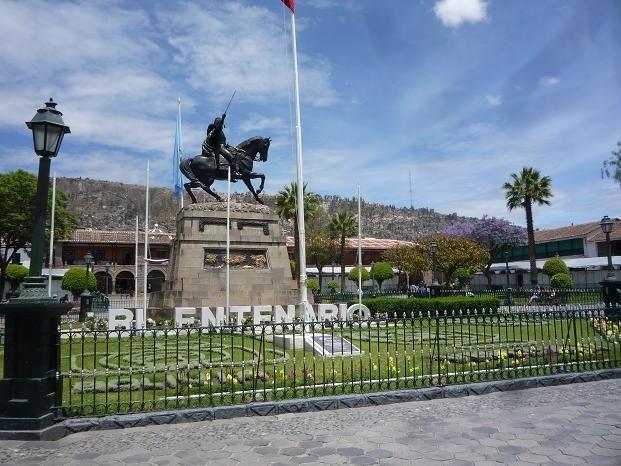
The Plaza Mayor, or Central Plaza, of Ayacucho. The statue commemorates Antonio José de Sucre, the Venezuelan liberator who, once things had been wrapped up in Ecuador and in his own country, joined his fellow Venezuelan Simón Bolívar in the liberation of Peru, which he achieved at the Battle of Ayacucho about 24 miles from here, in 1824. (Hence the “Bi[c]entenario” at the base of the statue in this 2024 photo.)
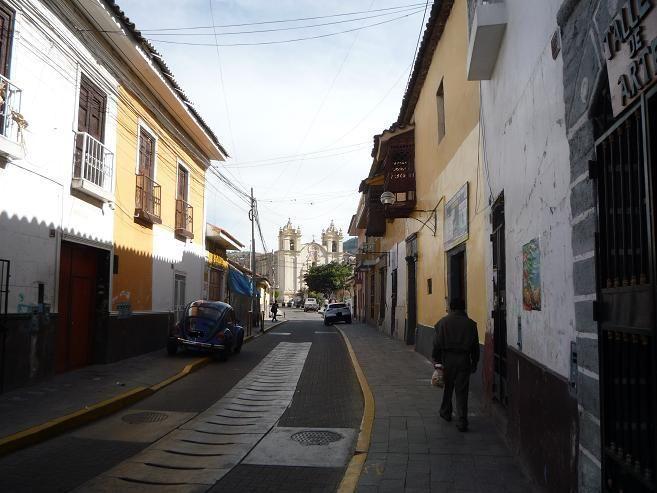
A typical street in Ayacucho; the Temple of Saint Teresa, begun in 1703, is in the background.
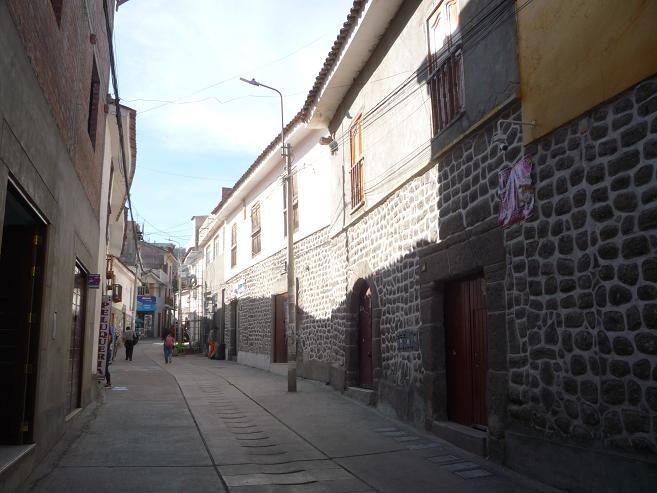
Another typical Ayacucho street.
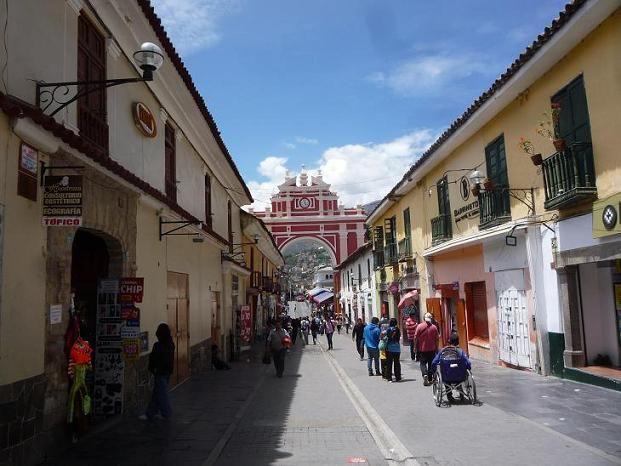
If you have visited Antigua, Guatemala, you might have had a moment of surprised recognition. But this really is Ayacucho, looking south down 28-July Avenue. (Antigua’s arch is great, but I really think that this is a nicer looking one.)
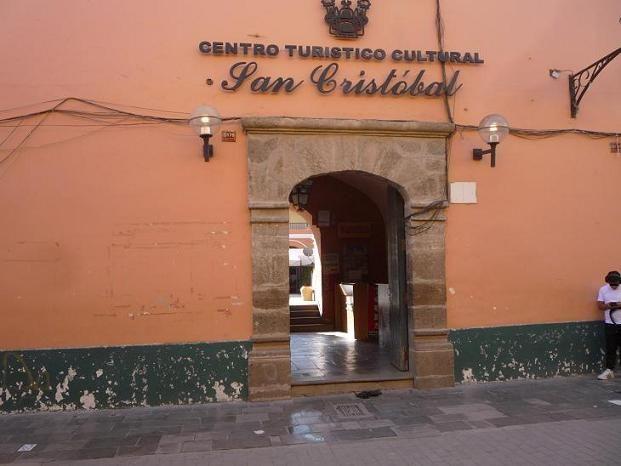
Not far from the Arch, you may want to check the San Cristóbal Cultural Center. There are cafes and artesan shops along the interior plaza, and if any cultural events are going on in town, they likely will be announced on a sign just inside.
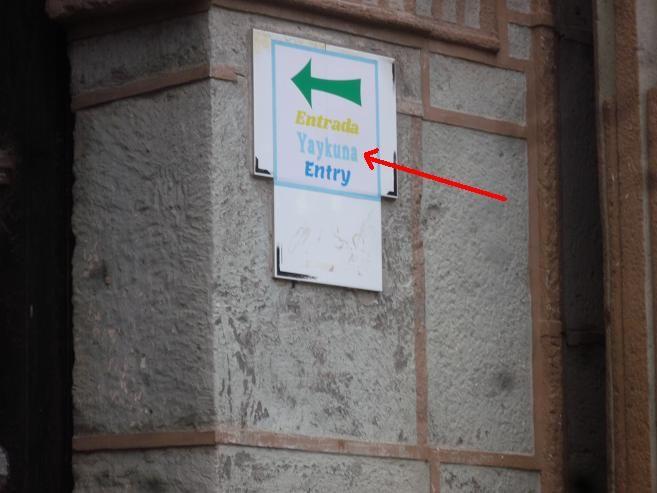
It's not unusual to encounter Quechua in Ayacucho.
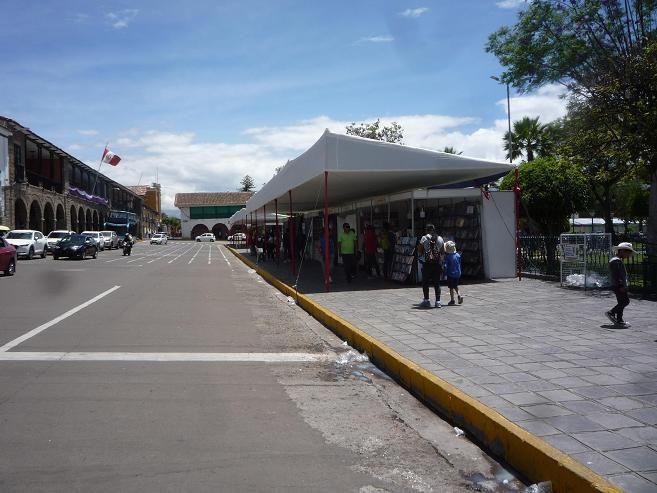
Luckily I made it to Ayacucho just in time for the last day of the Book Fair in the Plaza Mayor.

Jirón (Avenue) Lima in the center of the Ayacucho.
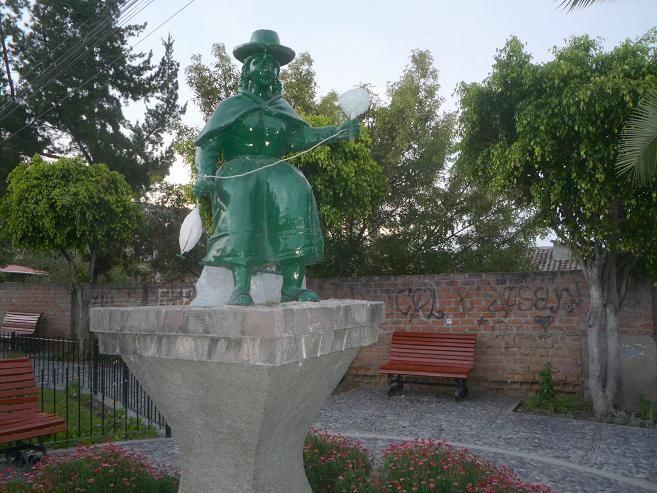
As you enter the traditional Quechua neighborood of Santa Ana, you will find this statue honoring the traditional Quechua-speaking woman.
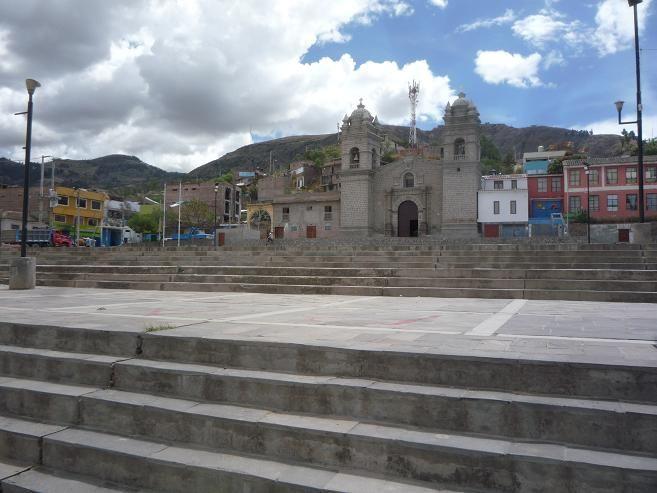
The main plaza of Barrio Santa Ana, and the Temple of its patroness saint (1569).
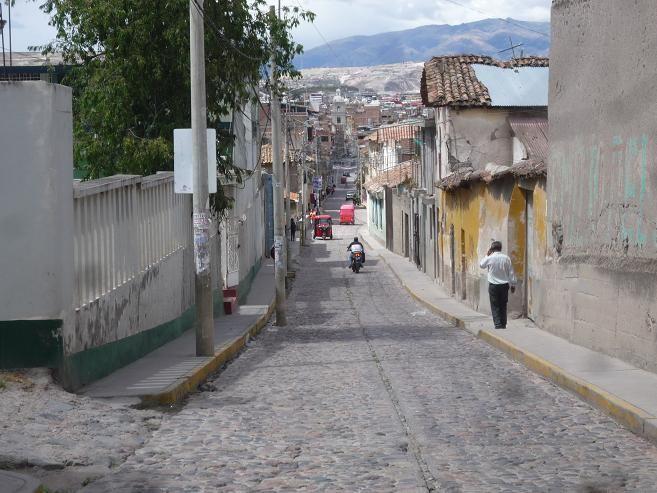
A street in Barrio Santa Ana.
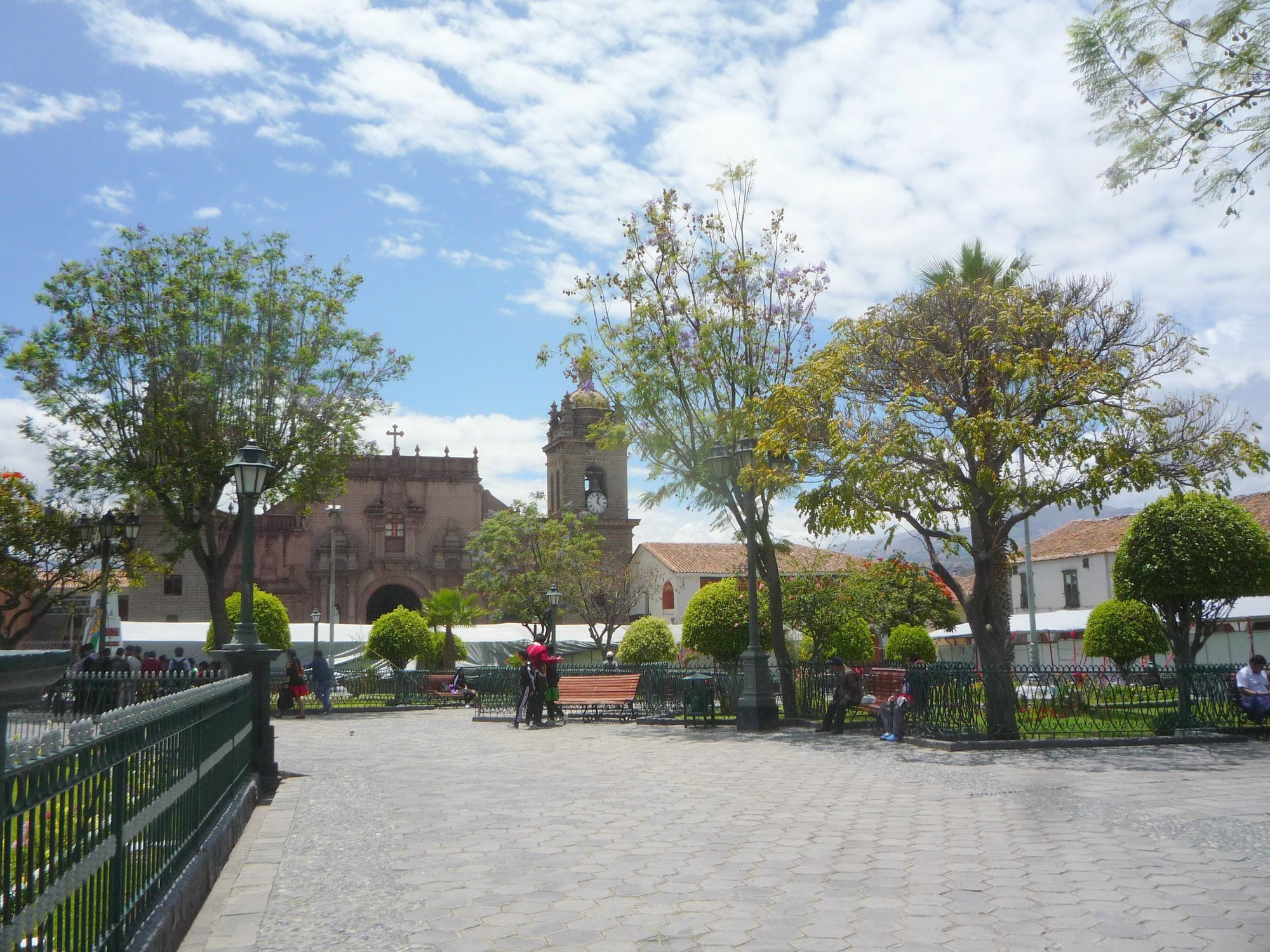
Looking across Ayacucho’s Plaza Mayor towards the Cathedral (1612).
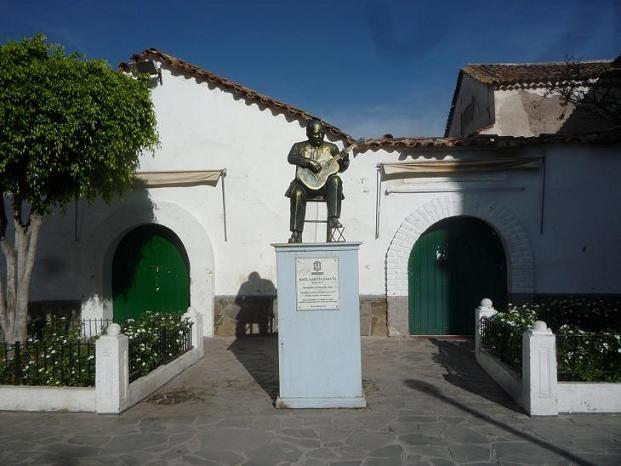
A memorial to Raúl García Zárate (1931-2017), local lawyer and self-taught musician whose guitar compositions are based mostly on traditional Andean themes
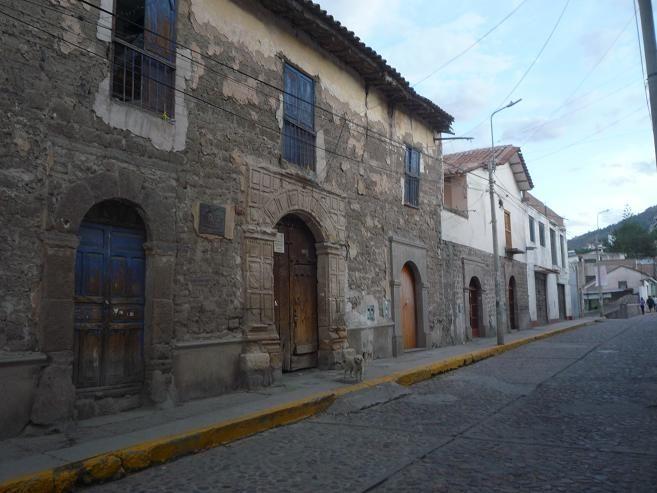
The large house dominating the left is where Simon Bolívar, Liberator of Peru, lodged during the late summer of 1824, while he was planning the battle with Spanish forces that would be commanded, and won, that December by Sucre.
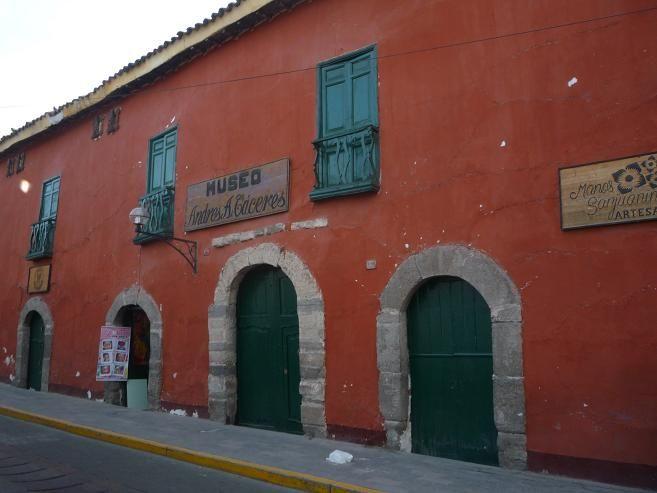
The House Museum of Andrés Caceres. Caceres was president of Peru twice during the 1890s, but he is best remembered in Peru for his military leadership during the War With Chile (1879-1883). Yet despite his reorganization of the Peruvian army, and several victories in the southern Andes, the war would be a disaster for Peru, and a calamity for Peru’s ally Bolivia.

The church of San Francisco de Asis (1552) — St.Francis of Assisi, of course.
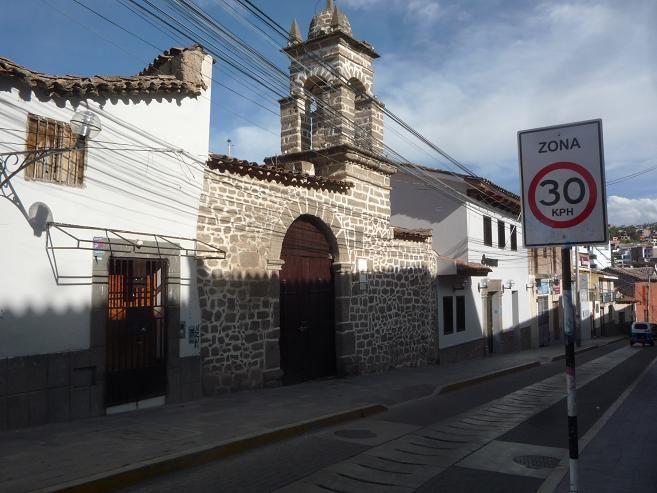
The small but distinctive Temple of St. Christopher (San Cristóbal, 1540). Some of the Spanish soldiers who died in a battle between the two dueling conquistadors, Francisco Pizarro and Diego de Almagro, may be entombed inside, but apparently this isn’t known for certain. You probably have guessed by now that Ayacucho is noted for its many surviving historic churches — 33 is the figure usually given, which I believe includes only the colonial-era ones.
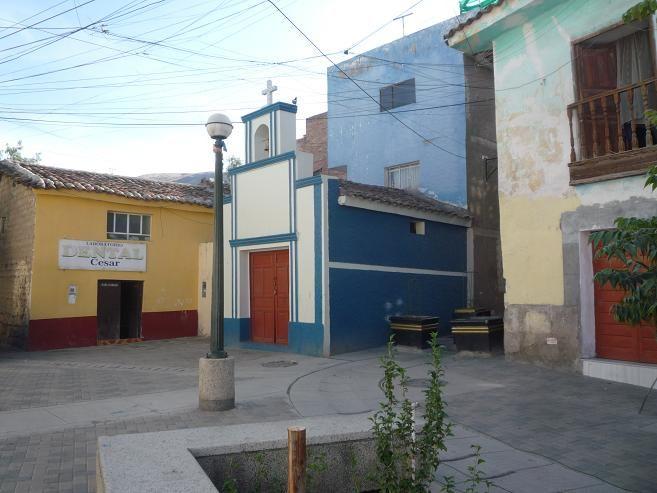
A tiny church. Actually, the Chapel (Capilla) of the Señor, or Lord, of Pampa Cruz. I should have looked more closely for an informative plaque, for I would later find that the same internet that will give me ten thousand pages on Elvis in a fraction of a second, had practically nothing to offer on the date of this church. Eventually I read in the Spanish version of Wikipedia that it is “contemporary with the Temple of San Cristóbal” (preceding picture).

Looking towards the outskirts of Ayacucho, sprawling beyond the historic city.

The Museum of Memory (Museo de la Memoria), dedicated to the story of the Shining Path insurgency of the 1980s, including the government counter-insurgency; and particularly to the many victims of the violence who were drawn into the conflict against their will.
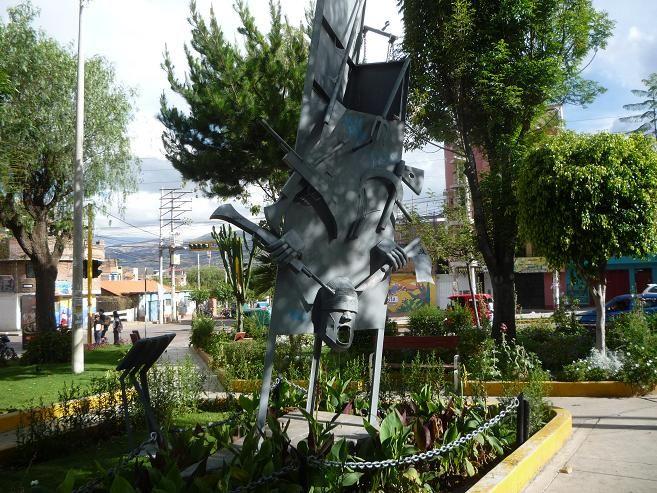
A semi-abstract sculpture in the park in front of the Museum evokes the terrors of the Shining Path years.
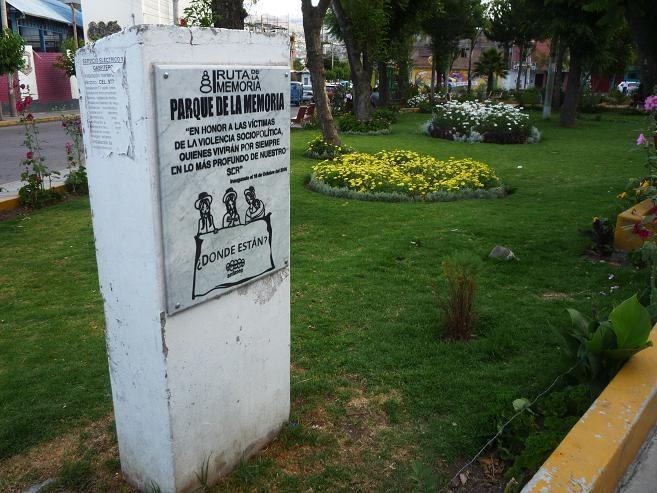
The Park of Memory in front of the Museum. The text on the monument reads "In honor of the victims of the social-political violence, who will live forever in the depths of our being. Where are they?"
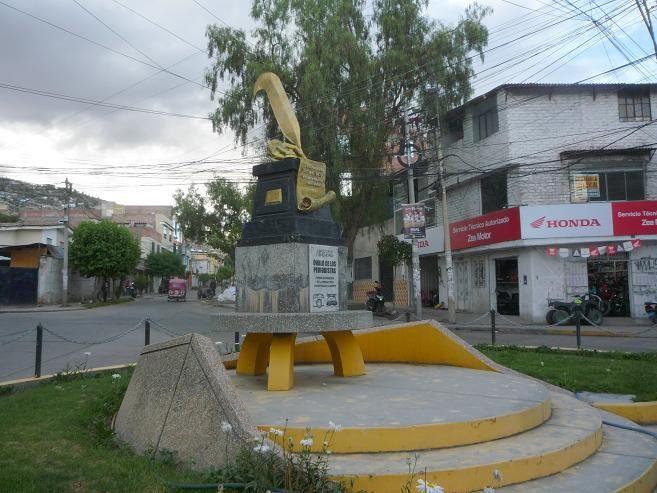
A few blocks south of the Museo de la Memoria, in the middle of a street roundabout on Jirón Garcilaso de la Vega, you’ll find this memorial to journalists who died covering the Shining Path, and the government counter-insurgency.
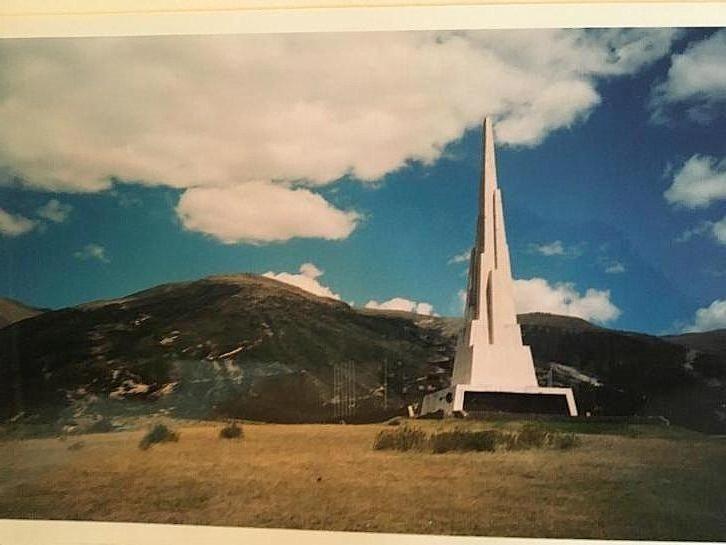
The obelisk at the site of the Battle of Ayacucho (1824). This photo is from 2004, for I didn't make it to Quinua on this recent trip, but I have no doubt that it’s still there — after all, former President Pedro Castillo was sworn in beside it as recently as 2021.
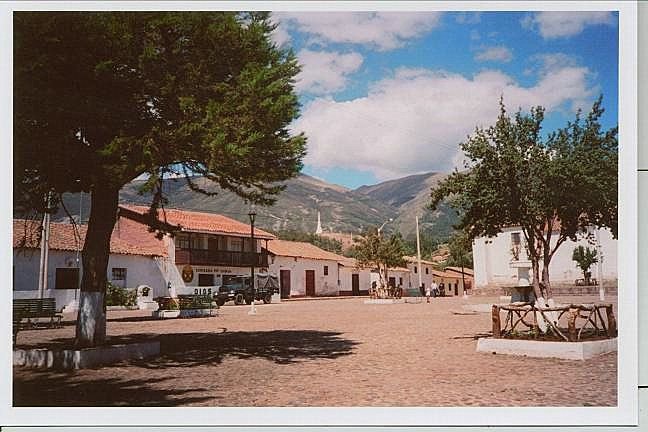
The plaza of Quinua, as I found it is 2004. Normally I wouldn’t have posted such an old photo, but two photos of the same plaza that I found online, one from 2016 and the other dated June 2024, seemed to show little significant change. (Note the obelisk -- see preceding photo -- in the center distance.)
The Plaza Mayor, or Central Plaza, of Ayacucho. The statue commemorates Antonio José de Sucre, the Venezuelan liberator who, once things had been wrapped up in Ecuador and in his own country, joined his fellow Venezuelan Simón Bolívar in the liberation of Peru, which he achieved at the Battle of Ayacucho about 24 miles from here, in 1824. (Hence the “Bi[c]entenario” at the base of the statue in this 2024 photo.)
A typical street in Ayacucho; the Temple of Saint Teresa, begun in 1703, is in the background.
Another typical Ayacucho street.
If you have visited Antigua, Guatemala, you might have had a moment of surprised recognition. But this really is Ayacucho, looking south down 28-July Avenue. (Antigua’s arch is great, but I really think that this is a nicer looking one.)
Not far from the Arch, you may want to check the San Cristóbal Cultural Center. There are cafes and artesan shops along the interior plaza, and if any cultural events are going on in town, they likely will be announced on a sign just inside.
It's not unusual to encounter Quechua in Ayacucho.
Luckily I made it to Ayacucho just in time for the last day of the Book Fair in the Plaza Mayor.
Jirón (Avenue) Lima in the center of the Ayacucho.
As you enter the traditional Quechua neighborood of Santa Ana, you will find this statue honoring the traditional Quechua-speaking woman.
The main plaza of Barrio Santa Ana, and the Temple of its patroness saint (1569).
A street in Barrio Santa Ana.
Looking across Ayacucho’s Plaza Mayor towards the Cathedral (1612).
A memorial to Raúl García Zárate (1931-2017), local lawyer and self-taught musician whose guitar compositions are based mostly on traditional Andean themes
The large house dominating the left is where Simon Bolívar, Liberator of Peru, lodged during the late summer of 1824, while he was planning the battle with Spanish forces that would be commanded, and won, that December by Sucre.
The House Museum of Andrés Caceres. Caceres was president of Peru twice during the 1890s, but he is best remembered in Peru for his military leadership during the War With Chile (1879-1883). Yet despite his reorganization of the Peruvian army, and several victories in the southern Andes, the war would be a disaster for Peru, and a calamity for Peru’s ally Bolivia.
The church of San Francisco de Asis (1552) — St.Francis of Assisi, of course.
The small but distinctive Temple of St. Christopher (San Cristóbal, 1540). Some of the Spanish soldiers who died in a battle between the two dueling conquistadors, Francisco Pizarro and Diego de Almagro, may be entombed inside, but apparently this isn’t known for certain. You probably have guessed by now that Ayacucho is noted for its many surviving historic churches — 33 is the figure usually given, which I believe includes only the colonial-era ones.
A tiny church. Actually, the Chapel (Capilla) of the Señor, or Lord, of Pampa Cruz. I should have looked more closely for an informative plaque, for I would later find that the same internet that will give me ten thousand pages on Elvis in a fraction of a second, had practically nothing to offer on the date of this church. Eventually I read in the Spanish version of Wikipedia that it is “contemporary with the Temple of San Cristóbal” (preceding picture).
Looking towards the outskirts of Ayacucho, sprawling beyond the historic city.
The Museum of Memory (Museo de la Memoria), dedicated to the story of the Shining Path insurgency of the 1980s, including the government counter-insurgency; and particularly to the many victims of the violence who were drawn into the conflict against their will.
A semi-abstract sculpture in the park in front of the Museum evokes the terrors of the Shining Path years.
The Park of Memory in front of the Museum. The text on the monument reads "In honor of the victims of the social-political violence, who will live forever in the depths of our being. Where are they?"
A few blocks south of the Museo de la Memoria, in the middle of a street roundabout on Jirón Garcilaso de la Vega, you’ll find this memorial to journalists who died covering the Shining Path, and the government counter-insurgency.
The obelisk at the site of the Battle of Ayacucho (1824). This photo is from 2004, for I didn't make it to Quinua on this recent trip, but I have no doubt that it’s still there — after all, former President Pedro Castillo was sworn in beside it as recently as 2021.
The plaza of Quinua, as I found it is 2004. Normally I wouldn’t have posted such an old photo, but two photos of the same plaza that I found online, one from 2016 and the other dated June 2024, seemed to show little significant change. (Note the obelisk -- see preceding photo -- in the center distance.)
Last edited by Faedus; Dec 10th, 2024 at 04:53 PM.
Dec 11th, 2024 | 11:47 AM
#3
Joined: May 2004
Posts: 9,773
Likes: 0
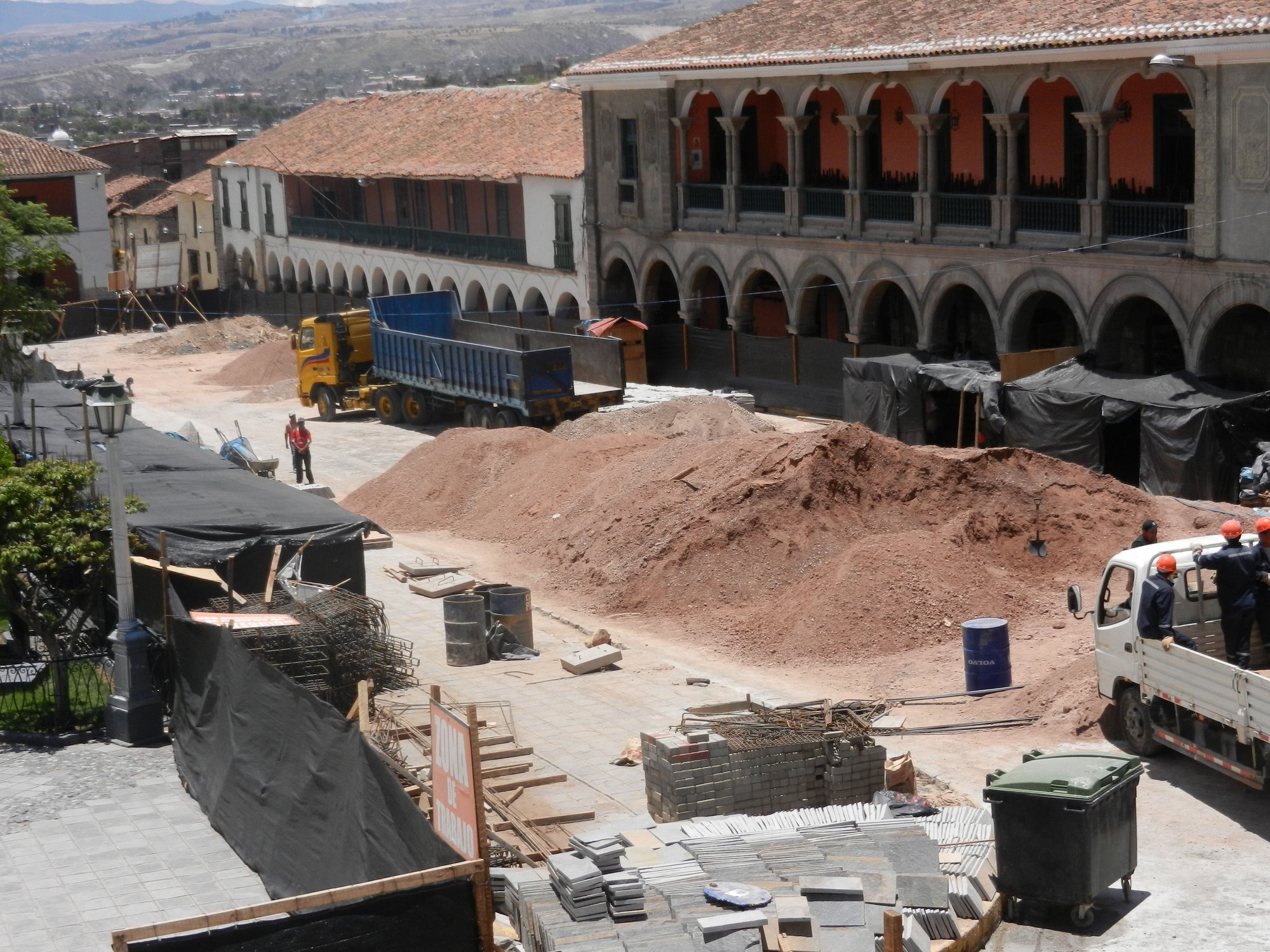
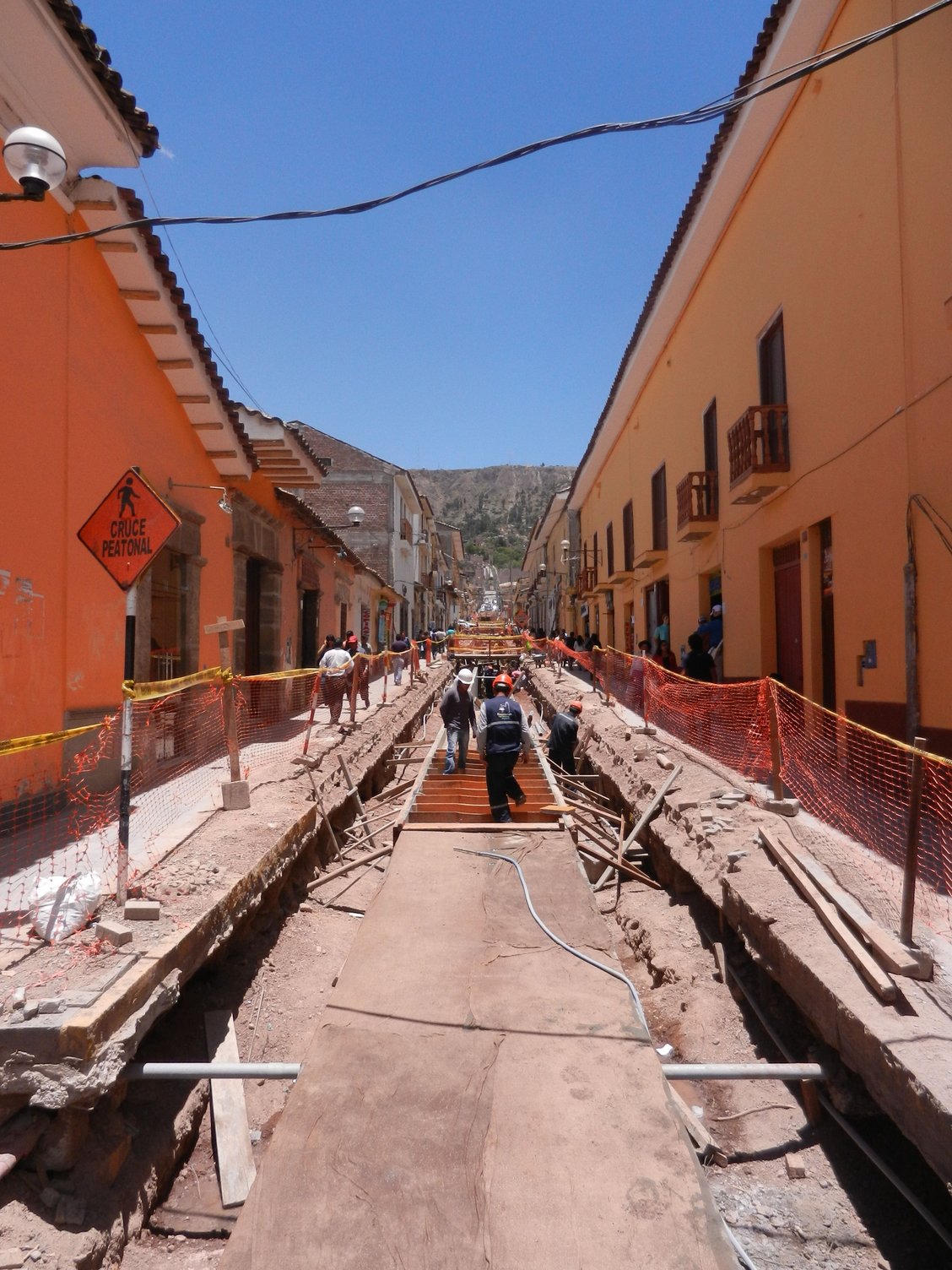
Thanks for sharing. You report and photos bring back a few memories from our long weekend visit there when we were renting an apartment in Lima a few years ago. As you say not many western tourists make it there though we did meet a lot of Mexicans and went on a few side trips with them which was fun. Good to see from the picture that all the street works have been completed - when we were there virtually all of the streets in the centre had been dug up to replace drainage. Good to see they seem to have replaced like with like.
We did consider heading on to Cusco from there but the bus ride from Lima along the winding mountain roads was plenty scary enough without going on the numerous "local" buses need to get to Cusco.
We did consider heading on to Cusco from there but the bus ride from Lima along the winding mountain roads was plenty scary enough without going on the numerous "local" buses need to get to Cusco.
Dec 16th, 2024 | 10:33 AM
#4
Joined: Jan 2005
Posts: 25,597
Likes: 0
I was able to find my old pics
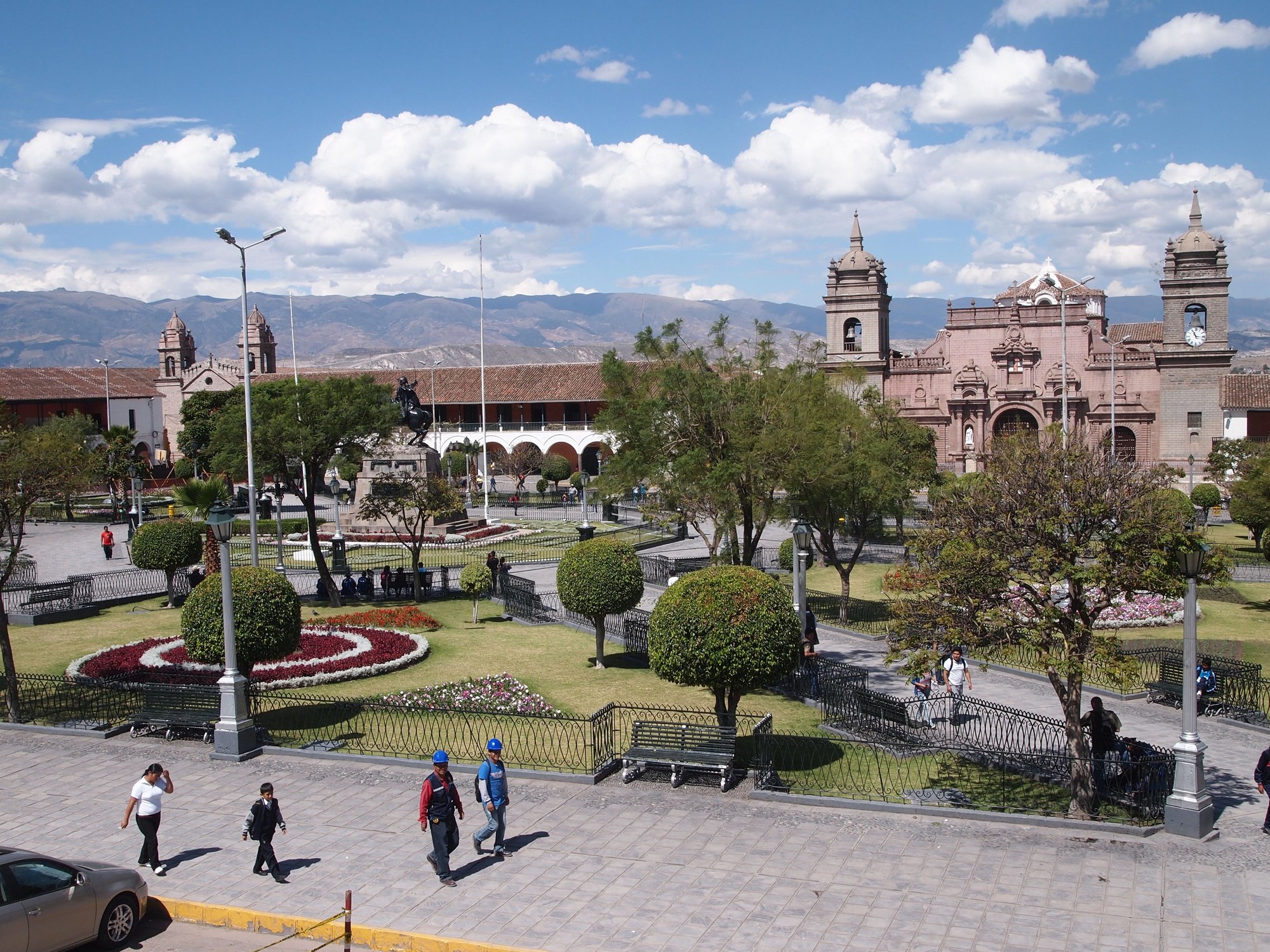
Main square from Via Via cafe balcony September 2013
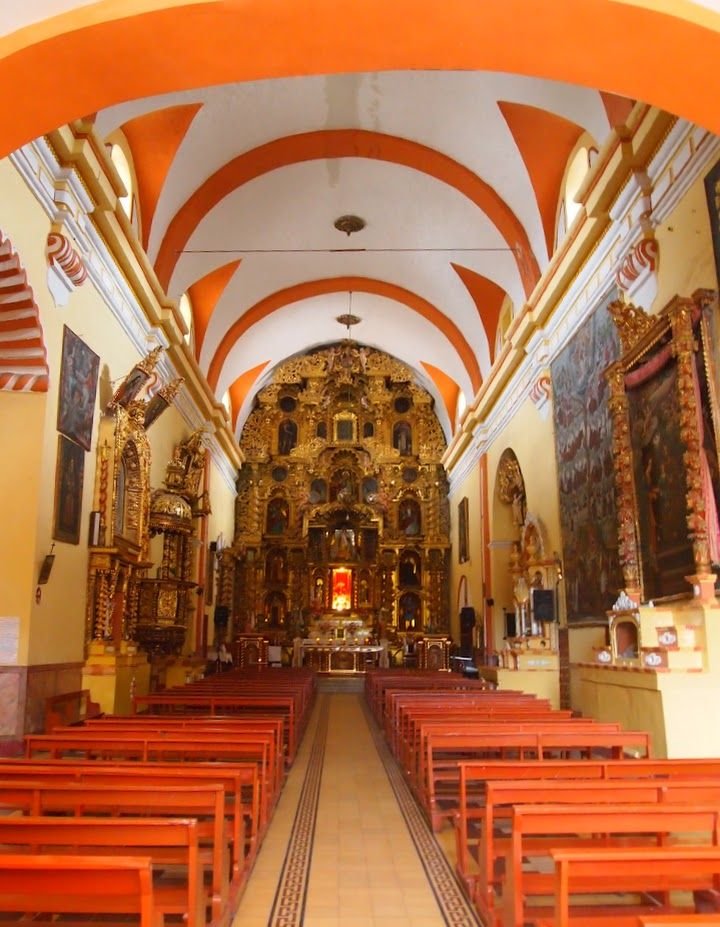
One of the colonial church interiors
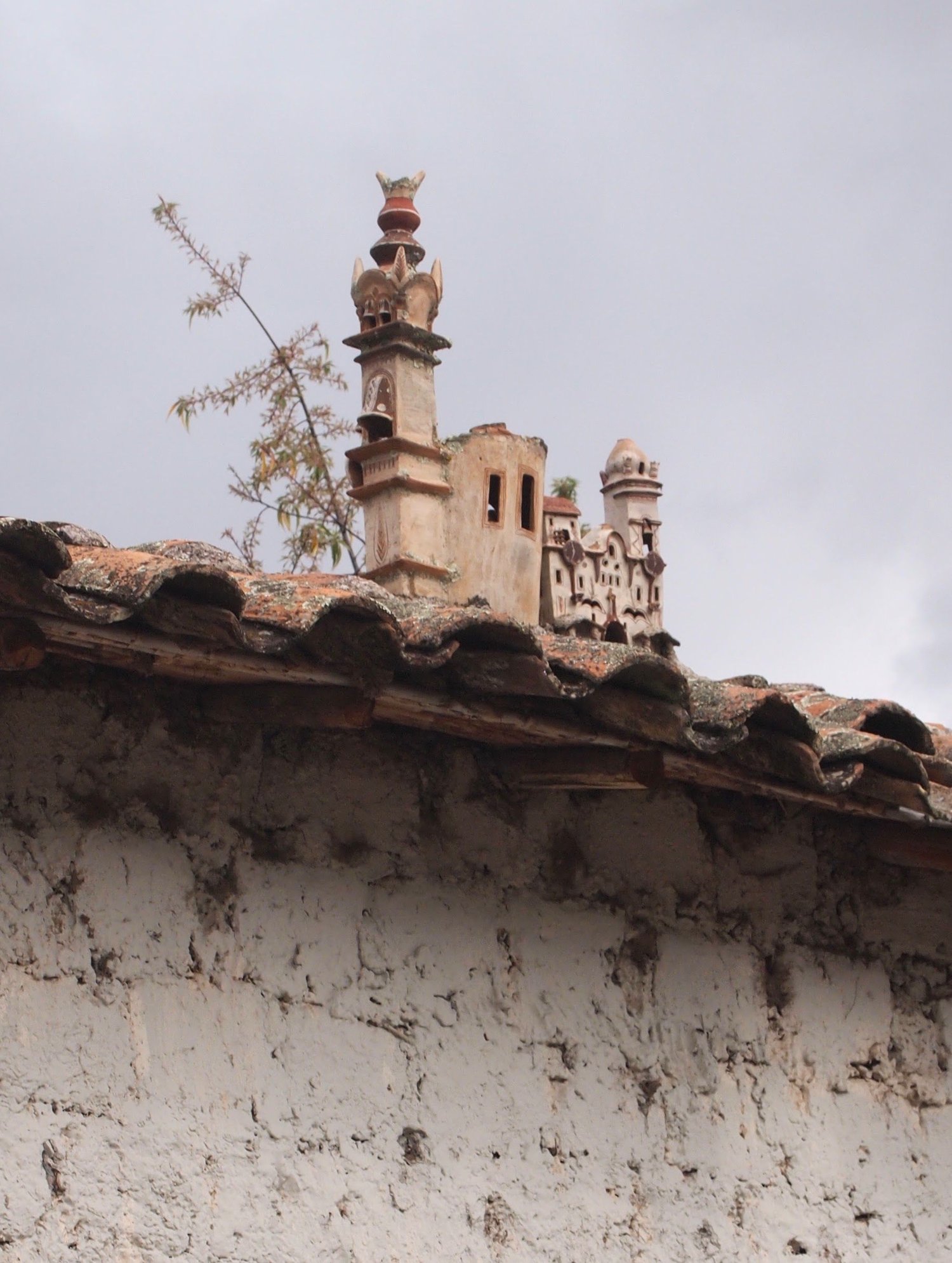
Traditional pottery church on rooftop in Quinua

Jiron 28 de Julio, Casa Olano, Ayacucho
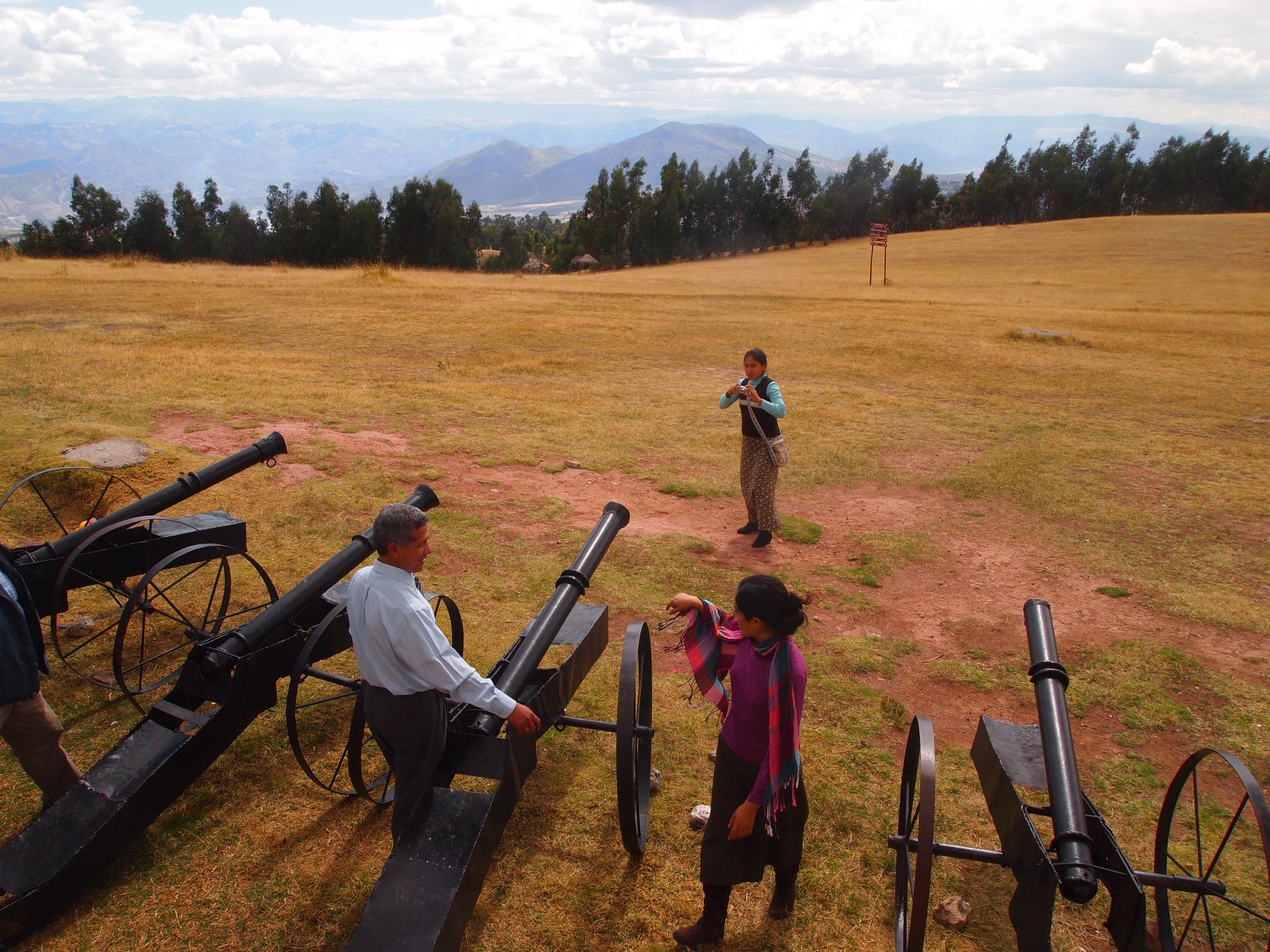
The battlefield at Pampas de Ayacucho
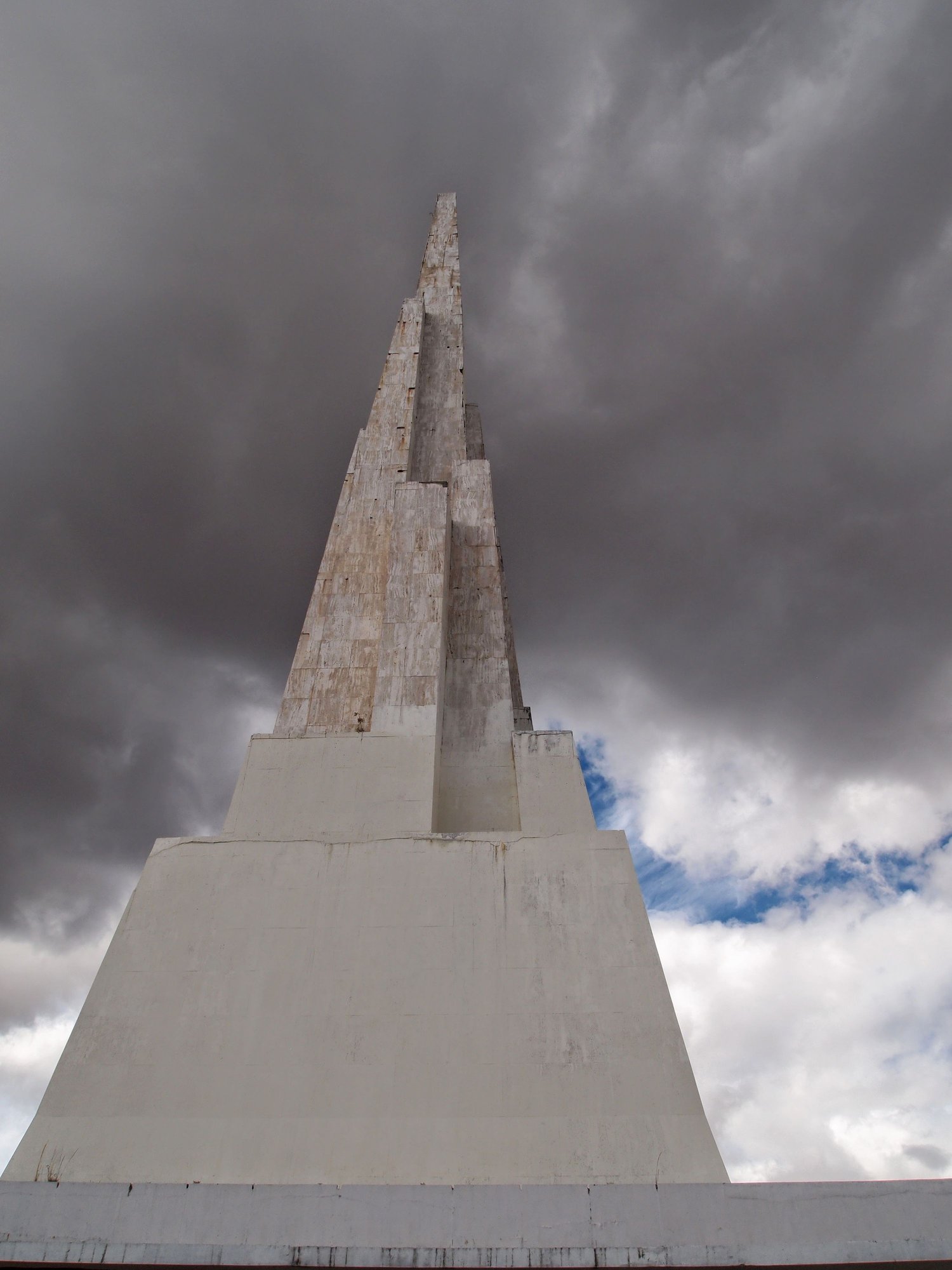
(The Obelisk pretty much as was posted by Faedus)
Main square from Via Via cafe balcony September 2013
One of the colonial church interiors
Traditional pottery church on rooftop in Quinua
Jiron 28 de Julio, Casa Olano, Ayacucho
The battlefield at Pampas de Ayacucho
(The Obelisk pretty much as was posted by Faedus)
Last edited by mlgb; Dec 16th, 2024 at 10:35 AM.
Dec 16th, 2024 | 03:52 PM
#5
Original Poster
Joined: Apr 2022
Posts: 202
Likes: 0
mlgb: Thank you for posting these photos; they add a lot to the report. Your photos are all very nice (rather nicer than mine, I would say!), but I especially liked the way you managed to get that pair of mountains into the near-background of the Pampa de Ayacucho picture. And yours is certainly the most dramatic picture of the Quinua obelisk I've ever seen!
Last edited by Faedus; Dec 16th, 2024 at 04:12 PM.
Dec 17th, 2024 | 08:11 AM
#6
Joined: May 2004
Posts: 9,773
Likes: 0
A couple of photos of the streets in the centre when we were there. Made it a little difficult to get around! Also meant to mention that my sister in law’s sister was kidnapped and killed by Shining Path terrorists when backpacking in the area.
Dec 17th, 2024 | 10:07 AM
#7
Joined: Jan 2005
Posts: 25,597
Likes: 0
Wow crellston you weren't kidding about the streets being torn up! That was what Chachapoyas was like on my last visit there.
Thank you for the complement Faedus. I used a compact Olympus camera back then. The photos were on Picasaweb, which Google has taken over. At least they were not lost in cyberspace.
PS Terrible re the SIL's sister. In 2013 the local guide said that over the mountain range to the east was still unsafe to visit. The closest I ever got was Huancayo when that lovely train ride was running.
Thank you for the complement Faedus. I used a compact Olympus camera back then. The photos were on Picasaweb, which Google has taken over. At least they were not lost in cyberspace.
PS Terrible re the SIL's sister. In 2013 the local guide said that over the mountain range to the east was still unsafe to visit. The closest I ever got was Huancayo when that lovely train ride was running.
Last edited by mlgb; Dec 17th, 2024 at 10:10 AM.
Trending Topics
Dec 17th, 2024 | 08:07 PM
#8
Original Poster
Joined: Apr 2022
Posts: 202
Likes: 0
mlgb: I was actually in Huancayo in 2015, and I rather liked it. I was really on way way to Huancavelica, but due to a couple of careless mistakes, I didn't make it there. Huancayo made for a pleasant stay, though, and it is, presumably, the home of Papas Huancaínas, my favorite Peruvian dish.
crellston : Thanks for the additional photos -- but lest they discourage any potential visitors, I'll point out that I found Ayacucho to be completely fixed up: no more trenches or construction vehicles; the city back back to its aesthetic, Spanish-colonial ambience. Also, it was sad to read of your sister-in-law's tragic misfortune in the Andes. There are people in Ayacucho, as I noted, who are working to keep alive the memory of those times, as a warning of what can happen, and I hope they succeed.
crellston : Thanks for the additional photos -- but lest they discourage any potential visitors, I'll point out that I found Ayacucho to be completely fixed up: no more trenches or construction vehicles; the city back back to its aesthetic, Spanish-colonial ambience. Also, it was sad to read of your sister-in-law's tragic misfortune in the Andes. There are people in Ayacucho, as I noted, who are working to keep alive the memory of those times, as a warning of what can happen, and I hope they succeed.
Last edited by Faedus; Dec 17th, 2024 at 08:18 PM.

Thread
Original Poster
Forum
Replies
Last Post
lasjas
United States
6
Oct 2nd, 2004 09:51 AM


