


Mai Tai Tom Stays On Track Through Belgium, Paris and Strasbourg
 Nov 1st, 2024 | 11:15 AM
#21

Joined: Jun 2003
Posts: 24,040
Likes: 6
I'm glad I'm not the only person who finds the cathedral a crummy waste of time. Secret tip: never visit the cathedral of Lille either.
I'm so glad that Belgium is another country that resists the American desire to overcook its beef. Love it or leave it; Or order something else.
I'm so glad that Belgium is another country that resists the American desire to overcook its beef. Love it or leave it; Or order something else.
 Nov 1st, 2024 | 02:11 PM
#23

Joined: Jan 2007
Posts: 3,526
Likes: 0
Sorry about the Basilique. I don't think you did so badly going there - it's the world's biggest Art Deco church. I once went there for a concert. The couple in front of us was feeding each other sardines from an oily tin on a fork. The woman next to us was sobbing and behind us there was a couple kissing. People were talking. I was trying to listen to the concert but I was really distracted. If you want an even uglier church, Dunkirk has a concrete cathedral with yellow and green glass windows (unsurprisingly built after WWII). Glad I saw it but would be happy never to see it again.
Lavandula
Lavandula
 Nov 1st, 2024 | 02:30 PM
#24
Original Poster
Joined: Mar 2003
Posts: 10,648
Likes: 21
'I'm so glad that Belgium is another country that resists the American desire to overcook its beef. Love it or leave it; Or order something else. '
I always order medium rare and in some cases rare, but there's also a really badly undercooked steak like the ones we had. You know what they say about assuming something. You needed a chainsaw to cut it.
PS - By the way, a steak well done is not a steak well done, if you know what I mean.
'I always order medium rare and in some cases rare, but there's also a really badly undercooked steak like the ones we had. You know what they say about assuming something. You needed a chainsaw to cut it.
PS - By the way, a steak well done is not a steak well done, if you know what I mean.
Last edited by maitaitom; Nov 1st, 2024 at 02:32 PM.
Nov 4th, 2024 | 01:47 PM
#26
Original Poster
Joined: Mar 2003
Posts: 10,648
Likes: 21
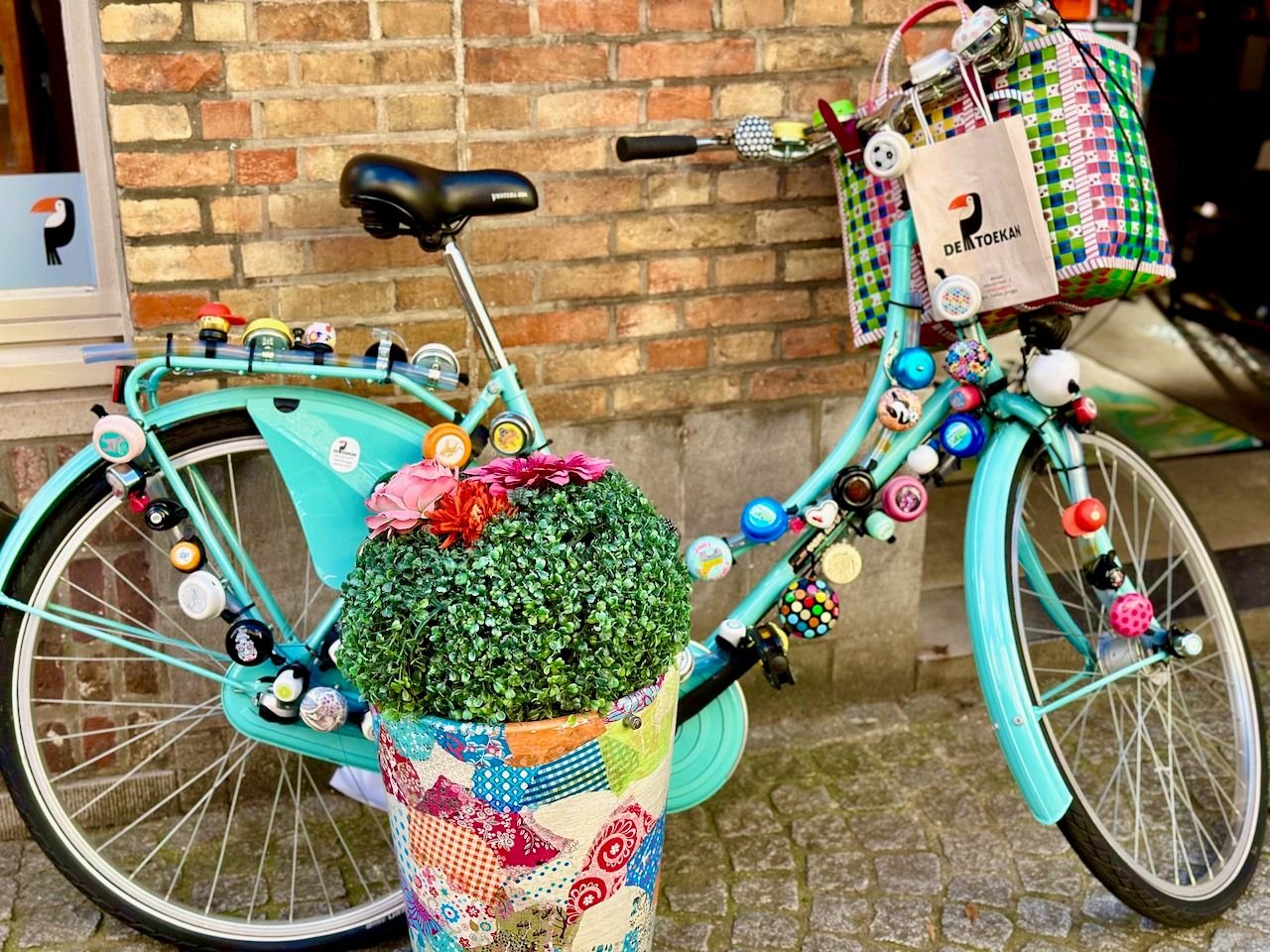
With such a bicycle culture everywhere we traveled in Belgium and France, Tracy decided to honor the late, great Mrs. Gio throughout the trip. As I finish up Day 1 in Bruges in the next day or so, here was our first tribute to Mrs. G

 Nov 8th, 2024 | 09:46 AM
#29
Original Poster
Joined: Mar 2003
Posts: 10,648
Likes: 21
Today, we make it to Brugge (Bruges), where we would spend three nights. We’d admire the lovely canals and town square, visit a church with mysterious relics, walk over a tiny bridge with a legend of love, see the only Michelangelo statue sold outside of Italy during his lifetime (not to mention stolen a couple of times), sample some Belgium brews, watch Tracy gun down predators by the dozens while I danced with some fried friends and end up having dinner at an excellent restaurant where a scene from a well-known movie was filmed. All that, and we still ended up “blue” after dinner. Story with photos in link below...
https://travelswithmaitaitom.com/cha...ree-in-bruges/

Chapter Three: In Bruges
Day Three - Wandering Aimlessly, Canal Zone, Dodging Bicycles, Old Relics (Not Us), Skipping The Palace, Eyes On The Fries, Tracy The Terminator, Beer Break, Please Don’t Stand On The Cow, Marry The First Person You See, Captivating Kerk, From Italy To Bruges, Monuments Men (Part One), Due Diligence To Do Diligence and Blue Markt
Taking an early morning train, we arrived in Bruges after a 50-minute ride. Our hotel for the next three nights would be a pleasant stay at Boutique Hotel Sablon (Kopstraat 10). The hotel has a charming patio area, which sadly we didn’t take advantage of due to some rainy weather and chilly temperatures (wimpy Southern Californians). This statute in the courtyard is of a magician, which the artist claims, “Magicians are the ambassadors of happiness.” We quickly disappeared.
By late morning we were strolling through beguiling Bruges. Being a Thursday, there weren’t the massive crowds we had feared. However, there was some good looking food.
Throughout our trip, Tracy took photos of bicycles she liked, and as were to find out, Bruges (and everywhere else we went) has a ton of bicycles.
It was a short walk to The Markt, an area that has been used as a marketplace since the mid 1900s. It has numerous, brightly colored buildings, including many guild houses. Unlike in Brussels, Bruges uses real horses to transport lazy people around town.
This statue in the square is from the 1880s and is of 14th-century revolutionaries Jean Breydel and Pieter de Coninck.
I tried to feign climbing inside the car, but instead I look like I’m … let’s just move on.
We wandered around town for a spell and realized we had basically just walked in a circle, which we seem to do in many cities. Although we were virtually next to the Rozenhoedkaai (Rosary Quai), the brain trust walked in the opposite direction.
Obviously we needed some caffeine, so Kim and Mary went to grab some, while Tracy and I ducked in to Sint-Salvatorskathedraal (Saint Saviour's Cathedral). It’s the oldest church in Bruges, with construction begun more than 1,000 years ago.
By now hunger had beaten out history, so we skedaddled pretty quickly.
After hearing rave reviews of how lovely Bruges was, we were happy the city lived up to expectations. It was really peaceful walking through different parts of town (for the most part).
However, one has to be alert as they walk. Bicyclists (mostly on their way to work, I assume) and pedestrians co-exist here on an up-close level. While many of those on two wheels are polite and even ring their bell when coming up from behind, there are a good number who think they’re Lance Armstrong (although perhaps not on steroids), and zip through town very fast, often narrowly missing their pedestrian counterparts. To be honest, it was a bit disconcerting at times. However, Bruges was not nearly as dangerous for pedestrians as a city we visited later on this trip (stay tuned).
We finally made it to the Rozenhoedkaai at the junction of the Dijver and Groenerei canals. This area is one of the, if not the, most photographed places in Bruges.
After admiring canals, we stopped to take a look at the exterior of Bruges Stadhuis (City Hall). It is one of the oldest city halls in the low country, begun in the late 1300s. One of our many mistakes on this trip was not buying a ticket to see the Stadhuis, which includes the adjacent Brugse Vrije (Palace of the Liberty of Bruges).
A nondescript entrance in the corner of The Burg on the other side led to the Basiliek van het Heilig-Bloed (Basilica of the Holy Blood), built in the 12th century as a chapel for the Count of Flanders. In 1150, the King of Jerusalem (Baldwin III) gave the Count of Flanders “a cloth allegedly soaked with the blood of Christ.” He brought it here. The vial of blood is located at this basilica (there are more than a couple of stories how it came to be here).
The lower chapel is dedicated to St. Basil.
We entered the Chapel of St. Ives. Built in 1504, it holds the relics of St. Basil and Charles The Good.
The chapel was very small, and we wondered how did this become a basilica (that’s Basil the Great in the center)?
On the way out, we almost missed the upper chapel until Tracy noticed people going up the stairs and wanted to see what they were looking at.
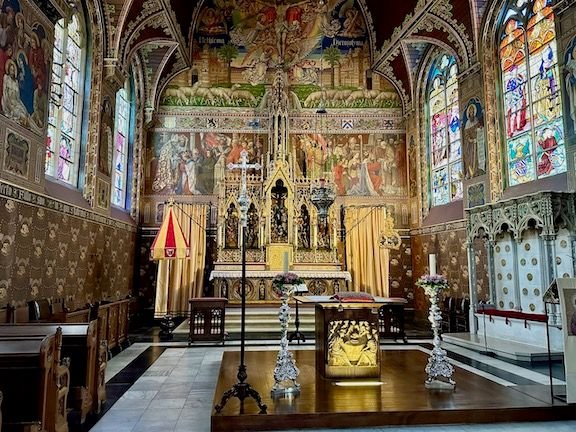
Wow! Now we know why, in 1923, it was declared a minor basilica. Vibrant colors have had some observe that it looks like a “Venetian-like palace-of-a-church.” It’s quite stunning.
The painting behind the altar is The Mystery of the Cross painted in 1905. The lower part depicts the vial coming to Bruges.
One of the prettiest chapels we have visited in recent memory.
And the actual vial? It’s located in below opulent tabernacle. At certain hours the vial is brought out so visitors can see and touch it (for the price of a donation).
The basilica museum contains the Reliquary of Albert and Isabella …
… Maria of Burgundy’s 15th century crown …
… the Great Reliquary of the Holy Blood …
… along with a 16th-century candle holder.
Ever since Portugal, Tracy likes to take photos of me walking down the stairs in case there’s some unexpected tumbling.
It was a spectacular day for walking Bruges, but I had my eye on a potato museum, although some might see it as a half-baked idea.
It was time to get our frites on at the Frietmuseum, which bills itself as “the world’s only museum dedicated to pommes frites.”
Here we learned about the roots of the potatoes (in more ways than one) and cultivating potatoes, while also learning that the first potato arrived in Belgium in November 1567 with a shipment from the Canary Islands.
The museum was only mildly interesting, until …
… we reached a room that Rambo would have loved. There we encountered the evil Potato Bug. But not to worry, we became Potato Troopers, and, in an arcade-style game, we gunned down as many of the little buggers as we could. Sadly, Tracy’s score blew me away, which is why I have banned all weapons in our house.
My favorite part of the museum was the Fritt’ Kaberet, where they had dancing and singing frites. Can there be anything better than being on Dancing With The Frites?
We ended up with a couple of goofy photos. It’s a place if short of time you could certainly pass on, but all in all, thanks to killing bugs and dancing with frites, it turned out to be kinda fun at the end.
Back on the street, we passed by a statue of a man who I called, The Birdman of Bruges. In reality, it is of Papageno, a character in Mozart’s opera The Magic Flute. Instead of a bird in the hand, it was a bird on the head.
Also on our walk through town was a store whose sweet motto resonated with me.
Earlier in the day we had strolled by a cow, albeit not a real one. It stood at the entrance of Brouweru Bourgnone des Flandres (Kartuizerinnenstraat 6).
We stopped in to the brewery to sample a cold one or two. We called Kim and Mary to join us, but warned them to not “stand on the cow.” That piqued their interest enough to come by.
We had tapped in to a refreshing spot.
Although we did not take part, they offer tours and flights of beer.
We sat at the bar, but as we walked toward our next stop, we saw they had a charming terrace overlooking the canal. Next time.
Speaking of that next stop, I had read about a famous little bridge in town located near Onze-Lieve-Vrouwekerk (Church of Our Lady).
Built in 1910, the stone Bonifaciusbrug looks ancient and is also known as “The Bridge of Love at First Sight.” Legend goes that you will marry the first person that you see after crossing the bridge. At first glance, I would have been charged with bigamy if the legend had been true.
I really liked this little area.
Ever since I was a kid, I have been obsessed with who is on various statues. Among other things, Juan Luis Vives was “a Spanish humanist, eminent in education, philosophy, and psychology.” Many call him the “father of modern psychology.” Maybe he could have helped me with my statue obsession.
Next, we stepped inside Onze-Lieve-Vrouwekerk, built between the 14h and 16th centuries.
Seen here behind the Gruuthusemuseum (which we’d visit tomorrow), it is “the third tallest brickwork tower in the world.”
The others can’t hold a candle to it.
Although the church is free to visit, there is a charge to see the artifacts of the church O.L.V.-Kerk Museum, which contains Michelangelo’s only piece of artwork that left Italy during his lifetime.
A reliquary containing part of the arm of St. Anthony the Abbot. In 1531, the people of Bruges picked him as Patron against the Plague.
A couple of late 17th century confessionals were interesting.
There was the Da Baenst Chapel and a 16th century Pieter Pourbus triptych, The Adoration of the Shepherds.
The most stunning chapel, in my opinion, was the Blessed Sacrament Chapel.
Gerard David’s early 16th century The Transformation of Jesus on Mount Tabor is a prized piece.
We happened upon a room containing tombs from 1501 of Mary of Burgundy and her father Charles the Bold. Mary was the daughter of Charles The Bold, the last duke of Burgundy. She was only 20 when her father was killed in the Battle of Nancy.
Sadly, only five years later, Mary was killed while on a falcon hunt when her horse tripped, throwing her into a ditch and then landing on top of her. She died a few weeks later, and in 1482 was buried at Onze-Lieve-Vrouwekerk.
She was married to Maximilian of Austria, who was devastated and commissioned her tomb. At the foot of her tomb is a dog.
The choir here is impressive with 30 Coats of Arms of the Knights of the Golden Fleece
The piece de resistance of the museum is the Madonna of Bruges, Michaelangelo’s early 16th-century sculpture, and the only sculpture by Michelangelo to be sold outside Italy during his lifetime. It has had quite a history. It was confiscated by French revolutionaries in 1794, but then returned in 1816.
The sculpture was once again stolen, this time by Nazis fleeing Bruges in 1945. Hidden in a salt mine in Austria, it was recovered in 1946 by the group known as The Monuments Men, and returned to Bruges. It’s an integral part of George Clooney’s 2014 movie The Monuments Men. The statue was actually smaller than I thought it would be from the movie. (BTW … Tracy said the book was better.)
Before exiting we took at look at the 17th century painting The Adoration of the Magi.
Finally, we gazed at this 18th century rococo pulpit.
Shortly thereafter, we received an alert, that a 5.0 earthquake had hit near our house. Of course, the over-concerned pet parents called our petsitter who said, “What earthquake?” I guess it wasn’t that bad.
On the way to dinner that evening we glanced at the King Charles II Memorial on the side of the Grand Hotel Casselbergh. Charles, when he was a prince, sought exile in Bruges during the English Civil War. His history is quite interesting.
Doing my due diligence, I had made a dinner reservation at Diligence (Hoogstraat 5). It was the first of three great dinners we enjoyed in Bruges.
It was a cozy little bistro featuring Belgian/French cuisine, and as Tracy noted, “Our server was a hoot!” As he explained the beer special (buy four beers and get one bottle to go), Kim asked wistfully, “Where were you in my 20s?”
Without missing a beat, our server replied, “Not alive yet.” Ouch!
Then Mary, forgetting she was talking with someone whose first language was not English, asked, “Does Bruges get ‘nutso’ on weekends?” I wish I had taken a picture of his perplexed face.
The beer of the night was Kim’s Grimbergen Dark.
Kim, Tracy and I all ordered the Flemish Stew, which our server assured us was “the best in all of Bruges.” It was excellent, and Tracy was happy I ate some vegetables on the trip. I told her pommes frites were vegetables, but she just shook her head.
Mary enjoyed her sea bass.
Diligence was one of the places where the movie “In Bruges” was filmed. Diligance is where the bar scene featuring actor Jordan Pentrice, a self described “person of short stature,” met up with a prostitute. I guess I should watch it.
I had made early reservations for dinner on many evenings in order to get blue hour photos. On this night, the weather cooperated. We had finished just in time.
It was was very chilly …
… and the wind was whipping.
We took one last look at the Belfry …
… and slowly made our way back to the hotel.
The following day in Bruges would be another busy one. In the morning we’d visit two museums, check out a Middle Ages charitable hospital, use our noodles to find a delicious lunch, stroll through town over to a beguinage and serene lake, relax on the patio of a hotel with a grand view, have dinner at an ultra-charming restaurant, and then risk a coronary event to take blue hour photos back at the Rozenhoedkaai.
Next - Chapter Four: Bruges Is More Than A Day Trip
https://travelswithmaitaitom.com/cha...ree-in-bruges/
Chapter Three: In Bruges
Day Three - Wandering Aimlessly, Canal Zone, Dodging Bicycles, Old Relics (Not Us), Skipping The Palace, Eyes On The Fries, Tracy The Terminator, Beer Break, Please Don’t Stand On The Cow, Marry The First Person You See, Captivating Kerk, From Italy To Bruges, Monuments Men (Part One), Due Diligence To Do Diligence and Blue Markt
Taking an early morning train, we arrived in Bruges after a 50-minute ride. Our hotel for the next three nights would be a pleasant stay at Boutique Hotel Sablon (Kopstraat 10). The hotel has a charming patio area, which sadly we didn’t take advantage of due to some rainy weather and chilly temperatures (wimpy Southern Californians). This statute in the courtyard is of a magician, which the artist claims, “Magicians are the ambassadors of happiness.” We quickly disappeared.
By late morning we were strolling through beguiling Bruges. Being a Thursday, there weren’t the massive crowds we had feared. However, there was some good looking food.
Throughout our trip, Tracy took photos of bicycles she liked, and as were to find out, Bruges (and everywhere else we went) has a ton of bicycles.
It was a short walk to The Markt, an area that has been used as a marketplace since the mid 1900s. It has numerous, brightly colored buildings, including many guild houses. Unlike in Brussels, Bruges uses real horses to transport lazy people around town.
This statue in the square is from the 1880s and is of 14th-century revolutionaries Jean Breydel and Pieter de Coninck.
I tried to feign climbing inside the car, but instead I look like I’m … let’s just move on.
We wandered around town for a spell and realized we had basically just walked in a circle, which we seem to do in many cities. Although we were virtually next to the Rozenhoedkaai (Rosary Quai), the brain trust walked in the opposite direction.
Obviously we needed some caffeine, so Kim and Mary went to grab some, while Tracy and I ducked in to Sint-Salvatorskathedraal (Saint Saviour's Cathedral). It’s the oldest church in Bruges, with construction begun more than 1,000 years ago.
By now hunger had beaten out history, so we skedaddled pretty quickly.
After hearing rave reviews of how lovely Bruges was, we were happy the city lived up to expectations. It was really peaceful walking through different parts of town (for the most part).
However, one has to be alert as they walk. Bicyclists (mostly on their way to work, I assume) and pedestrians co-exist here on an up-close level. While many of those on two wheels are polite and even ring their bell when coming up from behind, there are a good number who think they’re Lance Armstrong (although perhaps not on steroids), and zip through town very fast, often narrowly missing their pedestrian counterparts. To be honest, it was a bit disconcerting at times. However, Bruges was not nearly as dangerous for pedestrians as a city we visited later on this trip (stay tuned).
We finally made it to the Rozenhoedkaai at the junction of the Dijver and Groenerei canals. This area is one of the, if not the, most photographed places in Bruges.
After admiring canals, we stopped to take a look at the exterior of Bruges Stadhuis (City Hall). It is one of the oldest city halls in the low country, begun in the late 1300s. One of our many mistakes on this trip was not buying a ticket to see the Stadhuis, which includes the adjacent Brugse Vrije (Palace of the Liberty of Bruges).
A nondescript entrance in the corner of The Burg on the other side led to the Basiliek van het Heilig-Bloed (Basilica of the Holy Blood), built in the 12th century as a chapel for the Count of Flanders. In 1150, the King of Jerusalem (Baldwin III) gave the Count of Flanders “a cloth allegedly soaked with the blood of Christ.” He brought it here. The vial of blood is located at this basilica (there are more than a couple of stories how it came to be here).
The lower chapel is dedicated to St. Basil.
We entered the Chapel of St. Ives. Built in 1504, it holds the relics of St. Basil and Charles The Good.
The chapel was very small, and we wondered how did this become a basilica (that’s Basil the Great in the center)?
On the way out, we almost missed the upper chapel until Tracy noticed people going up the stairs and wanted to see what they were looking at.
Wow! Now we know why, in 1923, it was declared a minor basilica. Vibrant colors have had some observe that it looks like a “Venetian-like palace-of-a-church.” It’s quite stunning.
The painting behind the altar is The Mystery of the Cross painted in 1905. The lower part depicts the vial coming to Bruges.
One of the prettiest chapels we have visited in recent memory.
And the actual vial? It’s located in below opulent tabernacle. At certain hours the vial is brought out so visitors can see and touch it (for the price of a donation).
The basilica museum contains the Reliquary of Albert and Isabella …
… Maria of Burgundy’s 15th century crown …
… the Great Reliquary of the Holy Blood …
… along with a 16th-century candle holder.
Ever since Portugal, Tracy likes to take photos of me walking down the stairs in case there’s some unexpected tumbling.
It was a spectacular day for walking Bruges, but I had my eye on a potato museum, although some might see it as a half-baked idea.
It was time to get our frites on at the Frietmuseum, which bills itself as “the world’s only museum dedicated to pommes frites.”
Here we learned about the roots of the potatoes (in more ways than one) and cultivating potatoes, while also learning that the first potato arrived in Belgium in November 1567 with a shipment from the Canary Islands.
The museum was only mildly interesting, until …
… we reached a room that Rambo would have loved. There we encountered the evil Potato Bug. But not to worry, we became Potato Troopers, and, in an arcade-style game, we gunned down as many of the little buggers as we could. Sadly, Tracy’s score blew me away, which is why I have banned all weapons in our house.
My favorite part of the museum was the Fritt’ Kaberet, where they had dancing and singing frites. Can there be anything better than being on Dancing With The Frites?
We ended up with a couple of goofy photos. It’s a place if short of time you could certainly pass on, but all in all, thanks to killing bugs and dancing with frites, it turned out to be kinda fun at the end.
Back on the street, we passed by a statue of a man who I called, The Birdman of Bruges. In reality, it is of Papageno, a character in Mozart’s opera The Magic Flute. Instead of a bird in the hand, it was a bird on the head.
Also on our walk through town was a store whose sweet motto resonated with me.
Earlier in the day we had strolled by a cow, albeit not a real one. It stood at the entrance of Brouweru Bourgnone des Flandres (Kartuizerinnenstraat 6).
We stopped in to the brewery to sample a cold one or two. We called Kim and Mary to join us, but warned them to not “stand on the cow.” That piqued their interest enough to come by.
We had tapped in to a refreshing spot.
Although we did not take part, they offer tours and flights of beer.
We sat at the bar, but as we walked toward our next stop, we saw they had a charming terrace overlooking the canal. Next time.
Speaking of that next stop, I had read about a famous little bridge in town located near Onze-Lieve-Vrouwekerk (Church of Our Lady).
Built in 1910, the stone Bonifaciusbrug looks ancient and is also known as “The Bridge of Love at First Sight.” Legend goes that you will marry the first person that you see after crossing the bridge. At first glance, I would have been charged with bigamy if the legend had been true.
I really liked this little area.
Ever since I was a kid, I have been obsessed with who is on various statues. Among other things, Juan Luis Vives was “a Spanish humanist, eminent in education, philosophy, and psychology.” Many call him the “father of modern psychology.” Maybe he could have helped me with my statue obsession.
Next, we stepped inside Onze-Lieve-Vrouwekerk, built between the 14h and 16th centuries.
Seen here behind the Gruuthusemuseum (which we’d visit tomorrow), it is “the third tallest brickwork tower in the world.”
The others can’t hold a candle to it.
Although the church is free to visit, there is a charge to see the artifacts of the church O.L.V.-Kerk Museum, which contains Michelangelo’s only piece of artwork that left Italy during his lifetime.
A reliquary containing part of the arm of St. Anthony the Abbot. In 1531, the people of Bruges picked him as Patron against the Plague.
A couple of late 17th century confessionals were interesting.
There was the Da Baenst Chapel and a 16th century Pieter Pourbus triptych, The Adoration of the Shepherds.
The most stunning chapel, in my opinion, was the Blessed Sacrament Chapel.
Gerard David’s early 16th century The Transformation of Jesus on Mount Tabor is a prized piece.
We happened upon a room containing tombs from 1501 of Mary of Burgundy and her father Charles the Bold. Mary was the daughter of Charles The Bold, the last duke of Burgundy. She was only 20 when her father was killed in the Battle of Nancy.
Sadly, only five years later, Mary was killed while on a falcon hunt when her horse tripped, throwing her into a ditch and then landing on top of her. She died a few weeks later, and in 1482 was buried at Onze-Lieve-Vrouwekerk.
She was married to Maximilian of Austria, who was devastated and commissioned her tomb. At the foot of her tomb is a dog.
The choir here is impressive with 30 Coats of Arms of the Knights of the Golden Fleece
The piece de resistance of the museum is the Madonna of Bruges, Michaelangelo’s early 16th-century sculpture, and the only sculpture by Michelangelo to be sold outside Italy during his lifetime. It has had quite a history. It was confiscated by French revolutionaries in 1794, but then returned in 1816.
The sculpture was once again stolen, this time by Nazis fleeing Bruges in 1945. Hidden in a salt mine in Austria, it was recovered in 1946 by the group known as The Monuments Men, and returned to Bruges. It’s an integral part of George Clooney’s 2014 movie The Monuments Men. The statue was actually smaller than I thought it would be from the movie. (BTW … Tracy said the book was better.)
Before exiting we took at look at the 17th century painting The Adoration of the Magi.
Finally, we gazed at this 18th century rococo pulpit.
Shortly thereafter, we received an alert, that a 5.0 earthquake had hit near our house. Of course, the over-concerned pet parents called our petsitter who said, “What earthquake?” I guess it wasn’t that bad.
On the way to dinner that evening we glanced at the King Charles II Memorial on the side of the Grand Hotel Casselbergh. Charles, when he was a prince, sought exile in Bruges during the English Civil War. His history is quite interesting.
Doing my due diligence, I had made a dinner reservation at Diligence (Hoogstraat 5). It was the first of three great dinners we enjoyed in Bruges.
It was a cozy little bistro featuring Belgian/French cuisine, and as Tracy noted, “Our server was a hoot!” As he explained the beer special (buy four beers and get one bottle to go), Kim asked wistfully, “Where were you in my 20s?”
Without missing a beat, our server replied, “Not alive yet.” Ouch!
Then Mary, forgetting she was talking with someone whose first language was not English, asked, “Does Bruges get ‘nutso’ on weekends?” I wish I had taken a picture of his perplexed face.
The beer of the night was Kim’s Grimbergen Dark.
Kim, Tracy and I all ordered the Flemish Stew, which our server assured us was “the best in all of Bruges.” It was excellent, and Tracy was happy I ate some vegetables on the trip. I told her pommes frites were vegetables, but she just shook her head.
Mary enjoyed her sea bass.
Diligence was one of the places where the movie “In Bruges” was filmed. Diligance is where the bar scene featuring actor Jordan Pentrice, a self described “person of short stature,” met up with a prostitute. I guess I should watch it.
I had made early reservations for dinner on many evenings in order to get blue hour photos. On this night, the weather cooperated. We had finished just in time.
It was was very chilly …
… and the wind was whipping.
We took one last look at the Belfry …
… and slowly made our way back to the hotel.
The following day in Bruges would be another busy one. In the morning we’d visit two museums, check out a Middle Ages charitable hospital, use our noodles to find a delicious lunch, stroll through town over to a beguinage and serene lake, relax on the patio of a hotel with a grand view, have dinner at an ultra-charming restaurant, and then risk a coronary event to take blue hour photos back at the Rozenhoedkaai.
Next - Chapter Four: Bruges Is More Than A Day Trip
Nov 8th, 2024 | 12:40 PM
#30
Joined: Jan 2007
Posts: 3,526
Likes: 0
I also wondered why the Basilica was a basilica. I think it's because it is a place of pilgrimage:
https://en.wikipedia.org/wiki/Basili...the_Holy_Blood
https://en.wikipedia.org/wiki/Basili...atholic_Church
I didn't know why, I just thought it had to be big to be a basilica (but evidently not). Looks like you had a really nice time in Bruges (sometimes you need silly photos to bring a smile to the face ). How could you go wrong with a frietjes museum?
Lavandula
https://en.wikipedia.org/wiki/Basili...the_Holy_Blood
https://en.wikipedia.org/wiki/Basili...atholic_Church
I didn't know why, I just thought it had to be big to be a basilica (but evidently not). Looks like you had a really nice time in Bruges (sometimes you need silly photos to bring a smile to the face
). How could you go wrong with a frietjes museum?Lavandula
Nov 16th, 2024 | 10:27 AM
#32
Original Poster
Joined: Mar 2003
Posts: 10,648
Likes: 21
Lots to see in Bruges. Don’t see it as just a day trip. Today we’d hit Groeningemuseum, Gruuthusemuseum and Sint-Jansspitaal (Museum of St. John’s Hospital), before enjoying a great Thai lunch. Then it was off to Minnewaterpark with cool views, walk by a 13th-century beguinage and enjoy a beer at a “shabby chic”castle, chat with the swans and rest up a bit at a canal side restaurant for for our own Happy Hour. It was back to Minnewaterpark for dinner, and finally a mad dash to see if we could catch some blue hour photos at the Rosary Quay. (story with photos in link below).
https://travelswithmaitaitom.com/cha...an-a-day-trip/

Chapter Four: Bruges Is Much More Than A Day Trip
Day Four: Get a Room!, The Flemish Primitives, A Home Attached To The Church, Don’t Dust The Unicorn, Not Your Average Hospital, Losing My Cookies, Using Our Noodles, Topless Bartenders, Begin The Béguine, Lake Of Love (And Death), Beer At A “Shabby Chic” Castle, Hot Chocolate & Wine, One Restaurant I Wanted To Try & Turning Blue Looking For Blue
Up early again because we had 10 a.m. reservations at the Groeningemuseum, and we were hungry. In the lobby of Hotel Sablon, we saw more of the many pieces of art the hotel displays. These guys obviously knew the ropes.
We stopped for the requisite canal photos as we strolled through town.
As we approached Bonifaciusbrug (Boniface Bridge) Tracy and I explored the nearby Arentshof Park, which contained numerous statues.
The most interesting were De Vier Ruiters van de Apocalyps (The Four Horsemen of the Apocalypse), Revolution, War, Hunger and Death were represented, but we cut to the chase and just took photos of hunger and death in the park, virtually in the shadow of Onze-Lieve-Vrouwekerk.
Reaching the bridge, we took some photos …
… but then Tracy and I witnessed something which is still etched in our minds. In a secluded area near the bridge, it looked like Kim and Mary were becoming quite amorous in a serious public display of affection. As it turned out, she was just helping crack Kim’s back (or so they claim).
It was a short walk from there …
… to the Groeningemuseum. It was here we would learn about the Flemish Primitives, which at this time in the 15th century was a new movement in painting, started by Jan van Eyck, Robert Campin and an old favorite of ours, Rogier van der Weyden.
We first learned of him in 2015 when here was an exhibition of his work at the Prado in Madrid. In 2016, we were also wowed by his famed Beaune Altarpiece (Last Judgement) at Hospices de Beaune in France.
There are two copies of his work here, The Portrait of Philip The Good wearing the Order of the Golden Fleece, and Saint Luke Drawing The Madonna.
Here are two of van Eycks creations. His Madonna with Canon Joris van der Paele is considered one of the museum’s top masterpieces, complete with St. George giving a tip of his hat.
Hans Memling worked in van der Weyden’s workshop.
From the Death and the Miser to the The Martyrdom of Saint Catherine, there are plenty of end of life paintings …
… like this corrupt judge being flayed to death in The Judgement of Cambyses by Gerard David.
An interesting character enters from the right in The Last Supper by Pieter Pourbus.
And here we have The Death of the Virgin.
Even Lord Byron could not escape his death bed. Does anybody live in these paintings?
The museum has a Bosch … or does it? The Last Judgement had been attributed to Bosch, his workshop or a collaboration of the two. From The Garden of Eden on the left to Hell on the right and weird stuff with imaginary creatures going on in between, I loved it. I might need psychological help.
I also patiently enjoyed his Triptych of Job.
More death awaited Belisarius’ wife.
Finally some positiveness in the Allegory of the Peace of the Low Countries from the 16th century. The painting symbolizes peace between the Catholic and Protestant provinces.
The paintings of Archdukes Albert and Isabella and our trip through six centuries of art by Belgian artists was complete. It turned out to be quite a fascinating learning experience.
How do people know which one is theirs?
In a matter of minutes we were at the next of three museums of the day. I seem to be getting a little cocky (especially since it was raining) at this stair navigation thing.
The Gruuthusemuseum takes a look at 500 years of Bruges history. Located in a palace built in the late 1400s, it served as the “base of operations” for the Gruuthuse family, and contains a number of artifacts that bring to life those five centuries. Luis of Bruges (aka Louis of Gruuthuse) was a wealthy man thanks to … beer. At the time, according to the Visit Flanders website, there “was a consumption tax on gruit, then an important component of beer. With few exceptions, it was forbidden to brew, distribute or import beer that was not prepared with this family’s gruit.” The house is even connected to OLV-kerk.
Between St. Michael and St. George, it was tough being a dragon.
We might be nuts, but if there is something with a squirrel, it will be photographed.
There was lots of interesting furniture pieces like this cabinet from the late 17th century.
She’s on top of the world in this tapestry …
… along with other artwork in this room.
This late 18th-century fan depicts a “marriage proposal in a pastoral landscape.”
We wound up a circular staircase with stained-glass windows and more tapestries.
Gruuthuse had his own private chapel that was connected to O.L.V.-kerk. This tapestry from the Rubens workshop is entitled The Piety of Hannah.
As expected, there were lots of religious artifacts.
Unfortunately there was a large group of people, which made getting to the oratory and seeing the window that actually looks into part of Onze-Lieve-Vrouwekerk virtually impossible. This photo is courtesy of Visit Flanders.
The terrace has some nice views out toward Bruges.
The poster of the Bruges 1907 Exposition stood out in the next room.
Usually on these trips, I’m the one who gets reprimanded. This time, however, it was Mary. As we descended the staircase there was a statue of a unicorn. Mary must have seen a little dust, and being the impeccable housekeeper that she is, attempted to dust it. From out of nowhere a loud “Non!” was heard.
We took a glance at the decoratively carved ceiling, and our time at the Gruuthuse Museum was history.
Kim and Mary took off for O.L.V.-kerk, which they had skipped the day before. Before leaving, we admonished Mary not to dust the Michelangelo Madonna. Meanwhile we were off to the hospital … for historical purposes only.
Along with the Groeningemuseum, Sint-Jansspitaal & Memlingmuseum are two of the biggest biggest tickets in town.
People who rode these type of bicycles were far more cognizant of pedestrians.
Before entering Sint-Jansspitaal (Museum of St. John’s Hospital) and Memlingmuseum, was a sculpture called Pax (or Kiss of Peace). It shows two monks attempting to comfort each other after their monastery was bombed during World War II.
While I have been known to frequent hospitals on other trips, this was only to see one of the oldest preserved hospital buildings in Europe. In the 12th century, the hospital was a refuge for those who needed medical care or even just a place to sleep. Today it is also a museum with many treasures, some by the great early Netherlandish, Flemish Primitive Hans Memling, which included the altarpiece of John the Baptist and John the Evangelist. He was a German, who emigrated to Bruges … but I’m getting ahead of myself.
People who came to Sint-Jansspitaal were treated with respect and kindness, along with receiving food and even a cold brew or two.
Nuns were the caretakers.
They followed the rule of St. Augustine, who was often depicted with a burning arrow.
I took a quick glance in another direction and wondered, “Why is that woman holding a pig?” As it turned out, the woman was part of the contemporary sculpture, The Bridge. It’s “a woman lovingly embracing a chimaera, half human, half pig.” The lesson is to love people regardless of race, religion or belief.
This “Christmas crib” is from the mid 15th century. It’s called that because sisters “rocked the crib” (sounds like a dance party) of baby Jesus.
Some of the sick were transported to the hospital in this Sedan Chair.
The Whisper Sofa, which had recently been installed, also has a message. The artists asked people of Bruges “to donate garments of loved ones” to the hospital. Along with personal testimonies, the artists made this sofa in an attempt to deal with sorrow and grief.
Patients were given hope by touching the remains of saints. Apollonia was supposed to help with toothaches. Cornilius with fits and Roch with the plague. When all else failed Ursula and Barbara made sure you didn’t die suddenly, so you’d be prepared for life after death.
We passed by the chapel …
… and then it was time to see Memling’s ultimate masterpiece, The Shrine of Ursula. This gilded, mini-cathedral tells the tale of Saint Ursula with a set of paintings. The shrine supposedly “preserved the relics of 11,000 virgins.” No, I’m not going there.
On one side of the shrine, Ursula is shown protecting her “companions” while holding the arrow that killed her. It is an impressive piece to say the least.
Before leaving we saw one more Memling painting …
… and a painting of the old wards that has recently been restored. Another memorable stop in Bruges.
Out in the courtyard we could have stopped at the sister Apothecary, but we had already stopped to get preventative cough medicine, plus we were starving.
In search of a restaurant, instead we came upon a vibrant store that flaunted an array of macarons. I was unable to resist the urge.
We bought a couple, which were put in a box. Outside, Tracy took a lovely photo and then handed off the box to me for some reason. I fumbled the pass and the two macarons lay dead on the cobblestones. The scene was so horrific we couldn’t even a take photo of the deceased sweets. We went back inside and purchased two more, with Tracy handing me one … carefully.
Walking through Bruges, there are a plentiful amount of Ave Maria figures.
I told Tracy that that was a lovely display of purses. She told me that they weren’t really purses, but chocolate. I didn’t dare try to pick one up.
Now very hungry and deciding we could not just live on Flemish stew alone, we discovered Marco Polo, where we decided to Thai one on.
The mother-daughter combo cooked up some delicious dishes that really hit the spot.
They were very nice, too. If in town, give it a try when you need a diversion.
This sign might be as clever as any one I’ve seen.
We texted Kim and Mary to meet us at another brewery. We hopped on over to Huisbrouwerij De Halve Maan, which I had read was the most popular brewery in Bruges. And they were right. It was filled with damn tourists, so locals like us just decided to leave in search of greener pastures.
Dear God, they’re everywhere!
We headed toward Minnewaterpark and first passed by One restaurant, which is actually the name, We had reservations for dinner on this evening.
Not far from there was Sashuis (Lock keeper’s house), a 16th century former masterpiece guardian house. It seems locks were built here in the 12th century, and “this building regulated the water management for the Bruges canals until the 1970s.”
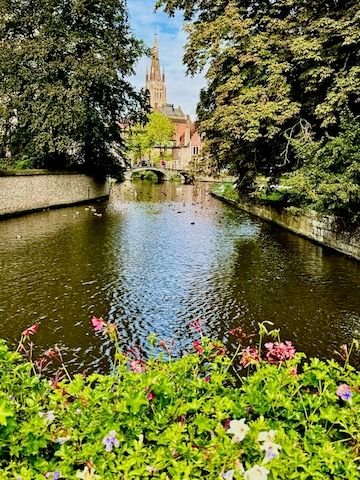
We took in a terrific view of Onze-Lieve-Vrouwekerk.
Next up were a row of whitewashed houses. Beginjnhof is a 13th-century beguinage (“an architectural complex which was created to house beguines: lay religious women who lived in community without taking vows or retiring from the world”). Today it houses Benedictine nuns.
Two lovely couples stop for a brief respite.
A building had dominated our views as we strolled around the lake, and it looked like it had a patio where four weary souls could find comfort in a libation.
We arrived at Kasteel Minnewater, and sure enough there was a terrace upon which to relax and have a beer and wine. The setting is charming, but the property has seen better days. I kind of worried when I saw this sign. Tracy called it, “shabby chic.” That was good enough for us and after finishing our drinks, we were on our way again. Somebody could turn this into quite a moneymaker.
We came upon the only part of Minnewaterpark that one can feed the swans. I think they knew it. There are many legends surrounding what is called The Lake of Love.
Once upon a time, “a young maiden whose name was Minna once lived in Bruges, and was hopelessly in love with Stromberg, a humble fellow her father did not approve of.’ Her dad didn’t like that and set her up with another guy. Minna left, but didn’t want to displease Stromberg or her dad, and soon she went on a mission. When Stromberg found her she was so weak that she died in his arms.”
Stromberg “built a dam in the river to dry out the middle, on the dry bedding he made a grave where he laid his Minna to rest forever. Then let the water back in again. On the bank where he had found Minna, he placed a heavy rock on which he engraved Minna water. Where once stood the stone, now stands the 'Poertoren by the Minnewater', and where once the dam was is now the Minnewater Bridge. All loving couples want to take a picture there.”
Some more canal stops, and we were back in Bruges, where we saved Kim from an oncoming bicycle. Just kidding, that wouldn’t happen for a few more days.
While Tracy and Mary went in search of scarfs, Kim and I settled in to a table overlooking a canal at a place called Opus Latino, which touted its location as the “best hidden terrace in Bruges.” It was pretty chilly, so Kim ordered a hot chocolate. It was pretty chilly, so I ordered more wine.
Dinner at One Restaurant that evening was quite good, and the restaurant oozed charm in a rather old-world setting. A family affair as the son is the chef and his mom the hostess. There is also a patio overlooking the water, but it was too cold, even if we had ordered a hot chocolate.
For an appetizer, we split a couple of really good cheese croquettes with a crunchy exterior. They were perfect.
Kim and Mary enjoyed their sea bass, while Tracy opted for a very good goat cheese salad, with frites (of course)
I loved my meat balls in cherry sauce … with frites.
As we left, I realized we still hadn’t hit the blue hour, which I very much wanted to see at the Rosary Quay.
Along the way, we took another gander at the Bridge of Love (and Death).
Walking very fast (well, as fast as an old man can walk). At times I slowed down to see if my heart rate was at 200 yet.
Our macaron shop was just as beautiful at night.
We continued on.
Getting closer.
It came in sight.
It was as beautiful as I thought it would be, if not more so.
Well, there’s always that one guy to ruin a glorious photo.
There’s much to see and experience in Bruges. I know many people just make it a day trip, but similar to Sintra, Portugal, it’s worth more time than that.
Back to the hotel, and off to bed. We had an early train the next morning because the four of us wanted to pay our respects to “the most stolen piece of artwork in history” located in nearby Ghent.
Chapter Five: Ghent Me To The Altar (Piece) On Time
https://travelswithmaitaitom.com/cha...an-a-day-trip/
Chapter Four: Bruges Is Much More Than A Day Trip
Day Four: Get a Room!, The Flemish Primitives, A Home Attached To The Church, Don’t Dust The Unicorn, Not Your Average Hospital, Losing My Cookies, Using Our Noodles, Topless Bartenders, Begin The Béguine, Lake Of Love (And Death), Beer At A “Shabby Chic” Castle, Hot Chocolate & Wine, One Restaurant I Wanted To Try & Turning Blue Looking For Blue
Up early again because we had 10 a.m. reservations at the Groeningemuseum, and we were hungry. In the lobby of Hotel Sablon, we saw more of the many pieces of art the hotel displays. These guys obviously knew the ropes.
We stopped for the requisite canal photos as we strolled through town.
As we approached Bonifaciusbrug (Boniface Bridge) Tracy and I explored the nearby Arentshof Park, which contained numerous statues.
The most interesting were De Vier Ruiters van de Apocalyps (The Four Horsemen of the Apocalypse), Revolution, War, Hunger and Death were represented, but we cut to the chase and just took photos of hunger and death in the park, virtually in the shadow of Onze-Lieve-Vrouwekerk.
Reaching the bridge, we took some photos …
… but then Tracy and I witnessed something which is still etched in our minds. In a secluded area near the bridge, it looked like Kim and Mary were becoming quite amorous in a serious public display of affection. As it turned out, she was just helping crack Kim’s back (or so they claim).
It was a short walk from there …
… to the Groeningemuseum. It was here we would learn about the Flemish Primitives, which at this time in the 15th century was a new movement in painting, started by Jan van Eyck, Robert Campin and an old favorite of ours, Rogier van der Weyden.
We first learned of him in 2015 when here was an exhibition of his work at the Prado in Madrid. In 2016, we were also wowed by his famed Beaune Altarpiece (Last Judgement) at Hospices de Beaune in France.
There are two copies of his work here, The Portrait of Philip The Good wearing the Order of the Golden Fleece, and Saint Luke Drawing The Madonna.
Here are two of van Eycks creations. His Madonna with Canon Joris van der Paele is considered one of the museum’s top masterpieces, complete with St. George giving a tip of his hat.
Hans Memling worked in van der Weyden’s workshop.
From the Death and the Miser to the The Martyrdom of Saint Catherine, there are plenty of end of life paintings …
… like this corrupt judge being flayed to death in The Judgement of Cambyses by Gerard David.
An interesting character enters from the right in The Last Supper by Pieter Pourbus.
And here we have The Death of the Virgin.
Even Lord Byron could not escape his death bed. Does anybody live in these paintings?
The museum has a Bosch … or does it? The Last Judgement had been attributed to Bosch, his workshop or a collaboration of the two. From The Garden of Eden on the left to Hell on the right and weird stuff with imaginary creatures going on in between, I loved it. I might need psychological help.
I also patiently enjoyed his Triptych of Job.
More death awaited Belisarius’ wife.
Finally some positiveness in the Allegory of the Peace of the Low Countries from the 16th century. The painting symbolizes peace between the Catholic and Protestant provinces.
The paintings of Archdukes Albert and Isabella and our trip through six centuries of art by Belgian artists was complete. It turned out to be quite a fascinating learning experience.
How do people know which one is theirs?
In a matter of minutes we were at the next of three museums of the day. I seem to be getting a little cocky (especially since it was raining) at this stair navigation thing.
The Gruuthusemuseum takes a look at 500 years of Bruges history. Located in a palace built in the late 1400s, it served as the “base of operations” for the Gruuthuse family, and contains a number of artifacts that bring to life those five centuries. Luis of Bruges (aka Louis of Gruuthuse) was a wealthy man thanks to … beer. At the time, according to the Visit Flanders website, there “was a consumption tax on gruit, then an important component of beer. With few exceptions, it was forbidden to brew, distribute or import beer that was not prepared with this family’s gruit.” The house is even connected to OLV-kerk.
Between St. Michael and St. George, it was tough being a dragon.
We might be nuts, but if there is something with a squirrel, it will be photographed.
There was lots of interesting furniture pieces like this cabinet from the late 17th century.
She’s on top of the world in this tapestry …
… along with other artwork in this room.
This late 18th-century fan depicts a “marriage proposal in a pastoral landscape.”
We wound up a circular staircase with stained-glass windows and more tapestries.
Gruuthuse had his own private chapel that was connected to O.L.V.-kerk. This tapestry from the Rubens workshop is entitled The Piety of Hannah.
As expected, there were lots of religious artifacts.
Unfortunately there was a large group of people, which made getting to the oratory and seeing the window that actually looks into part of Onze-Lieve-Vrouwekerk virtually impossible. This photo is courtesy of Visit Flanders.
The terrace has some nice views out toward Bruges.
The poster of the Bruges 1907 Exposition stood out in the next room.
Usually on these trips, I’m the one who gets reprimanded. This time, however, it was Mary. As we descended the staircase there was a statue of a unicorn. Mary must have seen a little dust, and being the impeccable housekeeper that she is, attempted to dust it. From out of nowhere a loud “Non!” was heard.
We took a glance at the decoratively carved ceiling, and our time at the Gruuthuse Museum was history.
Kim and Mary took off for O.L.V.-kerk, which they had skipped the day before. Before leaving, we admonished Mary not to dust the Michelangelo Madonna. Meanwhile we were off to the hospital … for historical purposes only.
Along with the Groeningemuseum, Sint-Jansspitaal & Memlingmuseum are two of the biggest biggest tickets in town.
People who rode these type of bicycles were far more cognizant of pedestrians.
Before entering Sint-Jansspitaal (Museum of St. John’s Hospital) and Memlingmuseum, was a sculpture called Pax (or Kiss of Peace). It shows two monks attempting to comfort each other after their monastery was bombed during World War II.
While I have been known to frequent hospitals on other trips, this was only to see one of the oldest preserved hospital buildings in Europe. In the 12th century, the hospital was a refuge for those who needed medical care or even just a place to sleep. Today it is also a museum with many treasures, some by the great early Netherlandish, Flemish Primitive Hans Memling, which included the altarpiece of John the Baptist and John the Evangelist. He was a German, who emigrated to Bruges … but I’m getting ahead of myself.
People who came to Sint-Jansspitaal were treated with respect and kindness, along with receiving food and even a cold brew or two.
Nuns were the caretakers.
They followed the rule of St. Augustine, who was often depicted with a burning arrow.
I took a quick glance in another direction and wondered, “Why is that woman holding a pig?” As it turned out, the woman was part of the contemporary sculpture, The Bridge. It’s “a woman lovingly embracing a chimaera, half human, half pig.” The lesson is to love people regardless of race, religion or belief.
This “Christmas crib” is from the mid 15th century. It’s called that because sisters “rocked the crib” (sounds like a dance party) of baby Jesus.
Some of the sick were transported to the hospital in this Sedan Chair.
The Whisper Sofa, which had recently been installed, also has a message. The artists asked people of Bruges “to donate garments of loved ones” to the hospital. Along with personal testimonies, the artists made this sofa in an attempt to deal with sorrow and grief.
Patients were given hope by touching the remains of saints. Apollonia was supposed to help with toothaches. Cornilius with fits and Roch with the plague. When all else failed Ursula and Barbara made sure you didn’t die suddenly, so you’d be prepared for life after death.
We passed by the chapel …
… and then it was time to see Memling’s ultimate masterpiece, The Shrine of Ursula. This gilded, mini-cathedral tells the tale of Saint Ursula with a set of paintings. The shrine supposedly “preserved the relics of 11,000 virgins.” No, I’m not going there.
On one side of the shrine, Ursula is shown protecting her “companions” while holding the arrow that killed her. It is an impressive piece to say the least.
Before leaving we saw one more Memling painting …
… and a painting of the old wards that has recently been restored. Another memorable stop in Bruges.
Out in the courtyard we could have stopped at the sister Apothecary, but we had already stopped to get preventative cough medicine, plus we were starving.
In search of a restaurant, instead we came upon a vibrant store that flaunted an array of macarons. I was unable to resist the urge.
We bought a couple, which were put in a box. Outside, Tracy took a lovely photo and then handed off the box to me for some reason. I fumbled the pass and the two macarons lay dead on the cobblestones. The scene was so horrific we couldn’t even a take photo of the deceased sweets. We went back inside and purchased two more, with Tracy handing me one … carefully.
Walking through Bruges, there are a plentiful amount of Ave Maria figures.
I told Tracy that that was a lovely display of purses. She told me that they weren’t really purses, but chocolate. I didn’t dare try to pick one up.
Now very hungry and deciding we could not just live on Flemish stew alone, we discovered Marco Polo, where we decided to Thai one on.
The mother-daughter combo cooked up some delicious dishes that really hit the spot.
They were very nice, too. If in town, give it a try when you need a diversion.
This sign might be as clever as any one I’ve seen.
We texted Kim and Mary to meet us at another brewery. We hopped on over to Huisbrouwerij De Halve Maan, which I had read was the most popular brewery in Bruges. And they were right. It was filled with damn tourists, so locals like us just decided to leave in search of greener pastures.
Dear God, they’re everywhere!
We headed toward Minnewaterpark and first passed by One restaurant, which is actually the name, We had reservations for dinner on this evening.
Not far from there was Sashuis (Lock keeper’s house), a 16th century former masterpiece guardian house. It seems locks were built here in the 12th century, and “this building regulated the water management for the Bruges canals until the 1970s.”
We took in a terrific view of Onze-Lieve-Vrouwekerk.
Next up were a row of whitewashed houses. Beginjnhof is a 13th-century beguinage (“an architectural complex which was created to house beguines: lay religious women who lived in community without taking vows or retiring from the world”). Today it houses Benedictine nuns.
Two lovely couples stop for a brief respite.
A building had dominated our views as we strolled around the lake, and it looked like it had a patio where four weary souls could find comfort in a libation.
We arrived at Kasteel Minnewater, and sure enough there was a terrace upon which to relax and have a beer and wine. The setting is charming, but the property has seen better days. I kind of worried when I saw this sign. Tracy called it, “shabby chic.” That was good enough for us and after finishing our drinks, we were on our way again. Somebody could turn this into quite a moneymaker.
We came upon the only part of Minnewaterpark that one can feed the swans. I think they knew it. There are many legends surrounding what is called The Lake of Love.
Once upon a time, “a young maiden whose name was Minna once lived in Bruges, and was hopelessly in love with Stromberg, a humble fellow her father did not approve of.’ Her dad didn’t like that and set her up with another guy. Minna left, but didn’t want to displease Stromberg or her dad, and soon she went on a mission. When Stromberg found her she was so weak that she died in his arms.”
Stromberg “built a dam in the river to dry out the middle, on the dry bedding he made a grave where he laid his Minna to rest forever. Then let the water back in again. On the bank where he had found Minna, he placed a heavy rock on which he engraved Minna water. Where once stood the stone, now stands the 'Poertoren by the Minnewater', and where once the dam was is now the Minnewater Bridge. All loving couples want to take a picture there.”
Some more canal stops, and we were back in Bruges, where we saved Kim from an oncoming bicycle. Just kidding, that wouldn’t happen for a few more days.
While Tracy and Mary went in search of scarfs, Kim and I settled in to a table overlooking a canal at a place called Opus Latino, which touted its location as the “best hidden terrace in Bruges.” It was pretty chilly, so Kim ordered a hot chocolate. It was pretty chilly, so I ordered more wine.
Dinner at One Restaurant that evening was quite good, and the restaurant oozed charm in a rather old-world setting. A family affair as the son is the chef and his mom the hostess. There is also a patio overlooking the water, but it was too cold, even if we had ordered a hot chocolate.
For an appetizer, we split a couple of really good cheese croquettes with a crunchy exterior. They were perfect.
Kim and Mary enjoyed their sea bass, while Tracy opted for a very good goat cheese salad, with frites (of course)
I loved my meat balls in cherry sauce … with frites.
As we left, I realized we still hadn’t hit the blue hour, which I very much wanted to see at the Rosary Quay.
Along the way, we took another gander at the Bridge of Love (and Death).
Walking very fast (well, as fast as an old man can walk). At times I slowed down to see if my heart rate was at 200 yet.
Our macaron shop was just as beautiful at night.
We continued on.
Getting closer.
It came in sight.
It was as beautiful as I thought it would be, if not more so.
Well, there’s always that one guy to ruin a glorious photo.
There’s much to see and experience in Bruges. I know many people just make it a day trip, but similar to Sintra, Portugal, it’s worth more time than that.
Back to the hotel, and off to bed. We had an early train the next morning because the four of us wanted to pay our respects to “the most stolen piece of artwork in history” located in nearby Ghent.
Chapter Five: Ghent Me To The Altar (Piece) On Time
Nov 22nd, 2024 | 11:16 AM
#37
Joined: Jun 2005
Posts: 841
Likes: 0
Love all of your detail and photos. Thanks so much Tom. You are an amazing researcher and planner!
Some have recommended Bruges as a town for my husband and I to have a longer stay in. To immerse ourselves, work remotely and “live” for a couple weeks. We loved Aix for a month (during Covid) and Sevilla for a month last Christmas. Bruges sounds somewhat similar: a couple of sights to see but lots of pedestrian streets, restaurants, shops, etc.
Any gut reaction? Too touristy? I recall you did not love Aix but loved Sevilla.
Thanks in advance!
Some have recommended Bruges as a town for my husband and I to have a longer stay in. To immerse ourselves, work remotely and “live” for a couple weeks. We loved Aix for a month (during Covid) and Sevilla for a month last Christmas. Bruges sounds somewhat similar: a couple of sights to see but lots of pedestrian streets, restaurants, shops, etc.
Any gut reaction? Too touristy? I recall you did not love Aix but loved Sevilla.
Thanks in advance!
Nov 22nd, 2024 | 01:01 PM
#38
Original Poster
Joined: Mar 2003
Posts: 10,648
Likes: 21
"To immerse ourselves, work remotely and “live” for a couple weeks. Any gut reaction? Too touristy?'
Thanks lrice ... We absolutely loved Bruges. Before leaving I red how the town was inundated by tourists. Outside of the Saturday afternoon when we arrived back from Ghent, I thought the crowds were quite manageable. The evening we took photos at the Rosary Quay during Blue Hour, I thought there would be tons of people doing the same. There were only about six to eight people taking photos. We were in Bruges during mid September, so I can't speak to other times of year.
Yes, there are plenty of restaurants to enjoy, and if you feel like scooting out for a day trip or an overnight somewhere, Brussels, Ghent and Antwerp are all a short distance (speaking of Ghent, I'm finishing up tonight and will send out tomorrow) Personally, both Tracy and I would love to spend a couple of weeks in Bruges. There's quite a few things to see, and having two weeks, you could do them in small doses. Plus, chilling by a canal with a glass of wine or beer can't be beat.
Thanks lrice ... We absolutely loved Bruges. Before leaving I red how the town was inundated by tourists. Outside of the Saturday afternoon when we arrived back from Ghent, I thought the crowds were quite manageable. The evening we took photos at the Rosary Quay during Blue Hour, I thought there would be tons of people doing the same. There were only about six to eight people taking photos. We were in Bruges during mid September, so I can't speak to other times of year.
Yes, there are plenty of restaurants to enjoy, and if you feel like scooting out for a day trip or an overnight somewhere, Brussels, Ghent and Antwerp are all a short distance (speaking of Ghent, I'm finishing up tonight and will send out tomorrow) Personally, both Tracy and I would love to spend a couple of weeks in Bruges. There's quite a few things to see, and having two weeks, you could do them in small doses. Plus, chilling by a canal with a glass of wine or beer can't be beat.
Nov 22nd, 2024 | 01:11 PM
#39
Joined: Jan 2007
Posts: 3,526
Likes: 0
lrice, you should ask the mods to start a new thread for you with the second half of your post. You will likely get a lot of answers, which will detract a bit from Tom's excellent TR, and I would like to take up the discussion with you.
Lavandula
Lavandula

