


Barcelona - the University + Gracia
 Nov 20th, 2022 | 05:54 AM
#1
Original Poster
Joined: Aug 2013
Posts: 747
Likes: 0
Barcelona - the University + Gracia
For the last part of our trip we took the fast train back to Barcelona (there are two earlier reports: TR #1 is “Barcelona – slow love” and TR #2 is “Girona – yesss”). We stayed in a different hotel on the edge of the Eixample, bordering the Gracia neighborhood.
We visited the main building of the University of Barcelona, an imposing building dating from the late 19th century, designed by Catalan architect Elies Rogent.

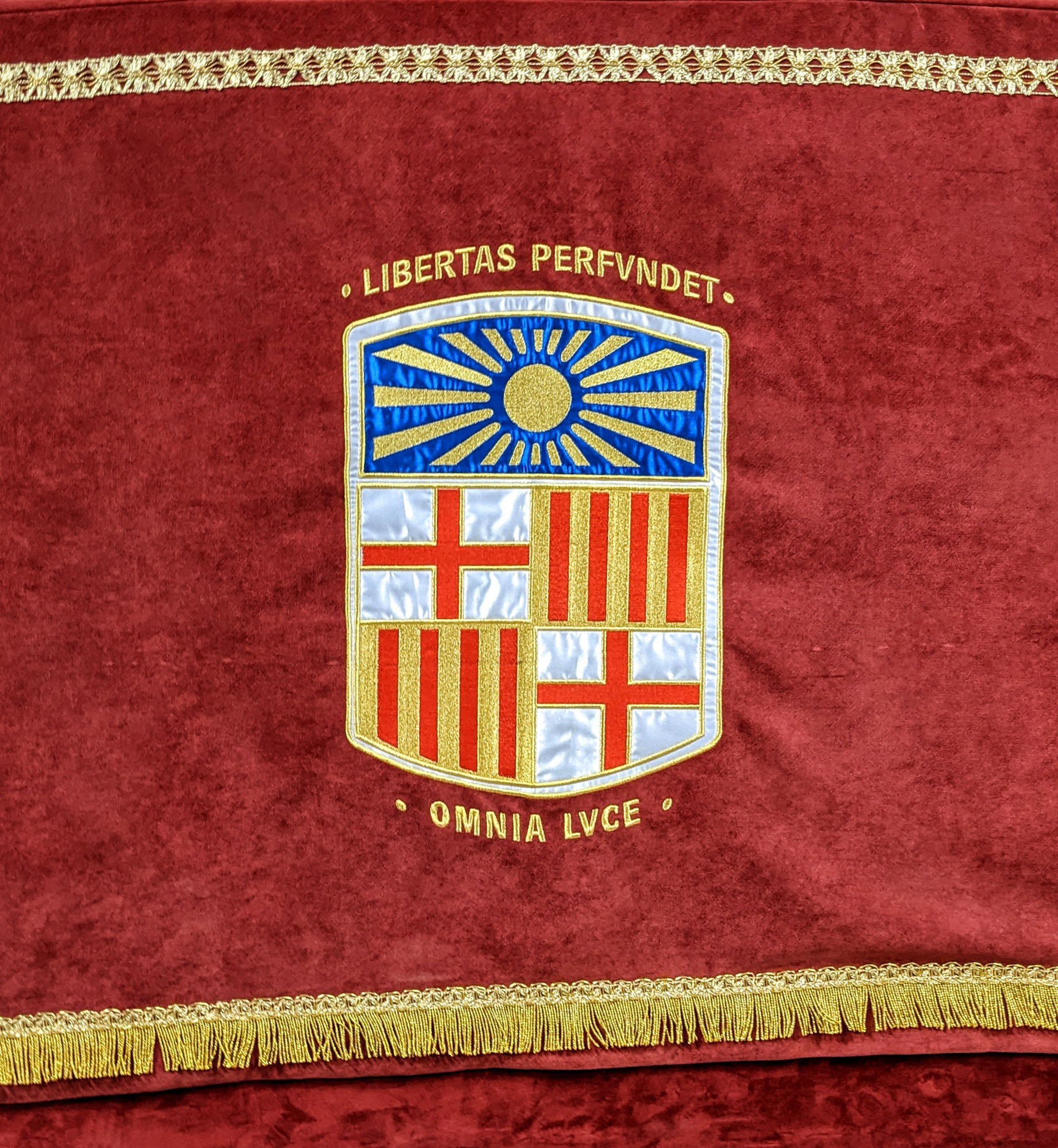

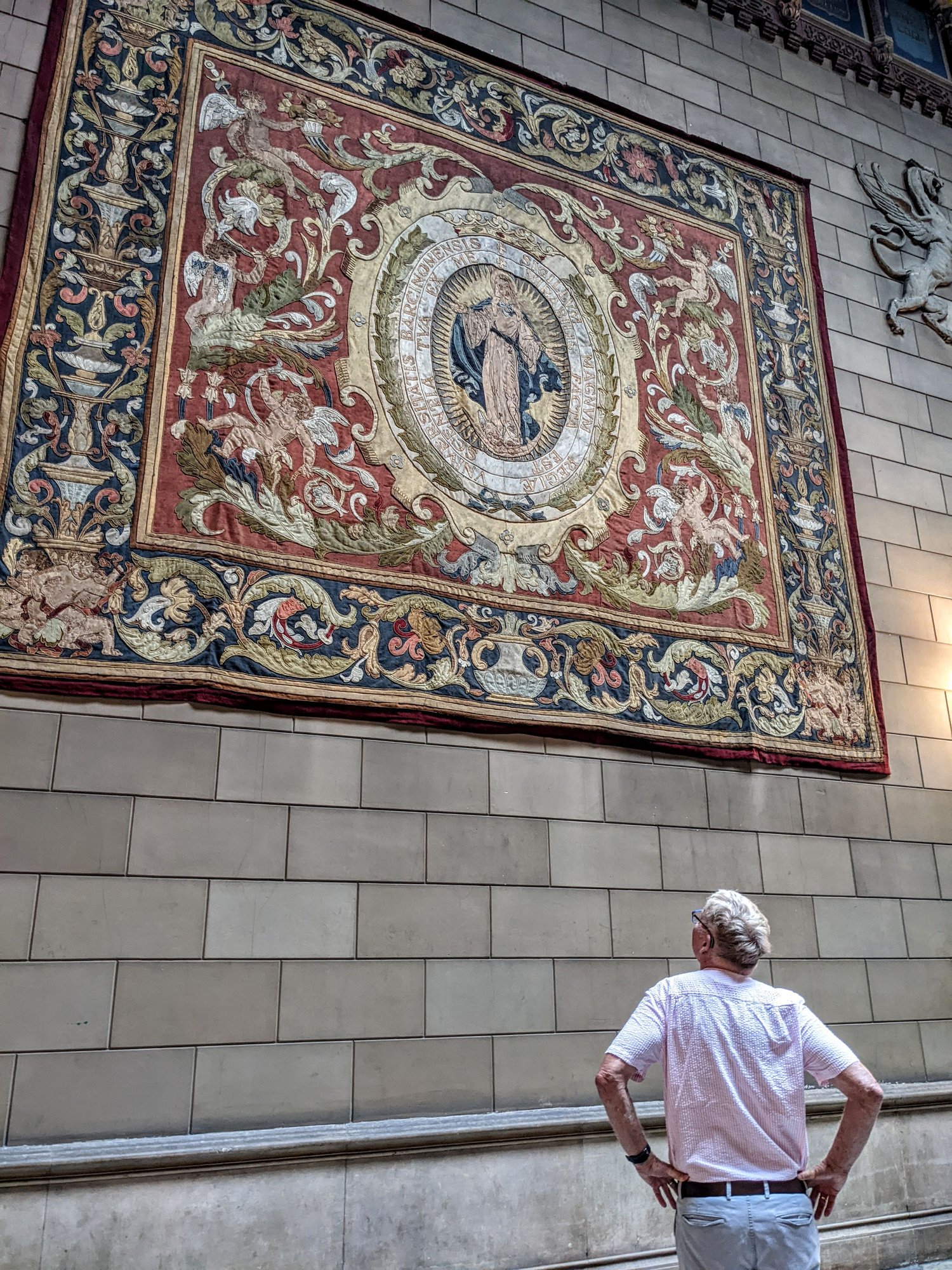

The highlight of the interior is the magnificent “Paraninfo” a large hall similar to an auditorium but splendidly decorated, used for important academic ceremonies such as the awarding of degrees.

The Paraninfo shows a blending of Romanesque and mudejar elements and has a 1,000 per cent wow factor.


The university headquarters has extensive courtyard gardens with more than 200 species of plants. It is a calming space in the midst of bustling Barcelona.


We wandered through the Gracia neighborhood, which feels like its own little village…many small shops, kids playing soccer in the square, little traffic in the narrow streets.


This neighborhood is the setting for one of Catalonia’s most beloved novels, The Time of the Doves by Merce Rodoreda. It is set in the time of the Spanish civil war. I had not heard of Rodoreda until I started reading about Catalonia in preparation for our trip. The writing is compelling, very simple and beautiful even in translation.
We stayed in a very fine hotel for this last part of our trip, Seventy Hotel. When we woke up the first morning, we had a surprise visitor in our room...

Our room, on the second floor, had a balcony and we had left the door open at night. The hotel staff told us that this beautiful cat lives in the neighborhood and makes regular visits to the hotel guests. A very athletic cat, to be able to scamper up to the second floor.
The hotel's public spaces were stunning...Great bar, restaurant...
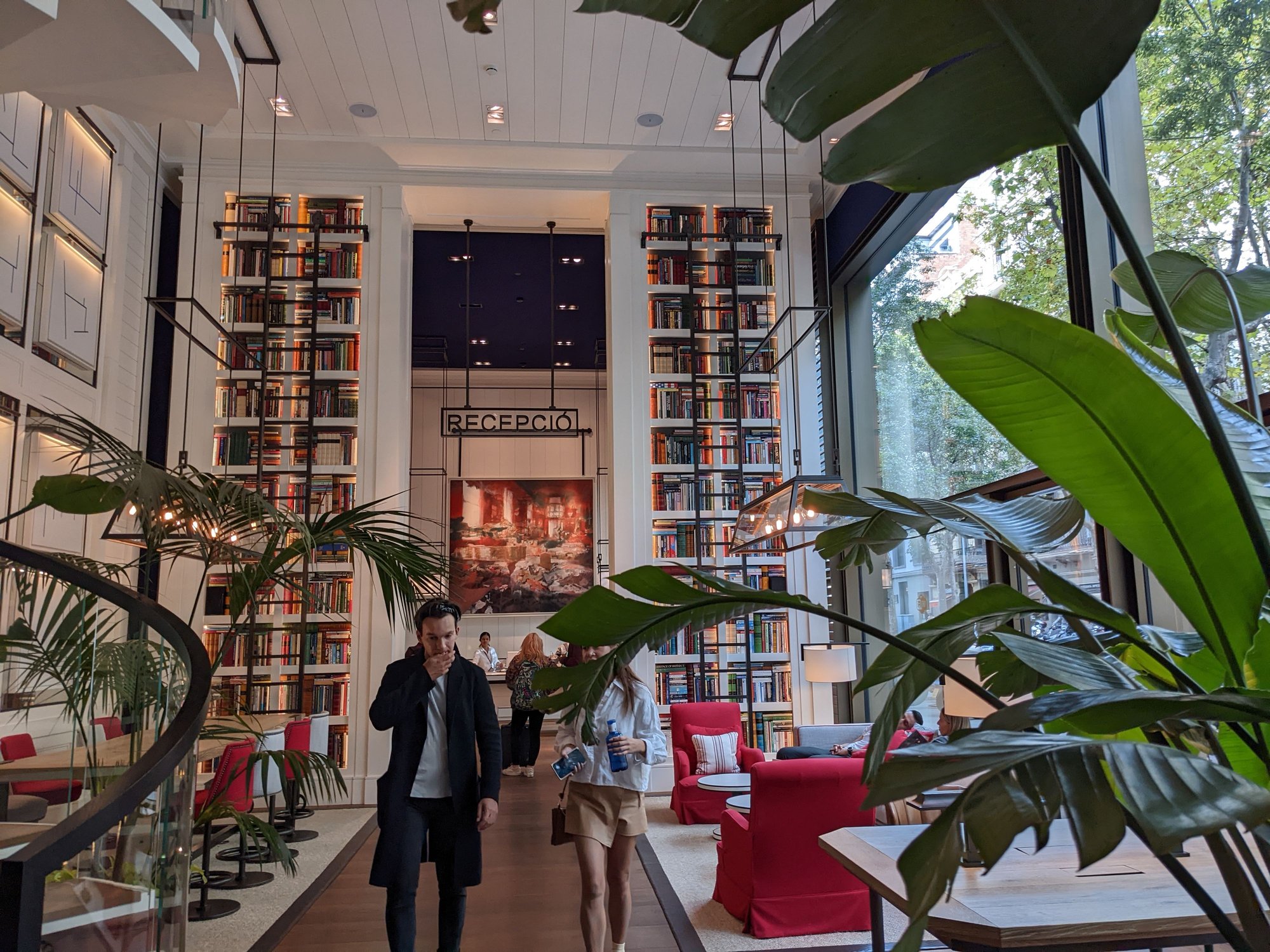

....and breakfast and evening cocktails surrounded by old olive trees in the courtyard. I asked our server one night how they obtained such old olive trees. Is it possible to go to a nursery and buy them? And how in the world did they move them into the interior courtyard since the doorways opening to the courtyard are not nearly large enough.

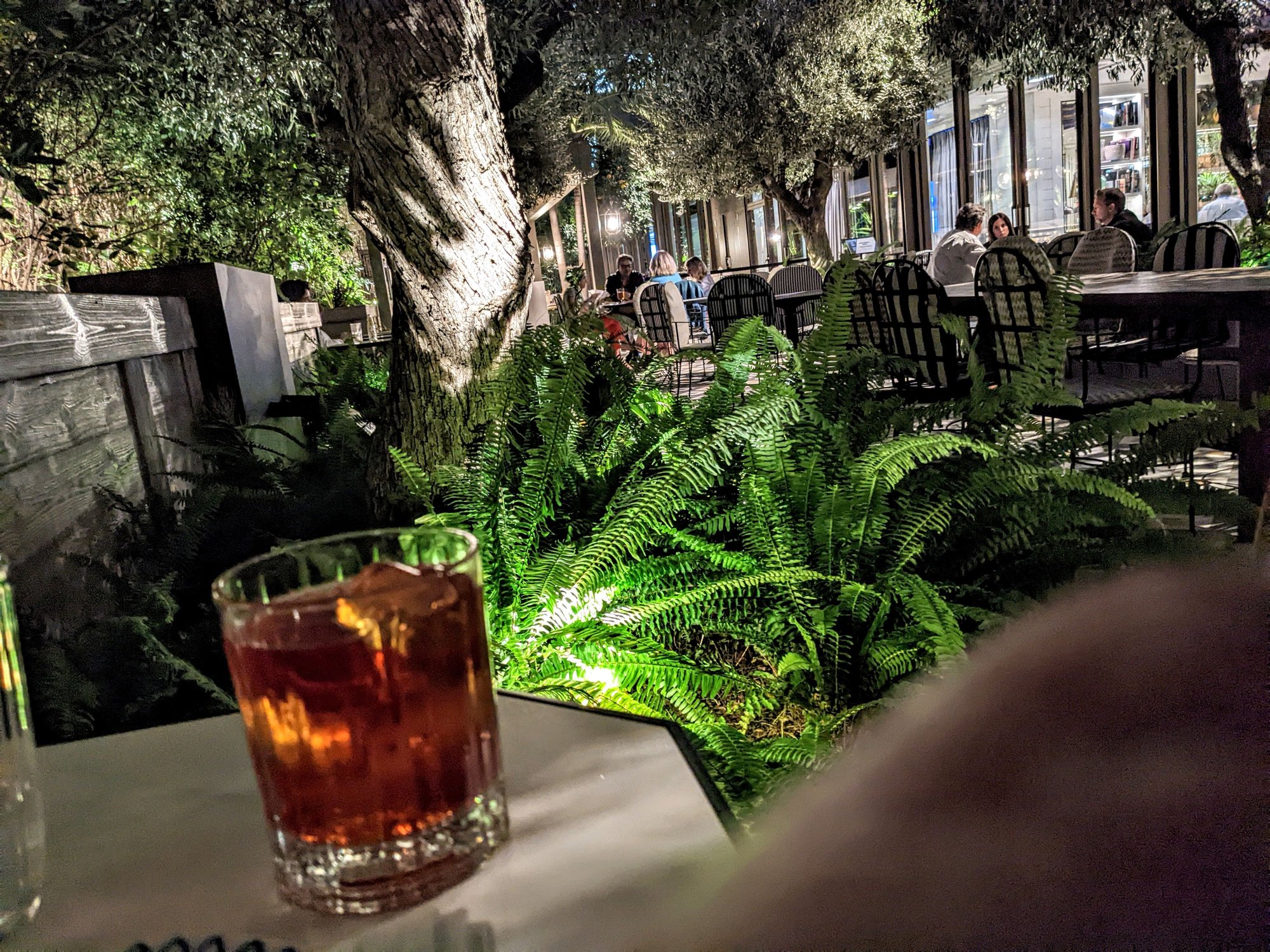
Answer: yes, they went to a farm and bought very old olive trees, dug them up and trucked them to the hotel. The hotel was being gutted and completely rebuilt on the interior, so they moved the trees through the open wall spaces and planted them in the courtyard and then completed the reconstruction of the building. Genius!
Thus endeth our trip. Easy flight back to JFK and Burlington and home!
We visited the main building of the University of Barcelona, an imposing building dating from the late 19th century, designed by Catalan architect Elies Rogent.
The highlight of the interior is the magnificent “Paraninfo” a large hall similar to an auditorium but splendidly decorated, used for important academic ceremonies such as the awarding of degrees.
The Paraninfo shows a blending of Romanesque and mudejar elements and has a 1,000 per cent wow factor.
The university headquarters has extensive courtyard gardens with more than 200 species of plants. It is a calming space in the midst of bustling Barcelona.
We wandered through the Gracia neighborhood, which feels like its own little village…many small shops, kids playing soccer in the square, little traffic in the narrow streets.
This neighborhood is the setting for one of Catalonia’s most beloved novels, The Time of the Doves by Merce Rodoreda. It is set in the time of the Spanish civil war. I had not heard of Rodoreda until I started reading about Catalonia in preparation for our trip. The writing is compelling, very simple and beautiful even in translation.
We stayed in a very fine hotel for this last part of our trip, Seventy Hotel. When we woke up the first morning, we had a surprise visitor in our room...
Our room, on the second floor, had a balcony and we had left the door open at night. The hotel staff told us that this beautiful cat lives in the neighborhood and makes regular visits to the hotel guests. A very athletic cat, to be able to scamper up to the second floor.
The hotel's public spaces were stunning...Great bar, restaurant...
....and breakfast and evening cocktails surrounded by old olive trees in the courtyard. I asked our server one night how they obtained such old olive trees. Is it possible to go to a nursery and buy them? And how in the world did they move them into the interior courtyard since the doorways opening to the courtyard are not nearly large enough.
Answer: yes, they went to a farm and bought very old olive trees, dug them up and trucked them to the hotel. The hotel was being gutted and completely rebuilt on the interior, so they moved the trees through the open wall spaces and planted them in the courtyard and then completed the reconstruction of the building. Genius!
Thus endeth our trip. Easy flight back to JFK and Burlington and home!
 Nov 20th, 2022 | 12:47 PM
#2


Joined: Mar 2003
Posts: 6,238
Likes: 0
Love your photos of Gracia and your hotel. We visited Barcelona when our daughter was studying there. So she had already done a lot of exploring and suggested we visit Gracia and Sarria. Loved both neighborhoods. I would describe Gracia exactly the way you did!
Welcome home!
Welcome home!

 Feb 22nd, 2023 | 07:09 AM
#7
Joined: Aug 2022
Posts: 57
Likes: 0
Thanks for the lovely pictures and your comments.
This is indeed the most beautiful campus building in all the universities in the city.
A bit of background:
The University of Barcelona (UB) is one of the 26 universities in the city. It was established in November 1450 and holds the distinction of being the first recognized institution of its kind in the city. While King Martí l'Humà had founded a medical school named Estudi General in 1401, it was not recognised by the City Council ("Consell de Cent") or other prominent institutions within the city, who viewed it as an infringement upon their respective areas of authority. In contrast, the UB offered a broad range of courses in subjects such as theology, civil and canonical law, moral and natural philosophy, medicine, the seven liberal arts, and various other scientific fields.
Following the conquest of the city by the Castilian and French armies led by King Philip V of Spain, and the defeat of Catalan troops in 1714, the Bourbon dynasty issued a Royal decree ("Decreto de Nueva Planta") mandating the closure and dismantlement of most cultural and political institutions in Catalonia, among which the University of Barcelona.
The university was restored during the liberal revolution of 1837 under the reign of Isabella II. On its return, the University was housed initially in the Convent of Carme, which had been disestablished a few years earlier. Here the Faculties of Canon Law, Law and Theology were provisionally installed while the Faculty of Medicine took up residence in the Royal Academy of Medicine, next door to the Hospital of Santa Creu, both in the El Raval neighbourhood.
The natural growth of the University of Barcelona has given rise to a number of buildings across the city and now the UB is present in a number of locations. The building in Plaça Universitat -so beautifully photographed by @EYWandBTV- remains as the "historic building", it was built between 1863 and 1882 and its construction was to have major repercussions for the city, since it was one of the first buildings to be raised outside the ancient city walls. It's home to the "faculties" (Schools of) of Education, Philology and Communication and Mathematics and Computer Science. You can have a look at the other locations here: https://www.ub.edu/web/portal/en/the...pus/faculties/
The University of Barcelona comprises 100 departments grouped in 18 faculties and two university schools, one school and eight attached schools. The library holds about 2,000,000 volumes and is the second-biggest university library in Spain. The UB offers 74 undergraduate programs, 349 graduate programs and 48 doctorate programs to 63,000 students. It also has 30 research centres.
A tip: on a typical hot summer weekday head to Orxateria la Valenciana -located around the corner from the university, in Carrer d'Aribau, 16- get some cold "orxata" or a "granissat de llimona" (or "de cafè") to go, and walk towards the university to take refuge in the inner garden located at the back -also photographed above. You will enjoy a moment of peace and tranquillity in a cool and very pleasant environment. Enter through the main door of Plaça Universitat, cross the impressive Pati d'Armes at the entrance and the interior cloisters and you will find the garden. Although, in principle, access is reserved for students and teachers of the centre, do walk confidently and discreetly and no one (no guard) will tell you anything or ask you where you are going.
"Orxata" in Catalan, the local language in Barcelona, pronounced (or-sha-tah) -also known as horchata in Spanish- is a sweet, creamy drink made from ground tiger nuts ("xufes" in Catalan), water, and sugar that has a unique, nutty flavour with hints of cinnamon and vanilla. Do not confuse it with the "Mexican horchata", a rice-based sweet, milky drink flavoured with cinnamon and sometimes vanilla, made from soaked rice, sugar, water and almonds or coconut. On the other hand, "granissat" is a popular frozen dessert that originated in Italy but is commonly found in many Mediterranean countries. It is made by blending ice with a flavoured syrup, usually fruit-based until it forms a slushy mixture, similar to a snow cone or a slushie.
Enjoy!
This is indeed the most beautiful campus building in all the universities in the city.
A bit of background:
The University of Barcelona (UB) is one of the 26 universities in the city. It was established in November 1450 and holds the distinction of being the first recognized institution of its kind in the city. While King Martí l'Humà had founded a medical school named Estudi General in 1401, it was not recognised by the City Council ("Consell de Cent") or other prominent institutions within the city, who viewed it as an infringement upon their respective areas of authority. In contrast, the UB offered a broad range of courses in subjects such as theology, civil and canonical law, moral and natural philosophy, medicine, the seven liberal arts, and various other scientific fields.
Following the conquest of the city by the Castilian and French armies led by King Philip V of Spain, and the defeat of Catalan troops in 1714, the Bourbon dynasty issued a Royal decree ("Decreto de Nueva Planta") mandating the closure and dismantlement of most cultural and political institutions in Catalonia, among which the University of Barcelona.
The university was restored during the liberal revolution of 1837 under the reign of Isabella II. On its return, the University was housed initially in the Convent of Carme, which had been disestablished a few years earlier. Here the Faculties of Canon Law, Law and Theology were provisionally installed while the Faculty of Medicine took up residence in the Royal Academy of Medicine, next door to the Hospital of Santa Creu, both in the El Raval neighbourhood.
The natural growth of the University of Barcelona has given rise to a number of buildings across the city and now the UB is present in a number of locations. The building in Plaça Universitat -so beautifully photographed by @EYWandBTV- remains as the "historic building", it was built between 1863 and 1882 and its construction was to have major repercussions for the city, since it was one of the first buildings to be raised outside the ancient city walls. It's home to the "faculties" (Schools of) of Education, Philology and Communication and Mathematics and Computer Science. You can have a look at the other locations here: https://www.ub.edu/web/portal/en/the...pus/faculties/
The University of Barcelona comprises 100 departments grouped in 18 faculties and two university schools, one school and eight attached schools. The library holds about 2,000,000 volumes and is the second-biggest university library in Spain. The UB offers 74 undergraduate programs, 349 graduate programs and 48 doctorate programs to 63,000 students. It also has 30 research centres.
A tip: on a typical hot summer weekday head to Orxateria la Valenciana -located around the corner from the university, in Carrer d'Aribau, 16- get some cold "orxata" or a "granissat de llimona" (or "de cafè") to go, and walk towards the university to take refuge in the inner garden located at the back -also photographed above. You will enjoy a moment of peace and tranquillity in a cool and very pleasant environment. Enter through the main door of Plaça Universitat, cross the impressive Pati d'Armes at the entrance and the interior cloisters and you will find the garden. Although, in principle, access is reserved for students and teachers of the centre, do walk confidently and discreetly and no one (no guard) will tell you anything or ask you where you are going.
"Orxata" in Catalan, the local language in Barcelona, pronounced (or-sha-tah) -also known as horchata in Spanish- is a sweet, creamy drink made from ground tiger nuts ("xufes" in Catalan), water, and sugar that has a unique, nutty flavour with hints of cinnamon and vanilla. Do not confuse it with the "Mexican horchata", a rice-based sweet, milky drink flavoured with cinnamon and sometimes vanilla, made from soaked rice, sugar, water and almonds or coconut. On the other hand, "granissat" is a popular frozen dessert that originated in Italy but is commonly found in many Mediterranean countries. It is made by blending ice with a flavoured syrup, usually fruit-based until it forms a slushy mixture, similar to a snow cone or a slushie.
Enjoy!
Last edited by EnricM; Feb 22nd, 2023 at 07:18 AM.


