


3 weeks in Nîmes, Marseille, and Arles


 Oct 25th, 2021 | 01:28 PM
#22
Original Poster

Joined: Oct 2013
Posts: 228
Likes: 0
Enjoyed this report immensely. As a lover of fish soups, though, I'm disappointed to learn that the legendary bouillabaisse of Marseille -- the Holy Grail of fish soups -- may not be all it's cracked up to be. I hope to get there soon, and will reread your report beforehand.
From an article in myprovence (in French) I learned that in the 1800s bouillabaisse was served in sumptuous restaurants, couvertes d’or et de miroirs qui reflètent l’argenterie des services (covered in gold, and with mirrors that reflect the silverware), at bourgeoise parties, and in all the cabanons populaires that lined the port. This already contradicts two things that I thought I knew: that authentic bouillabaisse was a dish of the poor, and that it was only served at home, never in restaurants.
In 1980, in a reaction against the touristy soups along the Vieux Port, seventeen chefs published a Charte de la Bouillabaisse that laid out the rules for a proper bouillabaisse. The link goes to the actual charter. Here is my very rough translation of part of it:
.
Preamble: It is not possible to normalize the cuisine. In effect, it is an art where the hand of the chef will make it succeed. However, the Bouillabaisse, plat marseillais par excellence, is composed of precise ingredients that must be used if one wants to respect tradition and not deceive the clientele ,,,
History: At its origin it was a fisherman's dish who, in separating out the fish for the market, would set aside certain pieces that they would prepare for their family. It is thus a simple and familiar dish which has been perfected over the years ...
The service: In general the dish is prepared and served in two plates: one for the fish, the other for the bouillon. According to the tastes of the gathering, the two can be combined in one soup bowl or served separately. One obligatory rule is that the cutting of the fish is done in front of the diners.
.
The charter goes on to talk about the choices of fish (at least four types, out of a list of eight) and the option of also including slipper lobster. The ingredients of the broth I think are well known known: saffron, olive oil, garlic, onions, fennel, parsley, potatoes, and tomatoes.History: At its origin it was a fisherman's dish who, in separating out the fish for the market, would set aside certain pieces that they would prepare for their family. It is thus a simple and familiar dish which has been perfected over the years ...
The service: In general the dish is prepared and served in two plates: one for the fish, the other for the bouillon. According to the tastes of the gathering, the two can be combined in one soup bowl or served separately. One obligatory rule is that the cutting of the fish is done in front of the diners.
.
After reading this I obviously did not have a bouillabaisse in Marseille. Even given that there are other historic variations, that soup I had was not close.
I did try and make reservations at one of well-known restaurants (Chez Michel, Le Rhul, Le Miramar, Chez Fonfon, L’épuisette), but they were all booked far in advance.
But at least I can say I had a delicious soupe des poissons in Aigues Mortes ... and the base of the soup sounds like the same bouillon used in a bouillabaisse.
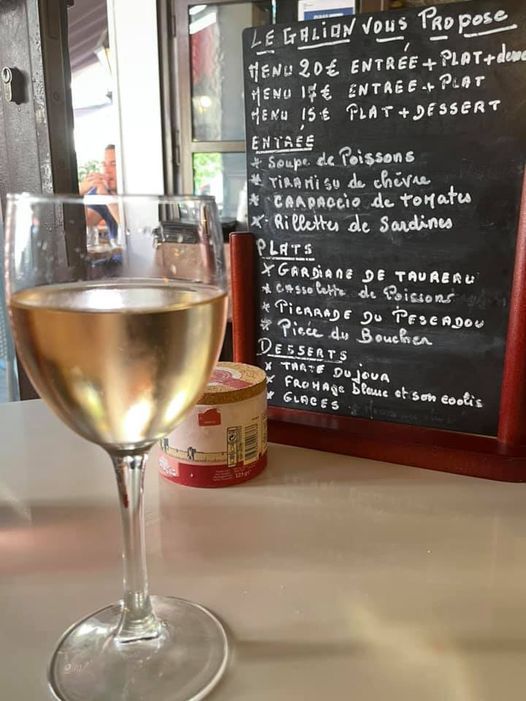
Menu du midi at the Restaurant Le Galion
I ordered the soup as an entrée. I was expecting a cup of soup; I got a whole cauldron!
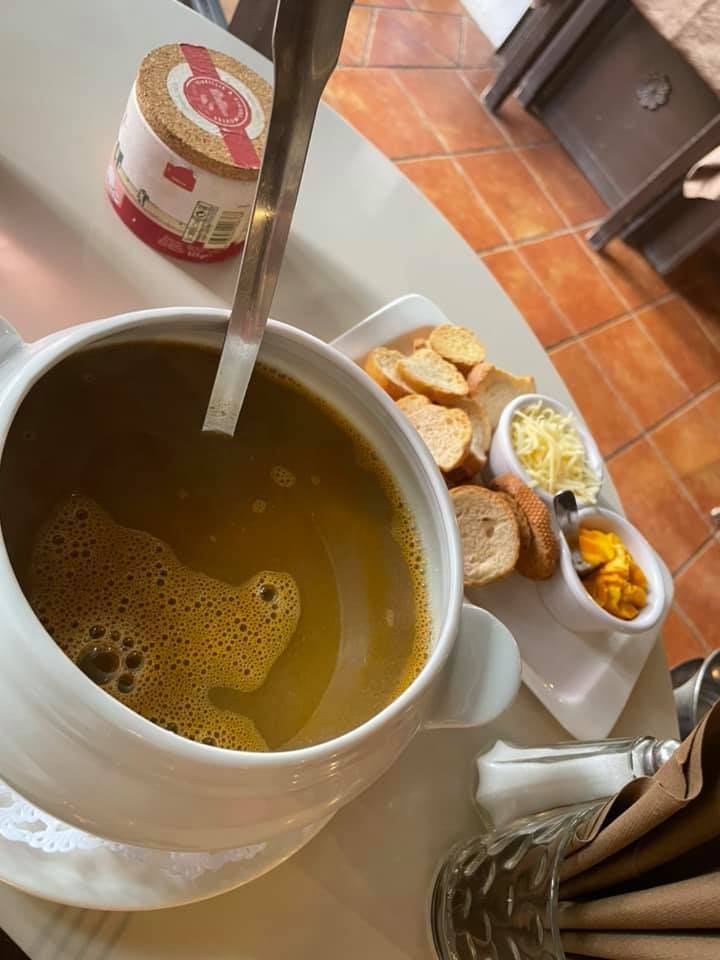
Condiments were Camarguaise salt, croutons, grated cheese, and sauce rouille (like an aioli, but with red peppers and saffron added)
.
I had never even heard of sauce rouille before, and I must have asked the server three times how to pronounce it so that I could remember it and look it up. The soup was good; the sauce made it divine.
Let's finish lunch:
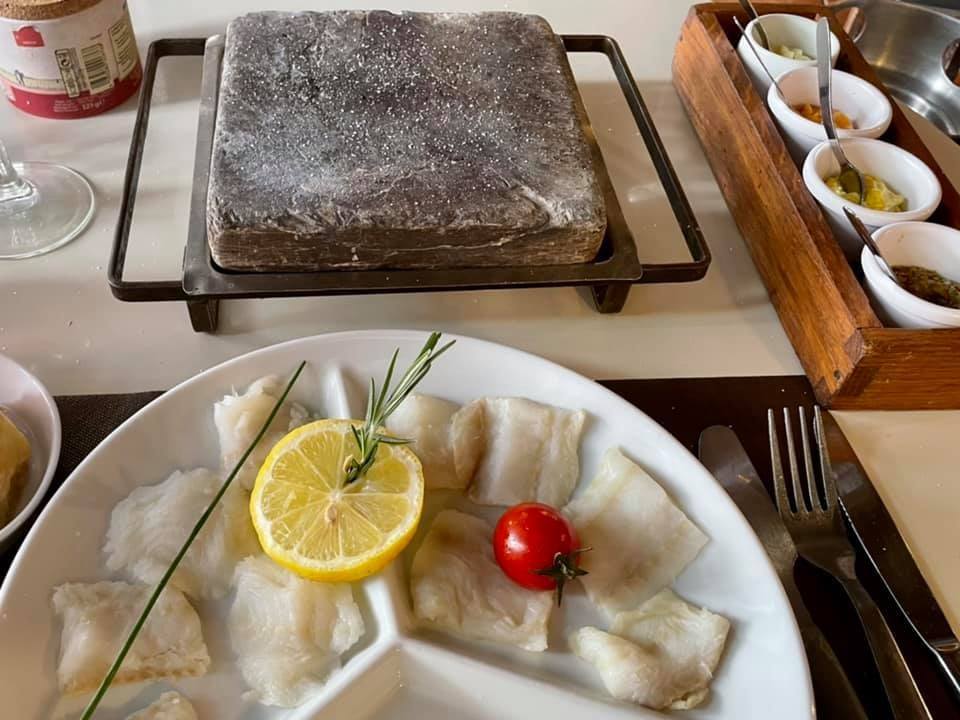
Pierrade de Pescadou. This was a winner! They bring you raw fish and a hot stone. You sprinkle the stone with fleur de sel, and cook each piece the way you like it. On the right, different sauces
Last edited by michael_cain_77398; Oct 25th, 2021 at 02:14 PM.
 Oct 25th, 2021 | 05:29 PM
#25
Original Poster
Joined: Oct 2013
Posts: 228
Likes: 0
Arles 1
I picked up my car on a Saturday morning, and drove the slower road near the coast to Arles. I was going to stop for lunch at Martigues, but all the public lots were full so I pushed on to Arles.
It was a challenge! It was a festival weekend, and a lot of the roads were closed. My GPS led me on a detour through impossibly narrow streets, and I finally turned it off and just tried to navigate on my own. I had seen signs for public parking, but got turned around trying to retrace my route. Finally I saw a parking space along a side street & grabbed it. I lucked out - by chance I was only a fifteen-minute walk from my hotel. Three cars pulled up while I was getting my pack out and asked if I was leaving. Parking on the weekends is definitely a challenge.
I had booked a room at L'Aubergine Rouge, but the owner emailed me saying the room wasn't going to be available & would I mind moving to the rooftop suite instead, at the same price? I said yes, and oh my ...
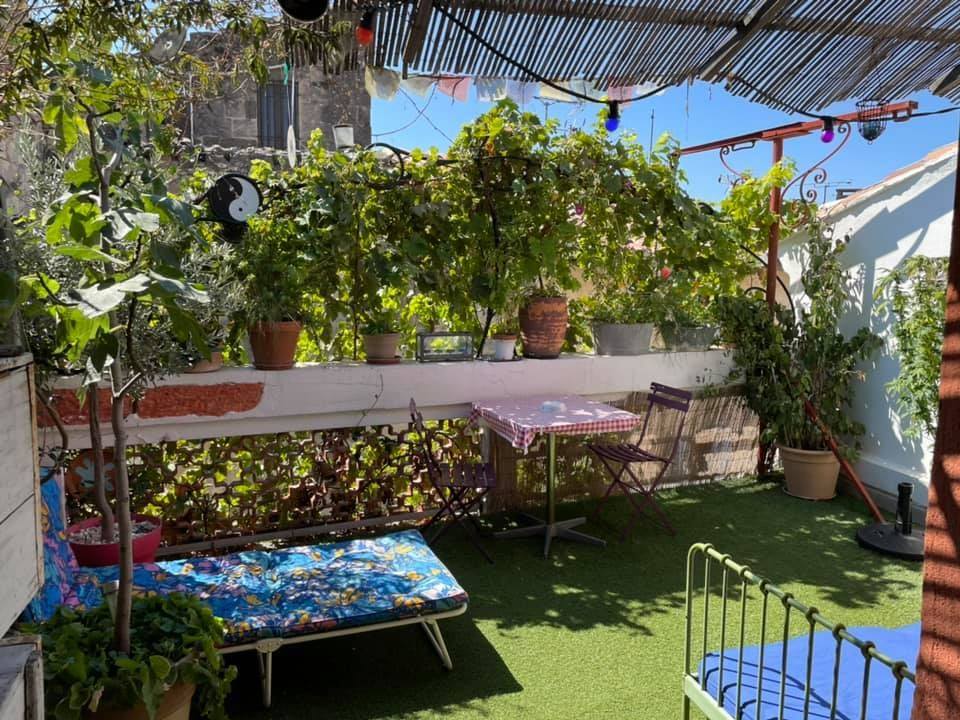
I had a private terrace, a kitchen, and a reading room - this was luxury!!!
I had the afternoon free to explore the town, and wandered without a set agenda.
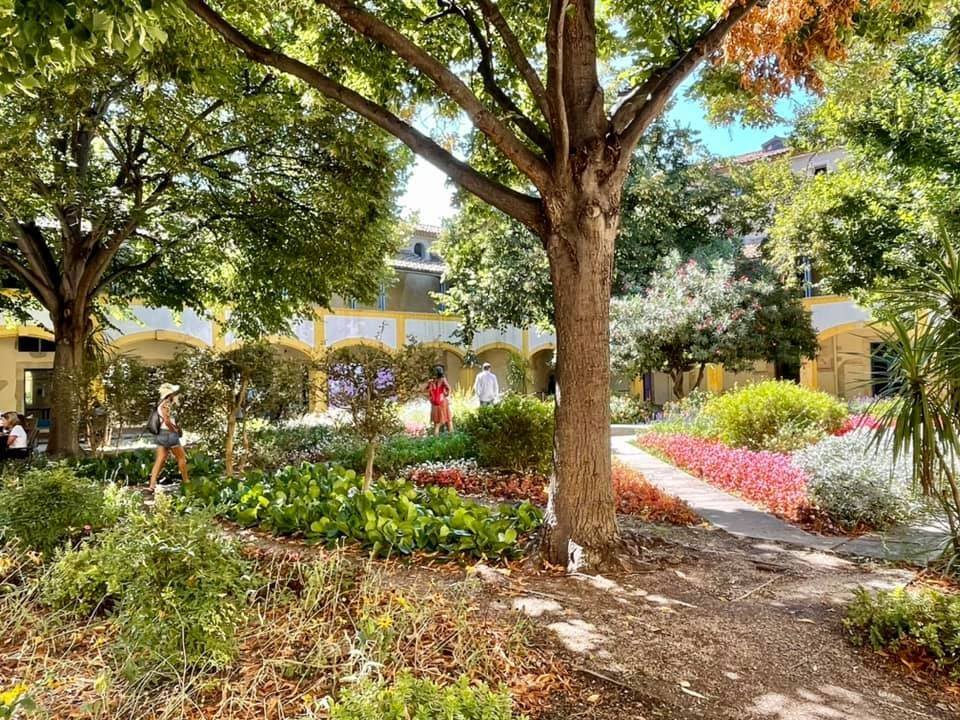
Place Van Gogh - not a painting

The old town was a constant pleasure to walk in

There are times when Occitan feels as much Spanish as French. My first lunch was paella and sangria!
I had tickets that night to La Corrida Goyesque d’Arles. There are two types of bullfighting in the region, the course camarguaise, which does not involve a kill, and the Andalusian style, which does. This festival features the Andalusian style.
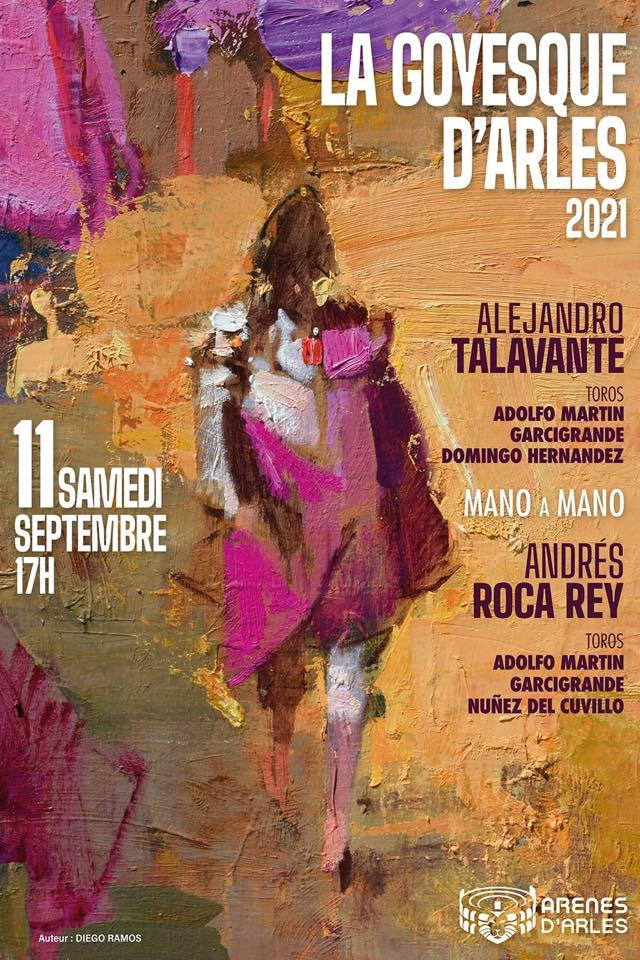
I have never seen a bullfight, and wasn't sure how I'd react. Between the music and the ritual I was riveted the entire three hours. When I entered the arena was already packed, there was a full orchestra playing selections from Carmen, and the crowd was singing along. The energy was intense. The torreadors and their assistants were all dressed in styles from the era of Francisco Goya. When the bulls came out the torreador would choreograph his moves to the music. When the end approached there would be total silence in the stands, and an opera singer would sing an aria during the final moments.
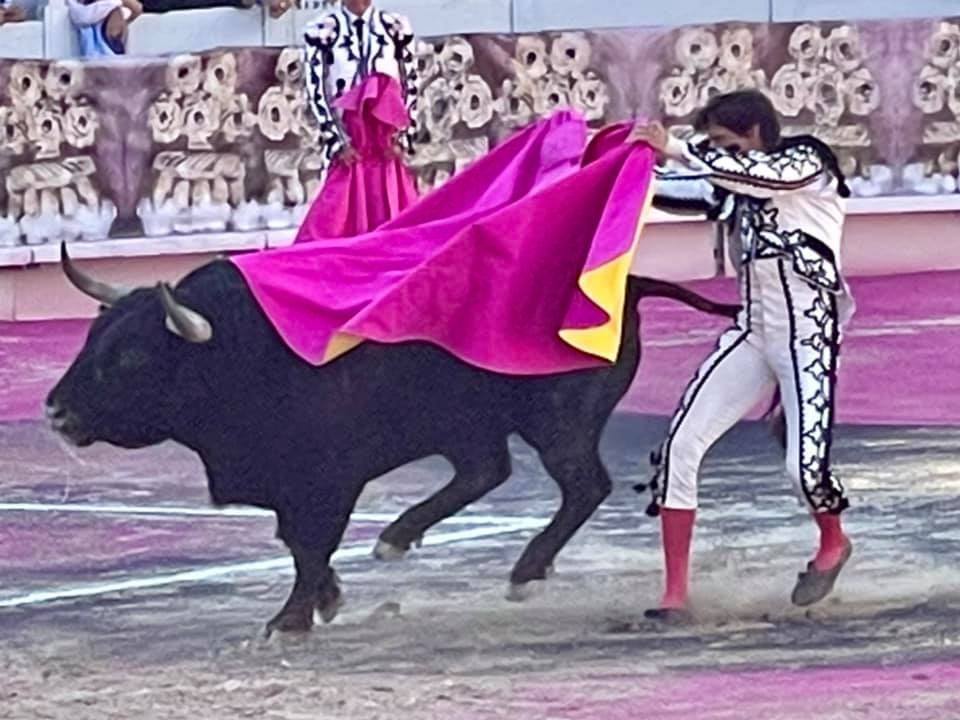
It was opera as blood sport
I can rationalize it, and argue that bullfighting is part of the culture, and that it is probably less cruel than American factory-farming. But in the end - I was just swept away by the drama.
I loved it. I also hated it. I don't know if I would ever go again.
That night all the squares were packed. There was a party in one with a dj, one with a live brass band, and another with a Louisiana-style jazz band. I didn't want to go to bed. I haven't been to a large street party in years and years. I would definitely return to Arles, or Nîmes, for a féria - especially if I could convince friends to join me.
I picked up my car on a Saturday morning, and drove the slower road near the coast to Arles. I was going to stop for lunch at Martigues, but all the public lots were full so I pushed on to Arles.
I had booked a room at L'Aubergine Rouge, but the owner emailed me saying the room wasn't going to be available & would I mind moving to the rooftop suite instead, at the same price? I said yes, and oh my ...
I had a private terrace, a kitchen, and a reading room - this was luxury!!!
I had the afternoon free to explore the town, and wandered without a set agenda.
Place Van Gogh - not a painting
The old town was a constant pleasure to walk in
There are times when Occitan feels as much Spanish as French. My first lunch was paella and sangria!
I had tickets that night to La Corrida Goyesque d’Arles. There are two types of bullfighting in the region, the course camarguaise, which does not involve a kill, and the Andalusian style, which does. This festival features the Andalusian style.
I have never seen a bullfight, and wasn't sure how I'd react. Between the music and the ritual I was riveted the entire three hours. When I entered the arena was already packed, there was a full orchestra playing selections from Carmen, and the crowd was singing along. The energy was intense. The torreadors and their assistants were all dressed in styles from the era of Francisco Goya. When the bulls came out the torreador would choreograph his moves to the music. When the end approached there would be total silence in the stands, and an opera singer would sing an aria during the final moments.
It was opera as blood sport
I can rationalize it, and argue that bullfighting is part of the culture, and that it is probably less cruel than American factory-farming. But in the end - I was just swept away by the drama.
I loved it. I also hated it. I don't know if I would ever go again.
That night all the squares were packed. There was a party in one with a dj, one with a live brass band, and another with a Louisiana-style jazz band. I didn't want to go to bed. I haven't been to a large street party in years and years. I would definitely return to Arles, or Nîmes, for a féria - especially if I could convince friends to join me.
Last edited by michael_cain_77398; Oct 25th, 2021 at 05:44 PM.
Oct 25th, 2021 | 05:41 PM
#26
Joined: Jun 2008
Posts: 31,225
Likes: 0
A rooftop sweet suite! A neat mind image of folks singing music from Carmen. DH and I day tripped to Arles and loved it. As we sat in a bar for coffee, I realized I was looking at the cafe van gogh painted. I was moved to tears. More TR, please!
Oct 25th, 2021 | 07:26 PM
#27
Original Poster
Joined: Oct 2013
Posts: 228
Likes: 0
Arles 2
In the morning I descended beneath the city in the Roman Cryptoportiques du Forum, and then ascended to the heavens in the XIIth Century Cloître Saint-Trophime. Both were worth the visit. I had planned to explore more when I heard a siren sound, followed by a warning that bulls would shortly be running down the street, and that we should stay behind the barricades for our own safety.
I immediately ran to the barricades and secured a front-row view. I didn't realize that I still had an hour to wait. Behind me a restaurant started cooking a massive plate of paella. It smelled so good I was ready to faint from hunger and desire - but I wasn't going to lose my spot. And finally, we saw the cowboys and cowgirls (cowpeople? cowfolks? I don't know the gender neutral term).
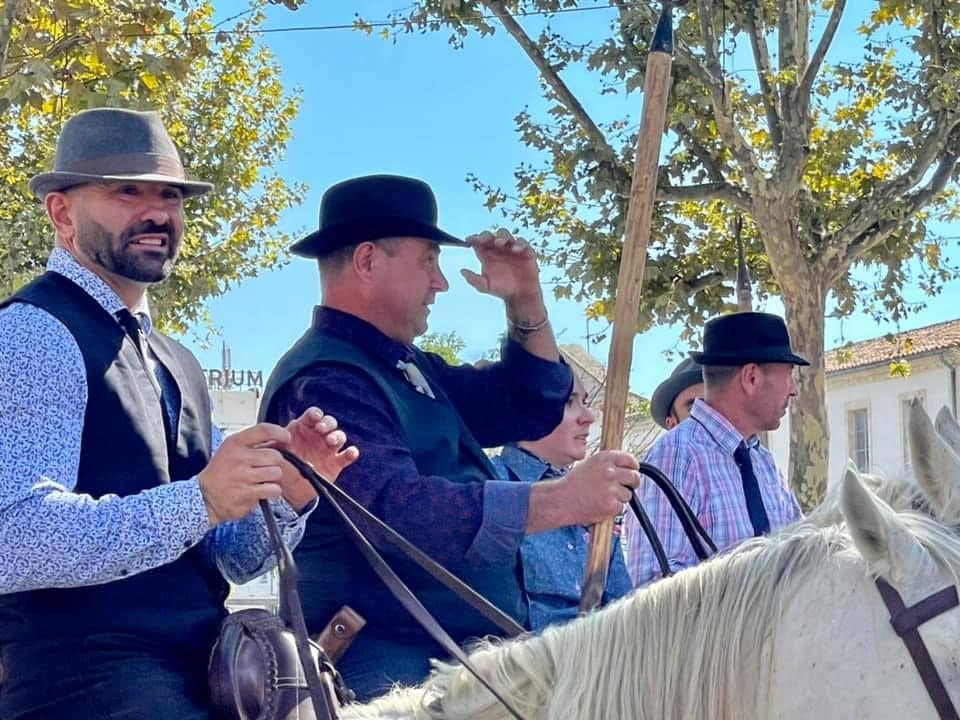
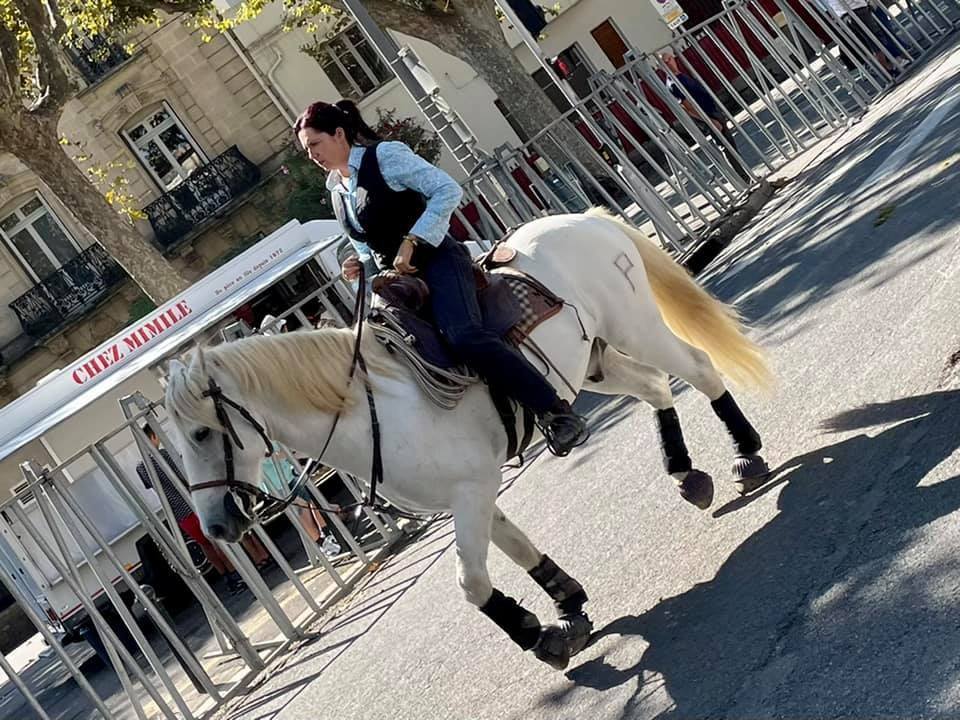
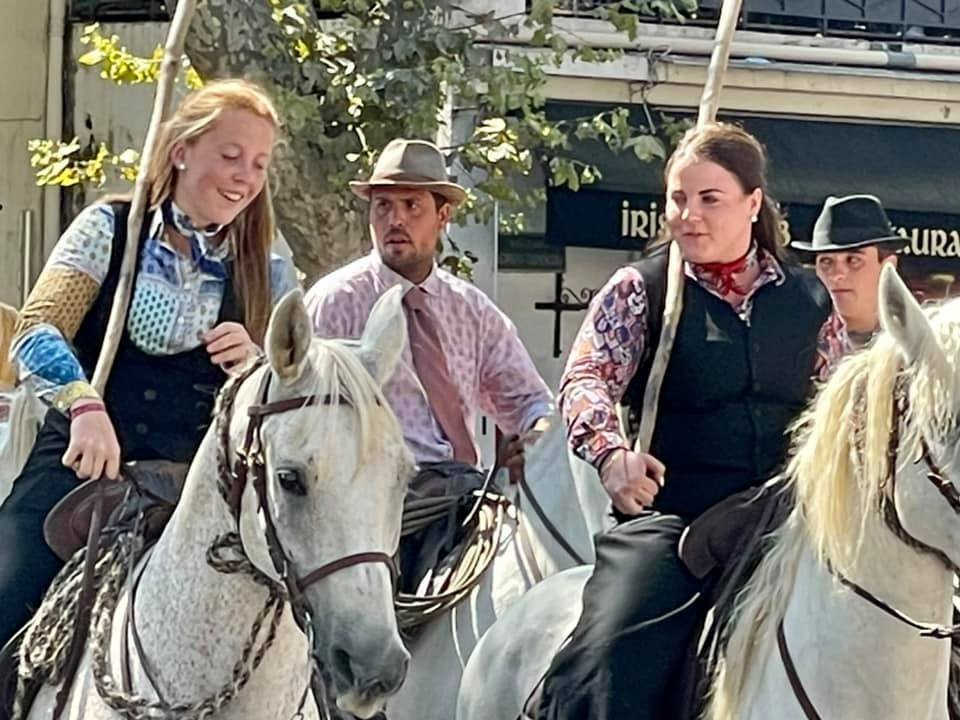
The actual running of the bulls was interesting to watch, but nothing like what you see in videos from Pamplona. The cowpokes from the different manades rode up and down, and then would run with a bull or two packed between the riders. Kids would then run into the street and chase the riders ... but there was no running ahead of the bulls.
When it was done I turned around to get some paella - - - and the restaurant was packed and there was a line around the corner! I ended up going back into the center for lunch, and had my first taste of orange wine. I had read about it, but this was my first time ever seeing it on a menu.
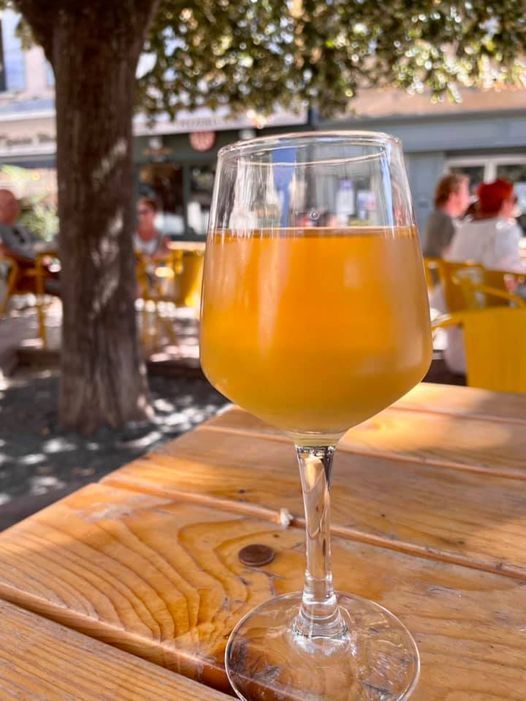
There’s more to wine than red white & rosé!
Orange wine is made with white grapes, but vinified like red wine and macerated with the skin on, then naturally fermented. It’s an older, rarer style of wine. For the wine nerds: the grapes are ugni blanc (trebbiano), gros manseng, and muscat d'Alexandrie. It’s more tannic than most whites, and slightly acidic. Stone fruit (green plums, apricots), citrus (orange peel) and minerals (quartz, slate) dominate.
I liked it. It’s more of an afternoon wine than a dinner wine. It’s worth looking for.
In the afternoon I wandered through Les Alycamps, the paleochristian and medieval necropolis just outside the center.
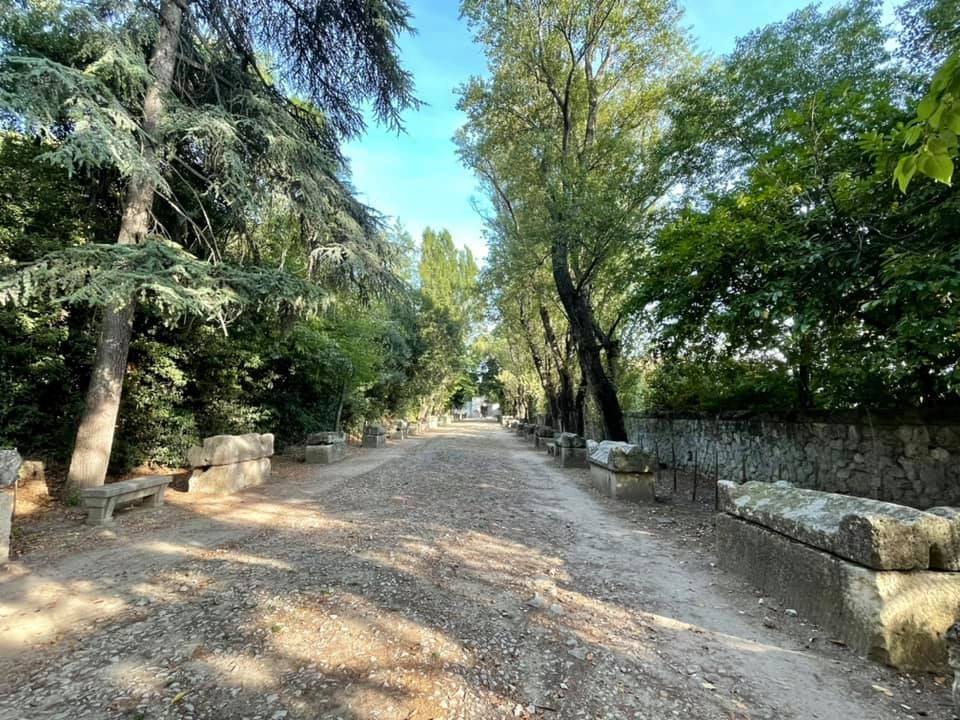
Les Alycamps

Van Gogh was here!
I was surprised that there wasn't a major museum dedicated to Van Gogh, even though the scenes he painted can still be found. I ate dinner a couple times in the plaza across from this well-known place:
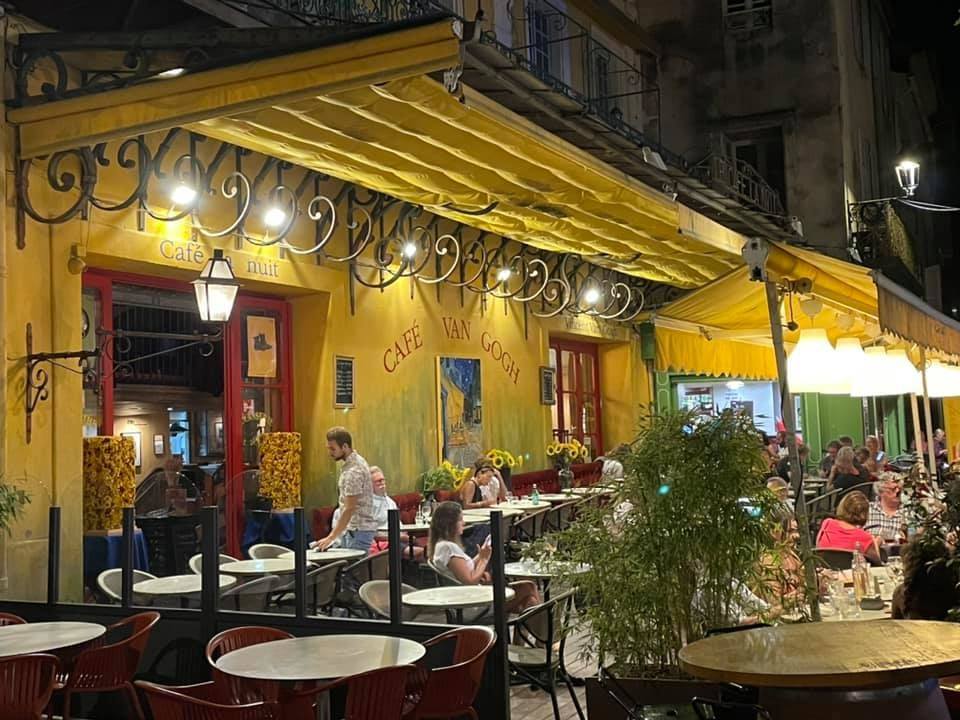
It's that one yellow café!
In the morning I descended beneath the city in the Roman Cryptoportiques du Forum, and then ascended to the heavens in the XIIth Century Cloître Saint-Trophime. Both were worth the visit. I had planned to explore more when I heard a siren sound, followed by a warning that bulls would shortly be running down the street, and that we should stay behind the barricades for our own safety.
I immediately ran to the barricades and secured a front-row view. I didn't realize that I still had an hour to wait. Behind me a restaurant started cooking a massive plate of paella. It smelled so good I was ready to faint from hunger and desire - but I wasn't going to lose my spot. And finally, we saw the cowboys and cowgirls (cowpeople? cowfolks? I don't know the gender neutral term).
The actual running of the bulls was interesting to watch, but nothing like what you see in videos from Pamplona. The cowpokes from the different manades rode up and down, and then would run with a bull or two packed between the riders. Kids would then run into the street and chase the riders ... but there was no running ahead of the bulls.
When it was done I turned around to get some paella - - - and the restaurant was packed and there was a line around the corner! I ended up going back into the center for lunch, and had my first taste of orange wine. I had read about it, but this was my first time ever seeing it on a menu.
There’s more to wine than red white & rosé!
Orange wine is made with white grapes, but vinified like red wine and macerated with the skin on, then naturally fermented. It’s an older, rarer style of wine. For the wine nerds: the grapes are ugni blanc (trebbiano), gros manseng, and muscat d'Alexandrie. It’s more tannic than most whites, and slightly acidic. Stone fruit (green plums, apricots), citrus (orange peel) and minerals (quartz, slate) dominate.
I liked it. It’s more of an afternoon wine than a dinner wine. It’s worth looking for.
In the afternoon I wandered through Les Alycamps, the paleochristian and medieval necropolis just outside the center.
Les Alycamps
Van Gogh was here!
I was surprised that there wasn't a major museum dedicated to Van Gogh, even though the scenes he painted can still be found. I ate dinner a couple times in the plaza across from this well-known place:
It's that one yellow café!
Oct 26th, 2021 | 05:38 PM
#30


Joined: Mar 2003
Posts: 6,237
Likes: 0
I am enjoying your report and photos! We've visited Marseilles a few times with our daughter. In fact, I went wedding dress shopping with her in Marseilles. I really enjoyed walking around the port, and I remember walking along an esplanade that is part of the Museum of Civilization and Culture. We didn't go into the museum but the walk along the esplanade was lovely with great views of the port and city and I seem to recall interesting gardens and vegetation. My husband and I have talked about spending a few nights in Marseilles by ourselves because our very young grandchildren wouldn't be interested in what we would like to see. The Le Panier neighborhood you mention sounds wonderful.
I might have mentioned upthread that our daughter lived in Aix for 2 years so we visited quite frequently and got to know it well. We love Aix! It is beautiful with so many fountains, cafes, lovely squares, markets, etc. We visited Arles very briefly during one of our visits, and I always said I want to spend more time there. You have reinforced that we need to do that! And visit Nimes, too!
I might have mentioned upthread that our daughter lived in Aix for 2 years so we visited quite frequently and got to know it well. We love Aix! It is beautiful with so many fountains, cafes, lovely squares, markets, etc. We visited Arles very briefly during one of our visits, and I always said I want to spend more time there. You have reinforced that we need to do that! And visit Nimes, too!
Oct 26th, 2021 | 07:14 PM
#31
Original Poster
Joined: Oct 2013
Posts: 228
Likes: 0
Arles 3: The Camargue
Today was my day for a road trip through the Camargue, the wetlands formed by the Rhône delta. I was ready for a landscape of birds and wild horses, ranches and rice fields and wetlands, and ... so I had heard ... mosquitoes.
My first stop was the Parc naturel régional de Camargue, which was only about 10 km outside of Arles. There was a museum there that I didn't go into, but I did walk for awhile on some trails in the park. This part of the Camargue has a gentle, soft agricultural landscape. I could hear a lot of songbirds but didn't see any. There were lots of dragonflies about, but luckily no mosquitoes. It was a nice way to start the morning. I walked the Chemin de Puy four years ago, and this brought back pleasant memories of walking in France.

If my camera could capture scents, it would capture wild thyme, laurel, and pine.

Rice fields, no birds yet
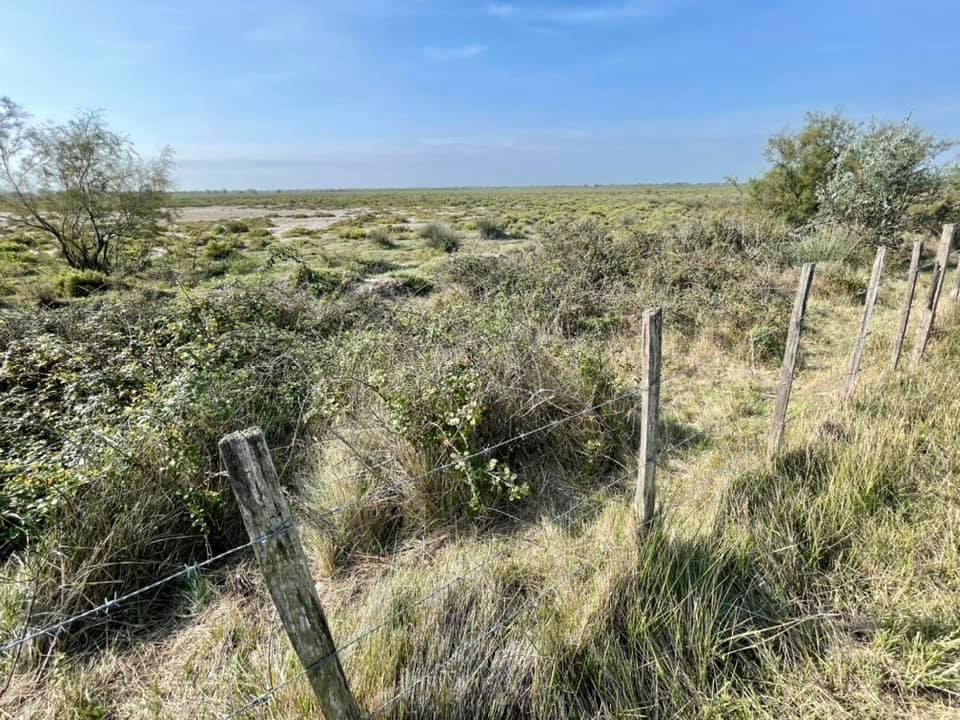
Uncultivated land. It was nice how balanced the wild and the agricultural areas were, and how they both fit into one unified landscape
My next, longer walk was in the Parc Ornitholigique du Pont-de-Gau. This was beautiful ... and full of birds!
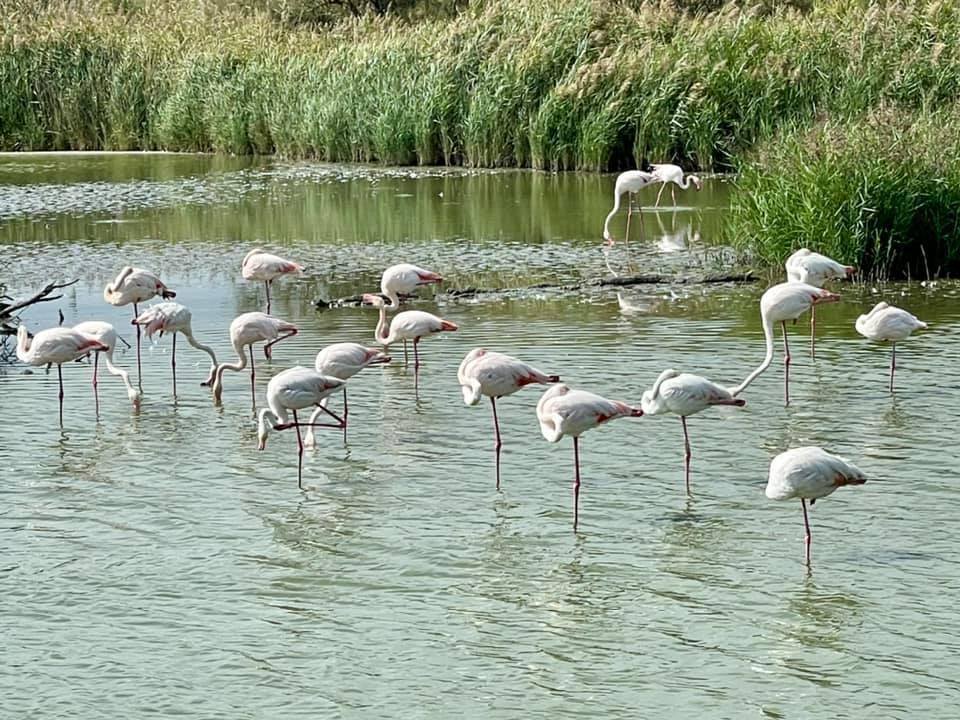
There were flamingos everywhere!
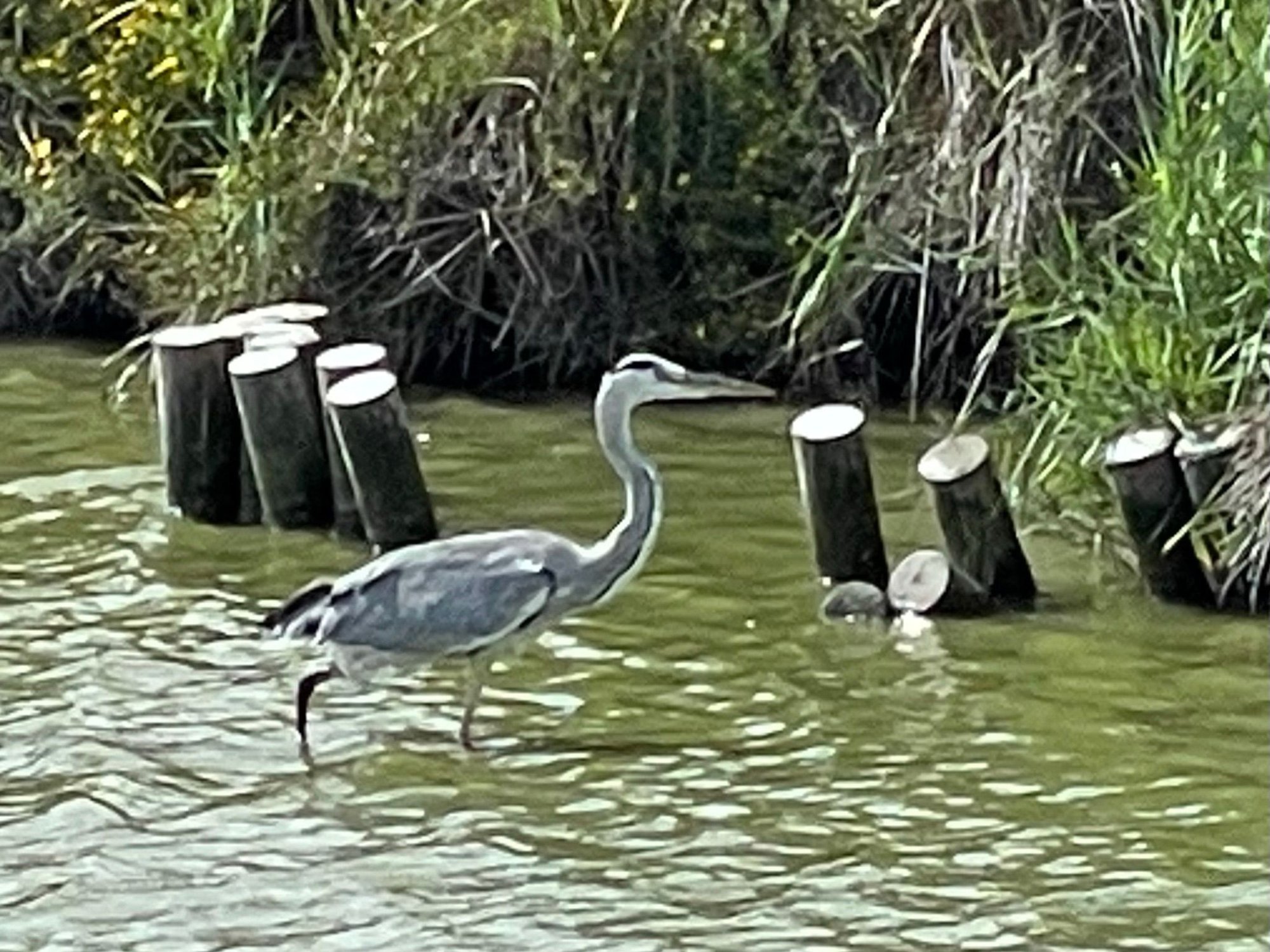
A heron trying to sneak through the flamingo herd
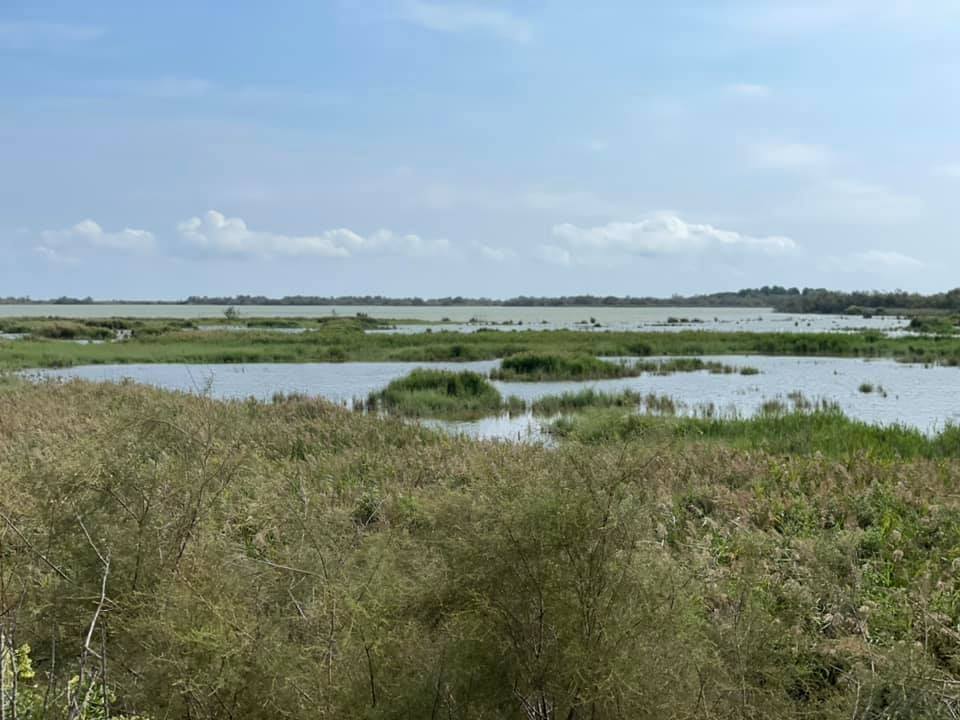
Looking out over the wetlands
I grabbed a quick sandwich and headed down to the coastal town of Saintes-Marie-de-la-Mer. According to tradition Saintes Marie Salomé and Marie Jacobé. were disciples of Jesus who were cast out of Jerusalem and put in a boat without sails or oars. They drifted over the sea before landing landed here, in Provence.
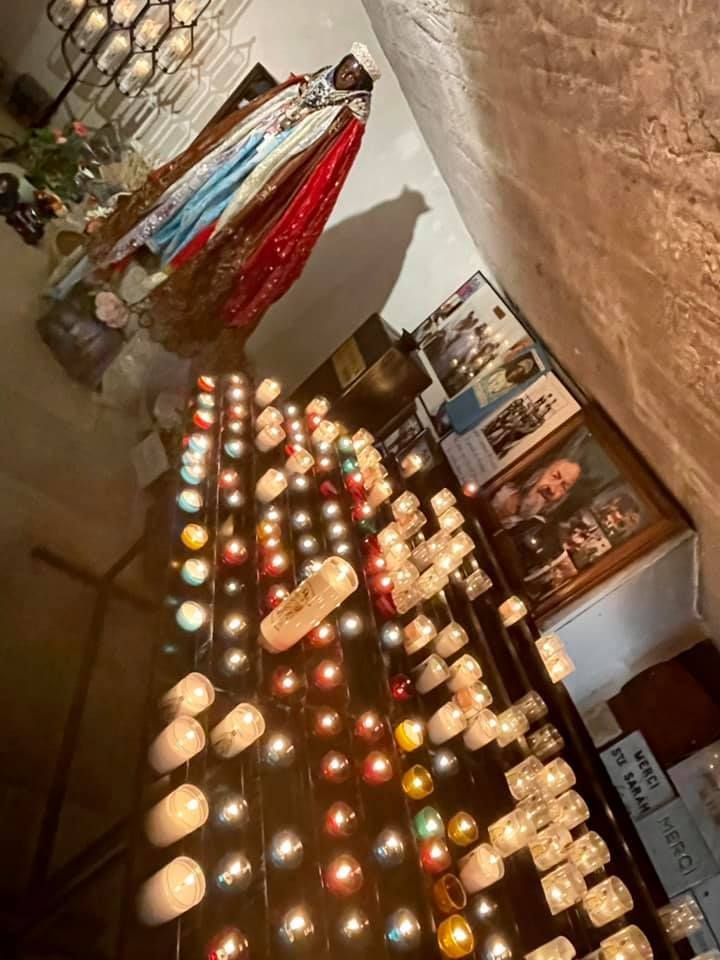
A shrine to Sara e Kali, Sarah the Black, patron saint of the Romani people. There’s a major Gitano pilgrimage here each Spring

Overlooking the city from the roof of the Église Notre-Dame-de-la-Mer. I'm actually nervous around heights ... and yet I keep climbing things.
I would have loved to have a big seafood lunch here, but my timing was off. I should have planned on getting here earlier. I explored the town a bit, then headed back to Arles. Storms were predicted for that evening, and I wanted to be somewhere safe and dry.
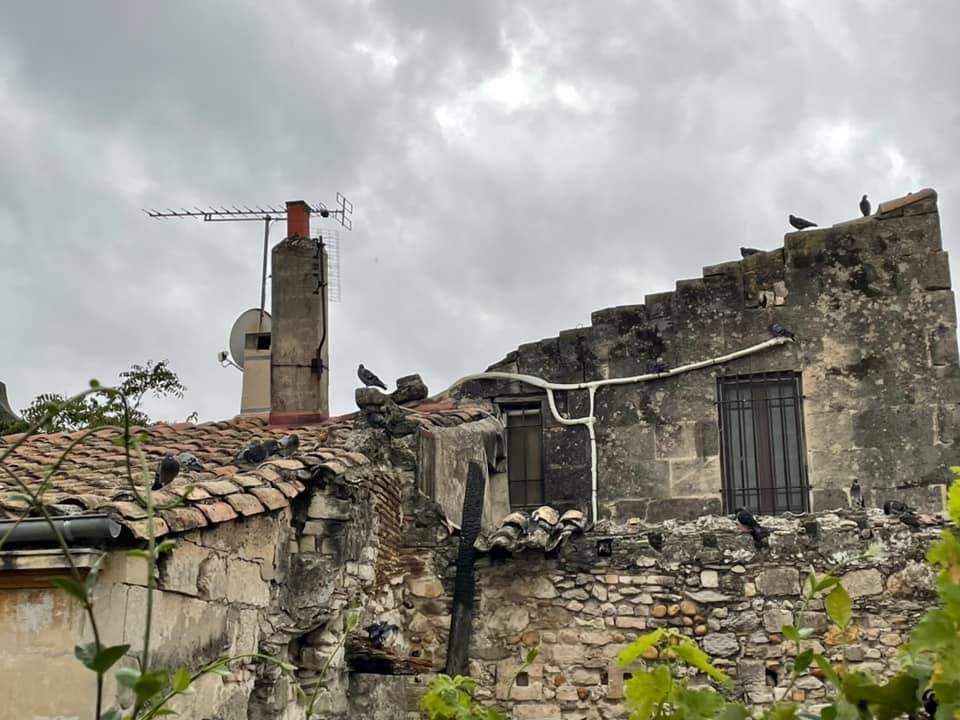
Before the storm. It was a good evening to stay in with some wine and a book.
I could have spent a second full day exploring the Camargue - I only saw a small corner of it. In theory I could have seen much more in a single day, but I like to get out, walk around, and take my time - I move slow! The road from Arles to Saintes-Maries-de-la-Mer was a good route for birds and rice fields. The road from Arles to Salin-de-Giraud would have been the route for ranches, horses, and salt ponds.
Today was my day for a road trip through the Camargue, the wetlands formed by the Rhône delta. I was ready for a landscape of birds and wild horses, ranches and rice fields and wetlands, and ... so I had heard ... mosquitoes.
My first stop was the Parc naturel régional de Camargue, which was only about 10 km outside of Arles. There was a museum there that I didn't go into, but I did walk for awhile on some trails in the park. This part of the Camargue has a gentle, soft agricultural landscape. I could hear a lot of songbirds but didn't see any. There were lots of dragonflies about, but luckily no mosquitoes. It was a nice way to start the morning. I walked the Chemin de Puy four years ago, and this brought back pleasant memories of walking in France.
If my camera could capture scents, it would capture wild thyme, laurel, and pine.
Rice fields, no birds yet
Uncultivated land. It was nice how balanced the wild and the agricultural areas were, and how they both fit into one unified landscape
My next, longer walk was in the Parc Ornitholigique du Pont-de-Gau. This was beautiful ... and full of birds!
There were flamingos everywhere!
A heron trying to sneak through the flamingo herd
Looking out over the wetlands
I grabbed a quick sandwich and headed down to the coastal town of Saintes-Marie-de-la-Mer. According to tradition Saintes Marie Salomé and Marie Jacobé. were disciples of Jesus who were cast out of Jerusalem and put in a boat without sails or oars. They drifted over the sea before landing landed here, in Provence.
A shrine to Sara e Kali, Sarah the Black, patron saint of the Romani people. There’s a major Gitano pilgrimage here each Spring
Overlooking the city from the roof of the Église Notre-Dame-de-la-Mer. I'm actually nervous around heights ... and yet I keep climbing things.
I would have loved to have a big seafood lunch here, but my timing was off. I should have planned on getting here earlier. I explored the town a bit, then headed back to Arles. Storms were predicted for that evening, and I wanted to be somewhere safe and dry.
Before the storm. It was a good evening to stay in with some wine and a book.
I could have spent a second full day exploring the Camargue - I only saw a small corner of it. In theory I could have seen much more in a single day, but I like to get out, walk around, and take my time - I move slow! The road from Arles to Saintes-Maries-de-la-Mer was a good route for birds and rice fields. The road from Arles to Salin-de-Giraud would have been the route for ranches, horses, and salt ponds.
Last edited by michael_cain_77398; Oct 26th, 2021 at 07:36 PM.
Oct 27th, 2021 | 07:26 AM
#32
Joined: Jun 2003
Posts: 24,040
Likes: 6
I have driven through the Camargue at least half a dozen times and been to the Saintes-Marie-de-la-Mer at least 3 or 4 times and Aigues-Mortes twice. So I have no excuse to have not properly seen the Camargue and yet, no, I have never seen it properly. It's sort of like driving through the American desert without stopping to actually see the desert. Some day I will learn where to stop and smell the roses see the flamingos.
Here is a little photo report on Aigues-Mortes, though: Aigues-Mortes (by kerouac2) | Any Port in a Storm (proboards.com) I hope to spend the night there next time.
Here is a little photo report on Aigues-Mortes, though: Aigues-Mortes (by kerouac2) | Any Port in a Storm (proboards.com) I hope to spend the night there next time.
Oct 27th, 2021 | 12:31 PM
#36

Joined: May 2010
Posts: 5,235
Likes: 0
I did a day trip to Cassis in July from Aix en Provence.
I skipped doing boat tours of the Calanques and hiking on the peninsula to go up to the Falaises or the cliffs on the eastern side of the Bay, overlooking the waters and the town.
The parking in town was crazy and impossible. Had to end up parking several kilometers to the NE of town and then taking a shuttle bus to town. I tried to walk on some coastal paths but they were also closed because of the threat of falling rocks from the cliffs above. I don't know how those paths were ever open. I don't think there was a recent geological change or anything.
But I'd certainly like to revisit, not just see Cassis again but also to see Marseille and La Ciotat.
I skipped doing boat tours of the Calanques and hiking on the peninsula to go up to the Falaises or the cliffs on the eastern side of the Bay, overlooking the waters and the town.
The parking in town was crazy and impossible. Had to end up parking several kilometers to the NE of town and then taking a shuttle bus to town. I tried to walk on some coastal paths but they were also closed because of the threat of falling rocks from the cliffs above. I don't know how those paths were ever open. I don't think there was a recent geological change or anything.
But I'd certainly like to revisit, not just see Cassis again but also to see Marseille and La Ciotat.
Oct 27th, 2021 | 10:47 PM
#37
Original Poster
Joined: Oct 2013
Posts: 228
Likes: 0
Arles 4: Les Baux-de-Provence
I don't know if I had mentioned before that this was my first international trip with a car. I've had cars for single day journeys, but never for five days at a time. There were times I thought, I'm just wasting money as my car sat unused in a parking garage. And there are days where I thought: oh ... so this is why folks say that you need a car to appreciate Provence! Yesterday and today were days that I absolutely needed a car, and they were both wonderful days.
The drive from Arles to Les Baux was easy. The scenery went from ok to interesting to stunning.
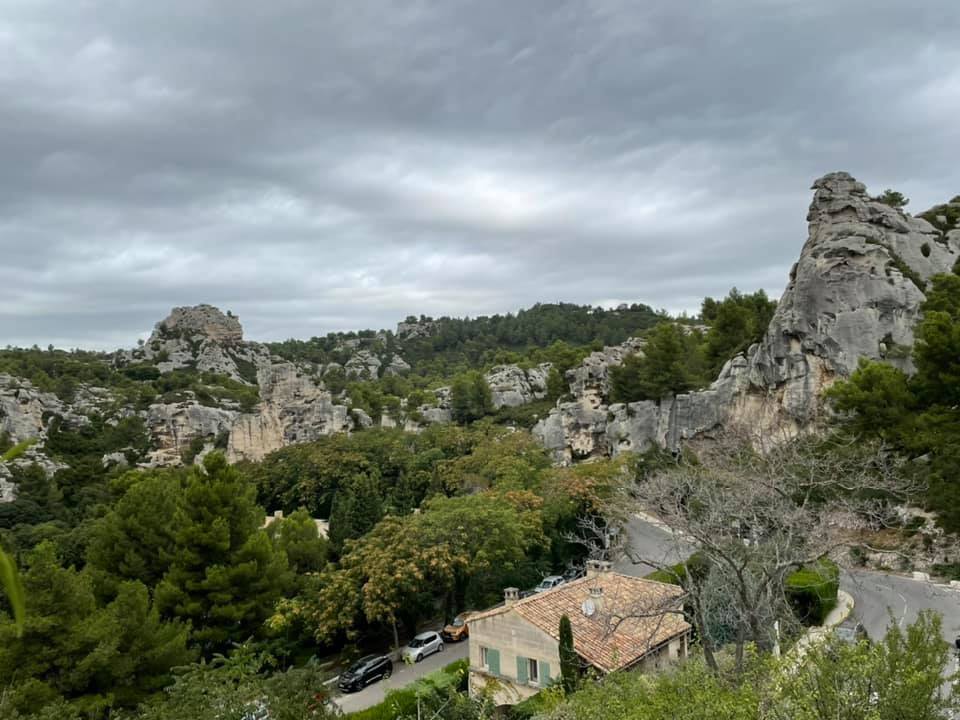
Looking out over the Val d'Enfer
My first stop was the Carrières de Lumières, an old quarry that has been converted to a multi-media art installation. I wish I could upload videos, just to convey the wonder of it. Photos don't do it justice. This was the site that did the original Van Gogh exhibition that has inspired all those cheap knock-offs that are touring the US these days. I saw one in Honolulu, and it was like watching a giant screen saver. This was truly immersive.
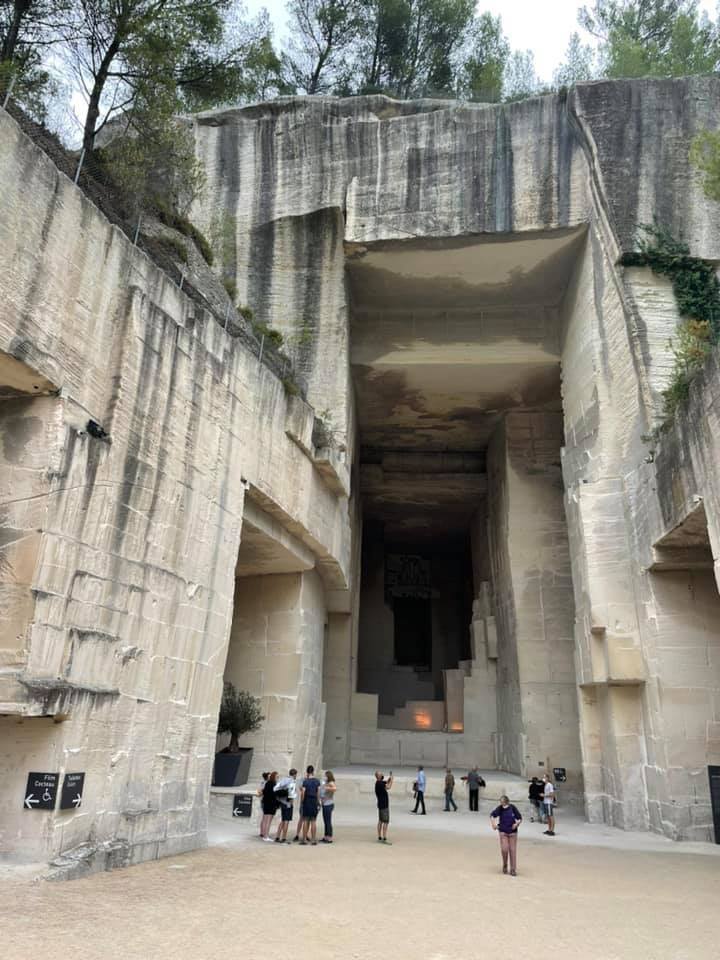
The quarry entrance. This season's shows: Cézanne and Kandinsky
There was no line at 10 am, and I was able to get right in. I saw longer lines later in the afternoon. I stayed for two shows, and watched the documentary in a side room.
From here it was an easy walk to Les Baux, which I also loved. My boss was staying here with her family, and for her it was the second time. She rave about Les Baux. I loved exploring the town on a day trip, but I'm glad that I was based in a more lively city like Arles.
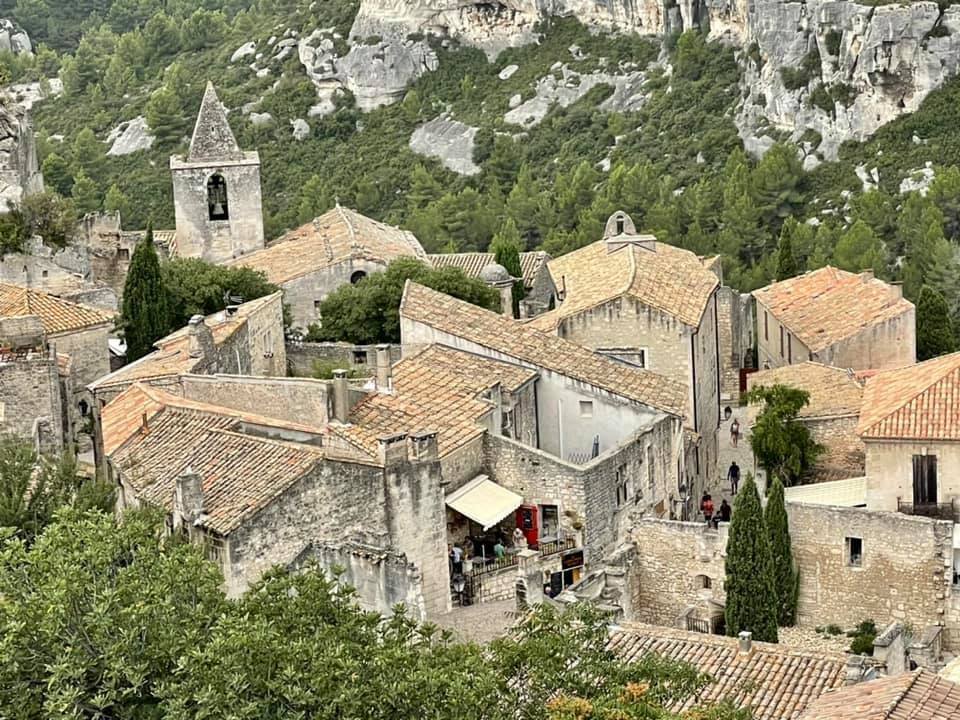
The city, seen from the ruins of the chateau.
There were a lot of foreign tourists here - more than I'd seen in the past couple weeks, For the first time I heard a lot of American accents. I spent some time reading up on all the restaurant reviews - I knew that a fair amount must be tourist traps. My research paid off - I had a wonderful assiette provençal at Au Café du Bouchon Rouge
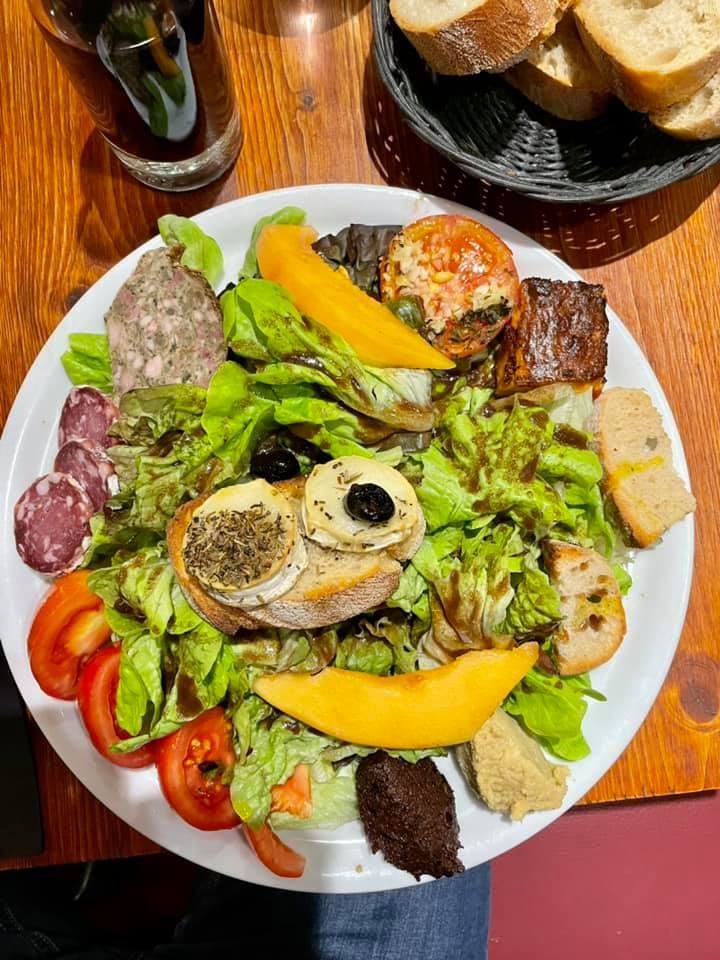
Warm goat cheese with honey, sausages, terrine, tapenade, a hummus-like bean spread, a vegetable dish that might have been squash, cantaloupe, tomatoes - now that's a salad!
On the way back I made a spur-of-the-moment stop at Abbaye de Montmajour. It was far more interesting than I had realized. The Lion in Winter was filmed here, which added to the coolness factor. I learned that the abbey had populated by monks with “a tendency to frivolity;” when they were replaced by more disciplined monks in 1639 the frivolous monks rebelled and pillaged the abbey.
I meant to make a quick stop, but it’s massive & it took me awhile to find the way out.
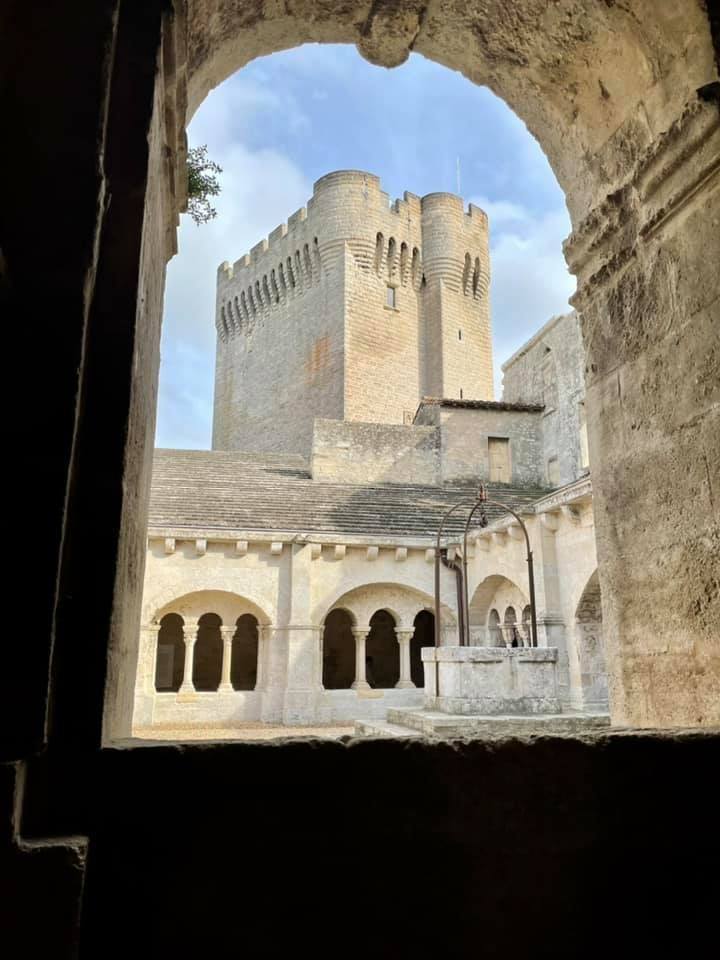
Exploring the abbey
And I just realized that I missed an important site in Arles itself, from my rainy day in the city: the Museon Arlaten. I usually don’t expect much from ethnographic museums, but this was fantastic.
Museon Arlaten was founded by the Occitan poet Frédéric Mistral, who used his Nobel-prize winnings to build a museum dedicated to Provençal language and culture. At the time, French was the sophisticated language and the Occitan languages (Provençal, Catalan, Gascon, et al) only spoken by workers and peasants.
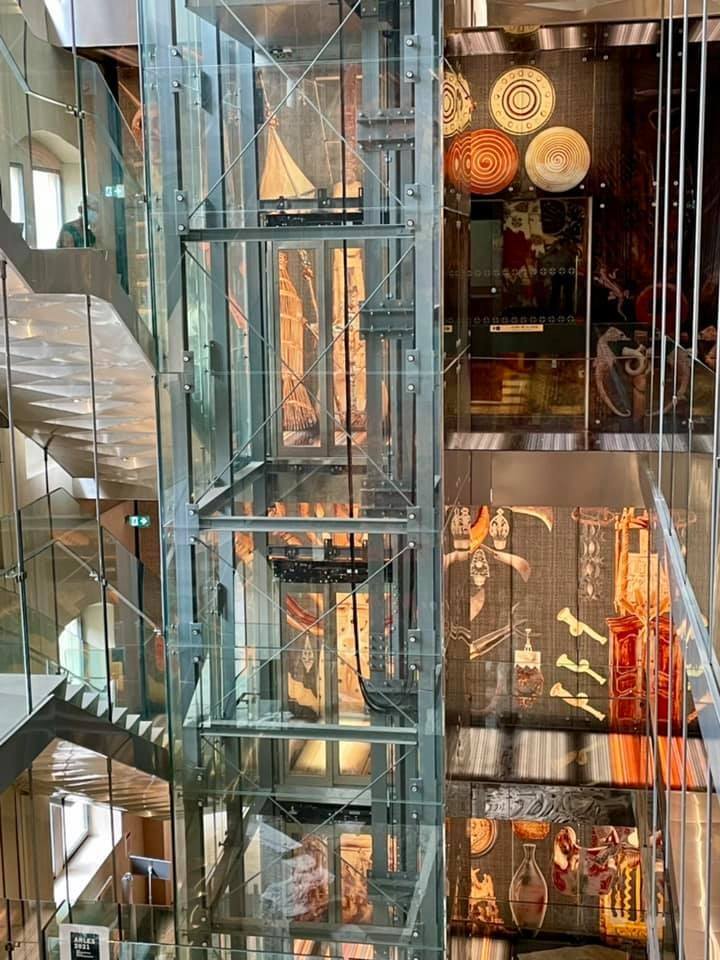
The house itself was a work of art
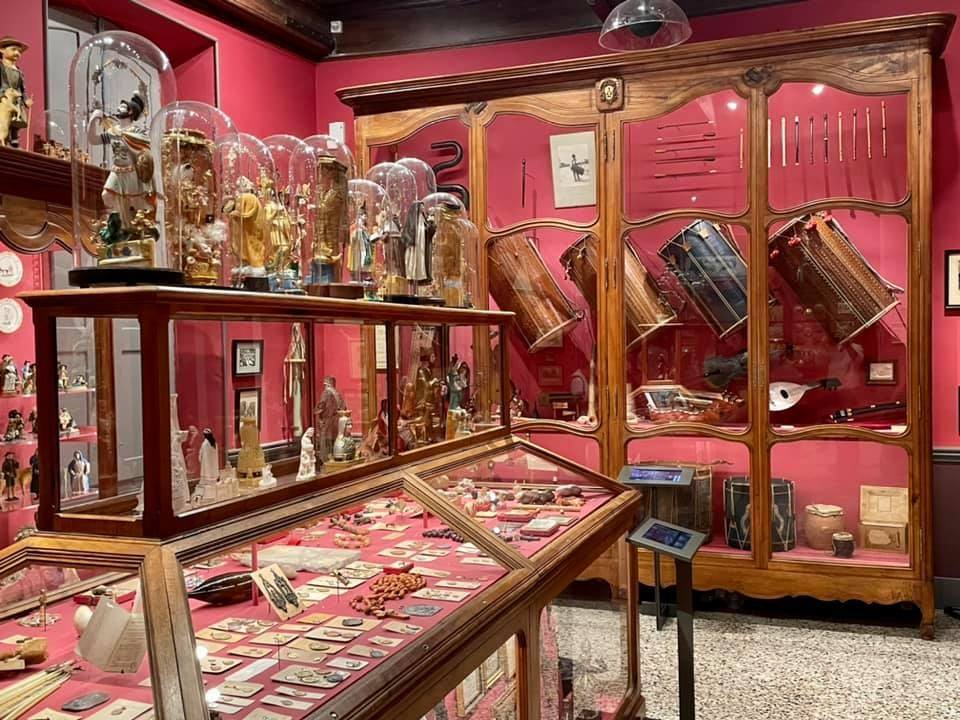
The exhibits had a 19th century classic feel, but were presented in a modern manner. The music room was interactive - there were touch pads that played samples of the instruments.
I don't know if I had mentioned before that this was my first international trip with a car. I've had cars for single day journeys, but never for five days at a time. There were times I thought, I'm just wasting money as my car sat unused in a parking garage. And there are days where I thought: oh ... so this is why folks say that you need a car to appreciate Provence! Yesterday and today were days that I absolutely needed a car, and they were both wonderful days.
The drive from Arles to Les Baux was easy. The scenery went from ok to interesting to stunning.
Looking out over the Val d'Enfer
My first stop was the Carrières de Lumières, an old quarry that has been converted to a multi-media art installation. I wish I could upload videos, just to convey the wonder of it. Photos don't do it justice. This was the site that did the original Van Gogh exhibition that has inspired all those cheap knock-offs that are touring the US these days. I saw one in Honolulu, and it was like watching a giant screen saver. This was truly immersive.
The quarry entrance. This season's shows: Cézanne and Kandinsky
There was no line at 10 am, and I was able to get right in. I saw longer lines later in the afternoon. I stayed for two shows, and watched the documentary in a side room.
From here it was an easy walk to Les Baux, which I also loved. My boss was staying here with her family, and for her it was the second time. She rave about Les Baux. I loved exploring the town on a day trip, but I'm glad that I was based in a more lively city like Arles.
The city, seen from the ruins of the chateau.
There were a lot of foreign tourists here - more than I'd seen in the past couple weeks, For the first time I heard a lot of American accents. I spent some time reading up on all the restaurant reviews - I knew that a fair amount must be tourist traps. My research paid off - I had a wonderful assiette provençal at Au Café du Bouchon Rouge
Warm goat cheese with honey, sausages, terrine, tapenade, a hummus-like bean spread, a vegetable dish that might have been squash, cantaloupe, tomatoes - now that's a salad!
On the way back I made a spur-of-the-moment stop at Abbaye de Montmajour. It was far more interesting than I had realized. The Lion in Winter was filmed here, which added to the coolness factor. I learned that the abbey had populated by monks with “a tendency to frivolity;” when they were replaced by more disciplined monks in 1639 the frivolous monks rebelled and pillaged the abbey.
I meant to make a quick stop, but it’s massive & it took me awhile to find the way out.
Exploring the abbey
And I just realized that I missed an important site in Arles itself, from my rainy day in the city: the Museon Arlaten. I usually don’t expect much from ethnographic museums, but this was fantastic.
Museon Arlaten was founded by the Occitan poet Frédéric Mistral, who used his Nobel-prize winnings to build a museum dedicated to Provençal language and culture. At the time, French was the sophisticated language and the Occitan languages (Provençal, Catalan, Gascon, et al) only spoken by workers and peasants.
The house itself was a work of art
The exhibits had a 19th century classic feel, but were presented in a modern manner. The music room was interactive - there were touch pads that played samples of the instruments.
Last edited by michael_cain_77398; Oct 27th, 2021 at 11:10 PM.
Oct 27th, 2021 | 11:07 PM
#38
Original Poster
Joined: Oct 2013
Posts: 228
Likes: 0
Arles 5: Martigues
Sad. It's my last day in France. My flight isn't until later in the afternoon, and my original plan had been to cut through the Camargue again, driving back along the coast. This section requires taking a car ferry near Salin-de-Giraud, and it had been storming most of the night and into the morning. and I didn't want to risk getting stuck in the countryside due to bad weather.
My guidebook didn't mention anything super intriguing on the drive, so when I stopped in Martigues for lunch I wasn't expecting much ...
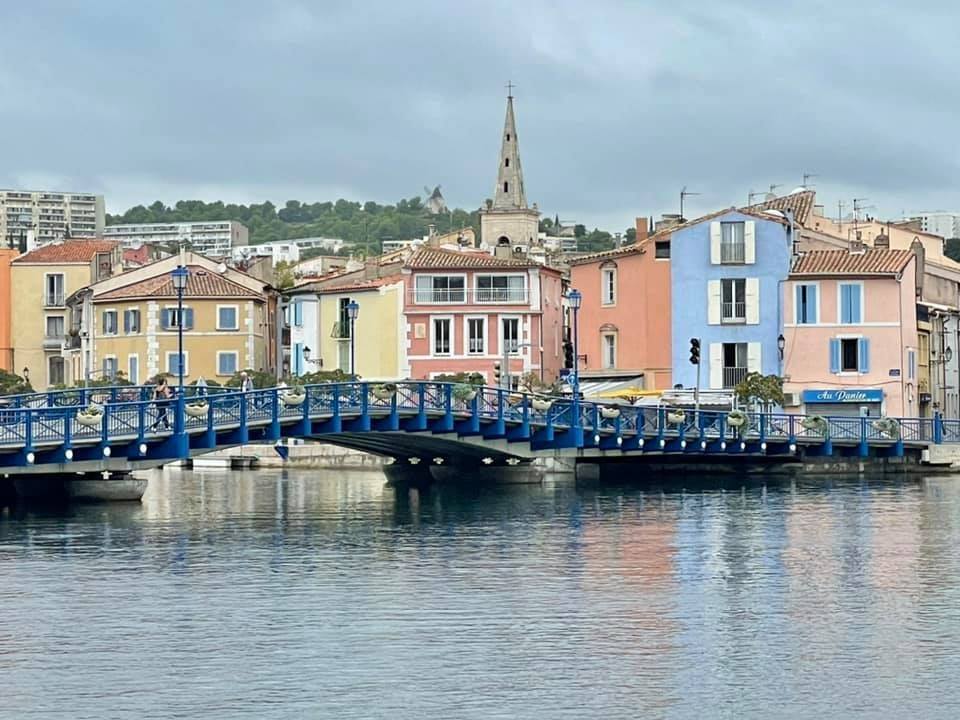
Martigues in the rain
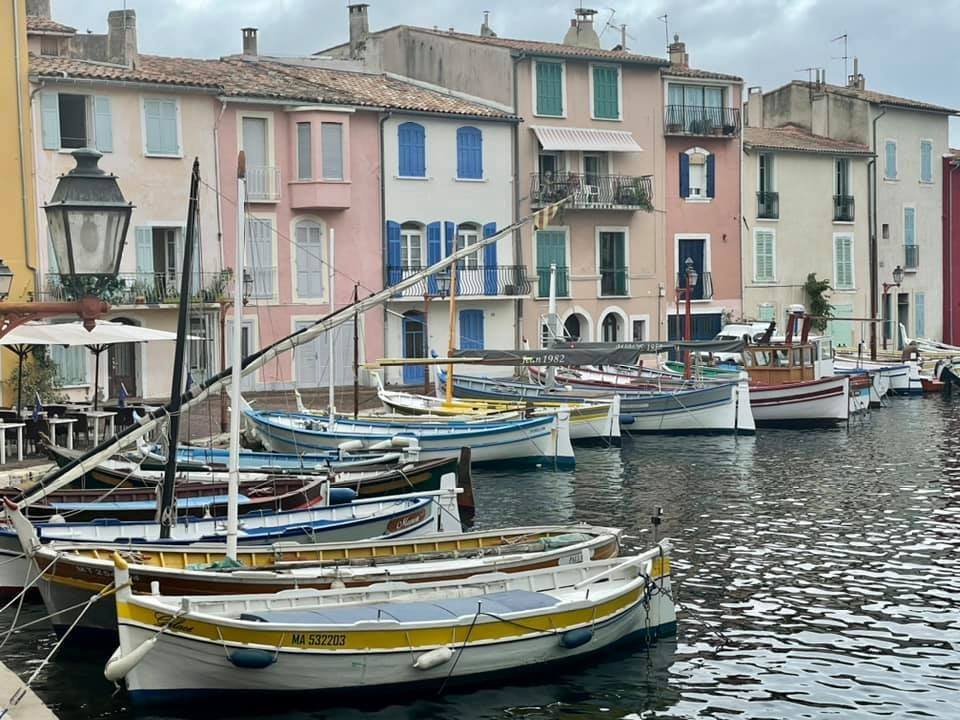
Quai Brescon dit «miroir aux oiseaux»
According to Alexandre Dumas «Martigues est à Venise ce qu’est une charmante paysanne à une grande dame; mais il n’eut fallu qu’un caprice de roi pour faire de la villageoise une reine» (Martigues is to Venise what a charming country girl is to a grande dame, but it would only take the caprice of a king to make the village girl into a queen).
Martiques was a lovely final stop on this adventure.
Arles, final thoughts: It's interesting how unique and individual each of the cities in the region felt. I like them all, but do have a soft spot for Arles more than the others. Perhaps it was due to the féria weekend (though it was very quiet during the week), perhaps it was that I had a car and didn't need to take busses to explore the region - but if I had to pick only one town to return to it would be Arles.
Le sud, final thoughts: Of course what one really should do is spend three to five days in all of them! Aix, Nîmes, Avignon, & Arles ... and then add the cities of Marseille and Nice ... oh and Montpelier ... and do a road trip with a car staying in the smaller towns ... I guess the perfect trip would take more than one visit.
I was perfectly fine without a car; I don't think it's necessary. However, having a car the final days really did open up new horizons. If I returned it would be to do a road trip. I've "done" the towns; next trip I'd like to explore the more rural areas.
Although, the trip I'm dreaming of won't involve cars or busses or trains. I love walking in France, and the Sentier Cathare - a 250 km trail in Languedoc, in the Pyrenean foothills - looks perfect. There's something about walking in these landscapes, and entering the medieval towns on foot, that can't compare.
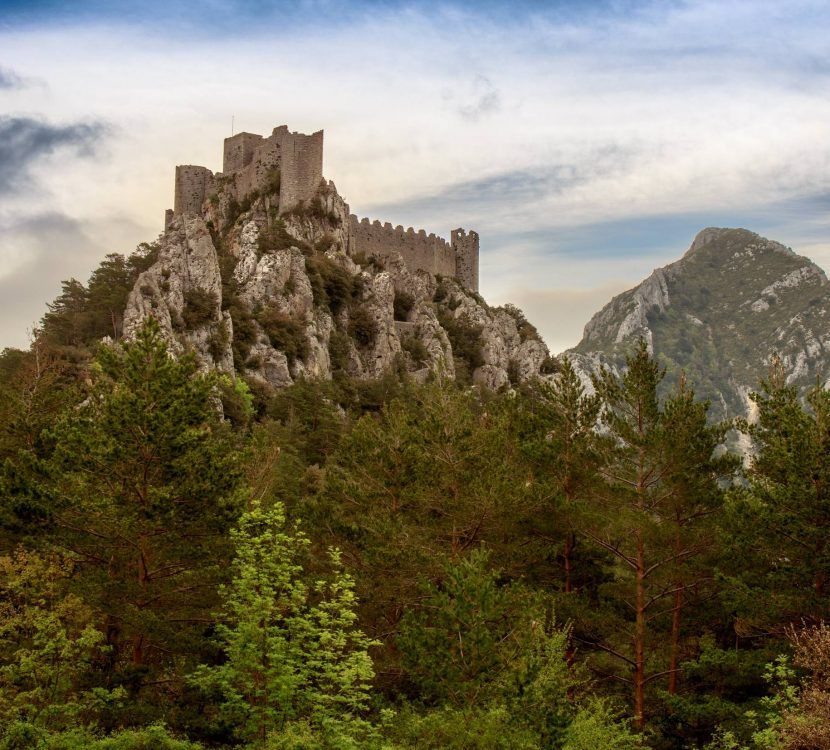
Not my photo
Alors, c'est fini. Thank you all for coming along, and the kind words! I learn a lot through trip reports on Fodors, and I'm glad when I'm able to share back.
Sad. It's my last day in France. My flight isn't until later in the afternoon, and my original plan had been to cut through the Camargue again, driving back along the coast. This section requires taking a car ferry near Salin-de-Giraud, and it had been storming most of the night and into the morning. and I didn't want to risk getting stuck in the countryside due to bad weather.
My guidebook didn't mention anything super intriguing on the drive, so when I stopped in Martigues for lunch I wasn't expecting much ...
Martigues in the rain
Quai Brescon dit «miroir aux oiseaux»
According to Alexandre Dumas «Martigues est à Venise ce qu’est une charmante paysanne à une grande dame; mais il n’eut fallu qu’un caprice de roi pour faire de la villageoise une reine» (Martigues is to Venise what a charming country girl is to a grande dame, but it would only take the caprice of a king to make the village girl into a queen).
Martiques was a lovely final stop on this adventure.
Arles, final thoughts: It's interesting how unique and individual each of the cities in the region felt. I like them all, but do have a soft spot for Arles more than the others. Perhaps it was due to the féria weekend (though it was very quiet during the week), perhaps it was that I had a car and didn't need to take busses to explore the region - but if I had to pick only one town to return to it would be Arles.
Le sud, final thoughts: Of course what one really should do is spend three to five days in all of them! Aix, Nîmes, Avignon, & Arles ... and then add the cities of Marseille and Nice ... oh and Montpelier ... and do a road trip with a car staying in the smaller towns ... I guess the perfect trip would take more than one visit.
I was perfectly fine without a car; I don't think it's necessary. However, having a car the final days really did open up new horizons. If I returned it would be to do a road trip. I've "done" the towns; next trip I'd like to explore the more rural areas.
Although, the trip I'm dreaming of won't involve cars or busses or trains. I love walking in France, and the Sentier Cathare - a 250 km trail in Languedoc, in the Pyrenean foothills - looks perfect. There's something about walking in these landscapes, and entering the medieval towns on foot, that can't compare.
Not my photo
Alors, c'est fini. Thank you all for coming along, and the kind words! I learn a lot through trip reports on Fodors, and I'm glad when I'm able to share back.

Thread
Original Poster
Forum
Replies
Last Post
Sassafrass
Europe
1
Sep 14th, 2013 09:31 AM


