

Fodor's Expert Review Jewish Ghetto
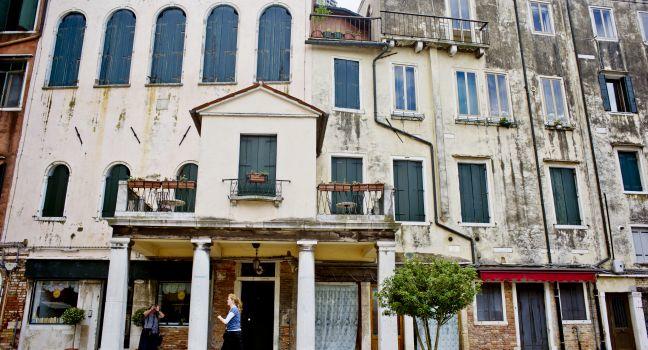
The neighborhood that gave the world the word "ghetto" is today a quiet area surrounding a large campo. It is home to Jewish institutions, several kosher restaurants, a rabbinical school, and five synagogues. Present-day Venetian Jews live all over the city, and the contemporary Jewish life of the ghetto, with the exception of the Jewish Museum and the synagogues, is an enterprise conducted almost exclusively by American Hasidic Jews of eastern European descent and tradition.
Although Jews may have arrived earlier, the first synagogues weren't built and a cemetery (on the Lido) wasn't founded until the Ashkenazi, or eastern European Jews, came in the late 1300s. Dwindling coffers may have prompted the Republic to sell temporary visas to Jews, who were over the centuries alternately tolerated and expelled. The Rialto commercial district, as mentioned in Shakespeare's The Merchant of Venice, depended on Jewish moneylenders for trade and to help cover ever-increasing war expenses.
In... READ MORE
The neighborhood that gave the world the word "ghetto" is today a quiet area surrounding a large campo. It is home to Jewish institutions, several kosher restaurants, a rabbinical school, and five synagogues. Present-day Venetian Jews live all over the city, and the contemporary Jewish life of the ghetto, with the exception of the Jewish Museum and the synagogues, is an enterprise conducted almost exclusively by American Hasidic Jews of eastern European descent and tradition.
Although Jews may have arrived earlier, the first synagogues weren't built and a cemetery (on the Lido) wasn't founded until the Ashkenazi, or eastern European Jews, came in the late 1300s. Dwindling coffers may have prompted the Republic to sell temporary visas to Jews, who were over the centuries alternately tolerated and expelled. The Rialto commercial district, as mentioned in Shakespeare's The Merchant of Venice, depended on Jewish moneylenders for trade and to help cover ever-increasing war expenses.
In 1516, relentless local opposition forced the Senate to confine Jews to an island in Cannaregio, then on the outer reaches of the city, named for its geto (foundry). The term "ghetto" also may come from the Hebrew "ghet," meaning separation or divorce. Gates at the entrance were locked at night, and boats patrolled the surrounding canals. Jews were allowed only to lend money at low interest, operate pawnshops controlled by the government, trade in textiles, or practice medicine. Jewish doctors were highly respected and could leave the ghetto at any hour when on duty. Though ostracized, Jews were nonetheless safe in Venice, and in the 16th century, the community grew considerably—primarily with refugees from the Inquisition, which persecuted Jews in Spain, Portugal, and southern and central Italy. The ghetto was allowed to expand twice, but it still had the city's densest population and consequently ended up with the city's tallest buildings.
Although the gates were pulled down after Napoléon's 1797 arrival, the ghetto was reinstated during the Austrian occupation. The Jews realized full freedom only in 1866 with the founding of the Italian state. Many Jews fled Italy as a result of Mussolini's 1938 racial laws, so that on the eve of World War II, there were about 1,500 Jews left in the ghetto. Jews continued to flee, and the remaining 247 were deported by the Nazis; only eight returned.
The area has Europe's highest density of Renaissance-era synagogues, and visiting them is interesting not only culturally, but also aesthetically. Though each is marked by the tastes of its individual builders, Venetian influence is evident throughout. Women's galleries resemble those of theaters from the same era, and some synagogues were decorated by artists who were simultaneously active in local churches; Longhena, the architect of Santa Maria della Salute, renovated the Spanish synagogue in 1635.
READ LESS