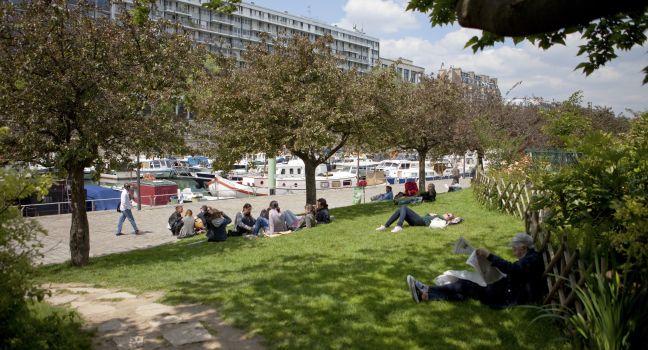
This once-forgotten canal has morphed into one of the city's trendiest places to wander. A good time to come is Sunday afternoon, when the Quai de Valmy is closed to cars and some of the shops are open. Rent a bike at any of the many Vélib' stations, stroll along the banks, or go native and cuddle quai-side in the sunshine with someone special.
In 1802 Napoléon ordered the 4.3-km (2.7-mile) canal dug as a source of clean drinking water after cholera and other epidemics swept the city. When it finally opened 23 years later, it extended north from the Seine at Place de la Bastille to the Canal de l'Ourcq, near La Villette. Baron Haussmann later covered a 1.6-km (1-mile) stretch of it, along today's Boulevard Richard Lenoir. It nearly became a highway in the 1970s, before the city's urban planners regained their senses. These days you can take a boat tour from end to end through the canal's nine locks: along the way, the bridges swing or lift open. The drawbridge with four giant pulleys at Rue de Crimée, near La Villette, was a technological marvel when it debuted in 1885. In recent years gentrification has transformed the once-dodgy canal, with artists taking over former industrial spaces and creating studios and galleries. The bar and restaurant scene is hipster central, and small designers have arrived, fleeing expensive rents in the Marais. To explore this evolving quartier, set out on foot. Start on the Quai de Valmy at Rue Faubourg du Temple (use the République métro stop). Here, at Square Frédéric Lemaître facing north, there is a good view of one of the locks (behind you the canal disappears underground). As you head north, detour onto side streets like Rue Beaurepaire, a fashionista destination with several "stock" (or surplus) shops for popular brands, some open on Sunday. Rues Lancry and Vinaigriers are lined with bars, restaurants, and small shops.
A swing bridge across the canal connects Lancry to the Rue de la Grange aux Belles, where you'll find the entrance to the massive Hôpital Saint-Louis, built in 1607 to accommodate plague victims and still a working hospital today. In front of you is the entrance to the chapel, which held its first Mass in July 1610, two months after the assassination of the hospital's patron, Henry IV. Stroll the grounds, flanked by the original brick-and-stone buildings with steeply sloping roofs. The peaceful courtyard garden is a neighborhood secret.
Back on Quai Valmy, browse more shops near the Rue des Récollets. Nearby is the Jardin Villemin, the 10e arrondissement's largest park (4½ acres) on the former site of another hospital. The nighttime scene, especially in summer, is hopping with twentysomethings spilling out of cafés and bars and onto the canal banks. If you've made it this far, reward yourself with a fresh taco or burrito at the tiny and authentically Mexican El Nopal taqueria ( 3 rue Eugène Varlin). Farther up, just past Place Stalingrad, is the La Rotonde Ledoux (commonly called Rotonde de la Villette), a lively square with restaurants and twin MK2 cinemas on either side of the canal, plus a boat to ferry ticket holders across. Canauxrama ( www.canauxrama.com) offers 2½-hour boat cruises through the locks (€20). Embarkation is at each end of the canal: at Bassin de la Villette or Port de l'Arsenal.