Welcome:
Login/Register

Ginkaku-ji Review

Read our Kyoto sights reviews. Or post your own.

Ginkaku-ji

  • Address: Ginkaku-ji-cho, Sakyo-ku, Kyoto

Fodor's Review:

Ginkaku-ji means "Temple of the Silver Pavilion," but the temple is not silver; it was only intended to be. Shogun Yoshimasa Ashikaga (1435-90) commissioned this villa for his retirement and decreed it would become a Zen temple after his death. Construction began in the 1460s, in the years leading up to the Onin Civil War, which was partially precipitated by a power struggle involving the Ashikaga line: Yoshimasa handed power over to his younger brother and then belatedly tried to install his young son as shogun. In 1474, a few years before the Imperial House went bankrupt and his shogunate became powerless, Yoshimasa, seeing the end in sight, abdicated to give his full attention to the building of his villa and his taste for aristocratic pleasures. These included romance, moon gazing, and the tea ceremony, which he helped develop into a high art form. Though he never had time to complete the coating of the pavilion with silver foil, he constructed a dozen or so buildings. Many were designed for cultural pursuits, such as incense and tea ceremonies. On his death, the villa was converted into a Buddhist temple. However, with the decline of the Ashikaga family, Ginkaku-ji deteriorated, and many buildings were destroyed.

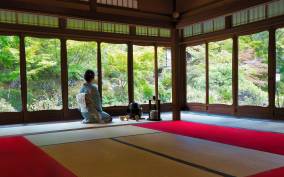
The remaining original buildings are Togu-do (East Seeking Hall) and Ginkaku-ji itself. The four other structures on the grounds were built in the 17th and 19th centuries. Yoshimasa is thought to have lived in the front room of Togu-do, and the statue of the priest is probably of Yoshimasa himself. The back room, called Dojin-sai (Comradely Abstinence), became the prototype for traditional tea-ceremony rooms. Ginkaku-ji is a simple and unadorned two-story building. Its appeal lies in the serene exterior shape, which combines Chinese elements such as bell windows with the developing Japanese Muromachi (1333-1568) architecture. The upper floor contains a gilt image of Kannon (goddess of mercy) said to have been carved by Unkei, a famous Kamakura-period sculptor; it's not, however ordinarily open to public view.

Ginkaku-ji overlooks the complex gardens, attributed to artist and architect Soami (1465-1523). Yoshimasa based his villa on Kinkaku-ji, which belonged to his grandfather, Shogun Yoshimitsu Ashikaga, who in turn had based his design on the moss gardens at Koinzan Saiho-ji. The central concept of all three designs is the juxtaposition of a dry Zen garden of raked sand, which is reshaped daily, with a verdant pond garden. The karensui, or dry garden, is composed of a 2-foot-high platform of raked sand that is supposed to evoke the sea and two sculpted mounds, the higher one symbolizing, perhaps, Fuji-san. The garden sparkles in the moonlight and has been aptly named the Sea of Silver Sand. You enter the garden on a shrub-lined path leading to the kara-mon, or Chinese gabled gate.

To reach Ginkaku-ji, take Bus 5 from Kyoto Station to the Ginkaku-ji-michi bus stop. Walk east on the street along the canal. Cross a north-south canal and Hakusa Son-so Garden on your right; then go straight and Ginkaku-ji will be in front of you.

  • Cost: ¥500
  • Open: Mid-Mar.–Nov., daily 8:30–5; Dec.–mid-Mar., daily 9–4:30

Get Advice From Other Travelers

Visit the Travel Talk forums for help on planning your trip >>


Buy the Guidebook

  • Fodor's Exploring Japan, 6th Edition
    $22
  • Fodor's Japan, 18th Edition
    $25.95

Get the Fodor's Newsletter

Read the current issue
For more travel ideas, tips, and deals, sign up for the Fodor's newsletter here. Browse previous issues.

Current Fodor's Newsletter

Copyright © 2009 Fodor's Travel, a division of Random House, Inc.