
79 Best Sights in USA

Background Illustration for Sights

We've compiled the best of the best in USA - browse our top choices for the top things to see or do during your stay.

Temescal

Temescal Fodor's Choice

Centering on Telegraph Avenue between 40th and 51st Streets, Temescal (the Aztec term for "sweat house") is a low-pretension, moneyed-hipster hood with young families and middle-aged folks in the mix. Protected bike lanes, bus islands, and a pedestrian plaza add to the vibrancy of this neighborhood. A critical mass of excellent eateries draws diners from around the Bay Area, including the excellent Filipino eats at FOB Kitchen ( 5179 Telegraph Ave.) and Smokin Woods BBQ ( 4307 Telegraph Ave.), as well as standbys like the fantastic fish tacos of Cholita Linda ( 4923 Telegraph Ave.) and the unusually refined café-brewery Rose's Taproom ( 4930 Telegraph Ave.). Old-timey dive bars and smog-check stations share space with public art installations of murals, sculptures, and mosaic trash cans.

Temescal Alley ( Off 49th St.), a tucked-away lane of tiny storefronts, crackles with creative energy. Get an old-fashioned straight-edge shave at Temescal Alley Barber Shop ( 470 49th St., Suite B). Don't miss grabbing a sweet scoop at Curbside Creamery ( 482 49th St.).
NoHo Arts District

North Hollywood

In only a few years, North Hollywood's performance arts hub has grown from the residential home of aspiring actors who frequent a few fringe theaters and several chain restaurants to a completely revitalized one square-mile district that boasts a vibrant collection of stages, galleries, dance studios, coffee shops, restaurants, bars, and colorful street art.

Rockridge

Rockridge

One of the East Bay's most desirable places to live is this fashionable, upscale neighborhood. Explore the tree-lined streets that radiate out from College Avenue, just north and south of the Rockridge BART station for a look at California Craftsman bungalows at their finest. By day, College Avenue between Broadway and Alcatraz Avenue is crowded with shoppers buying fresh flowers, used books, and clothing; by night, the same folks are back for satisfying meals filled with fresh local ingredients, artisanal wines, and locally brewed ales. There's even a cider bar, one of the few in the Bay Area (Redfield Cider Bar & Bottle Shop 5815 College Ave.). With its specialty food shops and quick bites to go, Market Hall, an airy European-style marketplace at Shafter Avenue, is a hub of culinary activity, including the wonderful Californian-Mediterranean cooking of the attached Acre Kitchen & Bar ( 5655 College Ave.).

Recommended Fodor's Video

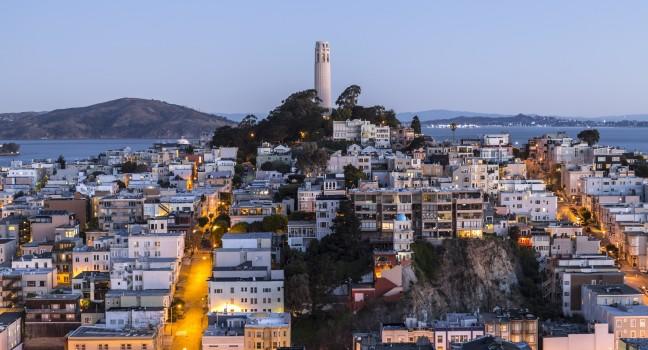
Telegraph Hill and the Filbert Steps

Fodor's Choice
Aerial dusk view of Coit tower in downtown San Francisco, California
trekandshoot / Shutterstock

Residents here have some of the city's best views, as well as the most difficult ascents to their aeries. The hill rises from the east end of Lombard Street to a height of 284 feet and is capped by Coit Tower. If you brave the slope, though, you'll be rewarded with a "secret treasure" San Francisco moment. Filbert Street starts up the hill, then becomes the Filbert Steps when the going gets too steep. You can cut between the Filbert Steps and another flight, the Greenwich Steps, on up to the hilltop. As you climb, you pass some of the city's oldest houses and are surrounded by beautiful, flowering private gardens. In some places the trees grow over the stairs, so it feels like you're walking through a green tunnel; elsewhere, you'll have wide-open views of the bay. The cypress trees that grow on the hill are a favorite roost of local avian celebrities, the wild parrots of Telegraph Hill; you'll hear the cries of the cherry-headed conures if they're nearby. The name comes from the hill's status as the first Morse code signal station back in 1853.

Alberta Arts District

Fodor's Choice

Arguably the first of Portland's several hipster-favored East Side neighborhoods to earn national attention, the Alberta Arts District (aka Alberta) has morphed from a downcast commercial strip into an offbeat row of hippie-driven counterculture and then more recently into a considerably more eclectic stretch of both indie arts spaces and sophisticated bistros and galleries. Extending a little more than a mile, Northeast Alberta offers plenty of one-of-a-kind dining and shopping. The area is also home to some of the best people-watching in Portland, especially during the Last Thursday (of the month) evening art walks.

Andersonville

Andersonville Fodor's Choice

Just northwest of Uptown there's a neighborhood that still shows signs of the Swedish settlers who founded it. Andersonville has some great restaurants and bakeries, many of which pay tribute to its Scandinavian roots. In winter months, be sure to drop by Simon's Tavern ( 5210 North Clark) for a glass of glögg (hot mulled wine)—it's a traditional favorite. Helping anchor the area is the Women & Children First bookstore ( 5233 North Clark), which stocks an extensive selection of feminist tomes and children's lit.

Arthur Avenue (Belmont)

Belmont Fodor's Choice

Manhattan's Little Italy is overrun with mediocre restaurants aimed at tourists, but Belmont (meaning "beautiful hill"), the Little Italy of the Bronx, is a real, thriving Italian American community. Unless you have family in the area, the main reason to come here is for the food: eating it, buying it, looking at it fondly through windows, and chatting with shopkeepers about it—perhaps getting recipe advice.

Nearly a century after pushcarts on Arthur Avenue catered to Italian American workers constructing the zoo and botanical garden, the area teems with meat markets, bakeries, cheese makers, and shops selling kitchenware (espresso machines, pasta makers, etc.). There are debates about which store or restaurant is the "best," but thanks to generations of Italian grandmothers, most vendors here serve fresh, handmade foods—including the sausages of the famed "sausage chandelier" at the Calabria Pork Store (  2338 Arthur Ave.). Although the area is no longer solely Italian—many Latinos and Albanians share this neighborhood now—Italian Americans dominate the food scene. 

Arthur Ave. between Crescent Ave./184th St. and 188th St., and 187th St. between Lorillard Pl. and Cambreleng Ave., Bronx, NY, 10458, USA
718-294–8259

Something incorrect in this review?

Ballpark Village

Downtown Fodor's Choice
Adjacent to Busch Stadium and just one block south of the Old Courthouse, this dining-and-entertainment district is very much a hot spot when Cardinals fans converge on downtown before and after games. But it's also a great place to hang out, grab a bite, and watch sports at other times, too. There's plenty of parking nearby.

Central East Side

Fodor's Choice

This expansive 681-acre tract of mostly industrial and commercial buildings was largely ignored by all but local workers until shops, galleries, and restaurants began opening in the neighborhood's handsome, high-ceilinged buildings beginning in the 1990s. These days, it's a legitimately hot neighborhood for shopping, craft-spirits and wine-tasting, and coffeehouse-hopping by day, and dining and bar-going at night. The neighborhood lies just across the Willamette River from Downtown—it extends along the riverfront from the Burnside Bridge south to the Oregon Museum of Science and Industry (OMSI) and Division Street, extending east about a dozen blocks to S.E. 12th Avenue. If you're coming by car, street parking is becoming tougher with all the new development but still possible to find, especially on quieter side streets.

Willamette River to S.E. 12th Ave. from Burnside to Division Sts., OR, 97214, USA

Something incorrect in this review?

Division Street

Fodor's Choice

Back in the early 1970s, Division Street (aka "Southeast Division") was earmarked for condemnation as part of a proposed—and thankfully never built—freeway that would have connected Downtown to Mt. Hood. For many years, this street sat forlornly, just a long stretch of modest buildings and empty lots. These days, Southeast Division—no longer threatened with condemnation—is one of the hottest restaurant rows on the West Coast, and sleek three- and four-story contemporary condos and apartments are popping up like dandelions. If culinary tourism is your thing, head to the 10 blocks of Southeast Division from about 26th to 39th Avenues. The main draw here is mostly food-and-drink related, and you'll also find a growing number of noteworthy restaurants and bars extending all the way to 12th Avenue to the west, and 50th Avenue to the east. You may hear some locals refer to the western end of the neighborhood as "Division/Clinton" referring to Clinton Street, a block south of Division, which has a clutch of great eateries and beautiful early- to mid-20th-century bungalows and houses, mostly from 27th to 20th Avenues.

Fairhaven

Fodor's Choice

Just 3 miles south of downtown Bellingham and at the beginning of Chuckanut Drive (Highway 11), this bustling historic district was an independent city until 1903 and still retains its distinct identity as an intellectual and artistic center. The beautifully restored 1890s redbrick buildings of the Old Fairhaven District, especially on Harris Avenue between 10th and 12th streets, house restaurants, galleries, and stylish boutiques. The action is centered on Fairhaven Green, the site of festivals, concerts, outdoor movies, and other fun gatherings throughout the year.

FATVillage (Flagler + Art + Technology)

Downtown Fodor's Choice

Inspired by Miami's Wynwood Arts District, Flagler + Art + Technology (or Food + Art + Technology) Village encompasses several square blocks of a formerly blighted warehouse district in downtown Fort Lauderdale. It's now thriving with a slew of production studios, art studios, and loft-style apartments. On the last Saturday of the month (except in December), FATVillage hosts an evening art walk, in which businesses display contemporary artworks by local talent and food trucks gather. There are libations, of course, and the warehouse district erupts into a giant, culture-infused street party.

Fernandina Historic District

Fodor's Choice

This district in Fernandina Beach, which is home to Florida's oldest existing lighthouse, oldest bar, and oldest hotel, has more than 50 blocks of buildings listed on the National Register of Historic Places. Its 450 ornate structures built before 1927 are some of the nation's finest examples of Queen Anne, Victorian, and Italianate architecture. Pick up a self-guided-tour map at the welcome center, in the old train depot—once a stopping point on the first cross-state railroad—and take your time exploring the quaint shops, restaurants, and boutiques that populate the district, especially along Centre Street.

Granary District

Fodor's Choice

If downtown Salt Lake City is growing fast, this historic manufacturing and railroad district on the southwest side of downtown is positively booming. Many of the neighborhood's handsome late-19th-century and early-20th-century warehouses and factory buildings have been converted into mixed-use developments, and in seemingly every direction, shiny new condos and apartments are going up. Many of the city's hottest drinking, dining, and shopping venues are in the Granary District, including Fisher Brewing, Laziz Kitchen, Water Witch, and The Pearl. West 900 South, between 300 West and South West Temple, is especially rife with buzzy places to eat and drink.

Hawthorne District

Fodor's Choice

Stretching from the foot of Mt. Tabor to S.E. 12th Avenue (where you'll find a terrific little food-cart pod), with some blocks far livelier than others, this eclectic commercial thoroughfare was at the forefront of Portland's hippie and LGBTQ+ scenes in the 1960s and 1970s. As the rest of Portland's East Side has become more urbane and popular among hipsters, young families, students, and the so-called creative class over the years, Hawthorne has retained an arty, homegrown flavor. An influx of trendy eateries and retailers opening alongside the still-colorful and decidedly low-frills thrift shops and old-school taverns and cafés makes for a hodgepodge of styles and personalities—you could easily spend an afternoon popping in and out of boutiques, and then stay for happy hour at a local nightspot or even later for dinner.

Hollywood District

Fodor's Choice

Of Woodinville's four main clusters of wineries, the Hollywood District, named for the historical former schoolhouse that anchors it, is by far the most picturesque and pedestrian-friendly. A good strategy is to park at one of the clusters of tasting rooms just off the traffic circle in the center of this neighborhood, and then hop out and stroll around. More than 40 tasting rooms are within a short walk of one another, along with a handful of restaurants. Some of the state's heavy hitters are here, including Alexandria Nicole, Betz, Cougar Crest, J. Bookwalter, Novelty Hill–Januik, and Pepper Bridge. 

Homer Spit

Fodor's Choice

Protruding into Kachemak Bay, the Homer Spit provides a sandy focal point for visitors and locals. A 4½-mile paved road runs the length of the Spit, making it the world's longest road into the ocean. A commercial-fishing-boat harbor at the end of the path has restaurants, hotels, charter-fishing businesses, sea-kayaking outfitters, art galleries, and on-the-beach camping spots. Fly a kite, walk the beaches, drop a line in the Fishing Hole, or just wander through the colorful shops looking for something interesting; this is one of Alaska's favorite summertime destinations.

Koreatown

Murray Hill Fodor's Choice

Despite sitting in the shade of the Empire State Building and being just steps from Herald Square, Koreatown (or "K-Town," as it's locally known) is not a tourist destination. In fact, it's a bustling area, with traditional and trendy places to shop, eat, drink, and be merry right under the noses of millions of tourists. Technically, Koreatown runs from 31st to 36th Street between 5th and 6th Avenues, though the main drag is 32nd Street between 5th and Broadway. Labeled Korea Way, this strip is home to Korean barbecue joints, karaoke bars, and grocery and beauty stores, all stacked next to each other. Find just about everything K-Pop-related at Koryo Books ( 35 W. 32nd St.), scope out a popular food hall at Food Gallery 32 ( 11 W. 32nd St.), or order desserts most worthy of an Instagram reel at Grace Street Coffee & Desserts ( 17 W 32nd St.). Fill up on kimchi (spicy pickled cabbage), kimbap (seaweed rice rolls), and red bean doughnuts (delicious); then top off your Koreatown experience by stepping into a jade-igloo sauna at Juvenex Spa ( 25 W. 32nd St.).

From 31st to 36th St., New York, NY, 10001, USA

Something incorrect in this review?

North Mississippi Avenue

Fodor's Choice

One of North Portland's strips of indie retailers, the liveliest section of North Mississippi Avenue stretches for several blocks and includes a mix of old storefronts and sleek new buildings that house cafés, brewpubs, collectives, shops, music venues, and an excellent food-cart pod, Prost! Marketplace. Bioswale planter boxes, found-object fences, and café tables built from old doors are some of the innovations you'll see along this eclectic thoroughfare. About a 10-minute walk east and running parallel to North Mississippi, the bike-friendly North Williams corridor is a more recently developed area of almost entirely new, eco-friendly buildings and condos rife with trendy restaurants.

Northalsted

Boystown Fodor's Choice

Just east of Wrigleyville lies this section of Lakeview; it's been a major "gayborhood" since the 1970s, which also makes it one of the country's first. In recent years there's been an admirable push by the local queer community to go beyond the gendered moniker of "Boystown" and reflect the more inclusive LGBTQIA+ world, which is why you'll hear the area referred to as Northalsted more often these days (as most of the queer-oriented shops, bars, and restaurants are concentrated on and around North Halsted Street). In June the area becomes a sea of people, when tens of thousands attend the annual Pride Fest as it floats down the street. One of the city's largest music-focused neighborhood street fests, Northalsted Market Days, floods the area with visitors once again in August.

Shattuck & Vine Street Neighborhood

Fodor's Choice

The success of Alice Waters's Chez Panisse defined California cuisine and attracted countless food-related enterprises to a stretch of Shattuck Avenue. Foodies will do well here poking around the shops, grabbing a quick bite, or indulging in a feast. Tigerlily ( 1513 Shattuck Ave.) dishes up modern Indian cuisine along with signature cocktails.

Nearby on Vine Street, the Vintage Berkeley ( 2113 Vine St.) wineshop offers tastings and reasonably priced bottles within a historic former pump house. The pint-sized Fava ( 2114 Vine St.) is a beloved lunch spot for the freshest of salads and excellent falafel sandwiches. Coffee lovers can head to the original Peet's Coffee & Tea at the corner of Walnut and Vine ( 2124 Vine St.).

South of Cedar Street, The Local Butcher Shop ( 1600 Cedar St.) sells locally sourced meat and a hearty sandwich of the day. For high-end food at takeout prices, try the salads, sandwiches, and signature potato puffs at Grégoire ( 2109 Cedar St.). Masse's Pastries ( 1469 Shattuck Ave.) is a museum of edible artwork. We could go on, but you get the idea.

Tin City

Fodor's Choice

This industrial park on the southern border of Paso Robles houses a collection of wineries, a craft brewery, a cider producer, and the Tin City Distillery. The latter produces gin, a few vodkas, and whiskey (including a single-malt whiskey), plus a Wine Shine label featuring brandy made from Paso Robles grapes. For your nonspirits explorations, start at Giornata Winery, Levo Winery, and Tin City Cider Co. The upscale Michelin-starred Six Test Kitchen is also located in this food-and-drink-centric neighborhood.

Vancouver Waterfront

Fodor's Choice

Just a 10-minute walk south of downtown, Vancouver's formerly industrial waterfront has been reborn as a handsome, contemporary mixed-use development flanked by a beautifully landscaped promenade and V-shape, cantilevered Grant Street Pier, which is suspended over the Columbia River by cable stays. The $1.5 billion project opened in 2018 and will expand over the years—potentially to include a public market. Other key features include a 7.3-acre Waterfront Park with imaginative public art installations, a sweeping grassy picnic area, a small urban beach, an amphitheater, and direct access to the Columbia River Renaissance Trail, an existing 5-mile paved multiuse track that connects additional parks, restaurants, and public art along the north shore of the Columbia River. Nearly a dozen prominent Washington wineries (Maryhill, Brian Carter Cellars, Pepper Bridge, Airfield Estates, and Barnard Griffin among them) have opened tasting rooms here, along with several restaurants and two hotels (an AC Hotel by Marriott and a Hotel Indigo). Especially when the sun is out, this festive district's restaurant terraces, pathways, and pier fill up with friends, families, and onlookers of all ages.

West End

Fodor's Choice

Sandwiched between the Pioneer Square area and the upscale Pearl District, this triangular patch of vintage buildings—interspersed with a handful of contemporary ones—has evolved since the early 2000s into one of the city's most eclectic hubs of fashion, nightlife, and dining. Boutique hotels like the Ace and Sentinel rank among the city's trendiest addresses. Along Harvey Milk Street, formerly the heart of Portland's LGBTQ+ scene, there's still a popular gay bar, but now you'll also find noteworthy restaurants and lounges, and plenty of indie boutiques.

S.W. 13th to S.W. 9th Aves., between W. Burnside St. and S.W. Yamhill St., OR, 97205, USA

Something incorrect in this review?

Argyle Strip

Uptown

Also known as "Little Vietnam," the stretch of Argyle Avenue between Broadway and Sheridan (and the blocks surrounding it) offers much more than just steaming bowls of pho. Among the storefront noodle-focused restaurants are Chinese bakeries, Thai curry specialists, dim sum destinations, and pan-Asian grocery stores that are a huge draw for locals and tourists alike. Roasted ducks hang in shop windows and bubble tea shops abound. 

Chicago, IL, 60640, USA

Something incorrect in this review?

Assembly Row

Assembly Row

What was once large, barren fields and the former home of a Ford assembly plant is now a thriving destination neighborhood along the Mystic River. Seemingly always growing, Assembly Row is an open-air community of live-work-play spaces all connected by waterfront walkways and parks. Retail abounds, with stores like Puma, Brooks Brothers, a J.Crew outlet, the area's only Saks Off Fifth, and more. For entertainment, check out the AMC movie theater, the newly revamped LEGO Discovery Center, and Lucky Strike Social, a 36,000-square-foot space with dining, bowling, games, and shuffleboard on the first floor and an island bar on the second. Seasonal programming includes Club Volo's volleyball and pickleball courts, yoga in the park, Markers Market, live music Fridays, free lessons at Dancing on the Row, and September's Riverfest.

There are 40 restaurants including the trendy River Bar (loved for its year-round fire pits), casual noodles and sake at Fuji, a three-season patio at Salt & Stone, Greek at Zo, and the relocation of neighborhood favorite Posto. The eight-in-one fitness studio FitRow has you covered for whatever workout you desire, from boxing to cycling to Pilates.

Need some downtime from all that activity? Pop into Heyday Facial and the area's first Squeeze Massage location for a quiet respite. Also here is the Row Hotel at Assembly Row, a boutique hotel with some of the best interior design around.

355 Artisan Way, Somerville, MA, 02145, USA

Something incorrect in this review?

Barrio de Analco

The Plaza

Along the south bank of the Santa Fe River, the barrio—its name means "District on the Other Side of the Water"—is one of America's oldest neighborhoods, settled in the early 1600s by the Tlaxcalan Indians (who were forbidden to live with the Spanish near the Plaza) and in the 1690s by soldiers who had helped recapture New Mexico after the Pueblo Revolt. The historic district was named a National Historic Landmark in 1968 and is a great place to experience Santa Fe's unique history of Native American, Spanish, Mexican, and American cultural influence. Plaques on houses on East De Vargas Street will help you locate some of the important structures. Check the performance schedule at the Santa Fe Playhouse on De Vargas Street, founded by writer Mary Austin and other Santa Feans in 1922.

Old Santa Fe Trail at E. De Vargas St., Santa Fe, NM, USA

Something incorrect in this review?

Bay Village

South End

This pocket of early-19th-century brick row houses, near Arlington and Piedmont streets, is a fine, mellow neighborhood (Edgar Allan Poe was born here) that's actually Boston's smallest officially recognized neighborhood. Its window boxes and short, narrow streets make the area seem a toylike reproduction of Beacon Hill. Note that, owing to the street pattern, it's difficult to drive to Bay Village, and it's easy to miss on foot.

Bounded (roughly) by Arlington, Stuart, Charles, and Marginal Sts., Boston, MA, 02117, USA

Something incorrect in this review?

Beach Drive

This upscale stretch along Downtown's waterfront is the epicenter of St. Pete's cultural revival and serves as the city's restaurant row. Tons of pricey shops and alfresco eateries line the east side of this blocks-long promenade, giving it a European feel. Highlights include the St. Petersburg Museum of Fine Art and Bella Brava. Dazzling waterfront parks, which are often packed during the area's many weekend festivals, flank the drive's west side.

The BLVD

Lancaster's downtown arts and culture district and social hub, The BLVD, stretches for nine blocks along West Lancaster Boulevard from 10th Street West to Sierra Highway. Boeing Plaza anchors the east end and marks the start of the Aerospace Walk of Honor—a series of murals and monuments lauding 100 legendary figures, including Neil Armstrong and Chuck Yaeger. The district is also home to the Lancaster Performing Arts Center, the Lancaster Museum of Art & History, galleries, restaurants, boutiques, coffee and tea shops, craft breweries, and entertainment venues.