40 Best Sights in USA

Background Illustration for Sights

We've compiled the best of the best in USA - browse our top choices for the top things to see or do during your stay.

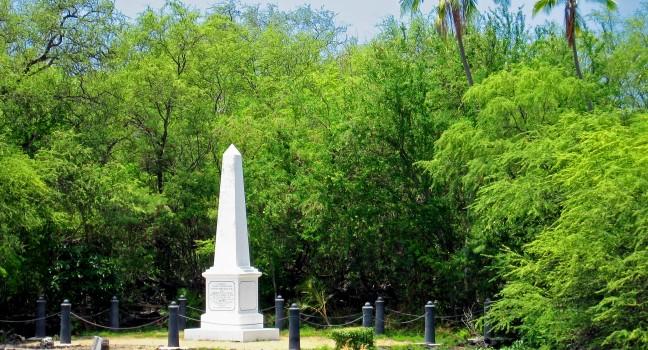
Captain James Cook Monument

Fodor's Choice
Captain Cook's Monument, Big Island, Hawaii
Captain Cook's Monument by

On February 14, 1779, famed English explorer Captain James Cook was killed here during an apparent misunderstanding with local residents, and this 27-foot-high obelisk marks the spot where he died. He had chosen Kealakekua Bay as a landing place in November 1778. Arriving during the celebration of Makahiki, the harvest season, Cook was welcomed at first. Some Hawaiians saw him as an incarnation of the god Lono. Cook's party sailed away in February 1779, but a freak storm forced his damaged ship back to Kealakekua Bay. Believing that no god could be thwarted by a mere rainstorm, the Hawaiians were not so welcoming this time. The theft of a longboat brought Cook and an armed party ashore to reclaim it. Shots were fired, daggers and spears were thrown, and Cook fell, mortally wounded. 

A trail leading to the site is accessible from the top of Napoopoo Road, but caution is advised. The very strenuous trail gains an elevation of about 1,500 feet and is recommended for advanced hikers only.

Captain Cook, HI, 96704, USA

Something incorrect in this review?

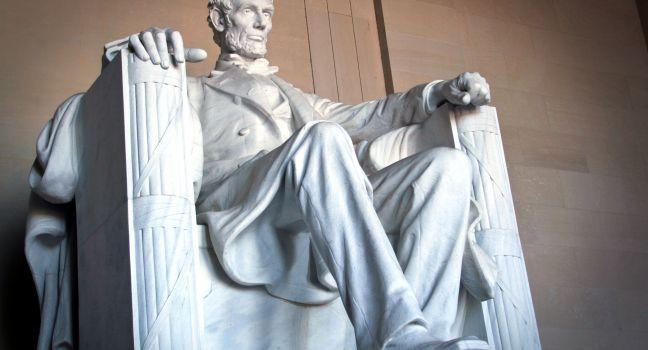
Lincoln Memorial

The Mall Fodor's Choice
Abraham Lincoln monument in Washington, DC; Shutterstock ID 95672686; Project/Title: cover spines and back images; Downloader: min yoon
Timothy Michael Morgan/Shutterstock

Daniel Chester French's statue of the seated president gazing out over the Reflecting Pool may be the most iconic on the Mall. The 19-foot-high sculpture is made of 28 pieces of Georgia marble. The surrounding white Colorado-marble memorial was designed by Henry Bacon and completed in 1922. The 36 Doric columns represent the 36 states in the Union at the time of Lincoln's death; their names appear on the frieze above the columns. Over the frieze are the names of the 48 states in existence when the memorial was dedicated. At night the memorial is illuminated, creating a striking play of light and shadow across Lincoln's face. Photography enthusiasts will find great light during dawn and dusk. Given the afternoon crowds, sunrise may be a great bet. 
Two of Lincoln's great speeches—the second inaugural address and the Gettysburg Address—are carved on the north and south walls. Above each is a Jules Guerin mural: the south wall has an angel of truth freeing an enslaved person; the unity of North and South is opposite.
The memorial's powerful symbolism makes it a popular gathering place. In its shadow, Americans marched for integrated schools in 1958, rallied for an end to the Vietnam War in 1967, and laid wreaths in a ceremony honoring the Iranian hostages in 1979. It may be best known, though, as the site of Martin Luther King Jr.'s "I Have a Dream" speech.

Martin Luther King Jr. National Memorial

The Mall Fodor's Choice
Washington DC, USA - October 17, 2014: The Martin Luther King Jr. Memorial located on the National Mall on the Tidal Basin in Washington DC is America's 395th National Park.
(c) Kropic | Dreamstime.com

One of the most iconic American figures, Martin Luther King Jr., stands among the presidents on the National Mall. For his dedication on October 16, 2011, President Barack Obama said, "This is a day that would not be denied." The memorial opened on August 22, 2011, 15 years after Congress approved it in 1996 and 82 years after the famed civil rights leader was born in 1929. Located strategically between the Lincoln and Jefferson memorials and adjacent to the FDR Memorial, the crescent-shaped King Memorial sits on a 4-acre site on the curved bank of the Tidal Basin. There are two main ways to enter the memorial. From West Basin Drive, walk through a center walkway cut out of a huge boulder, the Mountain of Despair. From the Tidal Basin entrance, a 28-foot-tall granite structure shows a likeness of King looking out toward Jefferson's statue. 
King's words explain the symbolism of the mountain and stone: "With this faith, we will be able to hew out of the mountain of despair a stone of hope." Chinese sculptor Lei Yixin carved the centerpiece stone; his design won the commission among more than 900 entries in an international competition. Fittingly, Yixin first read about King's "I Have a Dream" speech at age 10 while visiting the Lincoln Memorial.
The themes of democracy, justice, hope, and love are reflected through quotes on the south and north walls and the Stone of Hope. The quotes reflect King's speeches, sermons, and writings from 1955 through 1968. Waterfalls in the memorial reflect King's use of the biblical quote: "Let justice roll down like waters and righteousness like a mighty stream."

Recommended Fodor's Video

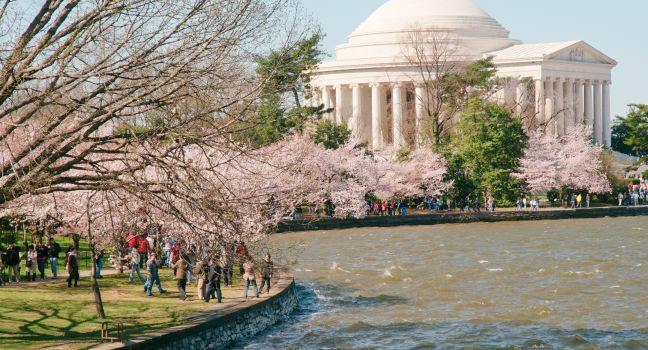
Thomas Jefferson Memorial

The Mall Fodor's Choice
Jefferson Memorial and the Tidal Basin during the National Cherry Blossom Festival; Shutterstock ID 69195697; Project/Title: Fodors; Downloader: Melanie Marin
Zack Frank / Shutterstock

In the 1930s, Congress decided to build a monument to Thomas Jefferson as prominent as the Washington and Lincoln memorials. Workers scooped and moved tons of the river bottom to create dry land for the spot due south of the White House. Jefferson had always admired the Pantheon in Rome, so the memorial's architect, John Russell Pope, drew on it for inspiration. His finished work was dedicated on April 13, 1943, the bicentennial of Jefferson's birth. The bronze statue of Jefferson stands on a 6-foot granite pedestal. Surrounding the statue are his writings about freedom, which have since come under scrutiny for their inherent hypocrisy, as Jefferson owned many enslaved people in his lifetime. The Smithsonian National Museum of African American History and Culture delves into Jefferson's transgressions in its Monticello exhibit Paradox of Liberty.

Vietnam Veterans Memorial

The Mall Fodor's Choice
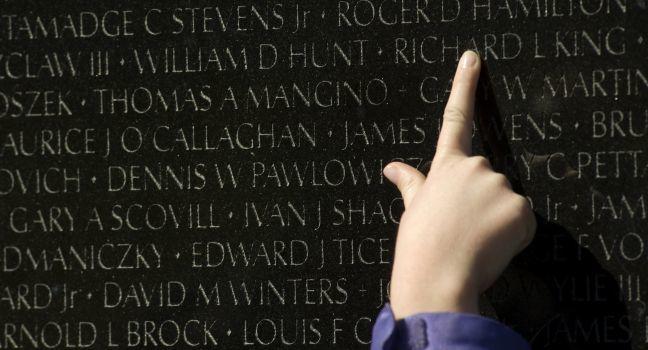
a finger points out a name inscribed at the Vietnam Veterans Memorial in Washington, DC; Shutterstock ID 10795432; Project/Title: Fodors; Downloader: Melanie Marin
John Keith / Shutterstock

"The Wall," as it's commonly called, is one of the most visited sites in Washington, D.C. The names of more than 58,000 Americans who died in the Vietnam War are etched in its black granite panels, creating a powerful memorial. Jan Scruggs, a corporal who served in Vietnam, conceived the memorial, and Maya Lin, a then-21-year-old architecture student at Yale, designed the landmark.

Thousands of offerings are left on the wall each year; many people leave flowers, and others leave soldiers' uniform items or letters of thanks.

In 1984, Frederick Hart's statue of three soldiers and a flagpole was erected to the south of the wall, with the goal of winning over veterans who considered the memorial a "black gash of shame." In 2004, a plaque was added to honor veterans who died after the war as a direct result of injuries in Vietnam, but who fall outside Department of Defense guidelines for remembrance at the wall.

The Vietnam Women's Memorial was dedicated in 1993. Glenna Goodacre's bronze sculpture depicts two women caring for a wounded soldier while a third kneels nearby; eight trees around the plaza commemorate the eight women in the military who died in Vietnam.
Names on the wall are ordered by the date of death. To find a name, consult the alphabetical lists at either end of the wall. You can get assistance locating a name at the white kiosk with the brown roof near the entrance. At the wall, rangers and volunteers wearing yellow caps can look up the names and supply you with paper and pencils for making rubbings. Every name on the memorial is preceded (on the west wall) or followed (on the east wall) by a symbol designating status. A diamond indicates "KIA." A plus sign (found by a small percentage of names) indicates "MIA."

23rd St. NW and Constitution Ave. NW, Washington, DC, 20024, USA
202-426–6841
Sight Details
Free

Something incorrect in this review?

World War II Memorial

The Mall Fodor's Choice
The National World War II Memorial, Washington, DC; Shutterstock ID 132698252; Project/Title: Photo Database top 200
AppalachianViews/Shutterstock

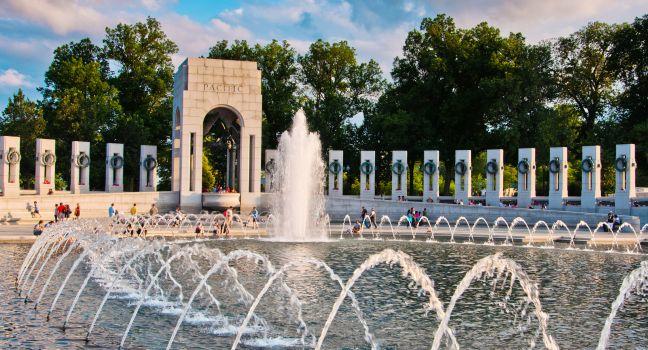
This symmetrically designed monument, in a parklike setting between the Washington Monument and Lincoln Memorial, honors the 16 million Americans who served in the armed forces, the more than 400,000 who died, and all who supported the war effort at home. An imposing circle of 56 granite pillars, each bearing a bronze wreath, represents the United States and its territories of 1941–45. Four bronze eagles, a bronze garland, and two 43-foot-tall arches inscribed with "Atlantic" and "Pacific," representing victory on both fronts, surround the large circular plaza. The roar of the water comes from the Rainbow Pool, here since the 1920s and renovated to form the memorial's centerpiece. There are also two fountains and two waterfalls. The Field of Stars, a wall of more than 4,000 gold stars, commemorates more than 400,000 Americans who lost their lives in the war. Bas-relief panels depict women in the military, medics, the bond drive, and V-J Day, all telling the story of how World War II affected Americans daily.

17th St. SW and Home Front Dr. SW, Washington, DC, 20024, USA
202-426–6841
Sight Details
Free

Something incorrect in this review?

Bunker Hill Monument

Charlestown Fodor's Choice

 Two misunderstandings surround this famous monument. First, the Battle of Bunker Hill was actually fought on Breed's Hill, which is where the monument sits today. (The real Bunker Hill is about ½ mile to the north of the monument.) In truth, Bunker was the originally planned locale for the battle, and for that reason its name stuck. Second, although the battle is generally considered a Colonial success, the Americans lost. It was a Pyrrhic victory for the British Redcoats, who sacrificed nearly half of their 2,200 men; American casualties numbered 400 to 600. One thing is true: the Battle of Bunker Hill put the British on notice that they were up against a formidable opponent. According to history books, this is also the location of the famous war cry, "Don't fire until you see the whites of their eyes," uttered by American colonel William Prescott or General Israel Putnam (there's still debate on who gave the actual command). This was a shout-out to an 18th-century Prussian warning to soldiers that lack of ammunition and notorious musket inaccuracy meant every shot needed to count. The Americans did employ a deadly delayed-action strategy on June 17, 1775, and conclusively proved themselves capable of defeating the forces of the British Empire.

Among the dead were the brilliant young American doctor and political activist Joseph Warren, recently commissioned as a major general but fighting as a private, and the British major John Pitcairn, who two months prior had led the Redcoats into Lexington. Pitcairn is believed to be buried in the crypt of Old North Church.

In 1823 the committee formed to construct a monument on the site of the battle chose the form of an Egyptian obelisk. Architect Solomon Willard designed a 221-foot-tall granite obelisk, a tremendous feat of engineering for its day. The Marquis de Lafayette laid the cornerstone of the monument in 1825, but because of a lack of funds, it wasn't dedicated until 1843. Daniel Webster's stirring words at the ceremony commemorating the laying of its cornerstone have gone down in history: "Let it rise! Let it rise, till it meets the sun in his coming. Let the earliest light of the morning gild it, and parting day linger and play upon its summit."

The monument's zenith is reached by a flight of 294 tightly spiraled steps. While the elevator is still under repair, the views from the observatory are worth the effort of the arduous climb if you can. The tower is only open for climbing between 1 and 4 pm. The adjacent museum's artifacts and exhibits tell the story of the battle, while a detailed diorama depicts the action in miniature. This is Freedom Trail stop 16.

Camp Hale-Continental Divide National Monument

Fodor's Choice

Established as an official National Monument in 2022, this historic site pays tribute to the 10th Mountain Division, a unique Army infantry unit from World War II that trained skiers to be soldiers. Trained for mountain conditions here, the soldiers eventually fought in Italy and Austria, facing some of the toughest terrain in the war. A self-guided tour offers 10 points of interest across the sprawling valley. The 53,804-acre site includes campgrounds and access to the Continental Divide Trail, which stretches 3,000-plus miles along the Rockies.

Washington Monument

The Mall Fodor's Choice

The top of the Washington Monument is perhaps the best, most breathtaking place to see the city and get a good idea of its layout.

The 555-foot, 5⅛-inch monument, which punctuates the capital like a huge exclamation point, was part of Pierre L'Enfant's plan for Washington, but his intended location proved to be so marshy that the structure was moved 100 yards southeast. Construction began in 1848 and continued until 1884. Upon completion, the monument was the world's tallest structure and weighed more than 81,000 tons. Six years into construction, members of the anti-Catholic Know-Nothing Party stole and smashed a block of marble donated by Pope Pius IX. This action, combined with funding shortages and the onset of the Civil War, brought construction to a halt. After the war, building finally resumed, and though the new marble came from the same Maryland quarry as the old, it was taken from a different stratum with a slightly different shade. Inserted into the walls of the monument are 193 memorial stones from around the world. The monument reopened in spring 2019 after an elevator modernization project. Up to six tickets can be requested for just $1 per person at  recreation.gov.

Washington Monument

Mount Vernon Fodor's Choice

Completed on July 4, 1829, the impressive monument was the first one dedicated to the nation's first president. An 18-foot statue depicting Washington caps the 160-foot white marble tower. The tower was designed and built by Robert Mills, the first architect born and educated in the United States; 19 years after completing Baltimore's Washington Monument, Mills designed and erected the national Washington Monument in D.C. After extensive restorations, the monument's lower-level museum has reopened; visitors can climb the 227-step circular staircase to the top and enjoy stunning bird's-eye vistas over downtown.

Will Rogers Shrine of the Sun

Fodor's Choice

This five-story tower was dedicated in 1937, after a tragic plane crash claimed the life of Will Rogers, America's favorite—and funniest—cowboy. The shrine's viewing deck provides an impressive panoramic view of Colorado Springs and the surrounding area. The tower interior is painted with all manner of Western murals in which Colorado Springs benefactor Spencer Penrose figures prominently, and is plastered with photos and homespun sayings of Rogers. In the chapel are 15th- and 16th-century European artworks.

Korean War Veterans Memorial

The Mall
Korean war memorial in Washington DC; Shutterstock ID 2505634; Project/Title: Fodors; Downloader: Melanie Marin
Graham De'ath / Shutterstock

At the west end of the National Mall, this memorial to the 5.8 million United States men and women who served in the Korean War (1950–53) highlights the cost of freedom. Often referred to as the "forgotten war," nearly 37,000 Americans died on the Korean peninsula, 8,000 were missing in action, and more than 103,000 were wounded. The privately funded memorial was dedicated on July 27, 1995, the 42nd anniversary of the Korean War Armistice.

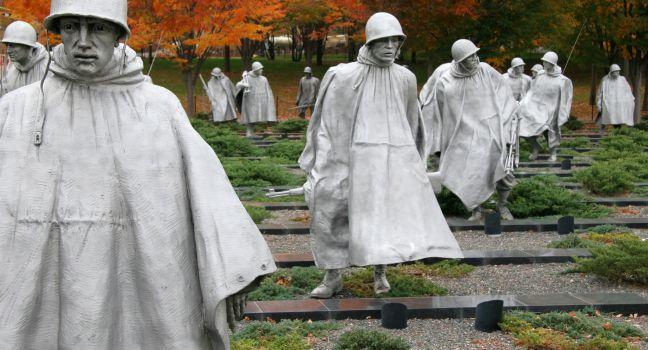
In the Field of Service, 19 oversize stainless-steel soldiers trudge through rugged terrain toward an American flag; look beneath the helmets to see their weary faces. The reflection in the black granite wall to their right doubles their number to 38, symbolic of the 38th parallel, the latitude established as the border between North and South Korea in 1953, as well as the 38 months of the war.

Unlike many memorials, this one contains few words. The 164-foot-long granite wall etched with the faces of 2,400 unnamed servicemen and servicewomen says, "Freedom is not free." The plaque at the flagpole base reads, "Our nation honors her sons and daughters who answered the call to defend a country they never knew and a people they never met." The only other words are the names of 22 countries that volunteered forces or medical support, including Great Britain, France, Greece, and Turkey. The adjacent circular Pool of Remembrance honors all who were killed, captured, wounded, or lost in action; it's a quiet spot for contemplation.

Daniel French Dr. SW and Independence Ave. SW, Washington, DC, 20024, USA
202-426–6841
Sight Details
Free

Something incorrect in this review?

Belmont-Paul Women's Equality National Monument

Capitol Hill

Standing strong on Capitol Hill for more than 200 years, this house witnessed the construction of the U.S. Capitol and Supreme Court, and its early occupants participated in the formation of Congress. In 1929, the National Woman's Party (NWP), founded by Alice Paul, an outspoken suffragist and feminist, purchased the house, and it soon evolved into a center for feminist education and social change. For more than 60 years, the trailblazing NWP utilized its strategic location, steps from the U.S. Capitol and its congressional offices, to lobby for women's political, social, and economic equality. Today an expansive collection of artifacts from the suffrage and equal rights campaigns brings the story of the women's rights movement to life. The innovative tactics and strategies these women devised became the blueprint for women's progress throughout the 20th century. In 2016, President Obama designated the home as a national monument.

The monument is closed for renovations through mid- to late 2023.

144 Constitution Ave. NE, Washington, DC, 20002, USA
202-543–2240
Sight Details
Free
Closed for renovation until mid- to late 2023

Something incorrect in this review?

Bennington Battle Monument

This 306-foot stone obelisk with an elevator to an observation deck commemorates General John Stark's Revolutionary War victory over the British, who attempted to capture Bennington's stockpile of supplies. Inside the monument you can learn all about the battle, which took place near Walloomsac Heights in New York State on August 16, 1777, and helped bring about the surrender of British commander "Gentleman Johnny" Burgoyne two months later. The top of the tower affords commanding views of the Massachusetts Berkshires, the New York Adirondacks, and the Vermont Green Mountains.

Boston Irish Famine Memorial

Downtown

Dedicated in 1998, this memorial and a small park were built in remembrance of Ireland's great famine of the mid-19th century. Artist Robert Shure's two sculptures depict an anguished family on the shores of Ireland, and a determined and hopeful Irish family stepping ashore in Boston. An gorta mor, as it's called in Irish, is a tribute to the rich immigrant past of this most Irish of American cities.

School St. at Washington St., Boston, MA, 02108, USA

Something incorrect in this review?

Boston Massacre Site

Downtown

A circle of cobblestones in front of the Old State House commemorates the Boston Massacre, which happened about 20 feet away. To recap: It was on the snowy evening of March 5, 1770, that nine British soldiers fired in panic upon a taunting mob of more than 75 colonists who were upset over British occupation and taxation. Five townsmen died. In the legal action that followed, the defense of the accused soldiers was undertaken by John Adams and Josiah Quincy, both of whom vehemently opposed British oppression but were devoted to the principle of a fair trial. All but two of the nine regulars charged were acquitted; the others were branded on the hand for the crime of manslaughter. Paul Revere lost little time in capturing the "massacre" in a dramatic engraving that soon became one of the Revolution's most potent images of propaganda. This is Freedom Trail stop 10.

Castle Hill

On this hill, Alaska was formally handed over to the United States on October 18, 1867, and the first 49-star U.S. flag was flown on January 3, 1959, signifying Alaska's statehood. To reach the hill, take the first right off Harbor Drive just before O'Connell Bridge; then enter the paved path switchbacks to the top, where you can read the interpretive signs on the area's Tlingit and Russian history and take in the views of Crescent Harbor and downtown Sitka. On a clear day, look for the volcanic flanks of Mt. Edgecumbe on the horizon.

Chinatown Gate

Chinatown

Two foo lions ward off evil for those who pass through the massive, traditional paifang gate that signals your entrance to Chinatown. It was donated to the Asian residents of Boston by Taiwan, in the early 1980s. You'll likely see red lanterns hanging from it; they signify good luck. The main square around the gate acts as a gathering place for the neighborhood's residents, who meet to socialize or play games. The gate is situated at Beach Street, and it also marks the end of the Greenway.

Beach St. at Hudson St., Boston, MA, 02111, USA

Something incorrect in this review?

Cuban Memorial Boulevard

Four blocks in the heart of Little Havana are filled with monuments to Cuba's freedom fighters. South of Calle Ocho (8th Street), Southwest 13th Avenue becomes a ceiba tree–lined parkway known as Cuban Memorial Boulevard, divided at the center by a narrow grassy mall with a walking path through the various memorials. Among them is the Eternal Torch of the Brigade 2506, blazing with an endless flame and commemorating those who were killed in the failed Bay of Pigs invasion of 1961. Another is a bas-relief map of Cuba depicting each of its municipios. There's also a bronze statue in honor of Nestor (Tony) Izquierdo, who participated in the Bay of Pigs invasion and served in Nicaragua's Somozan forces.

S.W. 13th Ave. between S.W. 8th and S.W. 12th sts., FL, 33135, USA

Something incorrect in this review?

El Tiradito (The Castaway)

Downtown

No one seems to know the details of the story behind this little shrine, but everyone agrees a tragic love triangle was involved. A bronze plaque indicates only that it's dedicated to a sinner who is buried here on unconsecrated ground. The candles that line the cactus-shrouded spot attest to its continuing importance in local Catholic lore. People light candles and leave milagros ("miracles," or little icons used in prayers for healing) for loved ones. A modern-day miracle: the shrine's inclusion on the National Register of Historic Places helped prevent a freeway from plowing through this section of the Barrio Historico.

Main Ave., Tucson, AZ, 85701, USA

Something incorrect in this review?

Florida Keys Memorial/Hurricane Monument

On Monday, September 2, 1935, more than 400 people perished when the most intense hurricane to make landfall in the United States swept through this area of the Keys. Two years later, the Florida Keys Memorial was dedicated in their honor. Native coral rock, known as keystone, covers the 18-foot obelisk monument that marks the cremated remains of some 300 of the storm victims.

81831 Old State Hwy. 4A, FL, 33036, USA
Sight Details
Free

Something incorrect in this review?

Four Corners Monument

An inlaid brass plaque marks the only point in the United States where four states meet: Arizona, New Mexico, Colorado, and Utah. Despite the Native American wares and booths selling greasy food, there's not much else to do here but pay a fee and stay long enough to snap a photo; you'll see many a twisted tourist trying to get an arm or a leg in each state. The monument is a 75-mile drive from Kayenta and is administered by the Navajo Nation Parks and Recreation Department. The entry fee is payable by card only now, and dogs are not allowed.

4 Corners Rd., Teec Nos Pos, AZ, 86514, USA
928-871–6647-Navajo Parks & Recreation Dept.
Sight Details
$8 per person per day

Something incorrect in this review?

Franklin Delano Roosevelt Memorial

The Mall

This 7½-acre memorial to the 32nd president, on the west side of the Tidal Basin, includes waterfalls and reflecting pools, four outdoor gallery rooms—one for each of Roosevelt's presidential terms (1933 to 1945)—and 10 bronze sculptures. You can find some of Roosevelt's famous statements, including "The only thing we have to fear is fear itself," engraved on the granite megaliths connecting the galleries. A bronze statue of First Lady Eleanor Roosevelt stands in front of the United Nations symbol in the fourth room. She was a vocal spokesperson for human rights and one of the most influential women of her time. Considering Roosevelt's disability, this was the first memorial designed to be wheelchair-accessible, and several pillars include Braille lettering. The memorial was dedicated in 1997, but it wasn't until 2001 that a statue of a wheelchair-bound Roosevelt was added near the entrance after years of debate about whether to portray Roosevelt realistically or to honor his desire not to display his disability, as had been done throughout his presidency.

400 W. Basin Dr. SW, Washington, DC, 20024, USA
202-426–6841
Sight Details
Free

Something incorrect in this review?

General Grant National Memorial

Upper West Side

Dominating the skyline here, the towering granite mausoleum (1897) is the final resting place of Civil War general and two-term U.S. president Ulysses S. Grant and his wife, Julia Dent Grant, who retired to NYC after the White House. The formal name is the General Grant National Memorial, but everybody except the National Park Service calls it Grant's Tomb. As the old joke goes, who's buried here? Nobody—they're entombed in a crypt beneath a domed rotunda, surrounded by photographs and Grant memorabilia. Once a more popular sight than the Statue of Liberty, this pillared Classical Revival edifice remains regal and timeless. The words engraved on the tomb, "Let Us Have Peace," recall Grant's speech to the Republican convention upon his presidential nomination. Surrounding the memorial are the so-called rolling benches, covered with colorful mosaic tiles. Made in the 1970s as a public art project, they are now as beloved as they are incongruous with the grand memorial they surround. Stop by the visitor center (across the street from the tomb; check hours online) for a 20-minute film about Grant.

Riverside Dr. and 122nd St., New York, NY, 10027, USA
212-666–1640
Sight Details
Free
Closed Mon. and Tues.

Something incorrect in this review?

The Girl Puzzle Monument

Roosevelt Island

Located in Roosevelt Island Lighthouse Park, this intriguing and monumental sculpture honors Nelly Bly, the journalist who exposed the horrors of the island's Women’s Lunatic Asylum by going undercover as a patient. Simultaneously, it spotlights women who have endured—and overcome—hardship. Shown as sections of faces in silver for Bly, and bronze for the others, the pieces represent being both broken and repaired. Also on-site, just behind the sculpture, is the Roosevelt Island Lighthouse. The stone structure was built by the New York City government in 1872. It is on the National Register of Historic Places and is also a New York City Landmark.

Holocaust Memorial

A bronze sculpture depicts refugees clinging to a giant bronze arm that reaches out of the ground and 42 feet into the air. Enter the surrounding courtyard to see a memorial wall and hear the music that seems to give voice to the 6 million Jews who died at the hands of the Nazis. It's easy to understand why Kenneth Treister's dramatic memorial is in Miami Beach: the city's community of Holocaust survivors was once the second largest in the country.

King Kamehameha Statue

A statue of Kamehameha the Great, the famous king who united the Hawaiian Islands in the early 19th century, stands watch over his descendants in North Kohala. The 8½-foot-tall figure wears the king's sacred feather kihei, mahiole, and kaei (cape, helmet, and sash). This is actually the original of the statue fronting the Judiciary Building on King Street in Honolulu. Cast in Florence in 1880, it was lost at sea. A replica was commissioned and shipped to Honolulu, but the original statue was later found in a Falklands Island junkyard. It now stands in front of the old Kohala Courthouse in Kapaau, next to the highway on the way toward Pololu Valley. Every year on King Kamehameha Day (June 11), Kohala residents honor their most famous son with a celebration that involves a parade and draping the statue in dozens of handmade floral lei.

54-3900 Kapaau Rd., Kapaau, HI, 96755, USA

Something incorrect in this review?

National Monument to the Forefathers

Said to be the largest freestanding granite statue in the United States, this allegorical monument stands high on an 11-acre hilltop site. Designed by Hammatt Billings of Boston in 1854 and dedicated in 1889, it depicts Faith, surrounded by Liberty, Morality, Justice, Law, and Education, and includes scenes from the Pilgrims' early days in Plymouth.

The New England Holocaust Memorial

Government Center

Located at the north end of Union Park, the Holocaust Memorial is the work of Stanley Saitowitz, whose design was selected through an international competition; the finished memorial was dedicated in 1995. During the day the six 50-foot-high glass-and-steel towers seem at odds with the 18th-century streetscape of Blackstone Square behind it; at night, they glow like ghosts while manufactured steam from grates in the granite base makes for a particularly haunting scene. Recollections by Holocaust survivors are set into the glass-and-granite walls; the upper levels of the towers are etched with 6 million numbers in random sequence, symbolizing the Jewish victims of the Nazi horror.

Boston, MA, 02108, USA
617-457–8755

Something incorrect in this review?

Nine Dragon Wall

Chinatown

Modeled after the one in Beijing's Beihai Park, this wall is graced by nine large and 500 smaller dragons, all signifying good fortune.

170 W. Cermak Rd., Chicago, IL, 60616, USA

Something incorrect in this review?