

117 Best Sights in USA

Background Illustration for Sights

We've compiled the best of the best in USA - browse our top choices for the top things to see or do during your stay.

Mokuaikaua Church

Fodor's Choice
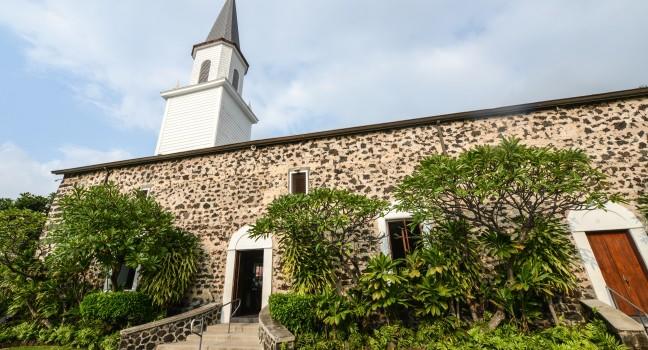
Mokuaikaua Church in Kona is the oldest Christian church in the Hawaiian Islands.
(c) Demerzel21 | Dreamstime.com

Site of the first Christian church in the Hawaiian Islands, this solid lava-rock structure, completed in 1837, is mortared with burned lime, coral, and kukui (candlenut) oil and topped by an impressive 112-foot steeple. The ceiling and interior were crafted of timbers harvested from a forest on Hualalai and are held together with wooden pegs, not nails. Inside, behind a panel of gleaming koa wood, rests a model of the brig Thaddeus as well as a koa-wood table crafted by Henry Boshard, pastor for 43 years. The sanctuary is still undergoing renovations, but if you attend Sunday services, they are glad to give you a tour.
Cathedral Basilica of St. Francis of Assisi

The Plaza Fodor's Choice

This iconic cathedral, a block east of the Plaza, is one of the rare significant departures from the city's nearly ubiquitous Pueblo architecture. Construction was begun in 1869 by Jean Baptiste Lamy, Santa Fe's first archbishop, who worked with French architects and Italian stonemasons. The Romanesque style was popular in Lamy's native home in southwest France. The cleric was sent by the Catholic Church to the Southwest to influence the religious practices of its native population and is buried in the crypt beneath the church's high altar. He was the inspiration behind Willa Cather's novel Death Comes for the Archbishop (1927). In 2005 Pope Benedict XVI declared St. Francis the "cradle of Catholicism" in the Southwestern United States, and upgraded the status of the building from mere cathedral to cathedral basilica—one of just 36 in the country.

A small adobe chapel on the northeast side of the cathedral, the remnant of an earlier church, embodies the Hispanic architectural influence absent from the cathedral itself. The chapel's Nuestra Señora de la Paz (Our Lady of Peace), popularly known as La Conquistadora, the oldest Madonna statue in the United States, accompanied Don Diego de Vargas on his reconquest of Santa Fe in 1692, a feat attributed to the statue's spiritual intervention. Each new season, the faithful adorn the statue with a new dress. Take a close look at the keystone in the main doorway arch: it has a Hebrew tetragrammaton on it. It's widely speculated that Bishop Lamy had this carved and placed to honor the Jewish merchants of Santa Fe who helped provide necessary funds for the construction of the church.

Duke Chapel

Duke University Fodor's Choice

A Gothic-style gem built in the early 1930s, this chapel is the centerpiece of Duke University. Modeled after England's Canterbury Cathedral, it has a 210-foot-tall bell tower. Weekly services are held here Sunday at 11 am, with tours following. The chapel is a popular wedding spot, so check the website before trying to visit on Saturday.

401 Chapel Dr., Durham, NC, 27708, USA
919-681–9488
Sight Details
Free
Tours Sun. 12:15 pm; organ music Tues.–Thurs. 1 pm

Something incorrect in this review?

Recommended Fodor's Video

Ebenezer Baptist Church

Sweet Auburn Fodor's Choice

A Gothic Revival–style building completed in 1922, the church came to be known as the spiritual center of the civil rights movement. Members of the King family, including the slain civil rights leader, preached at the church for three generations. Sitting in the main sanctuary on a quiet day when light is shining through the stained-glass windows can be a powerful experience. The congregation itself now occupies the building across the street.

El Santuario de Chimayó

Fodor's Choice

This small, frontier, adobe church has a fantastically carved and painted reredos (altar screen) and is built on the site where, believers say, a mysterious light came from the ground on Good Friday in 1810 leading to the discovery of a large wooden crucifix beneath the earth. The chapel sits above a sacred pozito (a small hole), the dirt from which is believed to have miraculous healing properties. Dozens of abandoned crutches and braces placed in the anteroom—along with many notes, letters, and photos—testify to this. The Santuario draws a steady stream of worshippers year-round—Chimayó is considered the Lourdes of the Southwest. During Holy Week as many as 30,000 pilgrims come here. The shrine is is surrounded by small adobe shops selling every kind of religious curio imaginable and some very fine traditional Hispanic work from local artists. A smaller chapel, Santo Niño de Atocha, was built in 1857 and lies 200 yards away. As at the more famous Santuario, the dirt in this place of worship is said to have healing properties.

Grace Cathedral

Nob Hill Fodor's Choice

Not many churches can boast an altarpiece by Keith Haring and two labyrinths, but this one, the country's third-largest Episcopal cathedral, does. The soaring Gothic-style structure took 14 (often interrupted) years to build, beginning in 1927 and eventually wrapping up in 1964. The gilded bronze doors at the east entrance were taken from casts of Lorenzo Ghiberti's incredible Gates of Paradise, designed for the Baptistery in Florence, Italy. A sculpture of St. Francis by Beniamino Bufano greets you as you enter.

The 34-foot-wide limestone labyrinth is a replica of the 13th-century stone maze on the floor of Chartres Cathedral. All are encouraged to walk the ⅛-mile-long labyrinth, a ritual based on the tradition of meditative walking. There's also a granite outdoor labyrinth on the church's northeast side. The AIDS Interfaith Chapel, to the right as you enter, contains a bronze triptych by the late artist Keith Haring (a gift from Yoko Ono) and panels from the AIDS Memorial Quilt. The church offers self- and docent-led tours. Especially dramatic times to view the cathedral are during Tuesday-evening yoga (6:15 pm), Thursday-night evensong (5:15 pm), and special holiday programs.

1100 California St., San Francisco, CA, 94108, USA
415-749–6300
Sight Details
Entrance and self-guided tours $12, docent-led tours $25--$35

Something incorrect in this review?

Holy Ascension of Our Lord Cathedral

Fodor's Choice

Undoubtedly the most dramatic human-made sight in Unalaska is the Holy Ascension Russian Orthodox church. The blue, onion-domed chapel right on the edge of Iliuluk Bay is arguably the most perfectly intact and authentic Russian church left in Alaska, and one of the most scenic churches anywhere. The extant buildings date to the 1890s, although there has been a church on the site since 1808. Now a National Historic Landmark, Holy Ascension is one of the oldest cruciform-style Russian churches in the nation, and it houses one of Alaska's richest collections of Russian artifacts, religious icons, and artwork. Next to the church is the Bishop's House. A walk in the graveyard between the two buildings captures some of the history of the area. Tours of the church can be arranged through the Unalaska/Dutch Harbor Convention and Visitors Bureau.

W. Broadway Ave., between 1st and 2nd Sts., Unalaska, AK, 99685, USA
907-581–5883-parish

Something incorrect in this review?

Lititz Moravian Church Square

Fodor's Choice

Church Square is the grounds of the Lititz Moravian church, built here in 1787 and still in operation today. Make an appointment for a free tour with a church volunteer who will regale you with historical facts and stories. You'll see the sanctuary with its exquisite organ and the coffee kitchen where goodies were prepared for gatherings. Your guide will also point out other historical buildings on the property and take you into the Moravian Museum and Archives, a true treasure trove of historical artifacts. In the gift shop you can buy an iconic Moravian star.

8 Church Square, Lititz, PA, 17543, USA
626-8515
Sight Details
free; donations accepted
Closed Sun.
reservations required

Something incorrect in this review?

Mission Basilica San Diego de Alcalá

Mission Valley Fodor's Choice

It's hard to imagine how remote California's earliest mission must have once been; these days, however, it's accessible by major freeways (I–15 and I–8) and via the San Diego Trolley. The first of a chain of 21 missions stretching northward along the coast, Mission San Diego de Alcalá was established by Father Junípero Serra on Presidio Hill in 1769 and moved to this location in 1774. In 1775, it proved vulnerable to enemy attack, and Padre Luís Jayme, a young friar from Spain, was clubbed to death by the Kumeyaay Indians he had been trying to convert. He was the first of more than a dozen Christians martyred in California. The present church, reconstructed in 1931 following the outline of the 1813 church, is the fifth built on the site. It measures 150 feet long but only 35 feet wide because, without easy means of joining beams, the mission buildings were only as wide as the trees that served as their ceiling supports were tall. Father Jayme is buried in the sanctuary; a small museum named for him documents mission history and exhibits tools and artifacts from the early days; there is also a gift shop. From the peaceful, palm-bedecked gardens out back you can gaze at the 46-foot-high campanario (bell tower), the mission's most distinctive feature, with five bells. Mass is celebrated on the weekends.

Mission San José

Southside Fodor's Choice

At the center of the Mission Trail and the largest mission, Mission San José is known as the Queen of Missions. It's near the historical park's visitor center and it's the best place to catch a tour, led by a Texas Ranger or volunteer, because the history of San José is critical to understanding the story of the missions and San Antonio. The mission was founded in 1720 by Father Antonio Margil de Jesus, a prominent Franciscan missionary. The current church is 80% original as the outer wall, granary, convent, and Native American quarters were restored by the WPA in the 1930s. The Rose Window, sculpted in 1775, is located on the south wall of the church sacristy and considered one of the finest examples of Baroque architecture in North America. 

Start your tour at the stunning Mission San José, the "Queen of Missions." It's adjacent to the visitor's center, where a National Park Service ranger or docent illuminates the history of the missions. San José's outer wall, American Indian dwellings, granary, water mill, and workshops have been restored. Here you can pick up a driving map of the Mission Trail that connects San José with the other missions.

Mission San Xavier del Bac

Westside Fodor's Choice

The oldest Catholic church in the United States still serving the community for which it was built, San Xavier was founded in 1692 by Father Eusebio Francisco Kino, who established 22 missions in northern Mexico and Southern Arizona. The current structure was made out of native materials by Franciscan missionaries between 1777 and 1797, and is owned by the Tohono O'odham tribe.

The beauty of the mission, with elements of Spanish, baroque, and Moorish architectural styles, is highlighted by the stark landscape against which it is set, inspiring an early-20th-century poet to dub it the White Dove of the Desert.

Inside, there's a wealth of painted statues, carvings, and frescoes. Paul Schwartzbaum, who helped restore Michelangelo's masterwork in Rome, supervised Tohono O'odham artisans in the restoration of the mission's artwork, completed in 1997; Schwartzbaum has called the mission the Sistine Chapel of the United States.

Across the parking lot from the mission, San Xavier Plaza has a couple of crafts shops selling the handiwork of the Tohono O'odham tribe, including jewelry, pottery, friendship bowls, and woven baskets with man-in-the-maze designs.

San Felipe de Neri Catholic Church

Fodor's Choice

Well over two centuries after it first welcomed worshippers, this lovely adobe structure is still active (mass is offered daily). A National Register of Historic Places site erected in 1793 (to replace Albuquerque's first Catholic church, which was founded here in 1706), its Spanish Colonial base was charmingly modified with a touch of Gothic Revival (note the spires) in the mid-19th century. Its tan stucco and fresh white trim stand out at the north end of Old Town's plaza, and while it has been expanded several times, a surprising amount of its original adobe walls (some 5 feet thick) and other features remain. Small gardens front and flank the church; the inside is a respite from the tourism bustle beyond its doorstep—the painting and iconography are simple and authentic, the atmosphere hushed. Next to it is a shop and small museum that displays relics (vestments, paintings, carvings) dating from the 17th century. Call ahead to arrange a tour. There's a hidden treasure behind the church: inside the gnarled tree is a statue that some speculate depicts the Virgin Mary.

San Fernando Cathedral

Downtown Fodor's Choice

All are welcome at the oldest standing church building in Texas and the first church in San Antonio. Still an active parish (mass is held daily), San Fernando Cathedral was built in 1731 by the city's Canary Island colonists. Mexican general Santa Anna raised a crimson "flag of no quarter" here before launching his assault on the Alamo in 1836, signaling to the Texans he would take no prisoners. In 1873, following a fire after the Civil War, the chapel was replaced with the present-day construction. A small sarcophagus on display holds the ashes of unknown soldiers, presented as the remains of the defenders of the Alamo. However, some modern historians are skeptical because evidence of military uniforms was discovered, which the Texan army never wore. Special events are held here, including musical performances and televised specials. The gift shop has an ample assortment of religious items including books, cards, rosaries, and candles for purchase and placement inside the church.

San Francisco de Asís Church

Fodor's Choice

A National Historic Landmark, this is a beloved destination among the faithful, as well as for artists, photographers, and architectural buffs. The active Catholic church regularly celebrates Mass, contains numerous Hispanic religious artifacts, and is open to the public for visiting. Be sure to show respect for house of worship norms. The building's shape is a surprise with rounded, sculpted buttresses. Construction began in 1772 and today its mud-and-straw adobe walls are replastered by hand every year in an annual event. The "Ranchos Church" with its massive earthen walls and undulating lines is an awe-inspiring sight that Georgia O’Keeffe painted and Ansel Adams photographed many times. Group tours provided by the church historian can be scheduled in advance. The famous Shadow of the Cross painting is preserved in a nearby building and is also worth seeing.

St. Louis Cathedral

French Quarter Fodor's Choice

The oldest active Catholic cathedral in the United States, this beautiful church and basilica at the heart of the Old City is named for the 13th-century French king who led two crusades. The current building, which replaced two structures destroyed by fire, dates from 1794 (although it was remodeled and enlarged in 1851). The austere interior is brightened by murals covering the ceiling and stained-glass windows along the first floor. Pope John Paul II held a prayer service for clergy here during his New Orleans visit in 1987; to honor the occasion, the pedestrian mall in front of the cathedral was renamed Place Jean Paul Deux. Of special interest is his portrait in a Jackson Square setting, which hangs on the cathedral's inner side wall. Docents often give free tours. You can also pick up a brochure ($1) for a self-guided tour. Books about the cathedral are available in the gift shop. A mass occurs daily at 12 pm. The cathedral holds a free concert nearly every evening in December.

The statue of the Sacred Heart of Jesus dominates St. Anthony's Garden, which extends behind the cathedral to Royal Street. The garden is also the site of a monument to 30 crew members of a French ship, who died in a yellow fever epidemic in 1857. The garden has been redesigned by famed French landscape architect Louis Benech, who also redesigned the Tuileries gardens in Paris.

St. Philip's Church

Fodor's Choice

Founded around 1680, St. Philip's didn't move to its current site until the 1720s, becoming one of the three churches that gave Church Street its name. The first building in this location burned down in 1835 and was replaced with the Corinthian-style structure seen today. A shell that exploded in the churchyard while services were being held during the Civil War didn't deter the minister from finishing his sermon (the congregation gathered elsewhere for the remainder of the war). Amble through the churchyards, where notable South Carolinians are buried. If you want to tour the church, call ahead, as hours depend upon volunteer availability.

Trinity Church

Back Bay Fodor's Choice

Trinity Church Boston is designated as “one of the ten most important buildings in America” by the American Institute of Architects. In his 1877 masterpiece, architect Henry Hobson Richardson brought his Romanesque Revival style to maturity; all the aesthetic elements for which he was famous come together magnificently—bold polychromatic masonry, careful arrangement of masses, sumptuously carved interior woodwork—in this crowning centerpiece of Copley Square. A full appreciation of its architecture requires an understanding of the logistical problems of building it here. The Back Bay is a reclaimed wetland with a high water table. Bedrock, or at least stable glacial till, lies far beneath wet clay. Like all older Back Bay buildings, Trinity Church sits on submerged wooden pilings. But its central tower weighs 9,500 tons, and most of the 4,500 pilings beneath the building are under that tremendous central mass. The pilings are checked regularly for sinkage by means of a hatch in the basement.

Richardson engaged some of the best artists of his day—John La Farge, William Morris, and Edward Burne-Jones among them—to execute the paintings and stained glass that make this a monument to everything that was right about the pre-Raphaelite spirit and the nascent aesthetic of Morris's Arts and Crafts movement. Along the north side of the church, note the Augustus Saint-Gaudens statue of Phillips Brooks—the most charismatic rector in New England, who almost single-handedly got Trinity built and furnished. The shining light of Harvard's religious community and lyricist of "O Little Town of Bethlehem," Brooks is shown here with Christ touching his shoulder in approval. For a nice respite, enjoy one of the Friday organ concerts at 12:15. Guided tours are held throughout the week.

206 Clarendon St., Boston, MA, 02116, USA
617-536–0944
Sight Details
Entrance free, guided and self-guided tours Tues.–Sat., $10
Closed Mon.

Something incorrect in this review?

Trinity Episcopal Church

Fodor's Choice

Built in 1860, this is the town's oldest standing church and an architectural landmark that anchors the town. Complete with a 125-foot spire, the Gothic Revival structure has an original chancery window imported from England and a rare working 1860 John Baker tracker organ.

San Miguel Mission

The Plaza
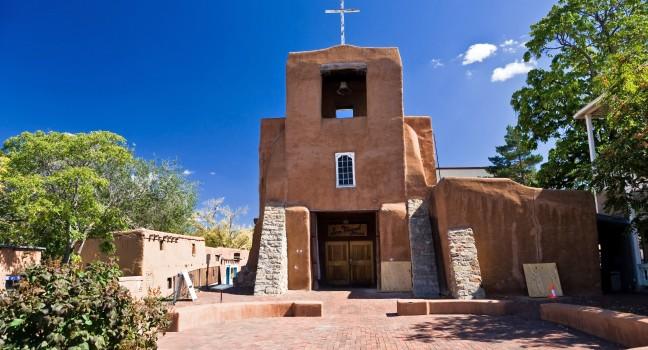
San Miguel Church is the oldest church in the USA, Santa Fe, New Mexico.
pmphoto / Shutterstock

Believed to be the oldest church still in use in the United States, this simple earth-hewn adobe structure was built around 1610 by the Tlaxcalan Indians of Mexico, who came to New Mexico as servants of the Spanish. Badly damaged in the 1680 Pueblo Revolt, the structure was restored and enlarged in 1710. On display in the chapel are priceless statues and paintings and the San José Bell, weighing nearly 800 pounds, which is believed to have been cast in Spain in 1356. In winter the church sometimes closes before its official closing hour. Latin mass is held daily at 2 pm, and new mass is on Sunday at 5 pm.

Arlington Street Church

Back Bay

Opposite the Park Square corner of the Public Garden, this church was erected in 1861—the first to be built in the Back Bay. Though a classical portico is a keynote and its model was London's St. Martin-in-the-Fields, Arlington Street Church is less picturesque and more Georgian in character. Note the 16 Tiffany stained-glass windows. During the year preceding the Civil War the church was a hotbed of abolitionist fervor. Later, during the Vietnam War, this Unitarian-Universalist congregation became famous as a center of peace activism.

351 Boylston St., Boston, MA, 02116, USA
617-536–7050
Sight Details
Guided and self-guided tours $5
Closed Tues.

Something incorrect in this review?

Asistencia Mission de San Gabriel

Franciscan Fathers built the mission in 1819, but it functioned as one for only a few years. In 1834 it became part of a rancho and later served as a school and a factory. The current mission is a replica. The landscaped courtyard contains an old Spanish mission bell, and one building holds a small museum.

26930 Barton Rd., Redlands, CA, 92373, USA
909-793–5402
Sight Details
$5
Closed Sun. and Mon. (sometimes closed other days; call before visiting)

Something incorrect in this review?

Basilica of St. Lawrence

A collaboration of Biltmore House head architect Richard Sharp Smith and the Spanish engineer-architect Rafael Guastavino, this elaborate Catholic basilica was completed in 1909. It follows a Spanish Renaissance design, rendered in brick and polychrome tile, and has a large self-supporting dome with Catalan-style vaulting. Take a self-guided tour with one of the free brochures in the vestibule, or book a 25- to 45-minute guided tour at least two weeks in advance.

97 Haywood St., Asheville, NC, 28801, USA
828-252–6042
Sight Details
Free
Open for self-guided tours Mon. 11 am–noon; Tues.–Thurs. 11 am–1 pm and 3–5 pm

Something incorrect in this review?

Bethesda-by-the-Sea

This Gothic-style Episcopal church had a claim to fame upon its creation in 1926: it was built by the first Protestant congregation in southeast Florida. Church lecture tours, covering Bethesda's history, architecture, and more, are offered at 12:05 on the second and fourth Sunday each month from September to mid-May (excluding December) and at 11:15 on the fourth Sunday each month from the end of May to August. Also notable are the annual Boar's Head and Yule Log festivals in January. Adjacent is the formal, ornamental Cluett Memorial Garden.

141 S. County Rd., Palm Beach, FL, 33480, USA
561-655–4554
Sight Details
Free

Something incorrect in this review?

Cathedral Basilica of Saints Peter and Paul

Parkway Museum District

The basilica of the archdiocese of Philadelphia is the spiritual center for the Philadelphia area's 1½ million Roman Catholics. Topped by a huge, distinctive copper dome, the large brownstone building was built between 1846 and 1864 in the Italian Renaissance style. Many of the interior decorations are by Constantino Brumidi, who painted the dome of the U.S. Capitol. Several Philadelphia bishops and archbishops are buried beneath the altar. Pick up a brochure for a self-guided tour by the entrance or gift shop, or see the website.

1723 Race St., Philadelphia, PA, 19103, USA
215-561–1313
Sight Details
Free

Something incorrect in this review?

Cathedral Basilica of St. Augustine

This cathedral has the country's oldest written parish records, dating from 1594. The circa-1797 structure underwent changes after a fire in 1887 as well as restoration work in the mid-1960s. If you're around for the holidays, stop in for Christmas Eve's gorgeous Midnight Mass, conducted amid banks of flickering candles that reflect off gilded walls. Regular Sunday masses are held throughout the year at 7, 9, 11, and 5.

38 Cathedral Pl., St. Augustine, FL, 32084, USA
904-824–2806
Sight Details
Donations welcome

Something incorrect in this review?

Cathedral Basilica of St. John the Baptist

Historic District

 Soaring over the city, this French Gothic–style cathedral, with pointed arches and free-flowing traceries, is the seat of the Catholic diocese of Savannah. It was founded in 1799 by the first French colonists to arrive in Savannah. Fire destroyed the early structures; the present cathedral dates from 1876. Its architecture, gold-leaf adornments, and the entire edifice give testimony to the importance of the Catholic parishioners of the day. The interior spaces are grand and dramatic, including incredible stained glass and an intricately designed altar.

222 E. Harris St., at Lafayette Sq., Savannah, GA, 31401, USA
912-233–4709
Sight Details
No tours Sun.

Something incorrect in this review?

Cathedral Church of St. John the Divine

Upper West Side

By some measures the largest cathedral in the world, even with its towers and transepts still unfinished, this divine behemoth comfortably asserts its bulk in the country's most vertical city. As such, the cathedral has long been a global landmark, and it was finally designated a New York City landmark in 2017. The seat of the Episcopal diocese in New York, it acts as a sanctuary for all, offering special interfaith services that include a celebration of New York's LGBTQ+ community. Built in two long spurts starting in 1892, the cathedral remains only two-thirds complete. What began as a Romanesque Byzantine–style structure under the original architects, George Heins and Christopher Grant Lafarge, shifted in 1911 to French Gothic.

Above the 3-ton central bronze doors is the intricately carved Portal of Paradise, which depicts St. John witnessing the Transfiguration of Jesus. Step inside the cavernous nave: more than 600 feet long, it holds some 5,000 worshippers and the 162-foot-tall dome crossing could comfortably contain the Statue of Liberty (minus its pedestal). The Great Rose Window is the largest stained-glass window in the United States. Sunday services are at 10:30, 2, and 7. Tours, including self-guided and guided Highlights Tour and a Vertical Tour, are offered throughout the week. An Extra-Hours Photography Tour on select Saturdays (check online) offers exclusive photography access outside open hours. The grand and Gothic interior hosts regular musical events including choir performances, organ recitals, artists in residence, and visiting national and international artists; check the online calendar for more details and to purchase tickets. The annual Blessing of the Animals in October is a beloved New York City tradition.

1047 Amsterdam Ave., New York, NY, 10025, USA
212-316–7540
Sight Details
Tours from $15

Something incorrect in this review?

Cathedral of All Souls

One of the most beautiful churches in America, the Episcopal Cathedral of All Souls was designed by Richard Morris Hunt following the traditional Greek Cross plan and inspired by abbey churches in northern England. It opened in 1896.

Cathedral of Our Lady of the Angels

Downtown

A half block from Frank Gehry's curvaceous Walt Disney Concert Hall sits the austere Cathedral of Our Lady of the Angels—a spiritual draw as well as an architectural attraction. Controversy surrounded Spanish architect José Rafael Moneo's unconventional design for the seat of the Archdiocese of Los Angeles. But judging from the swarms of visitors and the standing-room-only holiday masses, the church has carved out a niche for itself in Downtown L.A.

The plaza in front is glaringly bright on sunny days, though a children's play garden with bronze animals mitigates the starkness somewhat. Head underground to wander the mausoleum's mazelike white-marble corridors. Free self-guided tours start at the entrance fountain at 1 pm on weekdays.

There's plenty of underground visitors' parking; the vehicle entrance is on Hill Street.

555 W. Temple St., Los Angeles, CA, 90012, USA
213-680–5200
Sight Details
Free

Something incorrect in this review?

Cathedral of Saint Mary of the Assumption

Western Addition

This striking cathedral stands out with its sweeping contemporary design. Italian architects Pietro Belluschi and Pier Luigi Nervi intended to create a spectacular cathedral that reflects both the Catholic faith and modern technology. It was controversial when it opened in 1971, yet now is applauded for its grand, curving roof that rises to a height of 190 feet, with sections that form a cross highlighted with intricate stained-glass work. The cathedral is open daily for visitors other than during Mass, and it usually has docents on duty in the late morning hours. Most locals know the cathedral as Our Lady of Maytag for its resemblance to a washing machine agitator.

1111 Gough St., San Francisco, CA, 94109, USA

Something incorrect in this review?