200 Best Sights in USA

Background Illustration for Sights

We've compiled the best of the best in USA - browse our top choices for the top things to see or do during your stay.

Sabino Canyon

Foothills Fodor's Choice

Year-round, locals flock to Coronado National Forest to hike, picnic, and enjoy the waterfalls, streams, swimming holes, saguaros, and shade trees. No cars or bicycles are allowed on the roads and trails, but you can walk or take a narrated open-air tram ride (about 45 minutes round-trip) up the wide WPA-built road to the top of the canyon; hop off and on at any of the nine stops or hike any of the numerous trails.

There's also a shorter tram ride (or you can walk) to adjacent Bear Canyon, where a rigorous but rewarding hike leads to the popular Seven Falls (it'll take about 1½ to 2 hours each way from the drop-off point, so carry plenty of water). If you're in Tucson on a summer weekend, take the special Saturday evening tram, running from June to October, and watch the desert come alive with nocturnal critters.

Salmon Glacier

Fodor's Choice

A spectacular unpaved road from Hyder into Canada winds 17 miles to remote Salmon Glacier, one of the few glaciers accessible by road in Southeast Alaska and the fifth biggest glacier in North America. In summer, take Granduc Mine Road (also referred to as Salmon Glacier Road), which climbs several thousand feet to a viewing area. Be prepared for potholes, steep drop-offs, and incredible vistas along the way. The District of Stewart BC website provides a helpful downloadable Auto Tour Brochure of the route.

San Rafael Swell Recreation Area

Fodor's Choice

Tremendous geological upheavals pushed through the Earth's surface eons ago, forming a giant oval-shape dome of rock about 80 miles long and 30 miles wide, giving rise to the name "swell." Over the years, the harsh climate beat down the dome, eroding it into a wild array of multicolor sandstone and creating buttes, pinnacles, mesas, and canyons that spread across nearly 1 million acres—an area larger than the state of Rhode Island.

Managed by the Bureau of Land Management, the Swell offers visitors spectacular sights similar to those in Utah's national parks but without the crowds. In the northern Swell, the Wedge Overlook peers into the Little Grand Canyon with the San Rafael River below, for one of the most scenic vistas in the state. The strata at the edges of the southern Swell are angled nearly vertical, creating the San Rafael Reef. Both are known for fantastic hiking, canyoneering, and mountain biking. As recently as 2018, proposals have been made to designate the Swell a national monument; until then, the San Rafael Swell remains one of the little-known natural wonders of the American West.

Interstate 70 bisects the San Rafael Swell and is the only paved road in the region. Although there are many off-road opportunities, the main gravel road and many of the graded dirt roads through the Swell are accessible to two-wheel-drive vehicles. The Swell is about 25 miles south of Price (typically considered the main gateway to the Swell), and the setting is so remote that it's essential you bring whatever supplies you might need, including plenty of water, food, and a spare tire. For directions on how to access the San Rafael Swell viewing area from Green River, turn to the Green River section of the Moab and Southeastern Utah chapter.  Always keep your wits about you, as flash flooding can be deadly, especially in the Swell's narrow slot canyons.

Recommended Fodor's Video

Schoodic Point

Fodor's Choice

Massed granite ledges meet crashing waves at Schoodic Peninsula's tip, off the loop road at the end of Arey Cove Road. Dark basalt rock slices through pink granite, to dramatic effect. Look east for a close view of Little Moose Island; a bit farther away to the west for a sidelong view of Mount Desert Island; and south for an inspiring open ocean view. There are bathrooms and a good-size parking area.

Scoggins Valley Park and Henry Hagg Lake

Fodor's Choice

This beautiful area in the Coast Range foothills has a 15-mile-long hiking trail that surrounds the lake. Bird-watching is best in spring. Recreational activities include swimming, fishing, boating, waterskiing, picnicking, and hiking, and a 10½-mile, well-marked bicycle lane parallels the park's perimeter road.

Sieur de Monts

Fodor's Choice

Known as the “Heart of Acadia,” this multifaceted part of the park memorializes George Dorr, Acadia’s first superintendent. On land he donated to Acadia at the base of the mountain now bearing his name, the ranger-staffed seasonal Nature Center has exhibits about park conservation and serves as a visitor center. Steps from here is the level path through Wild Gardens of Acadia, where 400-plus native species—all labeled—are grouped to simulate park habitats like meadows, bogs, and mountaintops. Six "memorial paths,” their creation paid for by wealthy rusticators and most predating the park, begin at Sieur de Monts (Acadia’s original name). Don’t let “paths” fool you: most are steep, challenging trails with stone-cut stairs; many ascend mountains, and all connect with other trails. There’s also a trailhead for the easy, mostly level Jesup Path and Hemlock Path Loop, a 1½-mile round trip that follows a boardwalk through woodland and crosses the Great Meadow. Part of a wetland that's being restored to bring back native species, it's distinguished by The Tarn, a shallow pond and landmark nearby on Route 3. While Acadia is synonymous with the great outdoors, two historic octagonal structures entice at Sieur de Monts: the namesake domed springhouse and the Mediterranean-style original home (temporarily closed) of the Abbe Museum ( www.abbemuseum.org); exploring the history and culture of Maine’s Wabanaki nations, its main location is in downtown Bar Harbor.

Spouting Horn

Fodor's Choice

When conditions are right, a natural blowhole in the rocky shoreline behaves like Old Faithful, shooting salt water high into the air and making a hollow echoing sound. It's most dramatic during big summer swells, which jam large quantities of water through the ancient lava tube with great force. Most sidewalk vendors hawk inexpensive souvenirs, but a few carry locally set South Sea pearls or rare Niihau-shell creations, with prices ranging from affordable to several thousand dollars. Look for green sea turtles bobbing in the adjacent cove.

Table Rock

Fodor's Choice

This pair of monolithic rock formations rise some 700 to 800 feet above the valley floor. Operated by a partnership between the Bureau of Land Management and the Nature Conservancy, the Table Rock formations and surrounding 4,864 acres of wilderness afford panoramic valley views from their summits, and glorious wildflower viewing and migratory bird-watching in spring. This is one of the best venues in the Rogue Valley for hiking; you can reach Lower Table Rock on a moderately challenging 5½-mile round-trip trail, and Upper Table Rock via a shorter (about 3 miles round-trip), less-steep route. The trailheads to these formations are a couple of miles apart—just follow the road signs from Table Rock Road, north of TouVelle State Park.

Wizard Island

Fodor's Choice

The park's best picnic venue is on Wizard Island; pack a lunch and book yourself on one of the early-morning boat tour departures, reserving space on an afternoon return. There are no formal picnic areas and just pit toilets, but you'll discover plenty of sunny and shaded spots where you can enjoy a quiet meal and appreciate the astounding scene that surrounds you.

Haystack Rock

Fodor's Choice

Towering over the broad, sandy beach is a gorgeous, 235-foot-high dome that is one of the most photographed natural wonders on the Oregon Coast. For safety and to protect birding habitats, people are not allowed to climb on the rock, but you can walk right up to its base at low tide.

McKittrick Canyon

Fodor's Choice

A desert creek flows through this verdant canyon, one of the most wondrous sights of West Texas, lined with walnut, maple, and other trees that explode into brilliant hues each autumn. Call the visitor center for foliage updates—the spectacular changing of the leaves usually extends into early November. You're likely to spot mule deer heading for the water here. The canyon is ground zero for several hiking trails, including Pratt Cabin (two to three hours) and the Grotto (four hours).

Santa Elena Canyon

Fodor's Choice

The finale of a short but vigorous hike (1.6 miles round-trip) over a steep slope is a spectacular view of the Rio Grande and sheer limestone cliffs that rise 1,500 feet to create a narrow, natural box with the U.S. on one side, and Mexico on the other. Summer can feel like a sauna, but you might have this secluded place to yourself.

Florissant Fossil Beds National Monument

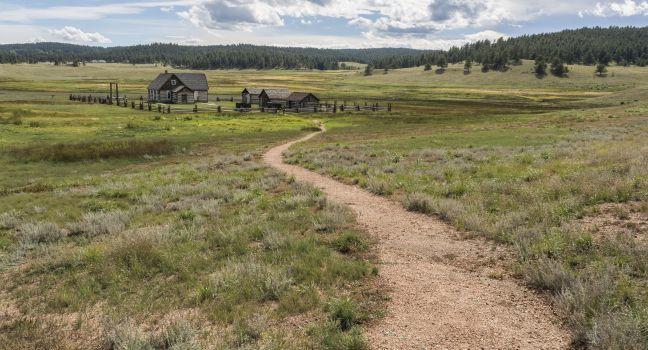
Colorado Log Cabin built in the late 1800's located in the Rocky Mountains of Colorado. Part of the Florissant Fossil Beds National Monument.; Shutterstock ID 169132808; Project/Title: Colorado ebook
Gary Saxe / Shutterstock

Once a temperate subtropical climate, Florissant Fossil Beds National Monument was perfectly preserved by volcanic ash and mud flow 34 million years ago. This little-known site is a haven for paleontologists. The visitor center offers a daily guided walk and ranger talks in the amphitheater in summer, or you can follow the more than 14 miles of well-marked hiking trails and lose yourself in the remnants of petrified redwoods from the Eocene epoch. Once a month, you can lose yourself in the star-filled skies with the park's Night Sky Programs. Certified as an International Dark Sky Park and featuring volunteer astronomers from the Colorado Springs Astronomical Society who bring additional telescopes and insights, it's worth planning a late-afternoon visit/hike to then hang out for an evening of galaxy-viewing. See the website for their schedule.

15807 Teller County Rd. 1, Florissant, CO, 80816, USA
719-748–3253
Sight Details
$10

Something incorrect in this review?

Ka Lae

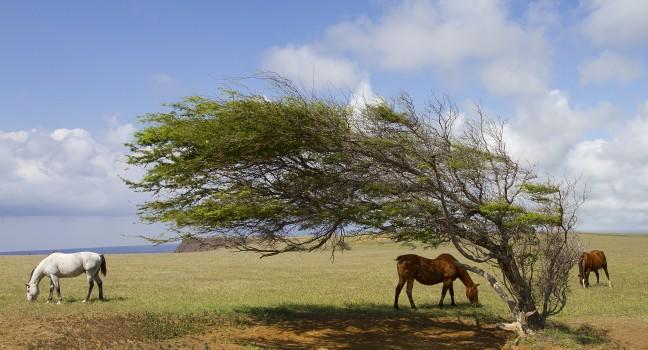
Horses at South Point graving around a wind blown tree.
Marty Wakat / Shutterstock

According to ancient Hawaiian lore, the first Polynesians came ashore at South Point, known in Hawaiian as "Ka Lae." The southernmost point of land in the United States, the South Point Complex is a National Historic Landmark known for the oldest Hawaiian settlement in the Islands, uncovered by archaeologists in 1956. Old canoe-mooring holes, still visible, were carved through the rocks, possibly by settlers from Tahiti as early as AD 750. Today, visitors come here for the views and access to Green Sand Beach. To get to the beach, drive 12 miles down the turnoff road, past rows of giant electricity-producing windmills powered by the nearly constant winds sweeping across this coastal plain. Bear left when the road forks, and park in the lot at the end. Walk past the boat hoists toward the little lighthouse. South Point is just past the lighthouse at the southernmost cliff. You may see brave locals jumping off the cliffs and then climbing up rusty old ladders, but swimming here is not recommended. Don't leave anything of value in your car. The area is isolated and without services. Green Sand Beach is a 40-minute hike down the coast.

South Point Rd. off Mamalahoa Hwy., HI, 96772, USA
Sight Details
Free

Something incorrect in this review?

Agate Bridge

Here you'll see a 100-foot log spanning a 40-foot-wide wash.

Main park road, Petrified Forest National Park, AZ, 86028, USA

Something incorrect in this review?

Ausable Chasm

The 1½-mi-long chasm opened to the public in 1870, becoming the country's first natural tourist attraction. The geological spectacle continues to be popular and is often overrun with visitors in summer.

A deck allows you to view formations such as Elephant Head with its trunk of rock. The trail around the rim provides soaring views, and stone walkways and stairways descend into the chasm. Sightseeing can be combined with a kayak, raft, or inner-tube ride on the Ausable River. Two-hour lantern tours start at dusk. The flickering lights transform the 500-million-year-old mass of time-sculpted stone formations. Reservations are required.

2144 Route 9, NY, 12911, USA
518-834--7454
Sight Details
$17.95

Something incorrect in this review?

Ayres Natural Bridge

Overland immigrants sometimes visited a rock outcrop that spans LaPrele Creek. It's now a small but popular picnic area and campsite where you can wade in the creek or simply enjoy the quiet. No pets are allowed at the campsite.

Douglas, WY., Douglas, WY, 82633., USA
307-358--3532

Something incorrect in this review?

Babcock Ranch Eco-Tours

To see what Florida looked like centuries ago, visit Babcock Ranch northeast of Fort Myers. During a 90-minute excursion, you ride in a converted school bus through several ecosystems, including the unusual and fascinating Telegraph Cypress Swamp. Along the way, an informative and typically amusing guide describes the area's social and natural history while you keep an eye peeled for alligators, wild pigs, all sorts of birds, Florida panthers, and other denizens of the wild. The tour also takes in the ranch's resident cattle and cougar in captivity. Reservations are needed for tours.

8502 Rte. 31, Punta Gorda, FL, 33982, USA
800-500–5583
Sight Details
Eco tours from $24; photo tours from $48; Sounds of the Night tours from $21
Reservations essential

Something incorrect in this review?

Bell Rock

With its distinctive shape right out of your favorite Western film and its proximity to the main drag, this popular butte ensures a steady flow of admirers, so you may want to arrive early in the day. The parking lot next to the Bell Rock Pathway often fills by midmorning, even midweek. The views from here are good, but an easy and fairly accessible path follows mostly gentle terrain for 1 mile to the base of the butte. Mountain bikers, parents with all-terrain baby strollers, and not-so-avid hikers should have little problem getting there. No official paths climb the rock itself, but many forge their own routes (at their own risk).

AZ 179, Big Park, AZ, 86336, USA

Something incorrect in this review?

Big Clifty Sandstone

The Big Clifty Sandstone, part of the Golconda Formation, lies atop the limestone bedrock of the Mammoth Cave region like a roof. Its cross-bedded layers of sandstone and shale form a shield impermeable to water, protecting the limestone beneath from dissolution. Only through cracks and holes in this shield can rainwater penetrate and begin undermining the caprock, flowing through the soluble limestones beneath and making caves. The Big Clifty Sandstone shows off its profile nicely at this location right off the Historic Entrance Trail nearby the visitor center. An outdoor exhibit facing the formation highlights the feature.

Mammoth Cave, KY, 42259, USA

Something incorrect in this review?

Big Pig Dig

Until 2008, paleontologists dug for fossils at this site near the Conata Picnic Area. It was named for a large fossil with a pig-like appearance (it turned out to be a small, hornless rhinoceros). Wayside signs and exhibits, including a mural, provide context on the area and its fossils.

Birdsong Nature Center

With 565 acres of lush fields, forests, swamps, and butterfly gardens, this nature center is a wondrous haven for birds and scores of other native wildlife. Miles of walking trails meander through the property, and nature programs are offered year-round. Check the website for the latest hours and program offerings.

Black Hills Petrified Forest

A 15-minute video and a self-guided nature walk teach you about the geologic evolution of western South Dakota. Allow about an hour for your visit to this forest, which opened to the public in 1929, and is about halfway between Rapid City and Sturgis.

8220 Elk Creek Rd., Piedmont, SD, 57769, USA
605-787–4884
Sight Details
$7
Memorial Day–Labor Day, daily 8–5; rest of May and Sept., and Oct., daily 9–5
Closed Oct.--Apr.

Something incorrect in this review?

Blind Slough Recreation Area

This recreation area includes a number of sites scattered along the Mitkof Highway from 15 to 20 miles south of Petersburg. Blind River Rapids Trail is a wheelchair-accessible 1-mile boardwalk that leads to a three-sided shelter overlooking the river—one of Southeast's most popular fishing spots—before looping back through the muskeg. Not far away is a bird-viewing area where several dozen trumpeter swans spend the winter. In summer you're likely to see many ducks and other waterfowl. At Mile 18 the state-run hatchery releases thousands of king and coho salmon each year. The kings return in June and July, the coho in August and September. Nearby is a popular picnic area. Four miles south of the hatchery is a Forest Service campground.

Bonneville Fish Hatchery

Built in 1909 and operated by the Oregon Department of Fish & Wildlife, the largest state-operated fish hatchery is next door to Bonneville Dam. Visitors can view the fishponds in which Chinook, coho, and steelhead spawn—October and November are the most prolific times. Other ponds hold rainbow trout (which visitors can feed) and mammoth Columbia River sturgeon, some exceeding 10 feet in length.

70543 N.E. Herman Loop, Cascade Locks, OR, 97014, USA
541-374–8393

Something incorrect in this review?

Byron Glacier

The mountains surrounding Portage Glacier are covered with smaller glaciers. A 1-mile hike off Byron Glacier Road—the trail begins about a mile south of Begich-Boggs Visitor Center—leads to the Byron Glacier overlook. The glacier is notable for its accessibility—this is one of just a few places where you can hike onto a glacier from the road system. In summer, naturalists lead free weekly treks in search of microscopic ice worms.

Byron Glacier Rd., AK, USA

Something incorrect in this review?

Calumet Dunes

Calumet Dunes, which crest at 620 feet above sea level, began forming about 12,000 years ago, when Lake Michigan's water level was higher. Explore them on a paved, ½-mile trail that connects with trails to the Glenwood Dunes complex and Dunewood Campground.
1596 N. Kemil Rd., Chesterton, IN, 46304, USA

Something incorrect in this review?

Capitol Dome

The rock formation that gave the park its name, this giant sandstone dome is visible in the vicinity of the Hickman Bridge trailhead on Highway 24, 2 miles east of the visitor center.

Hwy. 24, Capitol Reef National Park, UT, 84775, USA

Something incorrect in this review?

Cathedral of the Pines

This 236-acre outdoor memorial pays tribute to Americans who have sacrificed their lives in service to their country. There's an inspiring view of Mt. Monadnock and Mt. Kearsarge from the Altar of the Nation, which is composed of rock from every U.S. state and territory. All faiths are welcome, and you can hear organ music some afternoons. The Memorial Bell Tower, built in 1967 with a carillon of bells from around the world, is built of native stone. Norman Rockwell designed the bronze tablets over the four arches. Flower gardens, an indoor chapel, and a museum of military memorabilia share the hilltop, and several trails lace the property, leading to tranquil peaceful areas.

Cathedral Rock

It's almost impossible not to be drawn to this butte's towering, variegated spires. The approximately 1,200-foot-high Cathedral Rock looms dramatically over town. When you emerge from the narrow gorge of Oak Creek Canyon, this is the first recognizable formation you'll spot. The butte is best seen toward dusk from a distance. Hikers may want to drive to the Airport Mesa and then hike the rugged but generally flat path that loops around the airfield. The trail is ½ mile up Airport Road off AZ 89A in West Sedona; the reward is a panoramic view of Cathedral Rock without the crowds. Those not hiking should drive through the Village of Oak Creek and 5 miles west on Verde Valley School Road to its end, where you can view Cathedral Rock from a beautiful streamside vantage point and take a dip in Oak Creek if you wish.

Sedona, AZ, 86336, USA

Something incorrect in this review?