
189 Best Sights in USA

Background Illustration for Sights

We've compiled the best of the best in USA - browse our top choices for the top things to see or do during your stay.

875 N. Michigan Avenue (formerly the John Hancock Center) and 360 Chicago

Near North Side Fodor's Choice
Chicago skyline view from John Hancock Observatory
(c) Sidneyboot | Dreamstime.com

Designed by Skidmore, Owings & Merrill, this multipurpose skyscraper is distinguished by its tapering shape and enormous X braces, which help stabilize its 100 stories. Soon after it went up in 1970, it earned the nickname "Big John." No wonder: it's 1,127 feet tall (the taller east tower is 1,506 feet counting its antennae). Packed with retail space, parking, offices, a restaurant, and residences, it has been likened to a city within a city. Like the Willis Tower, which was designed by the same architectural team, this skyscraper offers views of four states on clear days. To see them, ascend to the 94th-floor observatory—now dubbed 360 Chicago ($30). While there, visitors can grab a cocktail, beer, wine, hot drink or nonalcoholic beverage at Bar 94, which can only be accessed with a General Admission ticket. Thrill seekers can pay an additional fee to take advantage of the tower's most exciting feature, The Tilt ($8), which has eight windows that tilt downward to a 30-degree angle, giving you a unique perspective on the city below. Those with vertigo might prefer a seat in the bar of the 96th-floor Signature Lounge; the tab will be steep, but you don't pay the observatory fee and you'll be steady on your feet.
Empire State Building

Murray Hill Fodor's Choice
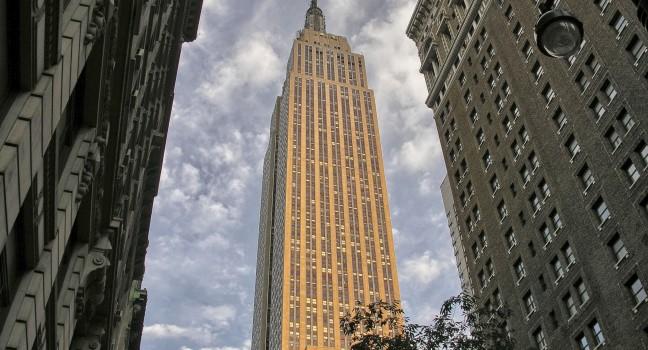
NEW YORK CITY - AUG 16: The Empire State Building on August 16, 2008 in New York, USA. The Empire State Building is a 102-story landmark and American cultural icon in New York City.
CristinaMuraca/Shutterstock

With a legendary silhouette recognizable virtually worldwide, the Empire State Building is an Art Deco monument to progress, a symbol of NYC, and a star in many romantic scenes—on- and off-screen. Built in 1931 at the peak of the skyscraper craze, this 103-floor limestone giant opened after 13 months of construction. The framework rose at a rate of 4½ stories per week, making the Empire State Building the fastest-rising skyscraper ever built, to date.

Enter the visitor experience in the building's designated Observatory lobby—a two-story hall off 34th Street—and exit through the building's illustrious 5th Avenue lobby. Purchase or retrieve prepurchased timed tickets at kiosks, then head to the 10,000-square-foot Second Floor Galleries to learn all about the skyscraper—from its engineering to its role in modern culture (including a fun photo op with King Kong himself). There are interactive experiences, along with marvelous Art Deco details throughout.

Rise from Floor 2 to reach Floor 80's enclosed observatory, with interactive kiosks to create custom NYC itineraries and an impressive NYC skyline drawing by memory artist Steven Wiltshire. Then head to the 86th-floor observatory (1,050 feet high) to find another enclosed area and the spectacular wraparound outdoor deck. The views from the compact 102nd-floor observatory are better still, though it comes with an extra price tag. A new Sunrise@ESB experience ($135) provides preopening access to the 86th floor observation deck on Saturday morning to watch the sunrise with pastries and a custom Starbucks coffee. A Starbucks Reserve Store opened inside the building in 2022.

Expect long lines during peak tourist times/seasons—best avoided with weekday morning or winter visits. Plan for three-plus hours to absorb the full experience and to pass through security. Save time by purchasing tickets online in advance. The building opens the stairs from the 86th floor down to the 80th floor on busy days so visitors can bypass any potential lines.

20 W. 34th St., New York, NY, 10001, USA
212-736–3100
Sight Details
$44 for 86th fl.; $79 to add 102nd fl.; $120 for Express Pass to 86th and 102nd fls.

Something incorrect in this review?

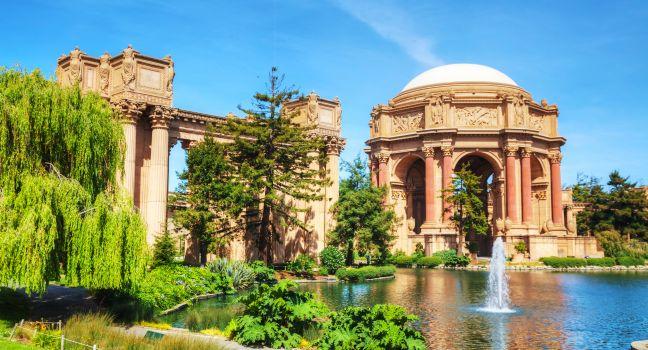
Palace of Fine Arts

Marina Fodor's Choice
The Palace of Fine Arts in San Francisco, California.
Andreykr | Dreamstime.com

This stunning, rosy rococo palace on a lagoon seems to be from another world—it's the sole survivor of the many tinted-plaster structures (a temporary neoclassical city of sorts) built for the 1915 Panama-Pacific International Exposition, the world's fair that celebrated San Francisco's recovery from the 1906 earthquake and fire. The expo buildings originally extended about a mile along the shore. Bernard Maybeck designed this faux-Roman classic beauty, which was reconstructed in concrete and reopened in 1967.

The pseudo-Latin language adorning the Palace's exterior urns continues to stump scholars. The massive columns (each topped with four "weeping maidens"), great rotunda, and swan-filled lagoon have been used in countless fashion layouts, films, and wedding photo shoots. Other than its use for major events and exhibitions inside the building, it's really an outdoor architecture attraction that's perfect for an hour of strolling and relaxing. After admiring the lagoon, look across the street to the house at 3460 Baker Street. If the statues out front look familiar, they should—they're original casts of the "garland ladies" you can see in the Palace's colonnade.

Recommended Fodor's Video

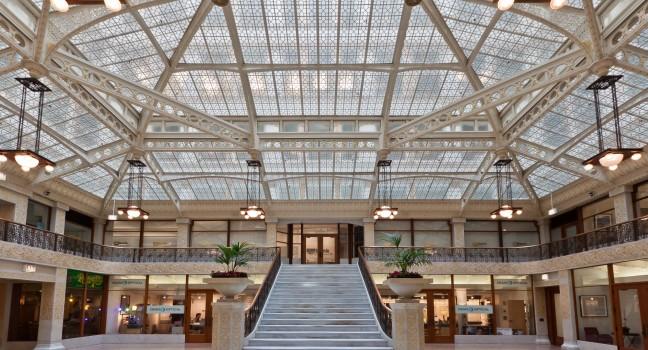
The Rookery

Chicago Loop Fodor's Choice
The main lobby of the Rookery building with its glass ceiling and amazing stairs. Chicago downtown, Illinois, United States.
(c) Afagundes | Dreamstime.com

This 11-story structure, with its eclectically ornamented facade, got its name from the pigeons and politicians who roosted at the temporary city hall constructed on this site after the Great Chicago Fire of 1871; the structure didn't last long, and The Rookery replaced it. Designed in 1885 by Burnham & Root, who used both masonry and a more modern steel-frame construction, The Rookery was one of the first buildings in the country to feature a central court that brought sunlight into interior office spaces. Frank Lloyd Wright, who kept an office here for a short time, renovated the two-story lobby and light court, eliminating some of the ironwork and terra-cotta and adding marble scored with geometric patterns detailed in gold leaf. The interior endured some less tasteful alterations after that, but it has since been restored to the way it looked when Wright completed his work in 1907.

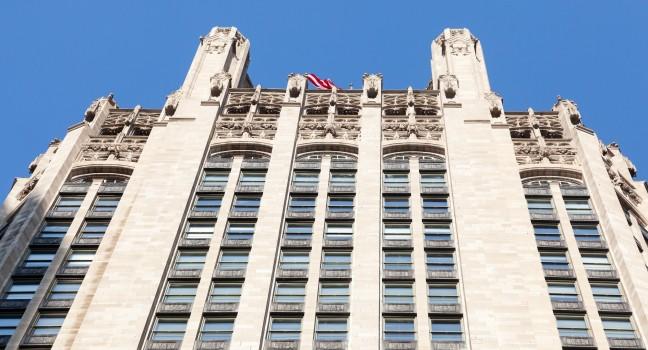
Tribune Tower

Near North Side Fodor's Choice
Top of Tribune Tower in Chicago in perspective shot taken from below.
(c) Steveheap | Dreamstime.com

Big changes have arrived at this iconic tower, which opened in 1925 to house the Chicago Tribune. Sold by the Tribune Company to CIM Group and Golub & Company for $240 million in 2016, the neo-gothic structure is no longer home to the newspaper, and WGN’s final broadcast there took place in 2018. Now the interior is 162 luxury residences with more than 55,000 square feet of indoor amenities. Visitors can still see fragments from famous sites, including the Taj Mahal and the Alamo, embedded in the building’s façade.

Willis Tower

Chicago Loop Fodor's Choice
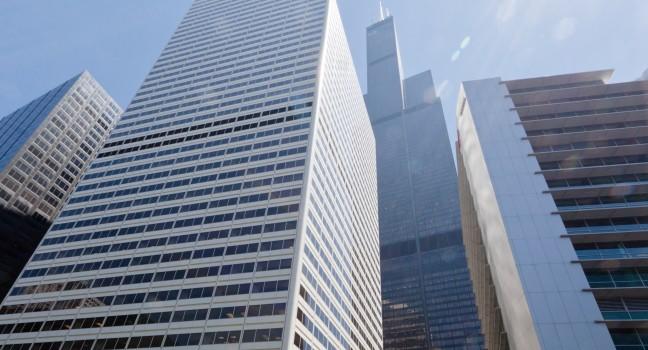
The Willis Tower (formerly Sears Tower) glass windows skyscraper in downtown Chicago, Illinois, United States. The EL mass transport system, pedestrians and cars on the street.
(c) Afagundes | Dreamstime.com

Designed by Skidmore, Owings & Merrill in 1974, the former Sears Tower was the world's tallest building until 1996. The 110-story, 1,730-foot-tall structure may have lost its title and even changed its name, but it’s still tough to top the Willis Tower's 103rd-floor Skydeck—on a clear day it offers views of Illinois, Michigan, Wisconsin, and Indiana. Enter on Jackson Boulevard to take the ear-popping ride up. ( Check the visibility ratings at the security desk before you decide to ascend.) Video monitors turn the 70-second elevator ride into a thrilling trip. Interactive exhibits inside the observatory bring Chicago's dreamers, schemers, architects, musicians, and sports stars to life; and computer kiosks in six languages help international travelers key into Chicago hot spots. For many visitors, though, the highlight (literally) is stepping out on the Ledge, a glass box that extends 4.3 feet from the building, making you feel as if you're suspended 1,353 feet in the air.

Academy of Music

Center City West Fodor's Choice

The only surviving European-style opera house in America is the current home of the Opera Philadelphia and the Pennsylvania Ballet; for the past century, it was home to the Philadelphia Orchestra. Designed by Napoleon Le Brun and Gustav Runge, the 1857 building has a modest exterior; the builders ran out of money and couldn't put marble facing on the brick, as they had intended. The lavish interior, modeled after Milan's La Scala, has elaborate carvings, murals on the ceiling, and a huge Victorian crystal chandelier.

Astoria Column

Fodor's Choice

For the best view of the city, the Coast Range, volcanic Mt. St. Helens, and the Pacific Ocean, scamper up the 164 spiral stairs to the top of the Astoria Column. When you get to the top, you can throw a small wooden plane and watch it glide to earth; each year some 35,000 gliders are tossed. The 125-foot-high structure sits atop Coxcomb Hill, and was patterned after Trajan's Column in Rome. There are little platforms to rest on if you get winded, or, if you don't want to climb, the column's 500 feet of artwork, depicting important Pacific Northwest historical milestones, are well worth a study.

Boldt Castle

Fodor's Choice

George C. Boldt, proprietor of the Waldorf-Astoria Hotel in New York, began building this 120-room Rhineland-style castle on Heart Island for his wife, Louise, in 1900. Four years later, when she died suddenly, he ceased work on the castle. The building remained deserted for 73 years, abused by vandals and weather. Since 1977, millions of dollars have been poured into restoration work. It's worth a trip to the 5-acre island to see the castle. Its fleet of wooden boats is in the Boldt Yacht House, on Wellesley Island. Uncle Sam Boat Tours runs shuttle boats between Alexandria Bay, Heart Island, and Wellesley Island.

Collins Landing, Alexandria Bay, NY, 13607, USA
315-482--9724-in season
Sight Details
Castle $9.50, yacht house $5
Yacht house mid-May–late Sept., daily 10–6:30; call for castle hrs.
Closed Nov.--Apr.

Something incorrect in this review?

Catalina Casino

Fodor's Choice

Built in 1929, this iconic circular white structure is an architectural masterpiece. The entrance offers Spanish-inspired Catalina tile and painted murals in marine blue, sand, and sea foam green colors. This casino was named after the Italian word for "gathering place," not gambling. The circular ballroom with a soaring 50-foot dome ceiling once famously hosted 1940s big bands and is still used for jazz festivals and gala events. The Santa Catalina Island Company leads two different types of guided walking tours of the Casino. On the lower level is the historic Avalon Theatre with more than 1,000 seats; first-run movies show here on the weekend. Look up to see one of the most beautiful art deco murals by John Gabriel Beckman. 

Divers can rent equipment here and take a tour under the sea at Casino Point.

Chicago Cultural Center

Chicago Loop Fodor's Choice

Built in 1897 as the city's original public library, this huge building houses the Chicago Office of Tourism Visitor Information Center, as well as a gift shop, galleries, and a concert hall. Designed by the Boston firm Shepley, Rutan & Coolidge—the team behind the Art Institute of Chicago—it's a palatial affair notable for its Carrara marble, mosaics, gold leaf, and the world's largest Tiffany glass dome.

Clinton Hill Architecture Walk

Fodor's Choice
Part of the National Register of Historic Places, the buildings along Clinton and Washington avenues were originally lavish summer homes for turn-of-the-20th-century industrialists like Charles Pratt. Federal, French Second Empire, Romanesque Revival, Greek Revival, Gothic Revival, and neo-Grec mansions line the streets, serving as university buildings, community centers, and private residences. There are also quintessentially Brooklyn brownstones and Italianate row houses, with mansard roofs as far as the eye can see.

The Comcast Center

Center City West Fodor's Choice

Now Philadelphia's second-tallest building, the 975-foot Comcast Center is also one of its most eco-friendly: the 58-story design by Robert A. M. Stern Architects uses 40% less water than a traditional office building and also deploys its glass-curtain-wall facade to reduce energy costs significantly. Not to be missed is The Comcast Experience, a 2,000-square-foot high-definition video "wall" in the building's lobby, which also features Humanity in Motion, an installation of 12 life-size figures by Jonathan Borofsky that appear to be striding along girders 110 feet above. The building is also the site of an upscale food court and a seasonal outdoor café.

1701 John F. Kennedy Blvd., Philadelphia, PA, 19103, USA

Something incorrect in this review?

Custom House & Tower

Financial District Fodor's Choice

At the time of its construction in 1847, the Custom House was the most expensive ever built in the United States and today it is one of Boston’s most recognizable buildings. It resembles a Greek Revival temple and features an iconic tower that was added in 1915, earning it the title of the city's tallest skyscraper. Today, Marriott operates it as a hotel and vacation club, but the public can take two elevators up 26 floors to the observation deck for unparalleled views of Downtown and Boston Harbor. Tours (30 minutes) leave once daily at 2 pm; there are no tours on Friday. Tours are free, but space is limited, so call ahead to make a reservation---tours book out months in advance.

The Gateway Arch

Downtown Fodor's Choice

The Gateway Arch is truly a sky-high experience. Not only is this marvel of design and engineering as tall (63 stories or 630 feet) as it is wide, but it's also 75 feet higher than the Washington Monument and twice the height of the Statue of Liberty. People come from around the world to enjoy the Arch from every angle—looking down from the top (where the sway can be up to 18 inches in 150 mph winds) or looking up from the bottom; from above in a helicopter or from below aboard a riverboat. Those uncomfortable with heights can skip the ride up and watch livestream video of topside views inside the Keystone replica. The Tram Ride to the Top experience includes an interactive, preboarding exhibit covering the decade in which the Arch was constructed. You then board one of eight, five-person tram capsules that travel at about 5 miles per hour. The ride takes four minutes up and three minutes down. Although the average visit takes 45 to 60 minutes, including transit time, you can stay in the observation deck to enjoy the views (both east and west) for as long as you like. Please note, though, that there are no amenities, including restrooms, at the top, so plan accordingly. Also, come prepared for incredible Instagram moments, and be sure to tag photos to the Arch’s humorous and popular X account: @GatewayArchSTL.

The Lodge at Bryce Canyon

Fodor's Choice

Architect Gilbert Stanley Underwood was already a national park specialist, having designed lodges at Zion and the Grand Canyon, before turning his T square to Bryce in 1924. With its distinctive, wavy, hunter-green shingle roof and artful interior, this National Historic Landmark has been faithfully restored, right down to the lobby's huge limestone fireplace and log and wrought-iron chandelier. Inside the historic building, the only remaining hotel built by the Grand Circle Utah Parks Company, are a restaurant and gift shop, comfy sitting areas, and information on park activities. Just a short walk from the rim trail, the lodge's landscaped brick terrace is an enchanting place to relax after a hike. The lodge also offers accommodations in several historic log cabins and two lodge-inspired but motel-style buildings nearby on the wooded grounds.

Manitoga–The Russel Wright Design Center

Fodor's Choice

Nature and art blend seamlessly throughout the home, studio, and 75-acre grounds of mid-20th-century industrial designer Russel Wright. Boulders protrude through the ground floor of Dragon Rock, Wright's experimental home and a National Historic Landmark. It is built on a rock ledge and spans 11 levels; fist-size stones serve as door handles. Four miles of paths weave through a landscape that appears natural but is actually a studied design of native trees, rocks, mosses, and wildflowers. The 90-minute tours take in the buildings and woodlands; wear comfortable walking shoes.

Old South Meeting House

Downtown Fodor's Choice

Boston's second-oldest church building might well be its most famous were it not for Longfellow's celebration of Old North Church in his poem "Paul Revere's Ride." However, Old South Meeting House is just as significant having been the site of some of the fiercest town meetings that led to the Revolution, including one on December 16, 1773, called by Samuel Adams, which led to the Boston Tea Party. The Old South's "Voices of Protest" exhibit celebrates the meetinghouse as a forum for free speech from way back then right up to the present.  This is Freedom Trail stop 8.

Old State House

Downtown Fodor's Choice

This Colonial-era landmark has one of the most recognizable facades in Boston, with its gable adorned by a brightly gilded lion and silver unicorn, symbols of British imperial power. This was the seat of the Colonial government from 1713 until the Revolution, and after the evacuation of the British from Boston in 1776 it served the independent Commonwealth until its replacement on Beacon Hill was completed in 1798. The Declaration of Independence was first read in public in Boston from its balcony. John Hancock was inaugurated here as the first governor under the new state constitution. Today, it's an interactive museum with exhibits, artifacts, and 18th-century artwork, and tells the stories of Revolutionary Bostonians through costumed guides. This is Freedom Trail stop 9.

Shofuso Japanese Cultural Center

Fairmount Park Fodor's Choice

Designed by Japanese architect Junzo Yoshimura, this exquisite replica of a traditional 17th-century house, reassembled here in 1958 after being exhibited at the Museum of Modern Art in New York City, is set in 1.2 acres of gardens with a teahouse, tiered waterfall, Japanese trees, and a koi pond. Shofu-So means "pine breeze villa," and the roof is made of the bark of the hinoki, a Japanese cypress. The house was created as an example of buildings that influenced mid-20th-century architecture. Twenty murals by acclaimed Japanese contemporary artist Hiroshi Senju decorate the main rooms, enhancing the serene spirit of the compact house and gardens. Staff is on hand to answer questions. Check the website for periodic tea ceremonies (reservations required) and events; Shofuso is one site of Philadelphia's Cherry Blossom Festival each spring. Note: Shofuso is not wheelchair accessible, and visitors must remove their shoes to enter the house.  Timed tickets are required, so it's best to reserve ahead. A visit takes 30 minutes to an hour, more if you linger and soak in this escape from the urban bustle. 

N. Horticultural Dr. and Lansdowne Dr., Philadelphia, PA, 19131, USA
215-878–5097
Sight Details
$15
Closed mid-Dec.–late Mar.; Mon. and Tues. late Mar.–Oct; and weekdays Nov.–mid-Dec.

Something incorrect in this review?

Spadena House

Fodor's Choice

Otherwise known as the Witch’s House in Beverly Hills, the Spadena House has an interesting history. First built on the Willat Studios lot in 1920, the house was physically moved to its current ritzy location in 1924. The house is not open for tourists, but the fairy-tale-like appearance is viewable from the street for onlookers to snap pics. Movie buffs will also recognize it from a background shot in the film Clueless.

Transamerica Pyramid

Financial District Fodor's Choice

It's neither owned by Transamerica nor, to some building experts, is it even a pyramid, but this 48-floor, 853-foot-tall pyramid-obelisk is the most photographed of the city's high-rises. Excoriated in the design stages as "the world's largest architectural folly," the icon was quickly hailed as a masterpiece when it opened in 1972. Today it's probably the city's most recognized structure after the Golden Gate Bridge, and it's the second-tallest in the city after the Salesforce Tower. You can't go up the pyramid (apparently there is now a bar on the 48th floor), but the best views and photo-ops are of the building itself anyway. After the real estate developer SHVO purchased the building in 2020, the legendary skyscraper architect Norman Foster led a renovation of the pyramid that was completed in 2024 (and unveiled with a new official name, the Transamerica Pyramid Center). Most of the building is still for private offices, but the public can visit a lobby coffee shop, a ground floor art gallery, and Café Sebastian located just steps from the building but still within the one-block large complex.  A fragrant redwood grove along the east side of the building, with benches and a rotating outdoor art exhibit, is a placid downtown oasis in which to unwind.

White Sands Visitor Center

Fodor's Choice
The centerpiece of the small White Sands Historic District, a complex of park buildings constructed by the WPA in New Mexico's distinctive Spanish–Pueblo Revival style in the mid-1930s, the park's only visitor center is built of thick adobe (mud and straw) bricks and has a traditional viga (beam) and savina (also called latilla) aspen-pole ceiling and architectural details typical of the period and style, like punched-tin light fixtures and hand-carved wooden benches. Inside you'll find an info desk and an array of excellent, modern, interactive exhibits as well as a small theater that shows a short film about the dunes. Walk out back to reach the park gift shop, which has books, souvenirs, water, a very limited assortment of snacks, and sleds with which to careen down the park's dunes. The district's other seven buildings include a visitor restroom, ranger residences, and various utility buildings.

Wrigley Building

Near North Side Fodor's Choice

The gleaming white landmark—designed by Graham, Anderson, Probst & White and the former headquarters of the chewing-gum company—was instrumental in transforming Michigan Avenue from an area of warehouses to one of the most desirable spots in the city. Its two structures were built several years apart and later connected, and its clock tower was inspired by the bell tower of the Giralda Tower in Seville, Spain. Be sure to check it out at night, when lamps bounce light off the 1920s terracotta facade.

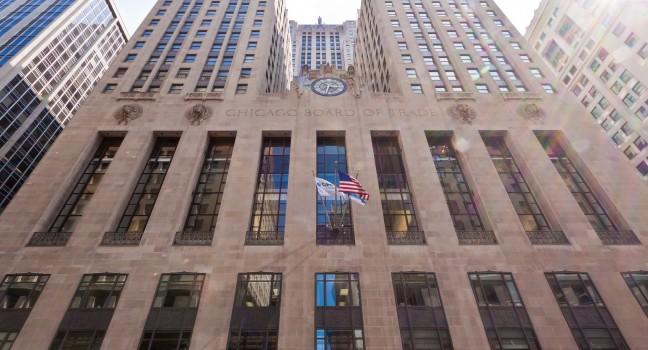
Chicago Board of Trade

Chicago Loop
The facade of the famous building with its clock. Chicago Board of Trade at downtown, Illinois state, United States.
(c) Afagundes | Dreamstime.com

Home of the thriving financial district, relatively narrow LaSalle Street earned the moniker "The Canyon" (and it feels like one) because of the large buildings that flank either end. This one was designed by Holabird & Root and completed in 1930. The streamlined, 45-story giant recalls the days when art deco was all the rage. The artfully lighted marble lobby soars three stories, and Ceres (the Roman goddess of agriculture) stands atop its roof. Trading is no longer done here, but it's worth a look at what was the city's tallest skyscraper until 1955, when the Prudential Center topped it.

Chinatown Gate

Chinatown
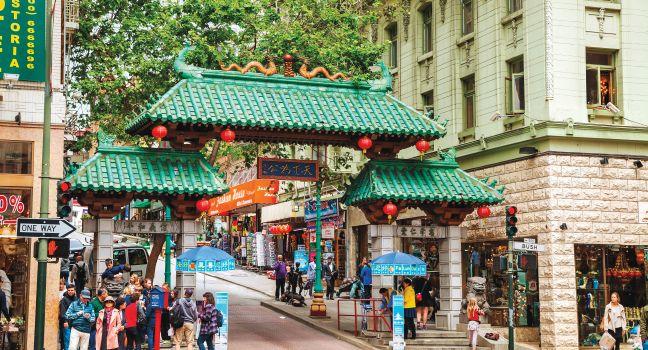
SAN FRANCISCO - APRIL 24: A Gateway Arch (Dragon Gate) on Grant Avenue at Bush Street in Chinatown on April 24, 2014 in San Francisco. It's the only authentic Chinatown Gate in North America.
photo.ua / Shutterstock

At the official entrance to Chinatown, stone lions flank the base of the pagoda-topped gate; the lions, dragons, and fish up top symbolize wealth, prosperity, and other good things. The four Chinese characters immediately beneath the pagoda represent the philosophy of Sun Yat-sen, the leader who unified China in the early 20th century. Sun Yat-sen, who lived in exile in San Francisco for a few years, promoted the notion of friendship and peace among all nations based on equality, justice, and goodwill. The vertical characters under the left pagoda read "peace" and "trust," the ones under the right pagoda "respect" and "love." The whole shebang telegraphs the internationally understood message of "photo op." Immediately beyond the gate, dive into souvenir shopping on Grant Avenue, Chinatown's tourist strip.

Grant Ave. at Bush St., San Francisco, CA, 94108, USA

Something incorrect in this review?

Chrysler Building

Midtown East
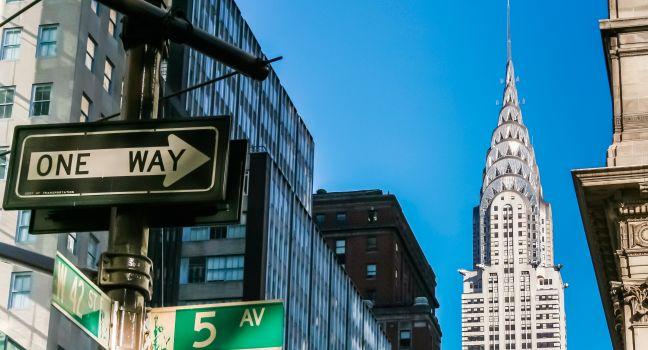
New York City street signs and Chrysler building
Marc Venema/iStockphoto

A monument to modernity and the mighty automotive industry, the former Chrysler headquarters wins many New Yorkers' vote for the city's most marvelous and beloved skyscraper, despite the fact that you can only love it from a distance. Architect William Van Alen, who designed this 1930 Art Deco masterpiece, incorporated car details into its form: American eagle gargoyles, made of chromium nickel and resembling hood ornaments used on 1920s Chryslers, sprout from the 61st floor; winged urns festooning the 31st floor reference the car's radiator caps. Most breathtaking is the pinnacle, with tiered crescents and spiked windows that radiate out like a magnificent steel sunburst. While the current owner has been given permission to reopen an observation deck on the 71st floor that closed in 1945, for now you have to make do with appreciating it from afar or ducking in for a quick look at the amazing time-capsule lobby replete with chrome "grillwork," intricately patterned wood elevator doors, marble walls and floors, and an enormous ceiling mural saluting transportation and human endeavor. You may enter the lobby during business hours (8 am–6 pm). For a great view/photo, walk to the northeast corner of 44th Street and 3rd Avenue.

Daniels & Fisher Tower

Downtown
The Daniels & Fisher Tower is one of the landmarks of the Denver skyline.
Arina P Habich / Shutterstock

This 330-foot-high, 20-floor structure emulates the Campanile of St. Mark's Square in Venice, and it was the tallest building west of the Mississippi when it was built in 1909. William Cooke Daniels originally commissioned the tower to stand adjacent to his five-story department store. Today it's an office building with a cabaret in the basement as well as the city's most convenient clock tower. It's particularly striking—the clock is 16 feet high—when viewed in concert with the fountains in the adjacent Skyline Park.

Flatiron Building

Flatiron District
The Flatiron Building, New York, circa May 2013. The Flatiron building is considered to be one of the first skyscrapers ever built. It was completed in 1902.
Marco Rubino / Shutterstock

When completed in 1902, the wedge-shape Fuller Building, as it was originally known, caused a sensation. Architect Daniel Burnham made ingenious use of the triangular wedge of land at 23rd Street, 5th Avenue, and Broadway, employing a revolutionary steel frame that allowed for the structure's 22-story, 286-foot height. Covered with a facade of limestone and white terra-cotta in the Italian Renaissance style, the building's shape resembled a clothing iron, hence its nickname. When it became apparent that the building generated strong winds, gawkers would loiter at 23rd Street hoping to catch sight of ladies' billowing skirts. Local traffic cops had to shoo away the male peepers—one purported origin of the phrase "23 skidoo."

175 5th Ave., New York, NY, 10010, USA

Something incorrect in this review?

Rockefeller Center

Midtown West
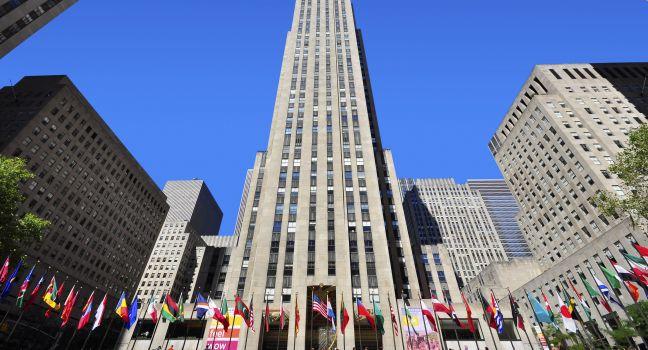
NEW  YORK - SEPTEMBER 5: Rockefeller Center on September 5, 2010 in NYC. Rockefeller Center is a complex of 19 commercial buildings, built by the Rockefeller family, located in Midtown Manhattan.; Shutterstock ID 100153565; Project/Title: MB_NYPhotoMap
ruigsantos/Shutterstock

Comprising more than 100 shops and 50 eateries, the Rockefeller Center complex runs from 47th to 52nd Street between 5th and 6th Avenues; special events dominate the central plazas in spring and summer. In December an enormous, twinkling tree towers above the ice-skating rink, causing crowds of visitors from across the country and the globe to shuffle through with cameras flashing.

\n

The world's most famous ice-skating rink occupies Rockefeller Center's sunken lower plaza from October through mid-April and converts to a roller-skating rink in summer. A gold-leaf statue of the Greek hero Prometheus hovers above. The lower plaza also provides access to the marble-lined concourse underneath Rockefeller Center, which houses restaurants, a post office, and clean public restrooms.

\n

Rising from the lower plaza's west side is the 70-story Art Deco GE building. Here John D. Rockefeller Jr. commissioned and then destroyed a mural by Diego Rivera. He replaced it with the monumental American Progress by José María Sert, still on view in the lobby, flanked by additional murals by Sert and English artist Frank Brangwyn. Up on the 65th floor is the landmark Rainbow Room, a glittering big-band ballroom dating from 1934. Higher up, Top of the Rock has what many consider the finest panoramas of the city. Rockefeller Center guided walking tours are available several times daily (tickets start at $27), with the option to add a visit to the observation deck.