


45 Best Sights in USA

Background Illustration for Sights

We've compiled the best of the best in USA - browse our top choices for the top things to see or do during your stay.

Martha's Vineyard Camp Meeting Association
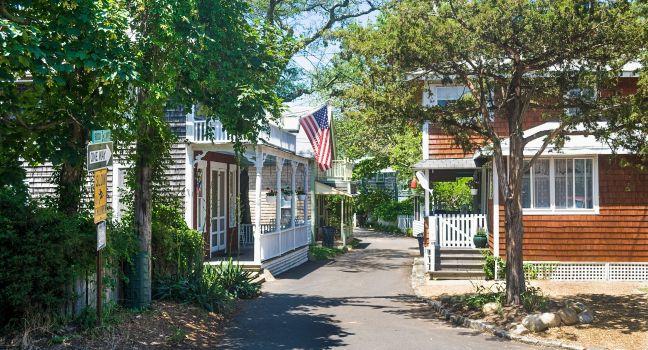
Oak Bluffs Fodor's Choice
Narrow streets and quaint cottages in Oak Bluffs on June 26, 2011. Oak Bluffs on Martha’s Vineyard is popular for the historic gingerbread style homes located there.
(c) Andykazie | Dreamstime.com

This 34-acre warren of streets is tightly packed with more than 300 gaily painted Carpenter Gothic Victorian cottages with wedding-cake trim; they date mainly to the 1860s and '70s, when visitors coming for Methodist revivalist services began to lease lots and build houses for summer use. As you wander through this fairy-tale setting, imagine it on a balmy summer evening, lighted by the warm glow of paper lanterns hung from every cottage porch. This describes the scene on Illumination Night at the end of the Camp Meeting season, which is attended these days by some fourth- and fifth-generation cottagers—and newcomers: some houses do change hands, and some are rented. Attendees mark the occasion as they have for more than a century, with lights, song, and open houses for families and friends. Ninety-minute tours of the area are conducted at 11 am on Tuesday and Thursday in July and August; the Friday night Sunset Concert Series on Tabernacle Green is always festive.
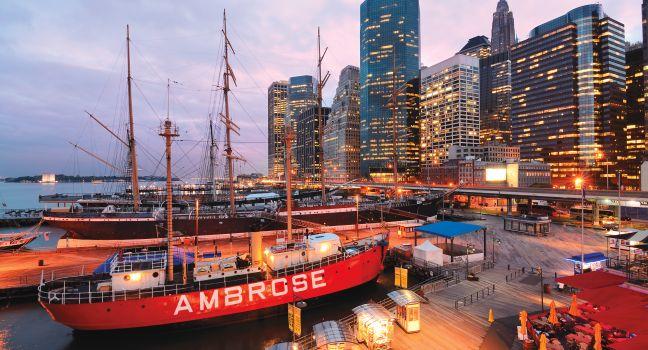
The Seaport

Financial District Fodor's Choice
South Street Seaport in New York, NY. The port is a designated historic district containing the largest concentration of 19th century landmarks in the city.
Sepavo | Dreamstime.com

Had this charming cobblestone neighborhood not been declared a historic district in 1977, the city's largest concentration of early-19th-century commercial buildings would have been destroyed. Thankfully, they survived, and in recent years have come to enjoy new life. The landmarked "South Street Seaport Historic District" has undergone a thorough makeover as a diverse shopping and dining destination, with seasonal markets, art installations, IPIC Theater (a luxury cinema with dining), and live entertainment—plus a simplified moniker as The Seaport.

At the intersection of Fulton and Water Streets, the main Seaport gateway, is the Titanic Memorial Lighthouse, a small white lighthouse that commemorates the sinking of the RMS Titanic in 1912. Beyond the lighthouse, Fulton Street turns into a cobblestone pedestrian mall. On the south side of Fulton is The Seaport's architectural centerpiece, Schermerhorn Row, a redbrick terrace of Georgian- and Federal-style warehouses and countinghouses built from 1810 to 1812. Cross South Street to Pier 16, where historic 19th- and 20th-century ships are docked. Pier 16 also is the departure point for various seasonal cruises. (Ship tours are included in the admission to the South Street Seaport Museum).

Across South Street along the East River are Pier 17 and the renovated Tin Building. Previously the longtime site of the Fulton Fish Market, in 2022, the latter reopened as the Tin Building by renowned chef Jean-Georges Vongerichten, a high-end dining destination and specialty food market ( tinbuilding.com). In 2018, the Pier 17 building became a multilevel office complex with several restaurants and bars at street level, and a 60,000-square-foot rooftop that's programmed with concerts and seasonal pop-ups ( rooftopatpier17.com). But the real highlight is the wraparound public wharf that's open year-round, with seating and stunning views of the harbor and Brooklyn Bridge.

Breckenridge Downtown Historic District

Fodor's Choice

Downtown Breckenridge's Historic District is one of Colorado's largest, with about 250 buildings on the National Register of Historic Places. The district is roughly a compact 12 square blocks, bounded by Main, High, and Washington Streets and Wellington Road. There are some 171 buildings with points of historical interest, from simple log cabins to Victorians with lacy gingerbread trim.

Recommended Fodor's Video

Cades Cove

Fodor's Choice

A 6,800-acre valley surrounded by high mountains, Cades Cove has more historic buildings than any other area in the park. It's also stunningly beautiful, punctuated by verdant meadows and dirt paths, all surrounded by a ring of peaks. The Park Service keeps hayfields and pastures cleared, so you can see how the valley may have looked in the 19th century. There's a campground and multiple options for day hikes to peaks and along quiet rivers. The Cherokee name for this valley is Tsiyahi, "place of otters," but today you're more likely to see bears, deer, coyotes, and wild turkeys. For hundreds of years the Cherokee people hunted in Cades Cove, but there is no evidence of major settlements. Under the terms of the Calhoun Treaty of 1819, the Cherokee lost their rights to Cades Cove, and the first white settlers came in the early 1820s. By the middle of the 19th century, well over 100 settler families were growing corn, wheat, oats, and vegetables. For a while, when government-licensed distilleries were allowed in Tennessee, corn whiskey was the major product of the valley. After the establishment of the park in the 1930s, many of the nearly 200 buildings were torn down to allow the land to revert to its natural state. More recently, the remaining farmsteads and other structures have been restored to depict life in Cades Cove as it was from around 1825 to the 1940s. Cades Cove's beauty is also its curse. To experience it in the best possible setting, without traffic, rent bicycles at the Cades Cove Campground Store and ride the loop road on a car-free Wednesday or at sunrise or sunset.

Downtown Boulder Historic District

Fodor's Choice

The late-19th- and early-20th-century commercial structures of the Downtown Boulder Historic District once housed mercantile stores and saloons, but today the stores here cater to modern tastes, with fair-trade coffees and Tibetan prayer flags. The period architecture—including Queen Anne, Italianate, and Romanesque styles in stone or brick—has been preserved.

Elkmont Historic District

Fodor's Choice

What began as a logging town in the early years of the 20th century evolved into a summer colony for wealthy families from Knoxville. Many prominent east Tennessee families built vacation homes here or visited the Wonderland Hotel via train service from Knoxville to Elkmont. After the national park was established, parts of the community were placed on the National Registry of Historic Places. Today, Elkmont is primarily a campground, and most of the 74 cottages have been removed. The last families lost their leases to their cabins in the 1990s. You can see the ruins of the biggest homes along Millionaires Row, where stone chimneys stand like ghostly sentinels in the wood. In recent years, the Park Service has restored several homes along Jakes Creek that are now open to the public. The Appalachian Clubhouse, built for a hunting and fishing club, is restored to its 1930s appearance, complete with rocking chairs on the porch. There's a short loop nature trail here, or you can take an easy flat walk along the Little River Trail.

Jackson Square Historic District

Financial District Fodor's Choice

This was the heart of the Barbary Coast of the Gay '90s—the 1890s, that is. Although most of the red-light district was destroyed in the fire that followed the 1906 earthquake, the remaining old redbrick buildings, many of them now occupied by advertising agencies, law offices, and antiques firms, retain hints of the romance and rowdiness of San Francisco's early days.

With its gentrified Gold Rush–era buildings, the 700 block of Montgomery Street just barely evokes the Barbary Coast days, but this was a colorful block in the 19th century and on into the 20th. Writers Mark Twain and Bret Harte were among the contributors to the spunky The Golden Era newspaper, which occupied No. 732 (now part of the building at No. 744).

Restored 19th-century brick buildings line charming Hotaling Place, a quiet lane that connects Washington and Jackson streets; it's named for the A. P. Hotaling Company whiskey distillery, the largest liquor repository on the West Coast in its day. The view of the Transamerica Pyramid from Hotaling Place is one of the most photographed vantage points in the city and is a remarkable juxtaposition of this neighborhood's 19th- and 20th-century history.

Today, Jackson Square is best known for its excellent collection of restaurants, cafés, art galleries (Gallery Japonesque at 824 Montgomery Street is well worth a stop if it's open), and upscale-stylish boutiques.

Jekyll Island National Historic Landmark District

Fodor's Choice

This 240-acre historic district encapsulates the village that once comprised the winter retreat and seasonal residences for America's wealthiest—Morgan, Pulitzer, Goodyear, Rockefeller, and Vanderbilt among them. Today, the original cottages still stand amid the historic grounds, with the Jekyll Island Club Hotel, founded in 1886, as the crown jewel. Nearby is Faith Chapel, built in 1904, which is illuminated by stained-glass windows, including one Tiffany original. Free admission is included with the purchase of any Historic Landmark District Tour.

La Cueva Historic District

Fodor's Choice

As you head south on NM 518 toward Las Vegas, be sure to stop in the La Cueva Historic District. Among the buildings here, which date to the 1850s, is a stone-walled mill that supplied flour to the soldiers of Fort Union. Pioneer rancher Vicente Romero's mill also supplied power to the area until 1950; at what is now called the Salman Ranch, you can pick raspberries mid-August to mid-October, or buy fresh berries, raspberry jam and vinegar, and dried flowers and herbs at the original La Cueva Ranch Store. Brilliantly colored wildflower gardens, and homemade tamales, burgers, and raspberry sundaes served at the café draw families during "U Pick" raspberry season. The historic district's San Rafael Church, dating from the 1870s, is also worth a look.

NM 518 at NM 442, La Cueva, NM, 87712, USA
575-387–2900
Sight Details
Store Jan.–June, Thurs.–Mon. 9–4; July–Dec., daily 9–5; café mid-Aug.–mid-Oct., Tues.–Sat. 11–4; U Pick field, mid-Aug.–mid-Oct., Tues.–Sun. 10–4.

Something incorrect in this review?

Little Tokyo

Downtown Fodor's Choice

One of three official Japantowns in the country—all of which are in California—Little Tokyo is blossoming again thanks to the next generation of Japanese Americans setting up small businesses. Besides dozens of sushi bars, tempura restaurants, and karaoke bars, there's a lovely garden at the Japanese American Cultural and Community Center and a renovated 1925 Buddhist temple with an ornate entrance at the Japanese American National Museum.

On 1st Street you'll find a strip of buildings from the early 1900s. Look down when you get near San Pedro Street to see the art installation called Omoide no Shotokyo ("Remembering Old Little Tokyo"). Embedded in the sidewalk are brass inscriptions naming the original businesses, quoted reminiscences from residents, and steel time lines of Japanese American history up to World War II. Nisei Week (a nisei is a second-generation Japanese American) is celebrated every August with traditional drums, dancing, a carnival, and a huge parade.

Docent-led walking tours are available by appointment on occasional Saturdays starting at 10:15 am. The cost is $15 and should be reserved in advance at littletokyohs.org.

Los Rios Historic District

Fodor's Choice

The Pacific Surfliner trains stop at the 1894 depot at the entrance of the oldest residential street in Southern California. Some of the houses date back to the 1790s. Train fans can stay overnight in the historic Los Rios Cottages. Located near Mission San Juan Capistrano, this was the first Californian mission to allow workers to live outside the mission grounds. On the street you'll find quaint shops, the Ramos House Cafe, and a beautiful Tea House in a flower garden.

12th Street

A National Historic District, Golden's 12th Street has a row of handsome 1860s brick buildings.

Golden, CO, 80401, USA

Something incorrect in this review?

Beaufort Historic Site

In the center of town, the historic site consists of 10 buildings dating from 1732 to 1859, including the 1796 Carteret County Courthouse and the 1859 Apothecary Shop and Doctor's Office. Don't miss the Old Burying Grounds (1709), where Otway Burns, a privateer in the War of 1812, is buried under his ship's cannon; a nine-year-old girl who died at sea is buried in a rum keg; and an English soldier saluting the king is buried upright in his grave. Tours of the entire 12-block historic site, which is now on the National Register of Historic Places, either on an English-style double-decker bus or by guided walk, depart from the visitor center. For a self-guided tour, download the free walking tour brochure from the website and put on your walking shoes—Beaufort has about 150 historic houses with plaques that list their date of construction and original owner.

Bremond Block Historic District

Downtown

Take a stroll through the Bremond Block Historic District, listed on the National Register of Historic Places and only a short walk from the Capitol. Admire the high-style, mid- to late-19th-century Victorian homes that belonged to Austin's first wave of wealthy merchants and bankers. While the private homes are not open to the public, self-guided audio walking tours are available for free on the Austin Visitor Center's website.

Brooklyn Heights Historic District

Brooklyn Heights

Most of Brooklyn Heights, with picturesque brownstones spanning Old Fulton Street to Atlantic Avenue, was designated a National Historic Landmark in 1965. This includes the quiet "fruit streets"—Pineapple, Cranberry, and Orange Streets—named in the 19th century by one Lady Middagh, a resident who thought it was more democratic to get rid of the former names of aristocratic families. Ironically, Middagh Street still exists. One notable building in the area is 58 Joralemon Street, which at a glance appears to be a 19th-century Greek revival town house, but is actually a facade for an MTA ventilation shaft.

Old Fulton St. to Atlantic Ave., between Cadman Plaza and Brooklyn Heights Promenade, Brooklyn, NY, USA

Something incorrect in this review?

Captain's Row

Old Town

Many of Alexandria's sea captains once lived on this block, which gives visitors the truest sense of what the city looked like in the 1800s. The houses are now all private residences and reflect the style of the Federal period. While the cobblestone pavement is a replica, it accurately represents the original which, according to local folklore, was laid down by Hessian soldiers taken prisoner in the Revolutionary War. Captain's Row is one of only two streets in Alexandria that is paved with cobblestones.

100--199 Prince St., Alexandria, VA, 22314, USA

Something incorrect in this review?

Central Avenue Historic District

Stretching a little more than ½ mile, this district contains an array of commercial buildings constructed between 1886 and 1930 in a variety of styles, including Classical, Italianate, Romanesque, Victorian, and art deco. Among the notable structures are the impressive Arlington Resort Hotel & Spa and the Medical Arts Building, a 1929 skyscraper that was the state's tallest structure until 1960. The district was placed on the National Register of Historic Places in 1985, and today these architecturally delightful buildings house a variety of businesses including restaurants, nightclubs, and boutiques.

Chinatown

Downtown

Smaller than San Francisco's Chinatown, this neighborhood near Union Station still represents a slice of East Asian life. Sidewalks are usually jammed with tourists, locals, and residents hustling from shop to shop picking up goods, spices, and trinkets from small shops and mini-plazas that line the street. Although some longtime establishments have closed in recent years, the area still pulses with its founding culture. During Chinese New Year, giant dragons snake down the street. And, of course, there are the many restaurants and quick-bite cafés specializing in Chinese feasts. In recent years, a slew of hip eateries like Howlin' Ray's and Majordomo have injected the area with vibrancy.

An influx of local artists has added a spark to the neighborhood by taking up empty spaces and opening galleries along Chung King Road, a faded pedestrian passage behind the West Plaza shopping center between Hill and Yale. Also look for galleries along a little side street called Gin Ling Way on the east side of Broadway. Chinatown has its main action on North Broadway. There are several garages available for parking here that range from $15 to $25 per day.

Corazón de Trinidad

Downtown Trinidad, called the Corazón de Trinidad, is a National Historic District, mixing historic original brick-paved streets and architecture with modern concerts, restaurants, shops, and festivals. Residents and officials recently launched a bit of a revival here with big plans for the creative district.

Downtown Historic Districts

Downtown

North of the Convention Center and the government buildings, El Presidio Historic District is an architectural thumbnail of the city's former self. The north–south streets Court, Meyer, and Main are sprinkled with traditional Mexican adobe houses sitting cheek by jowl with Territorial-style houses with wide attics and porches. Paseo Redondo, once called Snob Hollow, is the wide road along which wealthy merchants built their homes.

The area most closely resembling 19th-century Tucson is the Barrio Historico, also known as Barrio Viejo. The narrow streets of this neighborhood, including Convent Avenue, have a good sampling of thick-walled adobe houses. The colorfully painted houses are close to the street, hiding the yards and gardens within.

To the east of the Barrio Historico, across Stone Avenue, is the Armory Park neighborhood, mostly constructed by and for the railroad workers who settled here after the 1880s. The brick or wood Territorial-style homes here were the Victorian era's adaptation to the desert climate.

Tucson, AZ, 85701, USA

Something incorrect in this review?

Fort Point Channel Landmark District

Fort Point Channel

This historic district, which was designated by the City of Boston in 2009, features the city's largest, most cohesive grouping of late-19th- and early-20th-century industrial loft buildings. The Boston Wharf Company owned and developed the area from 1836 to 1882. Today, the small, walkable, revitalized area sits between the Fort Point Channel and the Seaport District and is home to working artist studios, bars and restaurants, and some small businesses.

Bounded by Seaport Blvd., Summer St., Boston Wharf Rd., and Fort Point Channel, Boston, MA, USA

Something incorrect in this review?

Greenpoint Historic District

Greenpoint

Landmarked in 1982, this historic district is lined with beautiful town houses. The area extends roughly from Calyer Street north to Kent Street, between Manhattan Avenue and Franklin Street. The brick homes date from the 1850s, when Greenpoint was a hub for shipbuilding and manufacturing. Walking along Franklin Street on a quiet morning is like stepping into an Edward Hopper painting.

Calyer St. to Kent St., Brooklyn, NY, 11222, USA

Something incorrect in this review?

Hale Farm and Village

Comprised of 32 historic buildings spread out over 100 acres, Hale Farm and Village is a living history museum that illustrates what life was like in the Cuyahoga Valley for early white settlers. The farm, listed on the National Register of Historic Places in 1973, was the original homestead of Jonathan Hale, a Connecticut farmer who migrated in 1810 to the Cuyahoga Valley region known then as the Western Reserve. Many of the buildings are open for self-guided experiences, while craft demonstrations of various 19th-century trades such as candle-making, glass blowing, blacksmithing, and pottery take place regularly. The Gatehouse Welcome Center at Hale Farm has an on-site gift shop and a lovely restaurant, Cafe 1810, which sources its produce from Hale's gardens and farm.

Hanapepe Walking Tour

This 1½-mile self-guided walking tour takes you to 14 plaques with historic photos and stories mounted on buildings throughout Hanapepe Town. This little main street had a colorful past––it was a portside "free town," not governed by sugar plantation company rules or decorum, and a deadly labor battle known as the "Hanapepe Massacre" happened here in 1924.

Historic Downtown District

Storied Route 66 runs right through the heart of downtown Flagstaff. The late Victorian, Tudor Revival, and early Art Deco architecture in this district recalls the town's heyday as a logging and railroad center. The Santa Fe Depot now houses the visitor center. The 1927 Hotel Monte Vista, built after a community drive raised $200,000 in 60 days, is one of the Art Deco highlights of the district; today it houses a restaurant, live music venue, and a combination coffeehouse and cocktail bar. Across the street, the 1888 Babbitt Brothers Building was constructed as a building-supply store and then turned into a department store by David Babbitt, the mastermind of the Babbitt empire. (The Babbitts are one of Flagstaff's wealthiest founding families.) The Weatherford Hotel, built in 1900, hosted many celebrities; Western author Zane Grey wrote The Call of the Canyon here. Most of the area's first businesses were saloons catering to railroad construction workers, which was the case with the 1888 Vail Building. Nowadays, downtown is a bustling dining and retail district, with restaurants, bakeries, and alluring shops. Across the railroad tracks, the revitalized Southside is home to popular eateries and craft breweries.

Rte. 66 north to Birch Ave., and Beaver St. east to Agassiz St., AZ, USA

Something incorrect in this review?

Historic Downtown Strand District

This shopping area is defined by the architecture of its 19th- and early-20th-century buildings, many of which survived the storm of 1900 and are on the National Register of Historic Places. When Galveston was still a powerful port city—before the Houston Ship Channel was dug, diverting most boat traffic inland—this stretch, formerly the site of stores, offices, and warehouses, was known as the Wall Street of the South. As you stroll up the Strand, you'll pass dozens of shops and cafés.

Historic Rittenhouse Town

Germantown

North America's first paper mill was built here in 1690 by Mennonite minister William Rittenhouse. Over the next 150 years, 10 generations of his family lived on the site and operated the mill. His most famous offspring, born in 1732, was David Rittenhouse, astronomer, statesman, and first president of the U.S. Mint. You can stroll anytime through this National Historic District that consists of 30 picturesque acres along the Wissahickon and seven outbuildings—this is worth doing, as it is also an entryway to Wissahickon Valley Park. Public tours (summer only) are offered intermittently—private tours can be arranged by phone. By the parking lot is the PAPERTrail Bike Cafe ( papertrailbikecafe.com), a tiny coffee and bike repair shop, where you can grab a coffee and snack and sit at picnic benches on the historic grounds.

206 Lincoln Dr., Philadelphia, PA, 19144, USA
215-438–5711
Sight Details
Grounds are free, tours are $15

Something incorrect in this review?

Historic Thurmond

This once-flourishing coal town along the Chesapeake and Ohio rail line is now little more than a memory, but restored buildings, including retail stores and a bank, allow your imagination to bring this town to life. Start at the Thurmond Depot (now a seasonal visitor center), then stroll the once-bustling commercial district, which met its demise when the swanky Lafayette Hotel burned down in 1963.

New River Gorge National Park, WV, USA

Something incorrect in this review?

La Villita Historic Arts Village

Downtown

Meaning "Little Village," La Villita is a prime square block of shopping, dining, arts and entertainment and host to more than 200 festive events each year. It was the original settlement in Old San Antonio and one of the city's first neighborhoods founded almost 300 years ago. Stroll among the adobe, brick, and stone structures in varying architectural styles. Enjoy browsing (and buying!) at about two dozen boutiques and galleries selling art, jewelry, and handmade items by local and regional artists, who occasionally present workshops and exhibitions on-site. La Villita Historic Arts Village is named on the National Register of Historic Places. Be sure to pick up a map so you don't miss anything in this charming hamlet.

Laclede's Landing

Downtown

Just one block from Gateway National Park's north entrance, this nine-block district is complete with cobblestone streets, 17 historic buildings, eight restaurants, and one great view of the river. Arch parking is available here, and the MetroLink light rail stops at this location, too.