Get FREE email communications from Fodor's Travel, covering must-see travel destinations, expert
trip planning advice, and travel inspiration to fuel your passion.
We've compiled the best of the best in Pennsylvania - browse our top choices for the top
things to see or do during your stay.
Sorry! We don't have any recommendations for Pennsylvania right now.
Sights Filter
Boathouse Row
Fairmount Park
Fodor's Choice
Share This
(c) Fairiegoodmother | Dreamstime.com
These architecturally varied, quaint-looking 19th-century buildings on the park's east side—a National Historic Landmark and riverside city icons built in Victorian Gothic, Gothic Revival, and Italianate styles—are home to the rowing clubs that make up the Schuylkill Navy ( boathouserow.org), an association of boating clubs organized in 1858. The clubs host various races, including the Dad Vail Regatta (held in New Jersey in 2025 due to work being done on the Schuylkill River) and the Head of the Schuylkill Regatta. You can see the boathouse up close from the path along Kelly Drive, but the view of the 15 buildings from the west side of the Schuylkill (along MLK Drive) is a cherished Philly favorite, especially at night when they're outlined with 6,400 LED lights upgraded in 2024 to allow for more special effects and colors; white is the classic look. The close-up look Lloyd Hall (1 Boathouse Row), is a public recreation center with a gymnasium, bicycle rentals in season, a café, and restrooms.
Independence Hall
Old City
Fodor's Choice
Share This
F11photo | Dreamstime.com
The birthplace of the United States, this redbrick building with its clock tower and steeple is one of the nation's greatest icons. It was constructed in 1732–56 as the Pennsylvania State House. What happened here between 1775 and 1787 changed the course of American history—and the name of the building to Independence Hall. The delegates to the Second Continental Congress met in the Assembly Room in May 1776, united in anger over British troops firing on citizens in Concord, Massachusetts. In this same room, George Washington was appointed commander in chief of the Continental Army, Thomas Jefferson's eloquent Declaration of Independence was signed, and later the Constitution of the United States was adopted. Here the first foreign minister to visit the United States was welcomed; the news of Cornwallis's defeat was announced, signaling the end of the Revolutionary War; and, later, John Adams and Abraham Lincoln lay in state. The memories this building holds linger in the collection of polished muskets, the silver inkstand used by delegates to sign the Declaration of Independence, and the "Rising Sun" chair in which George Washington sat. (After the Constitution was adopted, Benjamin Franklin said about the carving on the chair: "I have the happiness to know that it is a rising and not a setting sun.")
In the East Wing—attached to Independence Hall by a short colonnade—you can embark on free tours that start every 15 to 20 minutes and last 35 minutes. Admission is first-come, first-served; pick up free, timed tickets from the visitor center to avoid waiting in line. The West Wing of Independence Hall contains an exhibit of our nation's founding documents: the final draft of the Constitution, a working copy of the Articles of Confederation, and the first printing of the Declaration of Independence.
In front of Independence Hall, next to the statue of George Washington, note the plaques marking the spots where Abraham Lincoln stood on February 22, 1861, and where John F. Kennedy delivered an address on July 4, 1962. With Independence Hall in front of you and the Liberty Bell behind you, this is a place to stand for a moment and soak up a sense of history. From March through December and on major holidays, free, timed tickets from the Independence Visitor Center are required for entry. Tickets also can be reserved online. For tickets, visit www.recreation.gov/ticket/234639/ticket/90.
1719 Museum & Hans Herr House
Fodor's Choice
Share This
Built in 1719 and listed on the National Register of Historic Places, the Hans Herr House is the oldest building in Lancaster County and the oldest remaining Mennonite meeting house in the Western Hemisphere. It is believed to have been the residence of Herr, a Mennonite bishop, and was where his descendants lived. The main house remained a home until the early 1900s, when it fell into disuse. Never modernized, the house retains most of its original old-country German features, which were preserved when it was restored in the 1970s. An hour-plus tour covers the house and grounds, which include two other Pennsylvania German homes, Colonial-era barns and outbuildings, and a collection of period farm equipment. The site's re-created Native American longhouse, which illuminates the culture of the Conestoga–Susquehannock tribe, is a highlight.
Recommended Fodor's Video
Elfreth's Alley
Old City
Fodor's Choice
Share This
This alley is the oldest continuously occupied residential street in America, dating back to 1702. Much of Colonial Philadelphia resembled this area, with its cobblestone streets and narrow two- or three-story brick houses. These were modest row homes rented by craftsmen, such as cabinetmakers, silversmiths, pewterers, and those who made their living in the shipping industry. The earliest houses have pent eaves; taller houses, built after the Revolution, show the influence of the Federal style. The Elfreth's Alley Museum includes two homes that have been restored by the Elfreth's Alley Association: No. 124, home of a Windsor chair maker, and No. 126, a Colonial dressmaker's home, with authentic furnishings and a Colonial kitchen. In early June residents celebrate Fete Day, when some of the 30 homes are open to the public for tours hosted by guides in Colonial garb. In December, residents again welcome visitors for “Deck the Alley,” a holiday-themed celebration. Both of these special events require advance tickets. You can stop at the museum and purchase an audio tour or simply stroll down the street anytime.
Washington Crossing Historic Park
Share This
(c) Reddy | Dreamstime.com
It was from this evocative site, now a 500-acre park, that on Christmas night in 1776 General Washington and 2,400 of his men crossed the ice-studded Delaware River, attacked the Hessian stronghold at Trenton, and secured a desperately needed victory for the Continental Army. This crossing was immortalized in Emanuel Leutze's famous 1851 painting, which hangs in New York's Metropolitan Museum of Art. The park's visitor center, historic houses, and memorials are divided between the Lower Park (McConkey Ferry section) and Upper Park (Thompson-Neely section), about 5 miles apart.
In the Lower Park, the visitor center has park information, a short film, and helpful historic exhibits; it also sells tickets for informative guided tours in both areas. The Crossing the Delaware tour in the Lower Park emphasizes the role that ten crucial days played in the American Revolution. You can see replicas of the Durham boats used in the crossing, and for the country's 250th anniversary in 2026 a newly constructed replica will be placed along the Delaware as part of a new interpretive trail.
In the Upper Park, 125-foot-tall Bowman's Hill Tower offers a commanding view of the area. The Thompson-Neely House tour describes life in Bucks County; it was used as a hospital during the 1776–77 encampment of Washington's army. There's also a gristmill tour. The park's special events include a popular reenactment of the crossing in December.
On the New Jersey side of the Delaware, across the narrow Washington Crossing Bridge, is Washington Crossing State Park ( 355 Washington Crossing–Pennington Rd., Titusville 609/737–0623 nj.gov/dep $10 per car NJ residents, $20 per car others Memorial Day–Labor Day; free rest of year). It has a visitor center with a film and a museum that covers New Jersey's role in the Revolution, and a separate area with the Johnson Ferry House by the site where Washington and his troops landed. The park is also popular for its nature trails. At this writing, a new and expanded visitor center overlooking the Delaware is set to open by mid-2026.
Bouvier's Row
Society Hill
Share This
Three of the Victorian brownstones on a stretch of 3rd Street near Locust Street, often called Bouvier's Row, were once owned by the late Jacqueline Kennedy Onassis's ancestors. Michel Bouvier, her great-great-grandfather—the first of the family to come from France—and many of his descendants lie in the family vault at Old St. Mary's Church, a few blocks away on 4th Street. These are private residences and can be viewed from the outside only.
Carpenters' Hall
Old City
Share This
This handsome, patterned red-and-black brick building dating from 1770 was the headquarters of the Carpenters' Company, a guild founded to support carpenters, who were both builders and architects in this era, and to aid their families. In September 1774 the First Continental Congress convened here and addressed a declaration of rights and grievances to King George III. The year 2024 marked the 300th anniversary of the Carpenters' Company and the 250th anniversary of the First Continental Congress. The Carpenters' Company still owns and operates the building. Today re-creations of Colonial settings include original Windsor chairs and candle sconces and displays of 18th-century carpentry tools.
Congress Hall
Old City
Share This
Congress Hall was the meeting place of the U.S. Congress from 1790 to 1800, one of the most important decades in our nation's history. Here the Bill of Rights was added to the Constitution; Alexander Hamilton's proposals for a mint and a national bank were enacted; and Vermont, Kentucky, and Tennessee became the first new states after the original colonies. On the first floor you can find the House of Representatives, where President John Adams was inaugurated in 1797. On the second floor is the Senate chamber, where in 1793 George Washington was inaugurated for his second term. Both chambers have been authentically restored.
Declaration House
Old City
Share This
Thomas Jefferson and his enslaved servant Robert Hemings lived and worked in Philadelphia in the summer of 1776. Jefferson rented rooms on the second floor of the home of bricklayer Jacob Graff, where he drafted the Declaration of Independence; Hemings likely lived in the attic. The home was reconstructed for the Bicentennial celebration; the bedroom and parlor in which Jefferson lived that summer were re-created with period furnishings. The first floor has a Jefferson exhibition. The display on the Declaration of Independence shows some of the changes Jefferson made while writing it. You can see Jefferson's original version—which would have abolished slavery had the passage not been stricken by the committee that included Benjamin Franklin and John Adams.
\n
Free Quaker Meeting House
Old City
Share This
This was the house of worship for the Free "Fighting" Quakers, a group that broke away from the Society of Friends to support the cause against the British during the Revolutionary War. The building was designed in 1783 by Samuel Wetherill, one of the original leaders of the group, after they were disowned by their pacifist flock. Among the 100 members were Betsy Ross and Timothy Matlack, colonel in Washington's Army and assistant secretary of the Continental Congress. After the Free Quaker group dissolved, the building was used as a school, library, and warehouse. The meetinghouse, built in the Quaker plain style with a brick front and gable roof, has been carefully restored. No tickets are required, but call Independence National Historical Park to check on availability.
Julius Sturgis Pretzel Bakery
Share This
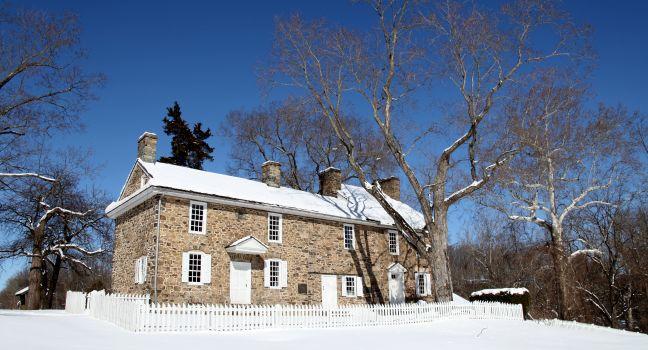
In 1861, pretzel maker Julius Sturgis opened America's first pretzel bakery. These days, the original site, a stone house on the National Register of Historic Places, operates guided tours and a hands-on lesson in pretzel twisting. An on-site bakeshop has souvenirs and fresh pretzels. Tours with lessons are by appointment only.
Library Hall
Old City
Share This
This 20th-century building is a reconstruction of Franklin's Library Company of Philadelphia, the first public library in the colonies. The American Philosophical Society, one of the country's leading institutions for the study of science, has its library here. The vaults contain such treasures as a copy of the Declaration of Independence handwritten by Thomas Jefferson, William Penn's 1701 Charter of Privileges, and journals from the Lewis and Clark expedition of 1803–06. The library's collection also includes first editions of Newton's Principia Mathematica, Franklin's Experiments and Observations, and Darwin's On the Origin of Species. The APS also offers a small, rotating exhibit of its rare books and manuscripts in the lobby of its first floor.
Old City Hall
Historic Area
Share This
Independence Hall is flanked by Congress Hall to the west and Old City Hall to the east: three distinctive Federal-style buildings erected to house the city's growing government. But when Philadelphia became the nation's capital in 1790, the just-completed city hall was lent to the federal government. It housed the U.S. Supreme Court from 1791 to 1800; John Jay was the Chief Justice. Later, the boxlike building with a peaked roof and cupola was used as the city hall. Today an exhibit presents information about the early days of the federal judiciary.
Second Bank of the United States
Old City
Share This
When Second Bank president Nicholas Biddle held a design competition for a new building, he required all architects to use the Greek style; William Strickland, one of the foremost architects of the 19th century, won. Built in 1824, the bank, with its Doric columns, was based on the design of the Parthenon and helped establish the popularity of Greek Revival architecture in the United States. The interior hall, though, was Roman, with a dramatic barrel-vault ceiling. Housed here are portraits of prominent Colonial Americans by noted artists such as Charles Willson Peale, William Rush, and Gilbert Stuart. Don't miss Peale's portraits of Jefferson and Lewis and Clark: the former is the only one that shows the third president with red hair, and the latter is the only known portrait of the famous explorers. The permanent exhibition, "The People of Independence," has a life-size wooden statue of George Washington by William Rush; a mural of Philadelphia in the 1830s by John A. Woodside Jr.; and the only known likeness of William Floyd, a lesser-known signer of the Declaration of Independence.
Subscribe to Newsletter
Sign up for Travel Tips & News
I want emails from Fodor's Travel with travel information and promotions. I can unsubscribe
any time using the unsubscribe link at the end of all emails.
Thank you for your interest!
Look out for our newsletters with travel tips and special offers.
Sign up for Travel Tips & News
By signing up for the
newsletter, I agree to the Privacy Policy. You must check the box to subscribe
Thank you for your interest!
Look out for our newsletters with travel tips and special offers.