Get FREE email communications from Fodor's Travel, covering must-see travel destinations, expert
trip planning advice, and travel inspiration to fuel your passion.
There are few American landmarks as moving as Gettysburg National Military Park, where General Robert E. Lee and his Confederate troops fought and lost to the Union forces of General George Meade from July 1 through 3, 1863. More than 1,300 mournful and inspiring markers and monuments honor the estimated 7,058 soldiers killed in the battle. Thirty-plus miles of marked roads lead through the 6,000-acre park to key battle sites; you can traverse them by driving, bicycling, or hiking yourelf or with a licensed guide, or via guided bus tours. In the first week of July, Civil War reenactors dress in period uniforms and costumes to commemorate the three-day battle.
Rittenhouse Square
Rittenhouse Square
Fodor's Choice
Share This
Aneta Waberska / Shutterstock
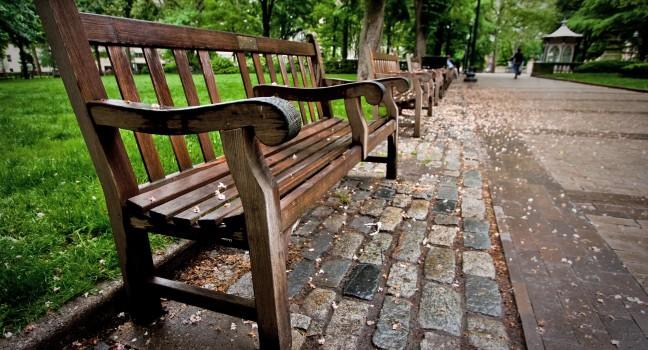
Once grazing ground for cows and sheep, Philadelphia's most elegant square is reminiscent of a Parisian park. One of William Penn's original five city squares, the park was named in 1825 to honor David Rittenhouse, 18th-century astronomer, clockmaker, and the first director of the United States Mint. Many of Philadelphia's celebrities have lived here. Extra paths were made for Dr. William White, a leader in beautifying the square, so he could walk directly from his home to the exclusive Rittenhouse Club across the square and lunch with author Henry James. Until 1950, town houses bordered the square, but they have now been replaced on three sides by luxury apartment buildings and hotels. Some great houses remain, including the former residence of Henry P. McIlhenny on the southwest corner. If you want to join the office workers who have lunch-hour picnics in the park, you can find many eateries along Walnut, Sansom, and Chestnut streets east of the square. Or you can dine alfresco at one of several upscale open-air cafés across from the square on 18th Street between Locust and Walnut. The term "Rittenhouse Row" describes the greater Rittenhouse Square area, bordered by Pine, Market, 21st, and Broad streets.
Valley Forge National Historical Park
Fodor's Choice
Share This
(c) Olivierl | Dreamstime.com
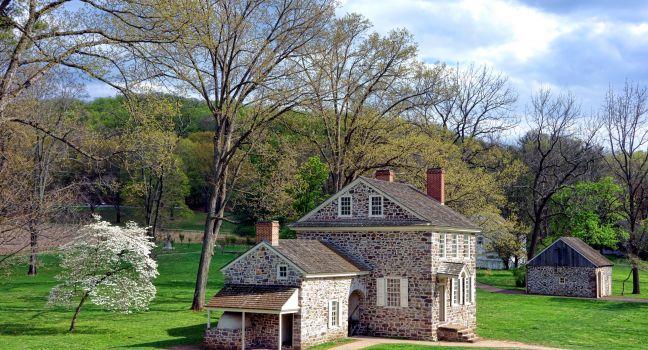
The 3,500-acre park is the location of the 1777–78 winter encampment of General George Washington and the Continental Army, where winter tested and proved the army's perseverance. Begin at the excellent Valley Forge Visitor Center for touring information and to explore displays of historical objects and immersive modern exhibits about the encampment and the men and women of all kinds who spent the winter here. The center also has an area with regional visitor information, an orientation film, and the Encampment Store. Take a nine-stop, 10-mile driving tour (free cell phone guide) or buy the audio guide ($8.95); or take a narrated trolley tour (limited times other than summer; reserve ahead) for $22. Call ahead if you want to hire a private tour guide. Stops include reconstructed log huts of the Muhlenberg Brigade and the National Memorial Arch, which pay tribute to the soldiers, and Washington's headquarters.
\n
In 1777 the army had just lost the nearby battles of Brandywine, White Horse, and Germantown, but Washington and his troops were actually encouraged (although exhausted), because they had fought the British well. While the British occupied Philadelphia, Washington's soldiers endured horrid conditions—blizzards, inadequate food and clothing, and disease. Although no battle was fought at Valley Forge, 2,000 soldiers (of about 12,000) died here. The troops did win the war of will, regaining strength under the leadership of Prussian drillmaster Friedrich von Steuben. In June 1778 Washington led his troops away from Valley Forge in search of the British.
\n
The park contains more than 35 miles of jogging and bicycling paths (bike rentals available in summer; call ahead) and hiking trails, and you can picnic in designated areas. A leisurely visit takes about half a day.
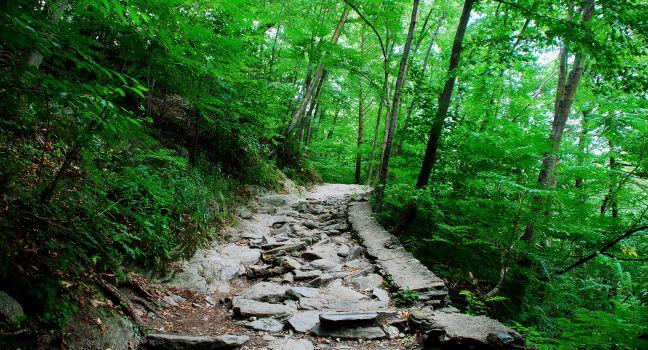
There are many great sections of Fairmount Park, but the 1,800 acres around Valley Green known as Wissahickon Valley Park may be the most stunning. Miles and miles of trails running along and above the river lead to covered bridges, a statue of a Lenape chief (rife with inaccuracies but created with good intentions), caves used by a 17th-century free-love cult, large boulders that drip water, and mallards quacking for bread bits. Forbidden Drive, on which cars are forbidden, runs from Northwestern Avenue (the westernmost part of Chestnut Hill) all the way to Lincoln Drive, where it connects to a bike and walking path that leads one way to Historic Rittenhouse Town (where you can also park and enter) and the other way to Manayunk and Kelly Drive, with additional bike/walking paths that take you to the city or out along the Schuylkill to Valley Forge. There are also many miles of surprisingly difficult mountain-bike trails. The Valley Green Inn is a very attractive restaurant with decent food at Forbidden Drive and Valley Green Road. Other recommended spots to hike to include Hudson and Andorra Meadows, Thomas Mill Covered Bridge, and Toleration Statue.
Delaware Canal State Park
Fodor's Choice
Share This
Completed in 1832 during America's great era of canal building, the 60-mile-long Delaware Canal runs from Bristol north to Easton, and today its towpath draws bicyclists and walkers who appreciate the scenic path with its canal and Delaware River views. It's easy to access the towpath in New Hope. In addition, the restored Locktender's House and Lock 11 (145 S. Main St.fodc.org Closed weekends Nov.–Apr.) explore how locks work and what daily life was like on the canal.
John Heinz National Wildlife Refuge at Tinicum
South Philadelphia
Fodor's Choice
Share This
Part of the appeal of this refuge is its truly strange location for a nature preserve: it's between the airport and an oil refinery, and visitors seem to really enjoy the oddity of it. More than 280 species of hawks, swallows, herons, egrets, geese, gallinules, eagles, orioles, ducks, and other birds have been spotted at this 1,200-acre preserve, the largest remaining freshwater tidal marsh in Pennsylvania. There are 10 miles of foot trails, an observation deck, and boardwalks through the wet areas. The refuge is also home to fox, deer, muskrat, turtles, and frogs, and you'll likely see large carp and catfish flopping about the lilies. An environmental education center has some explanatory exhibits on wetlands and regional wildlife. There are many guided tours. You can even canoe, kayak, and mountain bike, but there are no rentals here. Binoculars and fishing rods are available for loan, free of charge. The refuge is convenient to I–95, which you can pick up from Penn's Landing.
Kelly Drive
Fairmount Park
Fodor's Choice
Share This
One of the city's most scenic byways for a drive, woodsy Kelly Drive also has a popular walking, running, and biking path that parallels the road as it stretches more than 4 miles along the eastern side of the Schuylkill River from behind the Philadelphia Art Museum to City Avenue. You can make an almost 9-mile loop on bike or foot by crossing Falls Bridge and returning on the path parallel to the west side's Martin Luther King, Jr. Drive. MLK Drive closes to cars on weekends late March–November and has great Boathouse Row views. (The MLK Bridge has ongoing construction so check ahead to see if it's open.)
Sights, as well as river views, can distract you as you head north from the museum: Boathouse Row (rent a bike at Wheel Fun Rentals by Lloyd Hall); the Ellen Phillips Samuel Memorial Sculpture Garden with 17 statues on three terraces (and other park artworks; see associationforpublicart.org/tours), and nearby Laurel Hill Cemetery. Kelly Drive is named for John B. Kelly Jr., a city councilman and Olympic rower who was the brother of actress Grace Kelly. Parts of Kelly Drive sometimes close to cars for events, mostly on weekends, including rowing regattas (fun to watch; schedule on boathouserow.org) on the Schuylkill, mostly spring through fall.
Lancaster Central Market
Fodor's Choice
Share This
Built in 1889, this indoor farmers' market gave a new home to the city's original open-air market, in operation since 1742. The grand Romanesque building is a city fixture as a place to shop for fresh produce, meat, flowers and baked goods, most of it from the county's farms. In addition to Amish and Mennonite staples like Lebanon bologna and chowchow, there are stalls selling globally inspired prepared foods, from pierogis to Puerto Rican empanadas. It's open 6 am--3 pm on market days (Tuesday, Friday, and Saturday).
Arthur Ross Gallery
University City
Share This
Penn's official art gallery contains treasures from the university's collections—especially prints and drawings—and special exhibitions that have had a modern/contemporary bent in recent years. The gallery shares its historical-landmark building, designed by Frank Furness, with the Fisher Fine Arts Library.
Belmont Plateau
Fairmount Park
Share This
Literally the high point of a visit to Fairmount Park, the plateau has a stunning view from 243 feet above river level that takes in sweeping park vistas, recreation areas, and, 4 miles away, the Philadelphia skyline. This area is busy on weekends but may be empty during the week, depending on the weather. The large Palladian house on the plateau, Belmont Mansion, dates to 1745 and is an event space. It's also home to the small, rather dated but moving Underground Railroad Museum at Belmont Mansion (belmontmansion.org 215/878–8844 or 267/736–0007 $15 closed Fri.–Wed.), which has an introductory room with panels of historical information to read and some artifacts, a film with information about the Underground Railroad and the mansion's role as a stop on it, and additional displays seen on a tour in some of the mansion's rooms.
Benjamin Franklin Bridge
Old City
Share This
When the bridge opened in 1926, its 1,750-foot main span made it the longest suspension bridge in the world. Paul Cret, architect of the Rodin Museum, was the designer. The bridge, which crosses the Delaware River, is mainly used by cars and the PATCO commuter train, which has several stops in Center City and South Jersey. The bridge is most impressive when it's lit at night. Start the 1¾-mile walk (one way) from either the Philadelphia side, two blocks north of the U.S. Mint, or the Camden, New Jersey, side, where there are metered parking lots. Enjoy stunning city views along the way, but know it's best to walk across on mornings or cooler days, as there's no shade.
Carpenters' Hall
Old City
Share This
This handsome, patterned red-and-black brick building dating from 1770 was the headquarters of the Carpenters' Company, a guild founded to support carpenters, who were both builders and architects in this era, and to aid their families. In September 1774 the First Continental Congress convened here and addressed a declaration of rights and grievances to King George III. The year 2024 marked the 300th anniversary of the Carpenters' Company and the 250th anniversary of the First Continental Congress. The Carpenters' Company still owns and operates the building. Today re-creations of Colonial settings include original Windsor chairs and candle sconces and displays of 18th-century carpentry tools.
Cathedral Basilica of Saints Peter and Paul
Parkway Museum District
Share This
The basilica of the archdiocese of Philadelphia is the spiritual center for the Philadelphia area's 1½ million Roman Catholics. Topped by a huge, distinctive copper dome, the large brownstone building was built between 1846 and 1864 in the Italian Renaissance style. Many of the interior decorations are by Constantino Brumidi, who painted the dome of the U.S. Capitol. Several Philadelphia bishops and archbishops are buried beneath the altar. Pick up a brochure for a self-guided tour by the entrance or gift shop, or see the website.
Cherry Street Pier
Penn's Landing
Share This
Spread out across 55,000 square feet, the multiuse Cherry Street Pier is among the newer gems of Philadelphia’s slow but gradual Delaware River revitalization efforts. It's a great place to explore and soak in views of the Ben Franklin Bridge, waterfront scenery, and beyond, especially during the warmer months. It's free to walk around, but there's plenty to purchase here, as it's home to artists’ studios, artisan craft fairs, and continually changing exhibits throughout the versatile space. There's a diversity of snacks, too. Popular concessions include a variety of sweets, local brews, and comfort foods.
Chinatown Friendship Arch
Chinatown
Share This
Conceptualized by the late Sabrina Soong, a Chinese-American architect/artist and Philadelphia resident, the 40-foot-tall, 88-ton “China Gate” has welcomed visitors to historic Chinatown since its introduction in 1984. Designed in a manner reminiscent of China’s Qing dynasty, it features materials and cultural flourishes fabricated by artisans from Philadelphia’s sister city of Tianjin, China. The Chinese characters emblazoned on the “Friendship Arch” translate simply to “Philadelphia Chinatown,” a paean to the neighborhood’s historic importance and resilience.
Congress Hall
Old City
Share This
Congress Hall was the meeting place of the U.S. Congress from 1790 to 1800, one of the most important decades in our nation's history. Here the Bill of Rights was added to the Constitution; Alexander Hamilton's proposals for a mint and a national bank were enacted; and Vermont, Kentucky, and Tennessee became the first new states after the original colonies. On the first floor you can find the House of Representatives, where President John Adams was inaugurated in 1797. On the second floor is the Senate chamber, where in 1793 George Washington was inaugurated for his second term. Both chambers have been authentically restored.
Delancey Place
Rittenhouse Square
Share This
Cypress Street, north of Delancey Place, and Panama Street (especially the 1900 block, one block south of Delancey) are two of the many intimate streets lined with trees and town houses characteristic of the area. At No. 2010 is the Rosenbach Museum and Library.
Eisenhower National Historic Site
Share This
The farm residence of President Dwight D. Eisenhower, who bought it in 1950, was a weekend retreat and a meeting place for world leaders. The property adjoins the battlefield and the brick-and-stone farmhouse is preserved in 1950s style. Free home tours are conducted Thursday through Sunday, and seasonal walking tours of the farm are offered once a week.
Fairmount Water Works Interpretive Center
Fairmount Park
Share This
Designed by Frederick Graff to look like a country estate, this National Historic Landmark completed in 1815 was the country's first steam-pumping station of its kind, and the assemblage of Greek Revival buildings is one of the city's most beautiful sights. The waterworks, down the hill behind the Philadelphia Art Museum, include a small interpretive center with historical features such as an 1851 turbine and family-friendly exhibits about the region's water and wildlife. A short film on the site's history, a mussel hatchery (seasonal progagation Mar.–Aug.), and changing exhibits are other attractions. Nearby paths provide good views of the waterworks.
Franklin Delano Roosevelt Park
South Philadelphia
Share This
Frederick Law Olmsted is best known as the designer of New York’s Central Park, and his sons followed in their father’s footsteps in founding the Olmsted Brothers firm, which created this high-profile park in deep South Philly. Originally called League Island Park, when it was designed in the decade leading up to the 1926 Sesquicentennial Exposition, it’s now colloquially known as “The Lakes” for its network of channels and lagoons. The park contains numerous historical structures, including a soaring granite gazebo ringed in Doric columns, the dramatically arched boathouse, and the castlelike American Swedish Historical Museum. April through October, it's also home to the Southeast Asian Market ( www.fdrseamarket.com), where talented cooks from Cambodia, Laos, Thailand, Vietnam, and more cook street food from their cultures' cuisines.
Free Quaker Meeting House
Old City
Share This
This was the house of worship for the Free "Fighting" Quakers, a group that broke away from the Society of Friends to support the cause against the British during the Revolutionary War. The building was designed in 1783 by Samuel Wetherill, one of the original leaders of the group, after they were disowned by their pacifist flock. Among the 100 members were Betsy Ross and Timothy Matlack, colonel in Washington's Army and assistant secretary of the Continental Congress. After the Free Quaker group dissolved, the building was used as a school, library, and warehouse. The meetinghouse, built in the Quaker plain style with a brick front and gable roof, has been carefully restored. No tickets are required, but call Independence National Historical Park to check on availability.
Gettysburg National Cemetery
Share This
Also known as Soldiers' National Cemetery, this is the final resting place for more than 3,500 Union soldiers who died on the battlefield. Dedicated by President Abraham Lincoln in his Gettysburg Address, the cemetery is also where some 3,000 veterans of subsequent conflicts were laid to rest. A stroll through the beautiful grounds past row after row of white grave markers is a sobering reminder of the cost of war.
Laurel Hill Cemetery
Fairmount Park
Share This
John Notman, architect of the Athenaeum and other noted local buildings, designed Laurel Hill's eastern section in 1836; it is an important example of an early rural burial ground and the first cemetery in America designed by an architect. The striking, hilly location overlooking the Schuylkill River, rare trees, and impressive monuments and mausoleums made it a popular picnic spot in the 19th century, and today it is an accredited arboretum as well as a cemetery. The 78-acre eastern necropolis in Philadelphia has a visitor center and exhibition space at the Ridge Avenue entrance. It's a tranquil place to stroll or bike, take a guided thematic tour on history or nature (fee; see website for all programs), or download an app for a self-guided tour. Among the notables buried here or in the 200-acre western section in suburban Bala Cynwood (opened in 1869 across the river) are General George Meade and 39 other Civil War–era generals. Burials still take place, so visit respectfully.
Logan Circle
Parkway Museum District
Share This
The focal point of Logan Circle, one of the city's gems, is the Swann Memorial Fountain of 1920, designed by Alexander Stirling Calder, son of Alexander Milne Calder, who created the William Penn statue atop City Hall. You can find works by a third generation of the family, modern sculptor Alexander Calder (1898–1976), the mobile- and stabile-maker, in the nearby Philadelphia Art Museum and in Calder Gardens (opened 2025). The main figures in the fountain, three Native American figures in the form of river gods, symbolize Philadelphia's leading waterways: the Delaware and Schuylkill rivers and Wissahickon Creek. One of William Penn's five squares, Logan Circle was originally a graveyard and execution grounds. In 1825, the square was named for James Logan, Penn's secretary and a mayor of Philadelphia; in the 20th century it became a traffic circle.
LOVE Park
Parkway Museum District
Share This
Also known as John F. Kennedy Plaza, LOVE Park at the start of the Parkway is the place to get your photo with LOVE, Robert Indiana's iconic red sculpture, although you may need to wait in line to do so. The 6-foot sculpture, standing atop a 7-foot base, was placed in this area for the City of Brotherly Love's Bicentennial celebrations in 1976. (Another iteration of the sculpture is on the University of Pennsylvania campus.) Today the plaza has green spaces and seating, a fountain, views of City Hall and the Parkway, and the LOVE Park Visitor Center kiosk. It serves as the site of civic happenings like the Christmas Village Market, too. The southwest corner has a flying saucer–like building (a former visitor center) that is not in use at this writing.
Mount Hope Estate & Winery
Share This
Stop in at the winery's tasting room to sniff, sip, and savor the Pinot Noir, Zinfandel, and other wines produced at the northern edge of Lancaster County. Fruit wines (elderberry, plum, and others) are a specialty, and mead is another. The centerpiece of the estate is the curious Federal-Victorian mansion and its formal gardens, flanked by medieval-style crenelated towers. Also on the grounds are the winery's Swashbuckler Brewing Company, Spirits Distilling Company, and Lancaster County Cider, so most every category of adult beverage can be had here. Each summer the estate hosts the Pennsylvania Renaissance Faire.
New Hall Military Museum
Old City
Share This
When it was originally built in 1791, this building housed the U.S. Department of War. Today’s reconstruction outlines early American military history and the formation of the Army, Navy, and Marine Corps. On display are Revolutionary uniforms, medals, and authentic weapons, including powder horns, swords, and a blunderbuss. Dioramas depict highlights from the Revolutionary War through the late 18th century, and there are several scale models of warships and frigates as well. This museum is typically open for special events and occasions only.
Old City Hall
Historic Area
Share This
Independence Hall is flanked by Congress Hall to the west and Old City Hall to the east: three distinctive Federal-style buildings erected to house the city's growing government. But when Philadelphia became the nation's capital in 1790, the just-completed city hall was lent to the federal government. It housed the U.S. Supreme Court from 1791 to 1800; John Jay was the Chief Justice. Later, the boxlike building with a peaked roof and cupola was used as the city hall. Today an exhibit presents information about the early days of the federal judiciary.
Parkway Central Library
Parkway Museum District
Share This
In Philadelphia's main public library building, the grand entrance hall, marble staircase, and enormous reading rooms make the 1927 Greek Revival building look the way libraries should, but it also serves people with facilities such as an area for community gatherings and a Culinary Literacy Center with a kitchen. The children's department houses the city's largest collection of children's books in a made-for-kids setting, and there's a special area for teens. The rare-book department is a beautiful suite of rooms with first editions of Dickens, ancient Sumerian clay tablets, and medieval and other manuscripts, including the only known handwritten copy of Poe's "The Raven." Also here is a taxidermied Grip, Dickens's pet raven. Another treasure, the Edwin S. Fleisher Collection (visitors welcome, but researchers must make appointments), has more than 22,000 circulating orchestral performance sets (a full score and other parts) and is the largest of its kind in the world. Check the website for events such as author readings, timely special exhibits, and tours of parts of the library.
Penn Park
University City
Share This
This 24-acre park stretches along the western side of the Schuylkill River and is managed by the University of Pennsylvania. The park has natural grass and turf playing fields, 12 tennis courts for public use, and bike and walking trails; its most striking feature is an elevated walk offering pedestrians panoramic views of the Philadelphia skyline. A friendly culture of pickup soccer exists here on the weekends, with small nets to accommodate games.
Subscribe to Newsletter
Sign up for Travel Tips & News
I want emails from Fodor's Travel with travel information and promotions. I can unsubscribe
any time using the unsubscribe link at the end of all emails.
Thank you for your interest!
Look out for our newsletters with travel tips and special offers.
Sign up for Travel Tips & News
By signing up for the
newsletter, I agree to the Privacy Policy. You must check the box to subscribe
Thank you for your interest!
Look out for our newsletters with travel tips and special offers.