


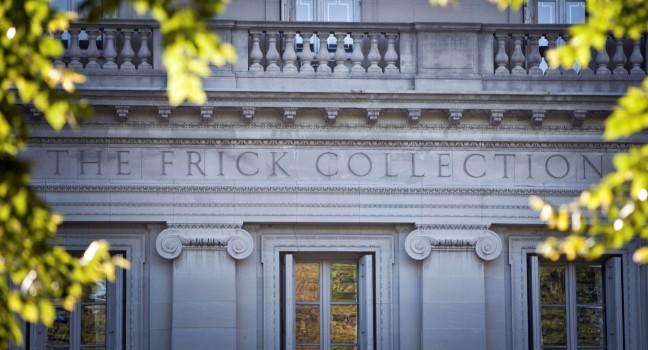
The Frick Collection
Get FREE email communications from Fodor's Travel, covering must-see travel destinations, expert trip planning advice, and travel inspiration to fuel your passion.

We've compiled the best of the best in Upper East Side - browse our top choices for the top things to see or do during your stay.

Wright's superior design was criticized by some who believed that the distinctive building detracted from the art, but the spiraling layout allows artwork to be viewed from different angles and distances. On permanent display, the museum's Thannhauser Collection is made up primarily of works by French Impressionists and Postimpressionists Van Gogh, Degas, Picasso, and Manet. Escape the crowded lobby by taking the elevator to the top and working your way down the spiral. The Cafe Rebay offers snacks, salads, and sandwiches, while the gift shop is near the museum's exit.
The 19th-, 20th-, and 21st-century, museum-quality art inside this five-story, marble-floored French neoclassical town house tends to be big-name stuff from the Impressionism, Post-impressionism, Cubism and Surrealism movements. The gallery showcases works from well-known artists, including Pablo Picasso, Amedeo Modigliani, Claude Monet, Edgar Degas, Jean-Michel Basquiat, and Andy Warhol. It's best to check the website of this third-generation, family-owned gallery for individual exhibit hours, which can vary.
The Asian art collection of Mr. and Mrs. John D. Rockefeller III forms the core of this museum's holdings, with artworks and artifacts dating as far back as the 11th century BCE. A growing contemporary collection features video, animation, photography, and new media art by artists from Asia and the Americas. Founded in 1956, the society has a regular program of panel discussions, film screenings, family events, and performances, in addition to changing on-loan exhibitions of traditional and contemporary art. Trees and flowering vines grow within the glass-enclosed, skylighted Leo Café, whose menu reflects the diversity of Asian cuisine. The AsiaStore carries the best in Asian design and literature. Docent tours are offered regularly; a schedule is posted on the museum's website.
Named for a German immigrant who was a prominent statesman and newspaper editor in the 19th century, this 14.9-acre park is so tranquil that you'd never guess you're directly above the FDR Drive. Walk along the esplanade and soak up views of the East River and Roosevelt Island across the way. To the north is Randalls (which is conjoined with Wards Island on the east side) and the Robert F. Kennedy Bridge (formerly the Triborough Bridge)—while the sights of locals pushing strollers, riding bikes, or walking their dogs surround visitors. Within the park is a Federal-style, wood-frame house that belies the grandeur of its name: Gracie Mansion, the official residence of the city's mayor. It was built in the 18th century.
One of the most influential art dealers of the 20th century, Leo Castelli helped foster the careers of many important artists, including one of his first discoveries, Jasper Johns. Castelli died in 1999, but the gallery continues to show works by Roy Lichtenstein, Ed Ruscha, Frank Stella, Robert Morris, and other heavy hitters. There's a satellite gallery in the Times Square area.
El barrio, Spanish for "the neighborhood," is the nickname for East Harlem, a largely Spanish-speaking community; the museum, on the edge of this neighborhood, focuses on Latin American, Latino, and Caribbean art. Founded in 1969, the museum's permanent collection of more than 8,500 objects is highlighted through evolving themes, including women, African and Indigenous artists, Latinx representation and more. Art and crafts from Latin America are prominent. One highlight is the over 300 santos, carved wooden folk-art figures from Puerto Rico. El Teatro, formerly the Heckscher Children's Theater, has stunning 30-foot murals and stained-glass roundels. The museum's events include lectures, films, festivals and parties for Latin and Caribbean holidays, including a Three Kings Day parade.
Designed by Louis Kahn, this triangular-shaped park, at Roosevelt Island's southernmost tip, is a public memorial to FDR and honors his 1941 State of the Union address emphasizing the universal freedoms of speech, worship, and freedom from want and fear. A large stone inscribed with this portion of his speech and a bronze bust of the president by sculptor Jo Davidson are on view here. Venture up a 100-foot-wide staircase or along the linden-tree aligned paved walkways going toward a three-sided open-air chamber. Here, the skyline views of Manhattan and Queens's Long Island City neighborhood are rewardingly photogenic.
If you are looking for ambitious works by the world's most acclaimed artists in a gallery that easily competes with the city's top museums, you have to visit Gagosian. Perhaps the most powerful art dealer in the world, Larry Gagosian has galleries in Beverly Hills, London, Paris, Rome, Athens, and Hong Kong, among other cities, as well as multiple galleries in New York City. The 980 Madison Avenue location, the contemporary art empire's headquarters, is a multifloor gallery that has shown works by big names like Andy Warhol, Jackson Pollock, Pablo Picasso, Roy Lichtenstein, Cy Twombly, and Damien Hirst.
Located in Roosevelt Island Lighthouse Park, this intriguing and monumental sculpture honors Nelly Bly, the journalist who exposed the horrors of the island's Women’s Lunatic Asylum by going undercover as a patient. Simultaneously, it spotlights women who have endured—and overcome—hardship. Shown as sections of faces in silver for Bly, and bronze for the others, the pieces represent being both broken and repaired. Also on-site, just behind the sculpture, is the Roosevelt Island Lighthouse. The stone structure was built by the New York City government in 1872. It is on the National Register of Historic Places and is also a New York City Landmark.
This mezzanine-level gallery represents some lofty artists. In addition to tapestries by modern masters like Joan Miró, Sonia Delaunay, and Alexander Calder, this gallery's specialties include works by late-19th- and early-20th-century modern artists like Fernand Leger and Marc Chagall. It is also one of the first gallery dealers for Pablo Picasso's ceramics in the United States. There's also an exhibition space in the neighborhood at 330 East 59th Street. Check the website for seasonal hours.
Founded in 1901, the Society of Illustrators holds many events and programs at this former town house--turned-museum. There are eclectic exhibitions on comics, science fiction, fashion, animation and 3-D, and historic illustrations from the permanent collection of 2,500 pieces, including the holdings of the Museum of Comic and Cartoon Art (MoCCA). In addition, there are lectures, costumed sketch nights and more. On the third floor, order a drink from the 128 Bar, which sports Norman Rockwell's "The Dover Coach," a large-scale oil painting for the Saturday Evening Post that was donated by the illustrator himself.
Run by the Roosevelt Island Visual Arts Association, this gallery helps to promote works by its 30 artist members through group and solo exhibitions, and other programming. Along with this gallery, the RIVAA manages another exhibition space, the Octagon Gallery within the Octagon Building, once the entrance of a hospital that's now part of an apartment complex. The latter spot features art by both RIVAA members and international guest contributors—including painters, sculptors, photographers, computer artists, graphic designers, ceramists, and installation artists.
Located in Southpoint Park, right before the entrance to Four Freedoms Park, this fenced-off, ivy-covered ruin was an 1856 smallpox hospital that was in operation during the island's time as Blackwell's Island. While this city landmark is off-limits, informative placards on the site tell much about the building's history and design by James Renwick Jr., whose resume includes the Smithsonian Institute in Washington, D.C. The hospital ruins are listed on the National Register of Historic Places. If you're in a taxi on the FDR Drive across the river, you'll notice the ruins are floodlit at night, creating an eerie spectacle from afar. While in this area, also see the FDR Hope Memorial, a bronze sculpture depicting Roosevelt in his wheelchair, greeting a young girl wearing leg braces.
The gallery, located in a historic town house on a tree-lined street, features a vast collection of works by contemporary artists from the era of World War II up to the present. Van Doren Waxter represents Caetano de Almeida, Marsha Cottrell, and Farid Haddad, among other artists, while handling secondary market work by Georgia O'Keeffe, Lee Krasner, Roy Lichtenstein, and other revered names.


