2 Best Sights in Big Island, Hawaii

Background Illustration for Sights

Nicknamed "The Big Island," Hawaii Island is a microcosm of Hawaii the state. From long white-sand beaches and crystal-clear bays to rain forests, waterfalls, valleys, exotic flowers, and birds, all things quintessentially Hawaii are well represented here.

An assortment of happy surprises also distinguishes the Big Island from the rest of Hawaii—an active volcano (Kilauea) oozing red lava and creating new earth every day, the clearest place in the world to view stars in the night sky (Maunakea), and some seriously good coffee from the famous Kona district, and also from neighboring Kau.

Home to eight of the world’s 13 sub-climate zones, this is the land of fire (thanks to active Kilauea volcano) and ice (compliments of not-so-active Maunakea, topped with snow and expensive telescopes). At just under a million years old, Hawaii is the youngest of the main Hawaiian Islands. Three of its five volcanoes are considered active: Mauna Loa, Hualalai, and Kilauea. The Southeast Rift Zone of Kilauea has been spewing lava regularly since January 3, 1983; another eruption began at Kilauea's summit caldera in March 2008, the first since 1982. Back in 1984, Mauna Loa's eruptions crept almost to Hilo, and it could fire up again any minute—or not for years. Hualalai last erupted in 1801, and geologists say it will definitely do so again within 100 years. Maunakea is currently considered dormant but may very well erupt again. Kohala, which last erupted some 120,000 years ago, is inactive, but on volatile Hawaii Island, you can never be sure.

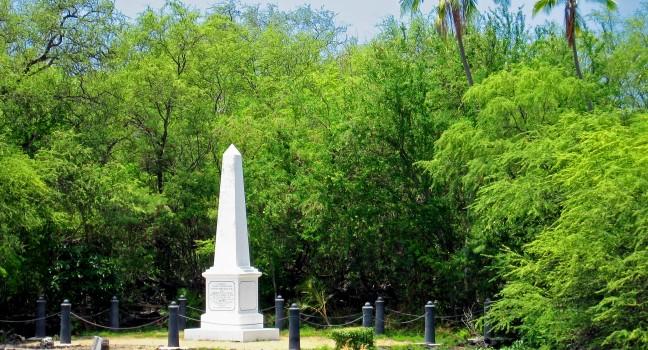
Captain James Cook Monument
Fodor's Choice
Captain Cook's Monument, Big Island, Hawaii
Captain Cook's Monument by

On February 14, 1779, famed English explorer Captain James Cook was killed here during an apparent misunderstanding with local residents, and this 27-foot-high obelisk marks the spot where he died. He had chosen Kealakekua Bay as a landing place in November 1778. Arriving during the celebration of Makahiki, the harvest season, Cook was welcomed at first. Some Hawaiians saw him as an incarnation of the god Lono. Cook's party sailed away in February 1779, but a freak storm forced his damaged ship back to Kealakekua Bay. Believing that no god could be thwarted by a mere rainstorm, the Hawaiians were not so welcoming this time. The theft of a longboat brought Cook and an armed party ashore to reclaim it. Shots were fired, daggers and spears were thrown, and Cook fell, mortally wounded. 

A trail leading to the site is accessible from the top of Napoopoo Road, but caution is advised. The very strenuous trail gains an elevation of about 1,500 feet and is recommended for advanced hikers only.

Captain Cook, HI, 96704, USA

Something incorrect in this review?

King Kamehameha Statue

A statue of Kamehameha the Great, the famous king who united the Hawaiian Islands in the early 19th century, stands watch over his descendants in North Kohala. The 8½-foot-tall figure wears the king's sacred feather kihei, mahiole, and kaei (cape, helmet, and sash). This is actually the original of the statue fronting the Judiciary Building on King Street in Honolulu. Cast in Florence in 1880, it was lost at sea. A replica was commissioned and shipped to Honolulu, but the original statue was later found in a Falklands Island junkyard. It now stands in front of the old Kohala Courthouse in Kapaau, next to the highway on the way toward Pololu Valley. Every year on King Kamehameha Day (June 11), Kohala residents honor their most famous son with a celebration that involves a parade and draping the statue in dozens of handmade floral lei.

54-3900 Kapaau Rd., Kapaau, HI, 96755, USA

Something incorrect in this review?