190 Best Sights in Quebec, Canada

Background Illustration for Sights

We've compiled the best of the best in Quebec - browse our top choices for the top things to see or do during your stay.

Basilique Notre-Dame-de-Montréal
Fodor's Choice
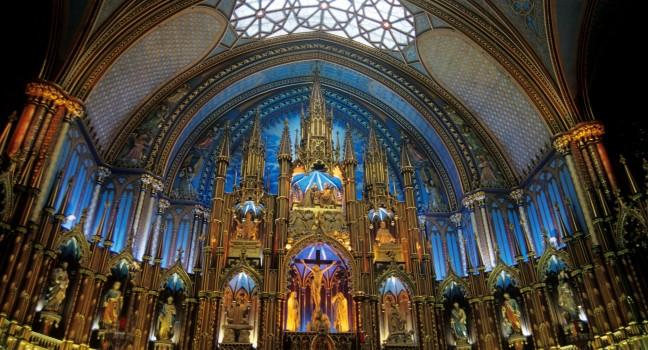
Montreal Notre-Dame Basilica Sunshine on the altar of Montreal
Peter Guttman/PeterGuttmann.com

Few churches in North America are as wow-inducing as Notre-Dame. Everything about the Gothic Revival–style church, which opened in 1829, seems designed to make you gasp—from the 228-foot twin towers out front to the tens of thousands of 24-karat gold stars that stud the soaring blue ceiling.

Nothing in a city renowned for churches matches Notre-Dame for sheer grandeur—or noisemaking capacity: its 12-ton brass bell is the largest in North America, and its 7,000-pipe Casavant organ can make the walls tremble. The pulpit is a work of art in itself, with an intricately curving staircase and fierce figures of Ezekiel and Jeremiah crouching at its base. The whole place is so overwhelming it's easy to miss such lesser features as the stained-glass windows from Limoges and the side altars dedicated to St. Marguerite d'Youville, Canada's first native-born saint; St. Marguerite Bourgeoys, Canada's first schoolteacher; and a group of Sulpician priests martyred in Paris during the French Revolution.

For a peek at the magnificent baptistery, decorated with frescoes by Ozias Leduc, you'll have to tiptoe through the glassed-off prayer room in the northwest corner of the church. Every year dozens of brides—including Céline Dion, in 1994—march up the aisle of Chapelle Notre-Dame-du-Sacré-Coeur (Our Lady of the Sacred Heart Chapel), behind the main altar, to exchange vows with their grooms before a huge modern bronze sculpture that you either love or hate.

Notre-Dame is an active house of worship, so dress accordingly. The chapel can't be viewed weekdays during the 12:15 pm mass, and is often closed Saturday for weddings. Don't miss the 45-minute multimedia spectacle, Aura, which celebrates the basilica's exquisite features through light and sound. See website for schedule ( www.aurabasiliquemontreal.com/en).  The basilica has been under major restoration since 2020 and is not expected to be complete until 2040. Be prepared to see scaffolding at the very least.
110 rue Notre-Dame Ouest, H2Y 1T1, Canada
514-842–2925
Sight Details
Self-guided tour C$16; multimedia show Aura from C$37
Purchase tickets online

Something incorrect in this review?

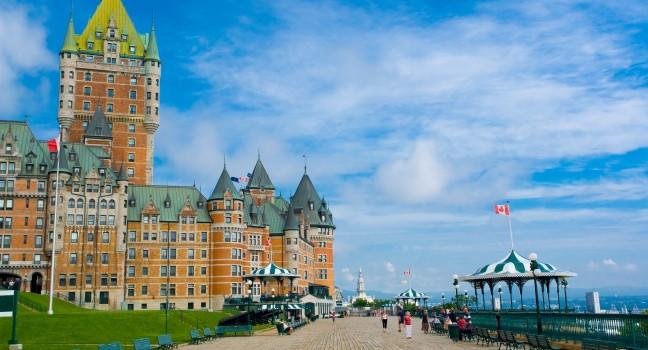
Fairmont Le Château Frontenac

Upper Town Fodor's Choice
Chateau Frontenac, best known landmark of Quebec, Canada
Asier Villafranca/Shutterstock

Québec City’s most photographed landmark, the Château Frontenac, commands the skyline above the St. Lawrence River, proudly reigning as the city’s crown jewel. Built in 1893 to attract luxury rail travelers, it belongs to a distinguished series of opulent château-style hotels commissioned across Canada. New York architect Bruce Price designed the hotel to impress, outfitting it with marble fixtures, cozy fireplaces in every room, and carefully selected antiques—luxuries unmatched at the time. The site once housed the residence of colonial governors Samuel de Champlain and the Comte de Frontenac, whose name the hotel proudly bears. The addition of a 20-story tower in 1924 finalized its iconic silhouette. Since then, Le Château, as locals call it, has hosted royalty—including Prince William and Kate Middleton, Queen Elizabeth II, and Princess Grace of Monaco—alongside Hollywood legends and world leaders. During WWII, Roosevelt and Churchill met here twice for wartime conferences, sealing the hotel’s legacy at the crossroads of history and glamour.

While the hotel itself doesn't offer guided tours, you can still dive deep into its storied past! Québec Cicerone Tours provides an exceptional experience, with guides in period costumes bringing legends to life within this historic landmark. Tours cost C$24 per adult and C$12 per child.

Jardin Botanique

Fodor's Choice
HDR image of the Chinese Garden of the Montreal Botanical Gardens.
Andre Nantel / Shutterstock

Creating one of the world's great botanical gardens in a city with a winter as harsh as Montréal's was no mean feat, and the result is that no matter how brutal it gets in January there's one corner of the city where it's always summer. With 181 acres of plantings in summer and 10 greenhouses open all year, Montréal's Jardin Botanique is the second-largest attraction of its kind in the world (after England's Kew Gardens). It grows more than 26,000 species of plants, and among its 30 thematic gardens are a rose garden, an alpine garden, and—a favorite with the kids—a poisonous-plant garden.

You can attend traditional tea ceremonies in the Japanese Garden, which has one of the best bonsai collections in the West, or wander among the native birches and maples of the Jardin des Premières-Nations (First Nations Garden). The Jardin de Chine (Chinese Garden), with its pagoda and waterfall, will transport you to the Ming dynasty. In the fall, all three cultural gardens host magical mixes of light, color, plant life, and sculpture during the annual Gardens of Light spectacle.

4101 rue Sherbrooke Est, H1X 2B2, Canada
514-868--3000
Sight Details
C$23.75
Closed Mon., except during summer and holiday season

Something incorrect in this review?

Recommended Fodor's Video

La Citadelle de Québec

Upper Town Fodor's Choice
A member of the Canadian Royal 22nd Regiment stands guard at the gates to the Citadel in Old Quebec City, Quebec, Canada.
Gary Blakeley / Shutterstock

Perched atop Cap Diamant, the city's highest point, the Citadelle stands as North America's largest fortified base still actively occupied by troops. This 25-building fortress is, quite literally, the star of the Fortifications of Québec National Historic Site. Its strategic purpose was clear: protect the port, prevent enemy advancements on the Plains of Abraham, and offer refuge during an attack. Since 1920, the Citadelle has been home to Canada's most storied French-speaking military formation, the Royal 22nd Regiment. Their history is proudly displayed in the museum, located in a former powder magazine built in 1750, showcasing firearms, uniforms, and decorations dating back to the 17th century. Every summer morning, visitors can catch the troops' impressive 30-minute concert, with soldiers clad in military crimson coats and black fur hats, all under the watchful eye of the regiment's well-behaved goat mascot. Due to its status as an operational military base, all visits to the Citadelle are exclusively guided.  Its prime location, perched high above the St. Lawrence River with stunning city views, makes it worth a visit even if you opt not to take a tour.

Musée d'Archéologie et d'Histoire Pointe-à-Callière (PAC)

Fodor's Choice
Musee d'Archeologie et d'Histoire Pointe-a-Calliere
Pointe-à-Callière by Jonathan Feinberg

A modern glass edifice built on the site of Montréal's first European settlement, the PAC impresses. The museum presents new local and international temporary exhibitions each year, but the real reason to visit the city's most ambitious archaeological museum is to take the elevator ride down to the 17th century.

It's dark down there, and just a little creepy thanks to the 350-year-old tombstones teetering in the gloom, but it's worth the trip. This is a serious archaeological dig that takes you to the very foundations of the city. A more lighthearted exhibit explores life and love in multicultural Montréal. For a spectacular view of the Old Port, the St. Lawrence River, and the Islands, ride the elevator to the top of the tower, or stop for lunch in the museum's glass-fronted bistro. In summer there are re-creations of period fairs and festivals on the grounds near the museum.

The Fort Ville-Marie pavilion showcases the remains of the forts and artifacts from the first Montrealers. The 360-foot underground William collector sewer, North America's first collector sewer built in the 1830s and considered a masterpiece of civil engineering at the time, connects the original museum space with the new pavilion and features a sound-and-light show projected onto the walls of the collector sewer.

Musée des Beaux-Arts de Montréal

Fodor's Choice
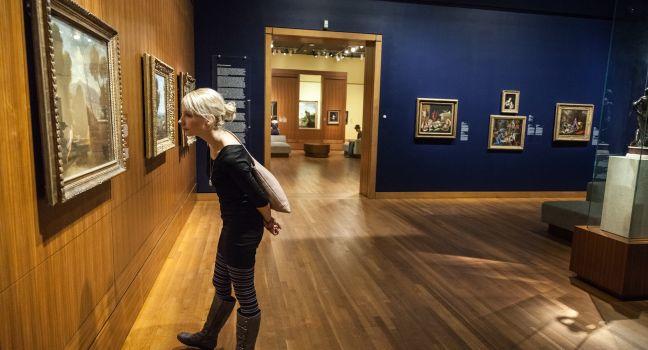
Montreal, Canada, Feb 22 2014 - Montreal Fine Arts Museum Room with Paintings on the wall and Young Adult looking at it.
Benoit Daoust / Shutterstock

Not surprisingly, Canada's oldest museum--and one of its most important institutions for the arts--has one of the finest collections of Canadian art anywhere. The works of such luminaries as Paul Kane, the Group of Seven, Paul-Émile Borduas, and Marc-Aurèle Fortin are displayed here in the Bourgie Pavilion, a space built onto the back of the neoclassical Erskine and American United Church, one of the city's most historic Protestant churches. The nave has been preserved as a meeting place and exhibition hall and also displays the church's 18 Tiffany stained-glass windows, the biggest collection of Tiffany's work outside the United States. The rest of the museum's permanent collection, which includes works by everyone from Rembrandt to Renoir, is housed in its four other pavilions: the neoclassical Hornstein Pavilion; the modernist 1970s Stewart Pavilion; the glittering, glass-fronted Desmarais Pavilion; and the cantilevered glass and aluminum Hornstein Pavilion for Peace, which looks like an illuminated paper lantern at night. All of the pavilions are linked by tunnels. Admission is half-price from 5 to 9 pm Wednesday.

1380 rue Sherbrooke Ouest, H3G 1J5, Canada
514-285–2000
Sight Details
C$31; half-price Wed. after 5 pm
Closed Mon.

Something incorrect in this review?

Parc Jean-Drapeau

Fodor's Choice
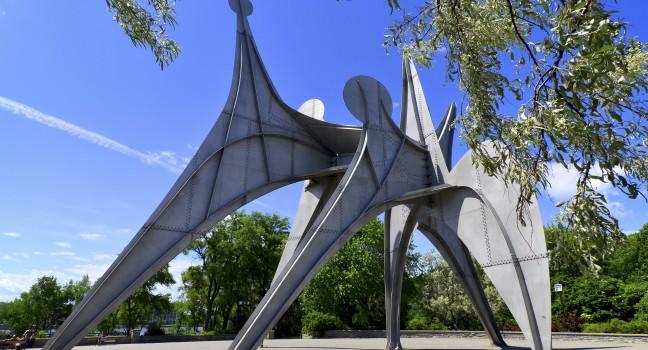
MONTREAL, CANADA - JUNE 19: The Alexander Calder sculpture L'Homme is a large-scale outdoor sculpture on june 19 2013 in Parc Jean-Drapeau, located in Montreal. Made for 1967 World Fair.
meunierd / Shutterstock

Île Ste-Hélène and Île Notre-Dame now constitute a single park named, fittingly enough, for Jean Drapeau (1916–99), the visionary (and spendthrift) mayor who built the métro and brought the city both the 1967 World's Fair and the 1976 Olympics. The park includes La Ronde (a major amusement park), acres of flower gardens, an aquatic complex, a beach with filtered water, the Formula 1 Grand Prix Circuit Gilles Villeneuve, performance spaces, and the Casino de Montréal. There's history here, too, at the Old Fort, which was built by the British to protect the country from a possible invasion by the United States. In winter, you can skate on the old Olympic rowing basin or slide down iced trails on an inner tube.

Place Royale

Lower Town Fodor's Choice
QUEBEC CITY, CANADA - AUGUST 25: Place royal place part of Old Quebec, a UNESCO world heritage treasure on August 25, 2010 in Quebec City, Canada.
meunierd / Shutterstock

Place Royale is where Samuel de Champlain founded the City of Québec in 1608; more than 400 years and several iterations later, this cobblestone square is still considered to be the cradle of French-speaking North America. Flanked on one side by the oldest stone church in North America, Église Notre-Dame-des-Victoires, and on the other by houses with steep Normandy-style roofs, dormer windows, and chimneys, once the homes of wealthy merchants, Place Royale is the epicenter of Old Québec. Until 1686 the area was called Place du Marché, but its name changed when a bust of Louis XIV was placed at its center. During the late 1600s and early 1700s, when Place Royale was continually under threat of British attack, the colonists moved progressively higher to safer quarters atop the cliff in Upper Town. After the French colony fell to British rule in 1759, Place Royale flourished again with shipbuilding, logging, fishing, and fur trading. The Fresque des Quebecois, a 4,665-square-foot trompe-l'oeil mural depicting 400 years of Québec's history, is to the east of the square, at the corner of rue Notre-Dame and côte de la Montagne.

Plains of Abraham

Upper Town Fodor's Choice
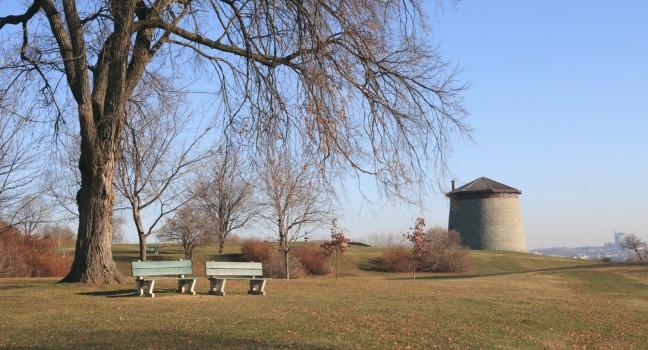
Martello Tower Plaines Abraham
LSOphoto / iStockphoto

This expansive urban park holds a pivotal place in Canadian history: it's the very ground where the famous Battle of Québec unfolded on September 13, 1759. This brief, yet acrimonious, clash within the larger Seven Years' War ultimately decided Canada's fate as the French lost the city to the British. On that fateful date, British soldiers under General Wolfe's command scaled the steep cliff face under the cover of darkness. They ultimately defeated the French through a single, devastating volley of musket fire, concluding the battle in less than 30 minutes. To truly grasp this pivotal moment, visit the Museum of the Plains of Abraham and explore the family-friendly activities at the nearby Martello Towers.

Today, this historic landscape transforms with the seasons. Locals flock here for cross-country skiing and to admire the majestic St. Lawrence River, even as it freezes over in winter. Come July, the park pulsates with energy as the Summer Festival takes over, drawing tens of thousands of concertgoers. Whatever the weather, head to Parc du Bastion-de-la-Reine for the ultimate Québec City postcard view.

Abbaye St-Benoît-du-Lac

Fodor's Choice

Built by the Benedictines in 1912 on a wooded peninsula on Lac Memphrémagog, the abbey is home to over 50 monks. They sell apples and sparkling apple wine from their orchards, as well as cheeses: Ermite (which means "hermit"), St-Benoît, and ricotta. Gregorian prayers are sung daily, and some masses are open to the public; call for the schedule. Dress modestly if you plan to attend vespers or other rituals, and avoid shorts. If you wish to experience a few days of retreat, there are guesthouses for both men and women. Reserve well in advance. Overnight visits cost C$60 per night, which includes three meals. Guided tours of the abbey cost C$14.

1 rue Principale, St-Benoît-du-Lac, J0B 2M0, Canada
819-843–4080
Sight Details
Closed major holidays; no guided tours July 11, aka the Feast of Saint Benedict

Something incorrect in this review?

Avenue Bernard

Fodor's Choice

If your taste runs to the chic and fashionable, then there is simply no better street than avenue Bernard, west of avenue Querbes, for people-watching. Its wide sidewalks and shady trees make it ideal for the kind of outdoor cafés and restaurants that attract the bright and the beautiful. And, in summer, the avenue is pedestrianized between avenues Wiseman and Bloomfield, with people walking freely and outdoor patios spilling out into the street.

Avenue Cartier

Montcalm Fodor's Choice

The mix of reasonably priced restaurants and bars, groceries and specialty food shops, and boutiques makes avenue Cartier a favorite lunchtime and after-work stop for many local residents. After business hours the street hums with locals running errands or soaking up the sun on patios. When darkness falls, the avenue's patrons get noticeably younger. The attraction? A half-dozen nightclubs and pubs that offer everything from wine and quiet conversation to Latin music and earsplitting dance tunes.

Québec City, G1R 2S3, Canada

Something incorrect in this review?

Basilique Ste-Anne-de-Beaupré

Fodor's Choice

Named for Québec's patron saint (the mother of the Virgin Mary), the small town of Ste-Anne-de-Beaupré is on Route 138, east of Québec City. It attracts more than a million pilgrims each year who come to visit the region's most famous religious site.

The French brought their devotion to St. Anne (also the patron saint of shipwrecked sailors) when they sailed across the Atlantic to New France. According to local legend, St. Anne was responsible for saving voyagers from shipwrecks in the harsh waters of the St. Lawrence. In 1650, Breton sailors caught in a storm vowed to erect a chapel in honor of this patron saint at the exact spot where they landed.

The present neo-Roman basilica, constructed in 1923, is the fifth to be built on the site where the sailors first touched ground. The original 17th-century wood chapel was built too close to the St. Lawrence and was swept away by river flooding.

The gigantic structure is in the shape of a Latin cross and has two imposing granite steeples. The interior has 22 chapels and 18 altars, as well as rounded arches and numerous ornaments in the Romanesque style. The 214 stained-glass windows, completed in 1949, are by Frenchmen Auguste Labouret and Pierre Chaudière.

Tributes to St. Anne can be seen in the shrine's mosaics, murals, altars, and ceilings. A bas-relief at the entrance depicts St. Anne welcoming her pilgrims, and ceiling mosaics represent her life. Numerous crutches and braces posted on the back pillars have been left by those who have felt the saint's healing powers.

10018 av. Royale, Ste-Anne-de-Beaupré, G0A 3C0, Canada
418-827–3781
Sight Details
Free
Shuttle service (round trip C$16-C$26) is available June–Oct. and is located near the Québec-Lévis Ferry. Check site for mass schedule.

Something incorrect in this review?

Christ Church Cathedral

Fodor's Choice

The seat of the Anglican (Episcopalian) bishop of Montréal offers downtown shoppers and strollers a respite from the hustle and bustle of rue Ste-Catherine. Built in 1859, the cathedral is modeled on Snettisham Parish Church in Norfolk, England, with some distinctly Canadian touches. The steeple, for example, is made with aluminum plates molded to simulate stone, and inside, the Gothic arches are crowned with carvings of the types of foliage growing on Mont-Royal when the church was built. The stained-glass windows behind the main altar, installed in the early 1920s as a memorial to the dead of World War I, show scenes from the life of Christ. On the wall just above and to the left of the pulpit is the Coventry Cross; it's made of nails taken from the ruins of Britain's Coventry Cathedral, destroyed by German bombing in 1940.The church building is a National Historic Site of Canada.  Free Saturday group tours can be arranged by calling the office.

Cimetière Mont-Royal

Fodor's Choice

If you find yourself humming "Getting to Know You" as you explore Mont-Royal Cemetery's 165 acres, blame it on the graveyard's most famous permanent guest, Anna Leonowens (1834–1915). She was the real-life model for the heroine of the Rodgers and Hammerstein musical The King and I. The cemetery—established in 1852 by the Anglican, Presbyterian, Unitarian, and Baptist churches—is laid out like a terraced garden, with footpaths that meander between crab-apple trees and past Japanese lilacs. Birders and nature photographers love to come to this cemetery for the 150 or so species of birds found here, including chestnut-sided warblers, ruby-throated hummingbirds, bluebirds, cedar waxwings, nuthatches, yellow warblers, woodpeckers, goldfinches, and more. And keep an eye out for the resident groundhogs and raccoons!

Croix sur la Montagne

Fodor's Choice

Visible from up to 50 miles away on a clear day, the 98-foot-high steel cross at the top of Mont-Royal has been a city landmark since it was erected in 1924, largely with money raised through the efforts of 85,000 high-school students. Once upon a time, it took four hours and the labor of three to replace the 249 electric bulbs used to light the cross; today, the iconic cross is illuminated via a high-tech remote-control LED system.

Église Notre-Dame-des-Victoires

Lower Town Fodor's Choice

Step into history at Notre-Dame-des-Victoires, North America's oldest stone church. This beautiful sanctuary on Place Royale, with its fortress-shaped altar, stands as a testament to a turbulent past. Built in 1688 and meticulously restored, it honors the Virgin Mary for aiding French forces against British invasions in 1690 and 1711. Inside, discover interesting paintings and a model of Le Brezé, the ship that brought French soldiers in 1664. Its side chapel is dedicated to Sainte Genevieve, Paris's patron saint.

32 rue Sous-le-Fort, Québec City, G1K 4G7, Canada
418-692–1650
Sight Details
Closed Mon.–Tue.

Something incorrect in this review?

L'Escalier Casse-Cou

Lower Town Fodor's Choice

Often regarded as one of the Old City's most iconic attractions, this stairway lives up to its playful name: Breakneck Steps. It's not just for the stunning views of the neighborhood; the sheer ambition and steepness of city architect Charles Baillairgé's 1893 design truly explain its moniker. Yet, despite the ominous name, no serious injuries have been reported on its 59 steps. This iron masterpiece was quite the upgrade from the original 17th-century wooden stairway, which first dared to link Upper and Lower Town.

Lac-Brome Museum

Fodor's Choice

Here's a wonderful opportunity to learn about the Loyalists who settled the area after fleeing the American Revolution. Several buildings, including the former county courthouse dating back to 1859, the old firehall (fire station), and a former school, house an eclectic collection that include 19th-century farm tools, Native Canadian arrowheads, and a military collection that includes uniforms and a World War I Fokker aircraft. The museum also maintains the Tibbits Hill Pioneer School, a stone schoolhouse built in 1834 to serve rural families—kids can find out what education was like in the mid-19th century.

Magasin Général Historique Authentique 1928

L'Anse-à-Beaufils Fodor's Choice

Step back in time at this marvelously restored early-20th-century general store, where counters and shelves are loaded with bygone products such as old-fashioned tinctures, sewing machines, and period clothing. Hear an old telephone ring and see a fully equipped barber shop. Other rooms feature antique stoves and carriages. Curiosities fill every shelf and corner. Shopkeepers in costume lead guided tours, giving a feel of being in the store while it was in operation. They point out how some old devices worked.

Maison de la littérature

Upper Town Fodor's Choice

This stunning library, housed in a former 19th-century Methodist church, is a true gem for design, architecture, and culture enthusiasts alike. Completely revamped a few years ago, its now whitewashed, design-heavy interior earned international acclaim and architectural awards. Inside, you'll find compelling permanent exhibitions on French Canadian literature and culture, along with weekly showings of various genres of French-Canadian movies.

Monastère des Augustines

Upper Town Fodor's Choice

In 1639, Augustinian nuns arrived from Dieppe, France, tasked with caring for the sick in the new colony. They established North America's first hospital north of Mexico, the Hôtel-Dieu. The complex underwent a full renovation and expansion in 2015 and now includes a quiet, health-conscious restaurant (with silent breakfast!), a holistic spa, and accommodations ranging from contemporary en suite rooms to dorm-like rooms with antique furniture—the perfect canvas for a calm retreat. The museum showcases an extensive collection of liturgical and medical artifacts, while the richly decorated chapel (by Thomas Baillairgé) and the 1659 vaults, used by nuns as shelter from bombardments, are also worth visiting. A small order of nuns continues to reside within the monastery, truly making it a place of living memory.

32 rue Charlevoix, Québec City, G1R 5N1, Canada
418-692–2492
Sight Details
C$17
Museum closed Oct.-Apr.

Something incorrect in this review?

Musée de la Civilisation

Lower Town Fodor's Choice

Wedged between narrow streets at the foot of the cliff, this spacious museum, with its striking limestone-and-glass façade, was designed by architect Moshe Safdie to seamlessly blend into the landscape. Its bell tower thoughtfully echoes the shape of the city's church steeples. A new exhibition, running until 2030, powerfully witnesses the narratives of 95,000 First Nations and Inuit women and men of Québec as they reflect on history, embrace the present, and envision a hopeful future. The temporary exhibits here are always well worth a visit too.

85 rue Dalhousie, Québec City, G1K 8R2, Canada
866-710–8031
Sight Details
C$21
Closed Mon. from early Sept. to late June

Something incorrect in this review?

Musée national des beaux-arts du Québec

Montcalm Fodor's Choice

Situated on the city's liveliest avenue, the Grand Allée, this neoclassical museum in the park with a slick and modern wing is a remarkable steel-and-glass setting for its collection of 22,000 traditional and contemporary pieces of Québec art. Designed by starchitects Rem Koolhaas and Shohei Shigematsu, the Lassonde Pavilion, added in 2016, features three stacked, cascading galleries; a grand stairwell that spirals dramatically from the top floor to the basement, where a rising almost-mile-long tunnel connects to the museum’s three other wings. MNBAQ houses works by local legends Jean-Paul Riopelle, Jean-Paul Lemieux, Alfred Pellan, Fernand Leduc, and Horatio Walker that are particularly notable, as well as temporary exhibits by international artists such as Turner, Miró, and Giacometti. The original museum building in Parc des Champs-de-Bataille is part of an abandoned prison dating from 1867; a hallway of cells, with the iron bars and courtyard, has been preserved as part of a permanent exhibition on the prison's history.

179 Grande Allée Ouest, Québec City, G1R 2H1, Canada
418-643–2150
Sight Details
C$25
Closed Mon. from Sept. to Jun.

Something incorrect in this review?

Observatoire de la Capitale

Montcalm Fodor's Choice

Located atop the Édifice Marie-Guyart, the city's tallest building, Observatoire de la Capitale offers a spectacular panorama of Québec City from 31 stories up. The site features an overview of the city's history with 3-D imagery, audiovisual displays in both French and English, and a time-travel theme with a 1960s twist.

Parc National du Fjord-du-Saguenay

Fodor's Choice

Colossal rock cliffs and forest-covered mountains meet the still waters of the Saguenay Fjord, one of the longest in the world, and the namesake national park runs its entire 105-km (65-mile) length. Of the park’s three regions, the Baie-Éternité, which hosts the visitor center, is about 60 km (37 miles) south of the city of Saguenay, where you can visit the Fjord Museum (Musée du Fjord). Outdoor enthusiasts have much to do here, including kayaking, fishing, hiking, camping, bird-watching, whale-watching, and mountain biking, and the park can supply equipment and guides. The spectacular Baie-Éternité escarpments provide thrilling climbs and a via ferrata. Or you can take it easy on sailboat and sightseeing boat cruises, or enjoy a thrilling whale-watching experience.

Parc National du Mont-Tremblant

Fodor's Choice

This vast wildlife sanctuary has more than 400 lakes and rivers and is home to nearly 200 species of birds and animals, so it’s great for wildlife-watching. Cross-country skiers, snowshoers, and snowmobilers enjoy the park's trails in winter, and camping, fishing, canoeing, and hiking are the popular summer activities. The park was once the home of the Algonquins, who called this area Manitonga Soutana, meaning "mountain of the spirits." 

Promenade Samuel-de-Champlain

Outside the Old City Fodor's Choice

This 6.8 km (4.2-mile) promenade along the St. Lawrence River offers a truly gorgeous and privileged space to enjoy the water. It's a beloved local hotspot, boasting stunning vistas of the river and the two bridges spanning it to the west. The park's creative and contemporary landscape design attracts a lively crowd of pedestrians, cyclists, and inline skaters on sunny summer days, with children often seen playing by the fountains and on the sprawling lawns. Toward the eastern end, you'll discover a charming café and an observation tower, alongside the newly inaugurated Station de la Plage. This spectacular addition features a sandy beach area complete with chairs and umbrellas, and an infinity pool that truly gives the impression of bathing directly in the river, complemented by cascading water fountains. During high season, shuttle bus #400 conveniently transports visitors directly from Petit-Champlain in Lower Town to this scenic stretch every 30 minutes.

Québec–Lévis Ferry

Lower Town Fodor's Choice

Crossing the St. Lawrence River on this ferry will reward you with a striking view of the Québec City skyline, with the Château Frontenac and the Québec Seminary high atop the cliff. The view is even more impressive at night. Ferries generally run every 20 or 30 minutes from 6 am until 6 pm, and then every hour until 2:20 am; there are additional ferries from April through November.

10 rue des Traversiers, Québec City, G1K 8L8, Canada
877-787–7483
Sight Details
C$4.15 each way (pedestrians, cyclists, car passengers)

Something incorrect in this review?

Réserve Faunique du Cap Tourmente

Fodor's Choice

Recognized as a Wetland of International Significance, this nature reserve protects a vital habitat for migrating greater snow geese and sees more than a million fly through every October and May, with tens of thousands of birds present every day. The park harbors hundreds of other kinds of birds and mammals, and more than 700 plant species. This enclave also has 20 km (12 miles) of hiking trails; naturalists give guided tours. It's on the north shore of the St. Lawrence River, about 8 km (5 miles) east of Ste-Anne-de-Beaupré.