21 Best Sights in Quebec, Canada

Background Illustration for Sights

We've compiled the best of the best in Quebec - browse our top choices for the top things to see or do during your stay.

Basilique Notre-Dame-de-Montréal
Fodor's Choice
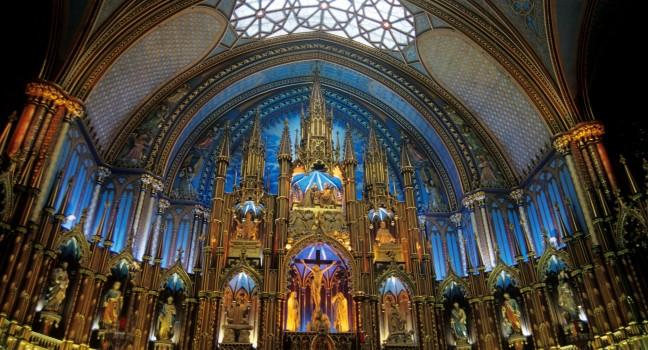
Montreal Notre-Dame Basilica Sunshine on the altar of Montreal
Peter Guttman/PeterGuttmann.com

Few churches in North America are as wow-inducing as Notre-Dame. Everything about the Gothic Revival–style church, which opened in 1829, seems designed to make you gasp—from the 228-foot twin towers out front to the tens of thousands of 24-karat gold stars that stud the soaring blue ceiling.

Nothing in a city renowned for churches matches Notre-Dame for sheer grandeur—or noisemaking capacity: its 12-ton brass bell is the largest in North America, and its 7,000-pipe Casavant organ can make the walls tremble. The pulpit is a work of art in itself, with an intricately curving staircase and fierce figures of Ezekiel and Jeremiah crouching at its base. The whole place is so overwhelming it's easy to miss such lesser features as the stained-glass windows from Limoges and the side altars dedicated to St. Marguerite d'Youville, Canada's first native-born saint; St. Marguerite Bourgeoys, Canada's first schoolteacher; and a group of Sulpician priests martyred in Paris during the French Revolution.

For a peek at the magnificent baptistery, decorated with frescoes by Ozias Leduc, you'll have to tiptoe through the glassed-off prayer room in the northwest corner of the church. Every year dozens of brides—including Céline Dion, in 1994—march up the aisle of Chapelle Notre-Dame-du-Sacré-Coeur (Our Lady of the Sacred Heart Chapel), behind the main altar, to exchange vows with their grooms before a huge modern bronze sculpture that you either love or hate.

Notre-Dame is an active house of worship, so dress accordingly. The chapel can't be viewed weekdays during the 12:15 pm mass, and is often closed Saturday for weddings. Don't miss the 45-minute multimedia spectacle, Aura, which celebrates the basilica's exquisite features through light and sound. See website for schedule ( www.aurabasiliquemontreal.com/en).  The basilica has been under major restoration since 2020 and is not expected to be complete until 2040. Be prepared to see scaffolding at the very least.

110 rue Notre-Dame Ouest, H2Y 1T1, Canada
514-842–2925
Sight Details
Self-guided tour C$16; multimedia show Aura from C$37
Purchase tickets online

Something incorrect in this review?

Abbaye St-Benoît-du-Lac

Fodor's Choice

Built by the Benedictines in 1912 on a wooded peninsula on Lac Memphrémagog, the abbey is home to over 50 monks. They sell apples and sparkling apple wine from their orchards, as well as cheeses: Ermite (which means "hermit"), St-Benoît, and ricotta. Gregorian prayers are sung daily, and some masses are open to the public; call for the schedule. Dress modestly if you plan to attend vespers or other rituals, and avoid shorts. If you wish to experience a few days of retreat, there are guesthouses for both men and women. Reserve well in advance. Overnight visits cost C$60 per night, which includes three meals. Guided tours of the abbey cost C$14.

1 rue Principale, St-Benoît-du-Lac, J0B 2M0, Canada
819-843–4080
Sight Details
Closed major holidays; no guided tours July 11, aka the Feast of Saint Benedict

Something incorrect in this review?

Christ Church Cathedral

Fodor's Choice

The seat of the Anglican (Episcopalian) bishop of Montréal offers downtown shoppers and strollers a respite from the hustle and bustle of rue Ste-Catherine. Built in 1859, the cathedral is modeled on Snettisham Parish Church in Norfolk, England, with some distinctly Canadian touches. The steeple, for example, is made with aluminum plates molded to simulate stone, and inside, the Gothic arches are crowned with carvings of the types of foliage growing on Mont-Royal when the church was built. The stained-glass windows behind the main altar, installed in the early 1920s as a memorial to the dead of World War I, show scenes from the life of Christ. On the wall just above and to the left of the pulpit is the Coventry Cross; it's made of nails taken from the ruins of Britain's Coventry Cathedral, destroyed by German bombing in 1940.The church building is a National Historic Site of Canada.  Free Saturday group tours can be arranged by calling the office.

Recommended Fodor's Video

Église Notre-Dame-des-Victoires

Lower Town Fodor's Choice

Step into history at Notre-Dame-des-Victoires, North America's oldest stone church. This beautiful sanctuary on Place Royale, with its fortress-shaped altar, stands as a testament to a turbulent past. Built in 1688 and meticulously restored, it honors the Virgin Mary for aiding French forces against British invasions in 1690 and 1711. Inside, discover interesting paintings and a model of Le Brezé, the ship that brought French soldiers in 1664. Its side chapel is dedicated to Sainte Genevieve, Paris's patron saint.

32 rue Sous-le-Fort, Québec City, G1K 4G7, Canada
418-692–1650
Sight Details
Closed Mon.–Tue.

Something incorrect in this review?

St. Patrick's Basilica

Fodor's Choice

Built in 1847, this is one of the purest examples of the Gothic Revival style in Canada, with a high vaulted ceiling glowing with green and gold mosaics. The tall, slender columns are actually pine logs lashed together and decorated to look like marble, so that if you stand in one of the back corners and look toward the altar you really do feel as if you're peering at the sacred through a grove of trees. St. Pat's—as most of its parishioners call it—is to Montréal's anglophone Catholics what the Basilique Notre-Dame-de-Montréal is to their French-speaking brethren—the mother church and a monument to faith and courage. One of the joys of visiting the place is that you'll probably be the only tourist there, so you'll have plenty of time to check out the old pulpit and the huge lamp decorated with six angels two meters (six feet) tall hanging over the main altar. And if you're named after some relatively obscure saint like Scholastica or Aeden of Fleury, you can search for your namesake's portrait among the 170 painted panels on the walls of the nave. For a solemn experience, visit on the third Sunday of the month (September through June), when the mass is sung completely in Latin.

454 boul. René-Lévesque Ouest, H2Z 1A7, Canada
514-866–7379
Sight Details
Free
Free tours are available most Sun. afternoons in summer.

Something incorrect in this review?

Basilique-Cathédrale Notre-Dame de Québec

Upper Town

François de Laval, the first bishop of New France and founder of Canada's Catholic Church, once ruled a diocese that stretched to the Gulf of Mexico. Videos and pictures astutely illustrate his life throughout the visit.

Laval's original cathedral burned down and has been rebuilt several times, but the current basilica still has a chancel lamp that was a gift from Louis XIV, the Sun King. The church's interior includes a canopy dais over the Episcopal throne, a ceiling of painted clouds decorated with gold leaf, and richly colored stained-glass windows. A "holy door" was added to the church in 2014. The large crypt was Québec City's first cemetery; more than 900 bodies are interred here, including, perhaps, Samuel de Champlain's; archaeologists have been searching for his tomb since 1950. Guided tours of the cathedral and crypt are available (by appointment only).

16 rue de Buade, Québec City, G1R 4A1, Canada
418-692–2533

Something incorrect in this review?

Cathedral of the Holy Trinity

Upper Town

The first Anglican cathedral outside the British Isles was erected in the heart of Québec City's Upper Town between 1800 and 1804. Its simple, dignified façade is reminiscent of London's St. Martin-in-the-Fields, and the pediment, archway, and Ionic pilasters introduced Palladian architecture to Canada. The land on which the cathedral was built was originally given to the Récollets (Franciscan monks from France) in 1681 by the king of France for a church and monastery. When Québec came under British rule, the Récollets made the church available to the Anglicans for services. Later, King George III ordered construction of the present cathedral, with an area set aside for members of the royal family. A portion of the north balcony is still reserved for the use of the reigning sovereign or his or her representative. The cathedral's impressive rear organ has 3,058 pipes. Even more impressive is the smaller English chamber organ, built in 1790, which was donated to the cathedral for the bicentennial celebrations in 2004.

31 rue des Jardins, Québec City, G1R 4L6, Canada
418-692–2193
Sight Details
Free

Something incorrect in this review?

Cathédrale Marie-Reine-du-Monde

The best reason to visit this cathedral is that it's a quarter-scale replica of St. Peter's Basilica in Rome—complete with a magnificent reproduction of Bernini's ornate baldachin (canopy) over the main altar and an ornately coffered ceiling. When Bishop Ignace Bourget (1799–1885) decided to build his cathedral in the heart of the city's Protestant-dominated commercial quarter, many fellow Catholics thought he was crazy. But the bishop was determined to assert the Church's authority—and its loyalty to Rome—in the British-ruled city. Bourget didn't live to see the cathedral dedicated in 1894, but his tomb holds a place of honor among those of his successors in the burial chapel on the east side of the nave.

Chapelle Notre-Dame-de-Bon-Secours

Mariners have been popping into Notre-Dame-de-Bon-Secours for centuries to kneel before a little 17th-century statue of the Virgin Mary and pray for a safe passage—or give thanks for one. Often, they've expressed their gratitude by leaving votive lamps in the shape of small ships, many of which still hang from the barrel-vaulted ceiling. This is why most Montrealers call the chapel the Église des Matelots (the Sailors' Church), and why some people still stop by to say a prayer and light a candle before leaving on a long trip.

These days, the statue of Our Lady of Perpetual Help guards the remains of St. Marguerite Bourgeoys, who had the original chapel built in 1657 and is entombed in the side altar next to the east wall of the chapel. The current chapel dates from 1771; a renovation project in 1998 revealed some beautiful 18th-century murals that had been hidden under layers of paint.

The 69-step climb to the top of the steeple is worth the effort for the glorious view of the angels overlooking the harbor as is the steep climb down to the archaeological excavations under the chapel for a glimpse into the history of the chapel and the neighborhood. The dig is accessible through the adjacent Musée Marguerite Bourgeoys, which also has exhibits on the life of St. Marguerite and the daily lives of the colonists she served.

400 rue St-Paul Est, H2Y 1H4, Canada
514-282–8670
Sight Details
Museum (includes archaeological site) and tower C$16, chapel free
Closed Mon. mid-Oct.–mid-May

Something incorrect in this review?

Chapelle Notre-Dame-de-Lourdes

Artist and architect Napoléon Bourassa called his work here l'oeuvre de mes amours, or a labor of love—and it shows. He designed the little Byzantine-style building himself and set about decorating it with the exuberance of an eight-year-old making a Mother's Day card. He covered the walls with murals and encrusted the altar and pillars with gilt and ornamental carving. It's not Montréal's biggest monument to the Virgin Mary, but it's the most unabashedly sentimental.

430 rue Ste-Catherine Est, H2L 2C5, Canada
514-845–8278-ext. 201
Sight Details
Free

Something incorrect in this review?

Chiesa della Madonna della Difesa

If you look up at the cupola behind the main altar of Little Italy's most famous church, you'll spot Montréal's most infamous piece of ecclesiastical portraiture. Yes, indeed, that lantern-jaw fellow on horseback who looks so pleased with himself is Benito Mussolini, the dictator who led Italy into World War II—on the wrong side. The mural, by Guido Nincheri (1885–1973), was completed long before the war and commemorates the signing of the Lateran Pact with Pope Pius XI, one of Il Duce's few lasting achievements. The controversy shouldn't distract you from the beauties of the rest of the richly decorated church.

6800 avenue Henri-Julien, H2S 2V4, Canada
514-277--6522
Sight Details
Free
Call ahead as the church is rarely open outside mass hours

Something incorrect in this review?

Church of St. Andrew and St. Paul

Montréal's largest Presbyterian church—sometimes affectionately called the A&P—is worth a visit, if only to see the glorious stained-glass window of the risen Christ that dominates the sanctuary behind the white-stone communion table. It's a memorial to members of the Royal Highland Regiment of Canada (the Black Watch) who were killed in World War I.

3415 rue Redpath (main entrance on rue Sherbrooke), H3G 2G2, Canada
514-842–3431
Sight Details
Free
In July and Aug., visitors are welcome to visit or join tours weekdays between 10 and 3. Rest of the year, Wed. and Thu. 11 to 3

Something incorrect in this review?

Église de la Visitation de la Bienheureuse Vierge Marie

A bit off the beaten tourist path, the oldest church on the island, the Church of the Visitation of the Blessed Virgin Mary, is found in Montréal North. It's not a must-see, but it is worth the trek if you have time and don't mind a little walking through some rather ordinary neighborhoods. The church had its stone walls raised in the 1750s, and the beautifully proportioned Palladian front was added in 1850. Ornamentation  lasted from 1764 until 1837, with stunning results. The altar and the pulpit are as elaborate as wedding cakes but still delicate. The church's most notable treasure is a rendering of the Visitation attributed to Pierre Mignard, a painter at the 17th-century court of Louis XIV. Parkland surrounds the church, and the nearby Îles de la Visitation (reachable by footbridge) make for a very good walk.

1847 boul. Gouin Est, H2C 1C8, Canada
514-388-–4050
Sight Details
Free
Closed Mon.

Something incorrect in this review?

Église St-François

Built in 1734, St-François is one of eight extant churches in Québec dating from the French regime. At the time the English seized Québec City in 1759, General James Wolfe knew St-François to be a strategic point along the St. Lawrence. Consequently, he stationed British troops here and used the church as a military hospital. In 1988, a car crash set the church on fire, and most of the interior treasures were lost. A separate children's cemetery stands as a silent witness to the difficult life of early residents.

3497 chemin Royal, St-François, G0A 3S0, Canada
418-828–2551
Sight Details
Free

Something incorrect in this review?

Église St-Jean

At the eastern end of the village sits a massive granite structure built in 1749, with large red doors and a towering steeple. The church resembles a ship; it's big, round, and appears to be sitting right on the river. Paintings of the patron saints of seamen line the interior walls. The church's cemetery is also intriguing, especially if you can read French. Back in the 1700s, piloting the St. Lawrence was a dangerous profession; the cemetery tombstones recall the many lives lost in these harsh waters.

2001 chemin Royal, St-Jean, G0A 3W0, Canada
418-828–2551
Sight Details
Free

Something incorrect in this review?

Église St-Laurent

The tall, inspiring church that stands next to the village marina on chemin Royal was built in 1860 on the site of an 18th-century church that had to be torn down. One of the church's procession chapels is a miniature stone reproduction of the original.

1532 chemin Royal, St-Laurent, G0A 3Z0, Canada
418-828–2551
Sight Details
Free

Something incorrect in this review?

Église St-Pierre

The oldest church on the island dates from 1717. It's no longer used for worship, but it was restored during the 1960s and is open to visitors. Many original components are still intact, such as benches with compartments below where hot bricks and stones were placed to keep people warm in winter. Félix Leclerc, the first Quebecois singer-songwriter to make a mark in Europe, is buried in the cemetery nearby.

1445 chemin Royal, St-Pierre-de-l'Île-d'Orléans, G0A 3E0, Canada
418-828–9824
Sight Details
Free

Something incorrect in this review?

Église St-Pierre-Apôtre

The Church of St. Peter the Apostle, built in the Gothic Revival style between 1851 and 1853, is home to the Chapel of Hope, a symbol of unconditional love. Dedicated to the victims of AIDS, it is the only chapel in the world to pay tribute to those who suffered and died from the fatal illness.

Église Ste-Famille

This impressive church, constructed in 1749, is the only one in Québec to have three bell towers at its front. The ceiling was redone in the mid-19th century with elaborate designs in wood and gold. The church also holds a famous painting, L'Enfant Jésus Voyant la Croix (Baby Jesus Looking at the Cross); it was done in 1670 by Frère Luc (Brother Luc), who had been sent from France to decorate churches in the area.

2483 chemin Royal, Ste-Famille, G0A 3P0, Canada
418-828–2656
Sight Details
Free

Something incorrect in this review?

St. George's Anglican Church

This is possibly the prettiest Anglican (Episcopalian) church in Montréal. Step into its dim, candle-scented interior and you'll feel you've been transported to some prosperous market town in East Anglia, England. The double hammer-beam roof, the rich stained-glass windows, and the Lady Chapel on the east side of the main altar all add to the effect. It certainly seems a world away from Centre Bell, the modern temple to professional hockey that's across the street.

1001 av. des Canadiens-de-Montréal, H3B 3B3, Canada
514-866–7113
Sight Details
Free

Something incorrect in this review?

Ursuline Chapel

Upper Town

Founded in 1639, the Ursuline Chapel and its Couvent des Ursulines stand as North America's oldest institution of learning for women. Step inside to discover some of the finest wood carving in all of Québec, painstakingly gilded by the nuns themselves. Though the exterior was rebuilt in 1902, the interior reveals the original chapel, a masterpiece that took sculptor Pierre-Noël Levasseur a decade (1726-1736) to complete.

12 rue Donnacona, Québec City, G1R 3Y7, Canada
418-694–0694
Sight Details
Closed Mon. Closed Nov.-Apr.

Something incorrect in this review?