

843 Best Sights in Mexico

Background Illustration for Sights

We've compiled the best of the best in Mexico - browse our top choices for the top things to see or do during your stay.

Universidad Nacional Autónoma de México (UNAM)

Fodor's choice

Some of the country's most celebrated modern architects—including Mario Pani, Enrique del Moral, and Teodoro González de Leon—designed buildings on the massive campus of UNAM, which sprawls across its own city within a city, the 2,500-acre (10-square-km) Ciudad Universitaria. Located in the southern reaches of the city, a little south of Coyoacán and San Ángel, the current campus was constructed in the 1950s on a then completely desolate field of petrified lava produced by the roughly AD 300 eruption of Xitle Volcano (a now dormant 1,000-foot-tall ash cone volcano about 8 km [5 miles] to the south). The university itself was established in 1910 and is one of the largest and most prestigious educational institutions in the world, with about 213,000 undergraduate and 30,000 graduate students enrolled across its numerous campuses around the country (as well as in extension schools in the United States and Canada). UNAM accepts only about 8% of applicants, and the campus here at Ciudad Universiteria is by far the largest and includes a number of outstanding architectural works and cultural attractions. Murals by Diego Rivera, David Alfaro Siqueiros, and Juan O'Gorman appear on some buildings, most notably the 1956 functionalist Central Library, which O'Gorman designed in collaboration with Gustavo Saavedra and Juan Martinez de Velasco (and on which his massive murals appear). In addition to its outstanding museums and performance spaces, another highlight on campus is Jardín Botánico. UNAM also operates some other important institutions around the city, including Palacio de Mineria and Colegio de San Ildefonso (with its famous murals) in Centro Histórico, Casa del Lago in Parque Chapultepec, and Museo Universitario del Chopo in Santa Maria la Ribera.
Uriarte Talavera

Fodor's choice

Founded in 1824, this is one of the few authentic Talavera workshops left today. To be the real deal, pieces must be hand-painted in intricate designs with natural dyes derived from minerals. That's why only five colors are used: blue, black, yellow, green, and a reddish pink. English- and Spanish-language tours take place daily except for Sunday, but visitors are also welcome to visit the shop and terrace for free.

Uxmal

Fodor's choice

Uxmal rivals Chichén Itzá, Coba, and other Maya sites in terms of its beauty and drama, but its distance from Cancún and the Riviera Maya helps assure that it is relatively less crowded. Although much of Uxmal has yet to be excavated, what is visible reflects the especially decorative style of Puuc Maya sites.

At 125 feet high, the Pirámide del Adivino is the site's most prominent structure. Unlike most Maya pyramids, which are stepped and angular, the so-called Pyramid of the Magician has a softer, more refined, round-corner design. This structure was rebuilt five times over hundreds of years, each time on the same foundation, so artifacts found here represent several kingdoms. The pyramid has a stairway on its western side that leads through a giant open-mouth mask to two temples at the summit. During restoration work in 2002, the grave of a high-ranking Maya official, a ceramic mask, and a jade necklace were discovered within the pyramid. Ongoing excavations continue to reveal exciting new finds. As with most ruins in Yucatán, climbing is prohibited.

West of the pyramid lies the Cuadrángulo de las Monjas, often considered to be the finest part of Uxmal. It reminded the conquistadores of typical convent buildings in Spain (monjas is Spanish for "nuns"). You may enter the four buildings, each comprising a series of low, gracefully repetitive chambers that look onto a central patio. Elaborate symbolic decorations—masks, geometric patterns, coiling snakes, and some phallic figures—blanket the upper facades.

Heading south, you'll pass a small ball court before reaching the Palacio del Gobernador. Covering 5 acres and rising over an immense acropolis, the palace lies at the heart of what may have been the city's administrative center. It faces east while the rest of Uxmal faces west, and archaeologists suggest this allowed the structure to serve as an observatory for the planet Venus.

The Cuadrángalo de los Pájaros (Quadrangle of the Birds) takes its name from the repeating pattern of doves that decorates the upper part of the building's frieze. In one of the building small chambers archaeologists discovered a statue of the ruler Chac (not to be confused with Chaac, the rain god), who was thought to have dwelled there.

A nightly sound and light show (8 pm April–October, 7 pm November–March) recounts Maya legends, though the spectacle is not cheap at MX$640. Still, the colored light brings out details of carvings and mosaics that are easy to miss when the sun is shining. The show is narrated in Spanish, but earphones (for an additional MX$39) provide an English translation.  In summer, tarantulas are a common sight on the grounds here.

Recommended Fodor's Video

Vallarta Botanical Gardens

Fodor's choice

Since its opening in 2005, the Vallarta Botanical Gardens has become a landmark of Puerto Vallarta and with good reason. The place is spectacular, set in the middle of the Sierra Madre mountains, just a few miles from the Pacific Ocean. In its 64 acres of land you will find extraordinary biodiversity, a vanilla plantation, hiking trails, plant conservatories, a scenic restaurant, and even a river of crystal clear waters. Plan to spend at least two hours here; you can easily spend a whole day. You can buy a tour, or explore on your own by foot or bicycle. A small shop sells plants, souvenirs, and arts and crafts.

Carretera a Barra de Navidad, Km 24, Mexico
322-223--6182
Sight Details
300 MXN
Closed Mon. Apr.–Nov.

Something incorrect in this review?

Viveros de Coyoacán

Coyoacán Fodor's choice

Officially this 96-acre swath of greenery is a nursery that was developed in 1913 to grow tree seedlings to be transplanted to the forests in and around Mexico City, but today Viveros functions for visitors as a glorious park (it has, in fact, been an official national park since 1938). A 2.2-km (1.4-mile) gravel walking and jogging trail laces the perimeter of the property, and a series of narrow trails crisscross the park, each one lined with specimen trees that are planted around the city: acacia, sweet gum, jacaranda, cedar, and so on. There are five entrances around the park: the southwest one is closest to Viveros metro, but the northeast one is better if you're walking over from elsewhere in Coyoacán or from the Coyoacán metro stop. Each entrance is staffed by security, and although admission is free, the gates shut to the public promptly at 6 pm and don't reopen until the next morning at 6 am. This is one of the most enjoyable (and popular) spots in the city for jogging, but throughout Viveros you'll also find benches, rows of ornamental plants, hundreds of colorful and friendly black and gray squirrels, swatches of grass to set up picnic blankets, and a central plaza that's often the site of small groups informally practicing fencing, yoga, dancing, and the like. Unless you glimpse the unfortunately bland Torre Mítikah, which was completed in 2021 on the neighborhood's northern border, you can easily imagine that you're miles from urban civilization while relaxing in this enchanting urban sanctuary. Near the northeast entrance, an actual nursery sells plants, flowers, and garden statuary and gifts of every imaginable kind.

Av. México and Calle Madrid, Mexico City, 04100, Mexico
Sight Details
Free

Something incorrect in this review?

Xcaret

Fodor's choice

Take a small collection of Maya ruins and build a mammoth theme park around them, and you have Xcaret, one of the Yucatán Peninsula’s most popular destinations. Among its most-visited attractions are the Paradise River raft tour that takes you on a winding, watery journey through the jungle; the Butterfly Garden, where thousands of butterflies float dreamily through a botanical garden while New Age music plays in the background; and an ocean-fed aquarium, where you can see local sea life drifting through coral heads and sea fans.

The park also has a wild-bird breeding aviary, nurseries for abandoned flamingo eggs and sea turtles, and a series of underwater caverns that you can explore by snorkeling or Snuba (a hybrid of snorkeling and scuba). A replica Maya village includes a colorful cemetery with catacomb-like caverns underneath; traditional music and dance ceremonies (including performances by the famed Voladores de Papantla, or Flying Birdmen of Papantla) are performed here at night. But the star performance is the evening "Xcaret Mexico Espectacular," which tells the history of Mexico through song and dance. The list of Xcaret's attractions goes on and on: you can visit a dolphinarium, a bee farm, a manatee lagoon, a bat cave, an orchid and bromeliad greenhouse, an edible-mushroom farm, and a small zoo. You can also climb a 240-foot tower that offers a spectacular view of the park.

The entrance fee covers only access to the grounds and the exhibits; some other activities and equipment—from sea treks and dolphin tours to lockers and swim gear—are extra. The Plus Pass includes park entrance, lockers, snorkel equipment, food, and drinks. You can buy tickets from any travel agency or major hotel along the coast. You can also book slightly discounted tickets through Xcaret's website.

Carretera 307, Km 282, Xcaret, 77710, Mexico
998-883–3143
Sight Details
Basic Pass $120; Plus Pass $164; Night Pass $98

Something incorrect in this review?

Xel-Há

Fodor's choice

Part of the Xcaret nature-adventure park group, Xel-Há (pronounced shel-hah) is a natural aquarium made of coves, inlets, and lagoons cut from the limestone shoreline. The name means "where the water is born," and a natural spring here flows out to meet the salt water, creating a unique habitat for tropical marine life. There's enough to impress novice snorkelers, though there seem to be fewer fish each year, and the mixture of fresh and salt water can cloud visibility. Low wooden bridges over the lagoons allow for leisurely walks around the park, and there are spots to rest, swim, cliff-jump, zip line, or swing from ropes over the water.

Xel-Há gets overwhelmingly crowded, so come early. The grounds are well equipped with bathrooms and restaurants. At the entrance you'll receive specially prepared sunscreen that won't kill the fish; other sunscreens are prohibited. The entrance fee includes a meal, towel, locker, inner tubes, and snorkel equipment; other activities, like scuba diving, zip-lining, swimming with the dolphins, and spa treatments, are available at additional cost. Discounts are offered when you book online.

Xochicalco

Fodor's choice

A trip to these ruins, which are a roughly 45-minute drive southwest of Cuernavaca, is one of the best reasons to visit the state of Morelos. Built by the Olmeca-Xicalanca people, the mighty hilltop city reached its peak between AD 700 and 900. It was abandoned a century later after being destroyed, perhaps by its own inhabitants. With its several layers of fortifications, the city appears unassailable. The most eye-catching edifice is the Pyrámide de Quetzalcóatl (Temple of the Plumed Serpent). Carvings of vicious-looking snakes—all in the style typical of the Maya to the south—wrap around the lower level, while figures in elaborate headdresses sit above. Be sure to seek out the Observatorio in a man-made cave reached through a tunnel on the northern side of the city. Through a narrow shaft in the ceiling, the Xochicalco astronomers could observe the heavens. Twice a year—May 14 and 15 and July 28 and 29—the sun passes directly over the opening, filling the room with light. From the ruins, you're also treated to an impressive view of the surrounding mountains.

Be sure to set aside at least a half-hour to explore the excellent solar-powered museum, where a wonderfully mounted exhibit of a wide variety of artifacts from Xochicalco are on display, including gorgeous sculptures of Xochicalco deities found nearby. There are dozens of other structures here, including three impressive ball courts.

Carretera Federal Xochicalco, Cuernavaca, 62609, Mexico
737-374–3090
Sight Details
MP90

Something incorrect in this review?

Xochimilco Canals

Greater Mexico City Fodor's choice

A former pre-Hispanic city 21 km (13 miles) south of current-day CDMX city center, the Xochimilco neighborhood is well worth a visit to explore its vast, ancient network of canals and chinampas (man-made islands), which have been declared a UNESCO World Heritage Site. When the first indigenous settlers arrived in the Valley of Mexico, they found an enormous lake. As the years passed and their population grew, the land could no longer satisfy their agricultural needs. They solved the problem by devising a system of chinampas, rectangular structures akin to barges, which they filled with reeds, branches, and mud. They planted the barges with willows, whose roots anchored the floating gardens to the lake bed, creating a labyrinth of small islands and canals on which vendors carried flowers and produce grown on the chinampas to market.

Today Xochimilco is the only place in Mexico where the gardens still exist. Go on a Saturday, when the tianguis (market stalls) are most active, or, though it's crowded, on a Sunday. On weekdays the distinctive community is usually much less crowded, so it loses some of its vibrancy but also its chaos. It's considered almost a mandatory custom to hire a trajinera (a flower-painted boat that's roughly akin to a large gondola); a colorfully painted arch over each boat spells out its name. You can hire the trajineras at several different points in town—the launch point along Calle de Mercado (just north of Camino a Nativitas) tends to be a little less crowded, as it's farther from the light-rail station, and a pretty pedestrian bridge crosses the canal, allowing for some great photos of these colorful boats. Expect to pay MP600 per hour for a boat that can accommodate up to around 18 passengers. Optional extras include beer, micheladas, and soft drinks along with mariachi and marimba bands, Bluetooth speakers, tour guides, and decorative arches for your boat made of actual flowers. As you sail through the canals, you'll pass mariachis and women selling tacos from other trajineras, and you'll pass by the bizarre Isla de las Munecas (the Island of Dolls), which you'll know when you see it. While a Xochimilco boat tour has become one of Mexico City's top experiences, note that it's not an activity for everyone—these are basically party boats that ply some pretty murky, badly polluted waters, and while the tours can be a lot of fun for groups of friends (less so for just a couple of passengers), Xochimilco is a long way to go for a touristy tour on a crowded canal. To get here, it's about a 45-minute to 1-hour drive, or you can take the metro to Tasqueña station, and then catch the light-rail commuter train to Xochimilco (a journey of about two hours each way).

Calle del Mercado at Camino a Nativitas, Mexico City, 16420, Mexico

Something incorrect in this review?

Xpu-Ha Beach

Fodor's choice

Other than the occasional villa and resort, including Royal Catalonia Tulum smack-dab in the center, this stretch of white sand is fairly isolated. South of here are a few spots where you can grab a midday snack, like La Playa Beach Club. There are no hidden rocks in shallow areas, so many people come to swim or snorkel, especially when the winds are calm. The sugary sand is raked, making it a good place for an unobstructed stroll, too. Unlike many beaches, this one isn’t blocked by resort security. You can access it through La Playa or by having lunch at one of the nearby restaurants and beach clubs. Amenities: food and drink; lifeguards; parking (fee); showers; toilets; water sports. Best for: partiers; snorkeling; swimming; walking.

Carretera 307, Km 265, Xpu-Há, 77790, Mexico

Something incorrect in this review?

Yaxchilán

Fodor's choice

Excavations at Yaxchilán (ya-shee-lan), on the banks of the Río Usumacinta, have uncovered stunning temples and delicate carvings. Spider monkeys and toucans are, at this point, more prolific than humans, and howler monkeys growl like lions from the towering gum trees and magnificent 100-year-old ceibas.

Yaxchilán, which means "place of green stones," reached its cultural peak during the Late Classic period, from about AD 800 to 1000. It's dominated by two acropolises that contain a palace, temples with finely carved lintels, and great staircases. Several generations ago the Lacandón made pilgrimages to this jungle-clad site to leave "god pots" (incense-filled ceramic bowls) in honor of ancient deities. They were awed by the headless sculpture of Yaxachtun (ya-sha-tun) at the entrance to the temple (called Structure 33) and believed the world would end when its head was replaced on its torso.

Zenzi

Fodor's choice

This beach club and restaurant is one of the few open every day from morning (8:30 am) to late (1 am). Take a dip in the ocean and then catch some rays on one of the sun beds or chaise lounges. When the sun goes down, there is live music, shows, and salsa lessons on the beach. Amenities: food and drink; toilets. Best for: partiers; swimming.

Calle 10 at the beach, Playa del Carmen, 77710, Mexico
984-803–5738
Sight Details
Free with purchase of food or drink

Something incorrect in this review?

Zócalo

Centro Histórico Fodor's choice

One of the world's largest urban squares, Mexico City's Zócalo is the clearest expression of the city's immense importance as the capital of New Spain: a showpiece of colonial power and wealth and, after independence, a symbol for every element of Mexico's complex political identity.

Zócalo literally means "pedestal" or "base"; in the mid-19th century, an independence monument was planned for the square, but only the base was built. The term stuck, however, and now the word "zócalo" is applied to the main plazas in many Mexican cities. Mexico City's Zócalo (because it's the original, it's always capitalized) is used for government rallies, protests, sit-ins, and festive events. It's the focal point for Independence Day celebrations on the eve of September 16 and is a maze of lights, tinsel, and traders during the Christmas season. Flag-raising and -lowering ceremonies take place here in the early morning and late afternoon.

Formally called the Plaza de la Constitución, the enormous paved square, the largest in the Western Hemisphere, occupies the site of the ceremonial center of Tenochtitlán, the capital of the Mexica empire, which once comprised 78 buildings. From the early 18th century until the mid-1900s, the plaza housed a market known as El Parián, specializing in luxury goods imported from Asia on the Manila Galleons, Spanish trading ships that crossed the Pacific from the Philippines to Acapulco. And while the Zócalo has seen the rise and fall of governments and movements for seven centuries, many of the rust-red facades that ring the plaza today—save for the first two floors of the emblematic Palacio Nacional and the Cathedral—were only added in the early 20th century, built in the neo-colonial style in fashion following the Revolution.

The Zócalo is the heart of Centro Histórico, and many of the neighborhood's sights are on the plaza's borders or just a few short blocks away. Even as the Mexican economy has gradually begun to centralize in recent years, the Zócalo remains the indisputable center of the nation.

Zona Arqueológica Bocana del Rio Copalita

Copalita Fodor's choice

The recently excavated Copalita archeological site is just 10 minutes from Huatulco's sleek hotel zone (a MX$70 taxi ride from La Crucecita's main plaza) but feels like a step back into another era. The well-designed site, a joint project by FONATUR and Mexico's National Institute of Anthropology and History, features the restored archaeological remains of the ancient city of Copalitan, occupied by the Zapotec and Mixtec peoples as far back as 500 BC. Plan to spend a few hours browsing the modern museum and its well-curated collection of ceremonial objects such as obsidian knives, jade jewelry, and funeral masks, and leave time for a stroll beneath a canopy of tropical trees to reach a spectacular cliff-side lookout across the Copalita River. Along the way, there are restored buildings from the Classic Period, including the Serpents Pyramid, a ball court, the Great Temple, and a pre-Hispanic lighthouse. Take insect repellent, a hat, water, and sturdy walking shoes.

Blvd. Copalita–Tangolunda tramo 15, Bahías de Huatulco, 70989, Mexico
No phone
Sight Details
MX$80
Tues.–Sun. 8–5

Something incorrect in this review?

Zona Arqueológica de Cholula

Fodor's choice

The remarkable center of this archaeological site in the center of Cholula is the Gran Pirámide, once the hub of Olmec, Toltec, and Aztec religious centers and, by volume, the largest pyramid in the world. It consists of seven superimposed structures connected by tunnels and stairways. Ignacio Márquina, the architect in charge of the initial explorations in 1931, decided to excavate two tunnels partly to prove that el cerrito (the little hill), as many still call it, was an archaeological trove. When seeing the Zona Arqueológica, you'll walk through these tunnels to a vast 43-acre temple complex that was dedicated to the god Quetzalcóatl.

On top of the pyramid stands the Spanish chapel Nuestra Señora de los Remedios (Our Lady of the Remedies). Almost destroyed by an earthquake in 1999, it has been impressively restored. From the top of the pyramid you'll have a clear view of other nearby churches, color-coded by period: oxidized red was used in the 16th century, yellow in the 17th and 18th centuries, and pastel colors in the 19th century. You can obtain an English-language guide for a small fee. The vistas of Popocatépetl volcano are extremely impressive as well.

C. 14 Pte. s/n, Cholula, 72600, Mexico
222-235--1478
Sight Details
MP90
Closed Sun. and Mon.

Something incorrect in this review?

Zona Arqueológica de Malinalco

Fodor's choice

If you have time for just one attraction, do not miss this impressive site---known officially as Cuauhtinchan---located high on a hill on the west side of town and comprising six ceremonial sites constructed by the Aztecs between the late 1400s and early 1500s (although archaeologists have determined that Indigenous people have worshipped on this site for centuries longer). You reach the site by walking west from Malinalco's colorful main plaza along Calle Vicente Guerrero, which is lined with crafts shops (some of them quite good) and cute bars and cafés. Turn left at the end and then continue a short way on Calle Amajac to the entrance gate, where you'll pay admission and be warned about the arduous---but well-maintained and quite beautiful---trail with 426 steps leading to the site itself. The trail has several resting spots with interpretative signs in English, Spanish, and Nahuatl, and you'll also likely encounter a guide or two whom you can hire, if you wish, to provide an informative tour of the site. At the top, you can climb atop several of the ruins, which have been constructed with local stone. The most interesting of these, the palapa-roof Cuauhcalli (or House of the Eagles), has been carved with great effort and engineering sophistication directly into the steep mountainside. 

Zona Arqueológica Tepozteco

Fodor's choice

Perched on a mountaintop, this small temple is dedicated to—depending on who you believe—either the Aztec deity Tepoztécatl, the god of the alcoholic drink pulque, or the Ahuizotl, the eighth Aztec emperor. The pyramid was part of a city that has not been uncovered, but was of such importance that pilgrims flocked here from as far away as Guatemala. Today it attracts hikers and sightseers willing to undertake the somewhat arduous climb up a well-maintained but rather steep trail of about a mile each way. At the top you can walk around the base and the top of the pyramid—the view over the valley is absolutely dazzling. Note that the last access to the trailhead is 3 pm. You'll find several snack bars and casual eateries lining the street to the trailhead.

North end of Av. del Tepozteco, Tepoztlán, 62520, Mexico
Sight Details
MP90
Closed Mon. and Tues.

Something incorrect in this review?

Zona Rosa LGBTQ District

La Zona Rosa Fodor's choice

Mexico City is home to one of the world's largest and most visible LGBTQ+ communities. Although you'll find gay or very mixed hangouts all over town, the epicenter of queer nightlife and rainbow flags is the Zona Rosa district of Juárez. Within this always bustling quadrant, you'll find nearly 20 LGBTQ+ bars and clubs, a handful of sex boutiques, and dozens of other more mainstream lounges, fast-food restaurants, music clubs, and the like. On a weekend evening, Zona Rosa pulses with revelers from all walks of life, the majority under 35 or so; pedestrianized Calle Génova almost feels like the CDMX equivalent of Bourbon Street in New Orleans. The more gay-frequented spots, including venerable hangouts like Kinky and Boy Bar, are predominantly along calles Amberes and Florencia south of Paseo de la Reforma, but there are a few notable exceptions—such as Baby and Rico—farther east on the Avenida Insurgentes side of the neighborhood.

Bound by Av. Insurgentes Sur, Paseo de la Reforma, Av. Chapultepec, and Calle Florencia, Mexico City, 06600, Mexico

Something incorrect in this review?

El Malecón

Zona Romántica Fodor's choice

If you have visited Puerto Vallarta before, maybe you remember that its malecón used to have cars between the boardwalk and the shops and nightclubs. But in 2012 Puerto Vallarta's beloved walkway underwent a huge renovation that closed it to traffic and transformed it into a highly enjoyable (and quiet) pedestrian walkway. The scene now takes in runners, skaters, and bicyclists, as well as traditional bronze sculptures. There is talk of reopening it to cars to cater to local businesses negatively affected by the loss of traffic, but for now you can enjoy it as a lovely pedestrian promenade.

Paseo Diaz Ordaz, Puerto Vallarta, Mexico

Something incorrect in this review?

Playa Palmares

Olas Altas Fodor's choice

This is the first beach to be awarded the prestigious Blue Flag certification, a program run by the Foundation for Environmental Education. To get a Blue Flag a beach needs to meet 32 criteria regarding water quality, environmental education, environmental management, and safety and services. Located 6 km (3 miles) south of Puerto Vallarta’s downtown, Playa Palmares is a pristine stretch of beach, good for swimming and equipped with all the necessary services. Facilities: food concessions; restrooms, showers, parking. Best for: swimming; walking; sunset.

Puerto Vallarta, Mexico

Something incorrect in this review?

Lover's Beach

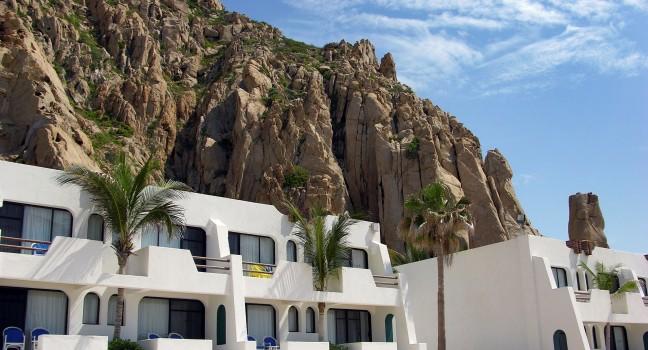
The resort building on Lovers' beach in Cabo San Lucas, Mexico.
Ramunas Bruzas / Shutterstock

Accessible only by boat, this charming beach at the tip of the Land's End peninsula is just as lovely as its name implies. Though the towering cliffs on either side lend an air of romantic seclusion, don't expect much privacy: it's one of the area's most photographed spots. It's an excellent place to swim and snorkel, with a variety of tropical fish easily visible in the clear, shallow water. Walk through a gap in the rocks to reach the cheekily named Divorce Beach (Playa del Divorcio); while the water at Lover's Beach faces the Sea of Cortez and is calm and pleasant, Divorce Beach is on the turbulent and unpredictable Pacific. It's far too dangerous for swimming, but ideal for sunbathing. Picnics are also popular, but be sure to bring your own food and refreshments; there may be a vendor or two selling drinks, but not reliably. To get here, you can hire a water taxi (called a "panga") to bring you there and back from Playa El Médano or the marina. Prices vary and can be negotiable depending on the vendor, but typically the cost can be $10--$20; the final departure back to shore is usually 4 pm. You can also rent a kayak, Jet Ski, or paddleboard and make your way over independently. Amenities: none. Best for: swimming; snorkeling.

Cabo San Lucas, 23410, Mexico

Something incorrect in this review?

Playa las Gatas

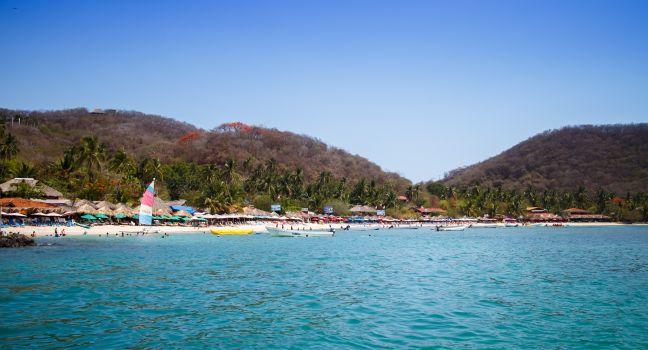
IXTAPA, ZIHUATANEJO/MEXICO -  JUN, 13: View of PLaya Las Gatas from a boat, this beach is accessible only by boat. Ixtapa, Zihuatanejo, Mexico on Jun, 13, 2013.
Chepe Nicoli / Shutterstock

Legend has it that a Tarascan king (from an indigenous, pre-Hispanic community) built the breakwater on Playa las Gatas to create a sheltered area for his daughter's exclusive use. Named for the gatas (cat-whiskered nurse sharks) that once lingered here, this beach is bordered by a long row of hewn rocks that create a breakwater. Snorkelers scope out the rocky coves, and surfers spring to life with the arrival of small but fun summer swells. The beach is lined with simple seafood eateries that provide lounge chairs for sunning, as well as kayak and snorkeling-gear rentals, and guiding services. (You really can't go wrong with any of the concessionaires, but La Red del Pescador, at the far end of the beach, has the best setup with the hippest music; ask for Cruz if you need a kayak guide.) Overlooking the beach is El Faro (the lighthouse); the view from the top is marvelous, but the safe path up can be hard to find—ask any of the waiters to point it out. You can reach Playa las Gatas in about 20 minutes by climbing over the rocks that separate it from Playa la Ropa. But it's much more common and convenient to take one of the skiffs that run from the municipal pier every 10 or 15 minutes between 8 am and 6 pm. Buy your round-trip ticket (about MX$80) on the pier, and keep the stub for your return trip. Amenities: food and drink; water sports. Best for: swimming; snorkeling.

Zihuatanejo, Mexico

Something incorrect in this review?

Acuario Inbursa

This Mexico City attraction has been a hit since it opened, attracting long lines of people eager to see the largest aquarium in the country. A visit to the site starts four stories underground, at the "bottom of the ocean," and moves upward toward the surface. Thousands of species of fish, sharks, rays, eels, jellyfish, and more swim among the ruins of a sunken ship, vibrantly colored coral, and gracefully swaying kelp, all dramatically lit in huge tanks. The "rain forest" exhibit is home to reptiles and amphibians such as Mexico's endangered, curious-looking ajolote salamander.

Av. Miguel de Cervantes Saavedra 386, 11529, Mexico
55-5395–4586
Sight Details
MP280

Something incorrect in this review?

Acuario Mazatlán

Olas Altas

A perfect child-pleaser—and a lot of fun for adults, too—Mazatlán's homey little aquarium has more than 50 tanks with sharks, sea horses, and multicolor salt- and freshwater fish. Animal shows featuring kissing sea lions, skating macaws, and penny-pinching parrots are offered three times daily. Note that if you sit in the front, you will get splashed! The grounds aren't extensive, but there are two turtle and crocodile habitats and a small aviary, as well as a gift shop and snack bar.

Av. de los Deportes 111, Mazatlán, 82000, Mexico
669-981–7815
Sight Details
$7.50
Daily 9:30–6

Something incorrect in this review?

Agua Azul

The series of waterfalls and crystalline blue pools at Agua Azul is breathtaking, especially during the dry season (from about November through March), as wet-season waters are often churned up and brown with mud. You can swim in a series of interconnected pools.

If the single cascade at nearby Misol-Há is less grandiose than the series of falls and pools at Agua Azul, it's no less amazing. You can swim in the pool formed by the 100-foot cascade, or explore behind the falls, where a cave leads to a subterranean pool. For safety reasons (the currents are deceptively fast and you may need someone to keep an eye on your belongings if you swim), we recommend visiting on a guided tour.

Mexico

Something incorrect in this review?

Aguas Termales Santa Rita

It might not be an obvious bet to seek out natural hot springs in a warm weather destination, but the Aguas Termales Santa Rita are truly special. This divinely sculpted Jacuzzi is an enchanting place to soak and relax, and there's a refreshing, cool-water river bend just a few steps away, ideal for moving back and forth between the two. The smell of sulfur is strong, but you get used to it, and it does wonders for your skin and any body aches. Assuming you bring your own provisions, there are areas to sit and eat (complete with picnic tables and basic grills) and even overnight campsites. It's a long drive down a dirt road to get here, but it adds to the charm and adventure of the experience. You will not have cell reception, so downloading Maps in advance is a must. You'll need cash to pay the entry fee, collected presumably by the family who lives on the land.

Note: there are two hot springs compounds right next to each other, with separate entrances and fees. The first, Los Encinos, is not as nice as Santa Rita, but could be ideal for families with young children as the water is more shallow and space more confined, making it easier to supervise your brood. Everyone else should continue driving just another hundred yards more to reach Santa Rita.

23500, Mexico
Sight Details
$8

Something incorrect in this review?

Aké

Experts estimate that Aké was populated between AD 250 and 900; today many people in the area have Aké as a surname. The city seems to have been related to the very important and powerful one at present-day Izamal. In fact, the two cities were once connected by a sacbé (white road) 13 meters (43 feet) wide and 33 km (20 miles) long. All that has been excavated so far are two pyramids, one with rows of columns (35 total) at the top, reminiscent of the Toltec columns at Tula, north of Mexico City.

Nearby, workers process sisal in a rusty-looking factory, which was built in the early 20th century. To the right of this dilapidated building are the ruins of the Hacienda and Iglesia de San Lorenzo Aké, both constructed of stones taken from Maya buildings.

97476, Mexico
Sight Details
MX$70

Something incorrect in this review?

Akumal Bay

Known for the sea turtles that swim in its waters, Akumal Bay is sheltered by an offshore reef—though, sadly only about 30% of it is alive. It's best to explore the waters with a certified guide available through dive shops in town. Do not wear sunscreen in the water as it can harm the reef, and, above all, do not touch the wildlife or coral. Be careful to stay clear of the red "fire reef," which stings on contact. When you drag yourself away from the snorkeling, there are plenty of palm trees for shade, as well as a variety of waterfront shops, restaurants, and cafés. If you continue on the main road, you'll reach Half Moon Bay and Laguna Yal-kú, also good snorkeling spots. Amenities: food and drink; lifeguards; parking (fee); showers; toilets; water sports. Best for: snorkeling; swimming; walking.

Akumal, 77760, Mexico

Something incorrect in this review?

Alameda de León

Centro Historico

This shady square, a bit smaller than the zócalo, is bordered by the massive cathedral on one side and the post office on the other. Locals gossip on wrought-iron benches or read the newspaper while their children chase pigeons and blow bubbles. Throughout the day, street artists perform alongside the cathedral.

Oaxaca, 68000, Mexico

Something incorrect in this review?

Alberca Olímpica Francisco Márquez

Benito Juárez
If you’ve ever wanted to swim in an Olympic-size pool, this one from the 1968 Olympic games (and the largest pool in all of Mexico) might be your best option. Created just for the 1968 games, today it serves as a neighborhood pool that offers open swim for all levels. Water polo and scuba diving are also options in the pool area, while the neighboring Gimnasio Olímpico Juan de la Barrera hosts volleyball and basketball pick-up and league games, tae kwon do classes, and other sports.
División del Norte 2333, Mexico City, Mexico
55-5604–8344
Sight Details
MP361 (unlimited visits for a month)

Something incorrect in this review?