


Ayasofya Mosque
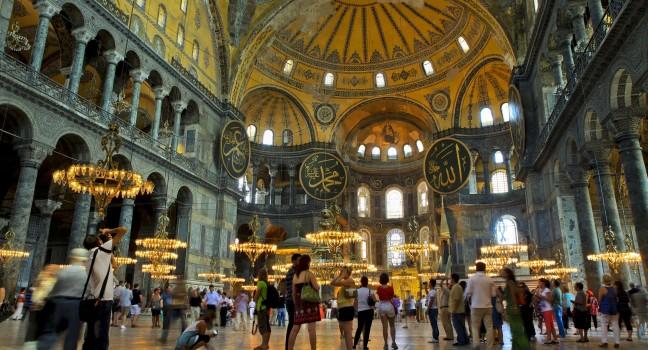
Variously referred to as either Hagia Sophia or Ayasofya, this soaring edifice is perhaps the greatest work of Byzantine architecture, and for almost a thousand years, starting from its completion in 537, it was the world's largest and most important religious monument. As Emperor Justinian may well have intended, the impression that will stay with you longest, years after a visit, is the sight of the dome. As you enter, the half domes trick you before the great space opens up with the immense dome, almost 18 stories high and more than 100 feet across, towering above. Look up into it, and you'll see the spectacle of thousands of gold tiles glittering in the light of 40 windows. Only Saint Peter's in Rome, not completed until the 17th century, surpasses Ayasofya in size and grandeur. It was the cathedral of Constantinople, the heart of the city's spiritual life, and the scene of imperial coronations.
When Mehmet II conquered the city in 1453, he famously sprinkled dirt on his head before entering the church after the conquest as a sign of humility. His first order was for Ayasofya to be turned into a mosque, and, in keeping with the Islamic proscription against figural images, mosaics were plastered over. Successive sultans added the four minarets, mihrab (prayer niche), and minbar (pulpit for the imam) that visitors see today, as well as the large black medallions inscribed in Arabic with the names of Allah, Muhammad, and the early caliphs. In 1935, Atatürk turned Ayasofya into a museum—a project of restoration, including the uncovering of precious mosaics, began, with the later now mostly finished and visible. In 2020, Ayasofya reverted into an active mosque, but it's possible to visit as a non-Muslim.
Restoration efforts uncovered, among other things, four large, beautifully preserved mosaics of seraphim, or six-winged angels, in the pendentive of the dome, which had been plastered over 160 years earlier but these and the mosaics in the upstairs galleries are currently closed. At the far end of the south gallery are several imperial portraits, including, on the left, the Empress Zoe, whose husband's face and name were clearly changed as she went through three of them. On the right is Emperor John Comnenus II with his Hungarian wife Irene and their son, Alexius, on the perpendicular wall. Also in the upper level is the great 13th-century Deesis mosaic of Christ flanked by the Virgin and John the Baptist, breathing the life of the early Renaissance that Byzantine artists would carry west to Italy after the fall of the city to the Turks—note how the shadows match the true light source to the left. The central gallery was used by female worshippers. The north gallery is famous for its graffiti, ranging from Nordic runes to a complete Byzantine galley under sail. On your way out of the church, through the "vestibule of the warriors," a mirror reminds you to look back at the mosaic of Justinian and Constantine presenting Ayasofya and Constantinople, respectively, to the Virgin Mary.
The tombs of various sultans and princes can be visited for free through a separate entrance around the back of Ayasofya (daily 9–7:30).


