8 Best Sights in Istanbul, Turkey

Background Illustration for Sights

We've compiled the best of the best in Istanbul - browse our top choices for the top things to see or do during your stay.

İstanbul Arkeoloji Müzeleri
Sultanahmet Fodor's Choice
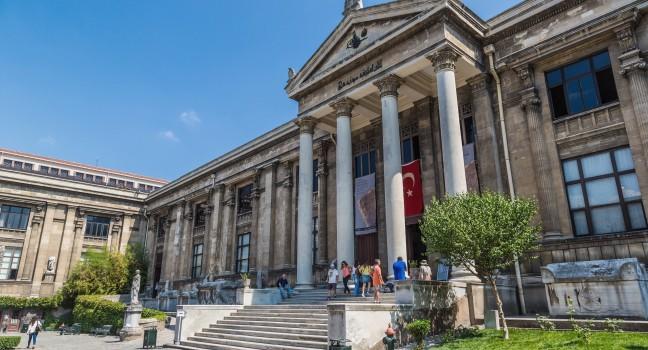
ISTANBUL - MAY 25: Istanbul Archaeology Museums on may 25, 2013 in Istanbul, Turkey. The complex of three museums contain more than a million pieces of different eras.
S-F / Shutterstock

Step into this vast repository of spectacular finds, housed in a three-building complex in a forecourt of Topkapı Palace, to get a head-spinning look at the civilizations that have thrived for thousands of years in and around Turkey. The main museum was established in 1891, when forward-thinking archaeologist and painter Osman Hamdi Bey campaigned to keep native antiquities and some items from the former countries of the Ottoman Empire in Turkish hands. The most stunning pieces are sarcophagi that include the so-called Alexander Sarcophagus, found in Lebanon, carved with scenes from Alexander the Great's battles, and once believed, wrongly, to be his final resting place. A fascinating exhibit on Istanbul through the ages has artifacts and fragments brought from historical sites around the city that shed light on its complex past, from prehistory through the Byzantine period. Exhibits on Anatolia include a display of some of the artifacts found in excavations at Troy, including a smattering of gold jewelry.

Don't miss a visit to the Çinili Köşk (Tiled Pavilion), one of the most visually pleasing sights in all of Istanbul—a bright profusion of colored tiles covers this onetime hunting lodge of Mehmet the Conqueror, built in 1472. Inside are ceramics from the early Seljuk and Ottoman empires, as well as brilliant tiles from İznik, the city that produced perhaps the finest ceramics in the world during the 16th and 17th centuries. In summer, you can mull over these glimpses into the distant past as you sip coffee or tea at the café in the garden, surrounded by fragments of ancient sculptures.

The Eski Şark Eserleri Müzesi (Museum of the Ancient Orient) transports you to even earlier times: a majority of the panels, mosaics, obelisks, and other artifacts here, from Anatolia, Mesopotamia, and elsewhere in the Arab world, date from the pre-Christian centuries. One of the most significant pieces in the collection is a 13th-century BC tablet on which is recorded the Treaty of Kadesh, perhaps the world's earliest known peace treaty, an accord between the Hittite King Hattusili III and the Egyptian pharaoh Ramesses II. Also noteworthy are reliefs from the ancient city of Babylon, dating from the era of the famous king Nebuchadnezzar II. As of this writing, it is temporarily closed.
Topkapı Sarayı

Sultanahmet Fodor's Choice
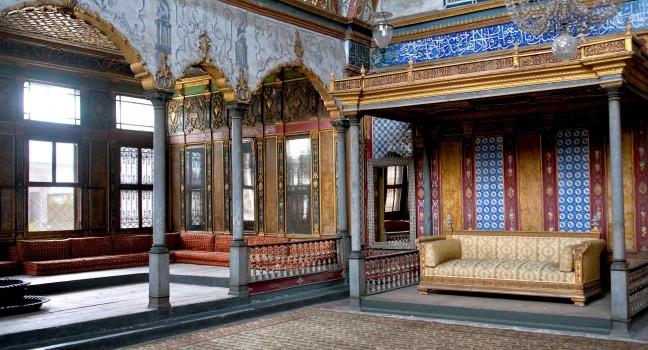
Harem in Topkapi palace, Istanbul, Turkey
vvoe / Shutterstock

This vast palace on Sarayburnu (Seraglio Point) was the residence of sultans and their harems in addition to being the seat of Ottoman rule from the 1460s until the mid-19th century, when Sultan Abdülmecid I moved his court to Dolmabahçe Palace. Sultan Mehmet II built the original Topkapı Palace between 1459 and 1465, shortly after his conquest of Constantinople. Over the centuries, it grew to include four courtyards and quarters for some 5,000 full-time residents. The main entrance, or Imperial Gate, leads to the Court of the Janissaries, also known as the First Courtyard. The modestly beautiful Hagia Irene (Church of St. Irene) is believed to stand on the site of the first church of Byzantium (separate admission). You will begin to experience the grandeur of the palace when you pass through the Bab-üs Selam (Gate of Salutation). Enter the Harem (separate admission) on the other side of the Divan from the Outer Treasury. The Treasury contains the popular jewels, including the 86-carat Spoonmaker's Diamond, the emerald-studded Topkapı Dagger, and two uncut emeralds (each weighing about 8 pounds).

Yerebatan Sarnıcı

Sultanahmet Fodor's Choice
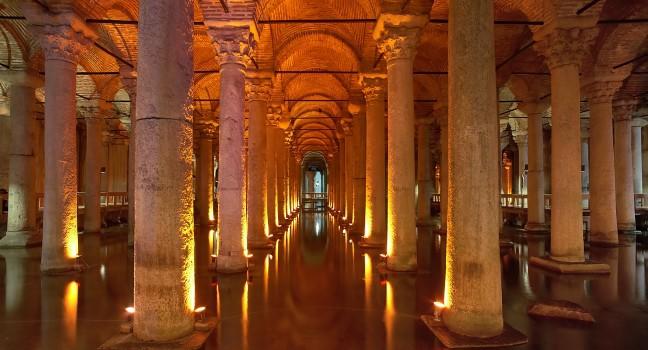
Underground Basilica Cistern (Yerebatan Sarnici) in Istanbul, Turkey.
Mikhail Markovskiy / Shutterstock

The major problem with the site of Byzantium was the lack of fresh water. So, for the city to grow, a great system of aqueducts and cisterns was built, the most famous of which is the Basilica Cistern, whose present form dates from the reign of Justinian in the 6th century. A journey through this ancient underground waterway takes you along dimly lit walkways that weave around 336 marble columns rising 26 feet to support Byzantine arches and domes, from which water drips unceasingly. The two most famous columns feature upturned Medusa heads. The cistern was always kept full as a precaution against long sieges, and fish, presumably descendants of those that arrived in Byzantine times, still flit through the dark waters. A hauntingly beautiful oasis of cool, shadowed, cathedral-like stillness (with Turkish instrumental music playing softly in the background), the cistern is a particularly relaxing place to get away from the hubbub of the Old City. What's more, an extensive renovation has just been completed, which aimed to strengthen its resilience against earthquakes. Come early to avoid the long lines and have a more peaceful visit.

Yerebatan Cad. at Divan Yolu, Istanbul, Türkiye
212-512–1570
Sight Details
Day ticket TL900. Night ticket TL1,400.

Something incorrect in this review?

Recommended Fodor's Video

Askeri Müze

Nisantasi

This large and fascinating museum boasts an extensive collection of swords, daggers, armor, and other weaponry, but it's not just for those interested in military history. Exhibits on the history of Turkic armies going back to the Huns, the Ottoman conquest of Istanbul, and more recent Turkish military engagements show the importance of military strength in shaping Ottoman history and modern Turkish society. Two gorgeously embroidered silk tents used by the Ottoman sultans on campaigns are particularly impressive. And don't miss the section of the great chain that the Byzantines stretched across the Golden Horn in 1453 during the Ottoman siege of the city. The highlight is the Mehter, or Janissary military band, which performs 17th- and 18th-century Ottoman military music in full period costume in a special auditorium at 3 pm when they're in town (most days when the museum is open). Watching this 55-member-strong ensemble, with their thunderous kettledrums and cymbals, will certainly give you an idea of why the Ottoman army was so feared in its day.

Deniz Müzesi

Besiktas

Founded in 1897 and located here since 1961, Istanbul's Naval Museum reopened in late 2013 with a new, state-of-the-art wing that impressively showcases its large collection of Ottoman-era boats and maritime paraphernalia. The multistory, hangar-like structure was built to house more than a dozen kayıks (caiques)—long, slim wooden boats rowed by oarsmen, that served as the primary mode of royal transportation in Istanbul for several hundred years. These graceful vessels are decorated with gorgeous painted patterns and intricate carvings and figureheads covered with gold leaf; most also have an equally ornate curtained wooden pavilion that was built for the sultan, his wife, or his mother. The underground level houses several exhibits of paintings, naval coats of arms, and other objects that give a good sense of the Ottoman Empire's onetime supremacy at sea. In the square just beside the museum are the tomb (usually locked) and a statue of Hayreddin Pasha, or "Barbarossa," the famous admiral of the empire's fleet in the Ottoman glory days of the early 16th century.

Beşiktaş Cad., Istanbul, Türkiye
212-327–4346
Sight Details
400 TL
Closed Mon.

Something incorrect in this review?

Gülhane Parkı

Sultanahmet

Central Istanbul has precious few public green spaces, which makes this park—once the private gardens of the adjacent Topkapı Palace—particularly inviting. Shaded by tall plane trees, the paved walkways, grassy areas, gazebos, and flower beds make this a relaxing escape from the nearby bustle of Sultanahmet. Walk all the way to the end of the park for excellent views of the Bosphorus and the Sea of Marmara. The Istanbul Museum of the History of Science and Technology in Islam is inside the park, as are a municipal-run café and a couple of places serving tea and snacks.

Alemdar Cad., Istanbul, Türkiye

Something incorrect in this review?

Rahmi M. Koç Müzesi

Western Districts

Housed on the grounds of an Ottoman-era shipyard on the shore of the Golden Horn, and in an adjacent foundry where anchors were cast for the Ottoman fleet, this museum complex was founded by one of Turkey's leading industrialists. The wonderful, eclectic collection includes aircraft, boats, a submarine, a tank, trucks, trains, a horse-drawn tram, motorcycles, antique cars, medieval telescopes, and every type of engine imaginable. Along with the many vehicles and machines, interactive displays on science and technology, as well as recreations of a sawmill and a 1920s olive oil factory, are of special appeal to children. There are several on-site food and beverage venues, including Café du Levant, a Parisian-style bistro with Art Nouveau furnishings, and the waterfront Halat Restaurant. Take a Golden Horn ferry, a bus from Şişhane, or a taxi to get here.

Rumeli Hisarı

Bosphorus

Built on a hill on the European side of the city overlooking the water, Rumeli Hisarı is the best preserved of all the fortresses on the Bosphorus and well worth a visit. Constructed in just four months in 1452, this eccentric-looking complex was ordered by Mehmet the Conqueror to be situated directly across from Anadolu Hisarı, at the narrowest point of the strait. This allowed the Ottomans to take control of the waterway, and Mehmet and his troops conquered Constantinople the following year.