10 Best Sights in The Pyrenees, Spain

Background Illustration for Sights

We've compiled the best of the best in The Pyrenees - browse our top choices for the top things to see or do during your stay.

Ordesa and Monte Perdido National Park
Fodor's Choice
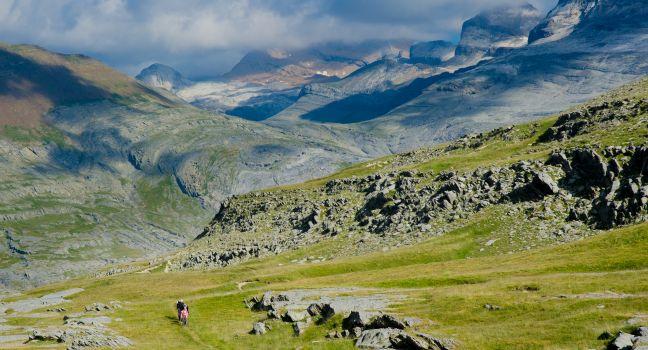
PYRENEES, SPAIN - CIRCA JULY, 2012 - Two peple hiking in the Spanish Pyrenees (GR11 trail) near Ordesa y Monte Perdido National Park, Spain
Michal Szymanski / Shutterstock

Welcome to the wildest, most unspoiled corner of the Pyrenees. The three main valleys of this national park—Ordesa, Pineta, and Añisclo—are carved out by the Ara River and its tributaries, the Arazas. They culminate in the majestic massif of Monte Perdido, which stands at 3,350 meters (11,000 feet) on the Franco-Spanish border; it's the highest of the park's three main mountains. The remote yet worthwhile valley of Las Gargantas de Escuaín is famous for its dolmen and soaring rock walls. Throughout the park, you'll find lakes, waterfalls, high mountain meadows, and forests of pine, fir, larch, beech, and poplar. Protected wildlife includes trout, boar, chamois, lammergeier, and the sarrio mountain goat (Rupicapra pyrenaica).

\n

Well-marked mountain trails lead to waterfalls, caves, and spectacular observation points. The Cola de Caballo, for example, is a five-to-six-hour round-trip route to one of those majestic waterfalls. From mid-July to mid-September and during Holy Week holidays, the town of Torla offers a shuttle service every 15 minutes to the trailhead in Pradera de Ordesa to manage overcrowded parking.
Vall de Núria Rack Railway (Cremallera)

Fodor's Choice
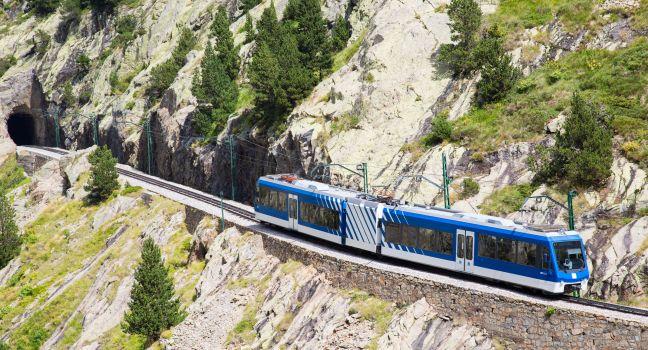
Cogwheel railway in the valley of Nuria Catalan Pyrenees
135pixels / Shutterstock

The 45-minute train ride from the town of Ribes de Freser up to Núria provides one of Catalonia's most eclectic excursions—in few other places in Spain does a train make such a precipitous ascent. The cogwheel train, nicknamed La Cremallera (\"The Zipper\" in English), was completed in 1931 to connect Ribes with the Santuari de la Mare de Déu de Núria (Mother of God of Núria) and with hiking trails and ski runs.

Pasarelas de Alquézar

Fodor's Choice

Take a breathtaking riverside hike (1½-2 hours) on the Ruta de las Pasarelas loop, which hugs near-sheer cliffs that plunge into rushing turquoise waters. There's a waterfall, a cave, and plenty of placards with information on the surrounding nature and historical buildings. Be sure to bring plenty of water and to arrive early, since parking (follow the signs) is limited. Certain stretches are on metal pathways with steep drops, so those with limited mobility or a fear of heights should skip this one. The trail starts at Plaza de Rafael Ayerbe beside the ayuntamiento (town hall). No bikes or pets are allowed.

Recommended Fodor's Video

Canfranc International Railway Station

In July and August, a guided train tour departs from the Jaca RENFE station, heading to the valley and Canfranc's magnificent Belle Époque train station, which has a bewitching history and was used as a location in the 1965 film Doctor Zhivago. At the time of writing the summer guided tour had not been announced, but a non-tourist train runs year-round between Jaca and Canfranc. The Canfranc station, right at the border of France, had been famously abandoned since 1970 and was slowly falling to pieces until the Barceló group opened a 104-room luxury five-star hotel in the building early this year. Unfortunately, many of the areas are now restricted to hotel guests. If you're staying elsewhere, the Canfranc tourism office also offers guided tours of some areas to visitors. 

Castillo de Loarre

This massively walled 11th-century structure surrounded by rocky outcroppings is perhaps the best-preserved Romanesque castle in Europe. Inside the walls are a church, tower, dungeon, and even a medieval toilet. The strategic vantage point commands views of the almond and olive groves in the Ebro basin.

Castillo de Loarre, 22809, Spain
974-342161
Sight Details
€6
Closed Mon. in winter

Something incorrect in this review?

EMOZ (Escuela Museo Origami Zaragoza)

Within Zaragoza's Centro de Historias, EMOZ houses one of the finest collections of origami in the world. These eye-popping exhibitions change themes seasonally and reveal the surprising story of Zaragoza's historical connection to the art of paper folding.

Pl. San Agustín 2, Zaragoza, 50002, Spain
876-034569
Sight Details
€3
Closed Mon.

Something incorrect in this review?

Ligne de Cerdagne

Affectionately called le train jaune (\"the yellow train\"), this line runs from Bourg-Madame and La Tour de Querol, both easy hikes over the border into France from Puigcerdà (Bourg-Madame is the closest). The border at La Tour, a pretty hour-long hike from Puigcerdà, is marked by a stone painted with the Spanish and French flags. The carrilet (narrow-gauge railway) is the last in the Pyrenees and is used for tours as well as transportation; it winds slowly through La Cerdanya to the medieval walled town of Villefranche-de-Conflent, where it can also be picked up. The 63-km (39-mile) tour can take most of the day, especially if you stop to browse in Mont-Louis or Villefranche. The last section, between La Cabanasse and Villefranche, is the most picturesque. In low season, the trains have infrequent and unpredictable timetables.

Ctra. Cruïlla N152 N260, Puigcerdà, 17520, Spain
972-140665-Cerdanya tourist office (Spain)
Sight Details
€45 round-trip from Bourg-Madame to Villefranche (check for frequent online discounts)

Something incorrect in this review?

Museo del Foro de Caesaraugusta

Remains of the Roman forum and elaborate sewage system can be seen here. Two more Roman sites, the thermal baths at Calle de San Juan y San Pedro and the river port at Plaza San Bruno, are also open to the public. English-language audio guides are available.

Pl. de la Seo 2, Zaragoza, 50001, Spain
976-721221
Sight Details
€4
Closed Mon.

Something incorrect in this review?

Parque Cultural del Río Vero

A UNESCO World Heritage site, this park within the Sierra de Guara contains more than 60 limestone caves with prehistoric paintings. Some date to around 22,000 BC, though most are from between 12,000 and 4000 BC. Information, guided tours, and kid-friendly activities are available through the interpretation center in Colungo; check the monthly schedule on the home page. Hours vary, so call ahead.

Calle Las Braules 2, 22148, Spain
974-306006
Sight Details
Free (€3–€5 for some exhibits)

Something incorrect in this review?

Selva de Irati

A 15-km (9-mile) detour north through the town of Orbaizeta up to the headwaters of the Irati River, at the Irabia Reservoir, gets you a good look at the Selva de Irati, one of Europe's major beech forests and the source of much of the lumber for the Spanish Armada. Today it's a popular nature reserve that's veined with trails from which you might glimpse wildlife like deer, woodpeckers, wild boar, and even wolverines. Notably, it also contains megalithic cromlechs and dolmens around the villages of Azpegi and Orbaizeta.