3 Best Sights in Barcelona, Spain

Background Illustration for Sights

We've compiled the best of the best in Barcelona - browse our top choices for the top things to see or do during your stay.

Real Monestir de Santa Maria de Pedralbes
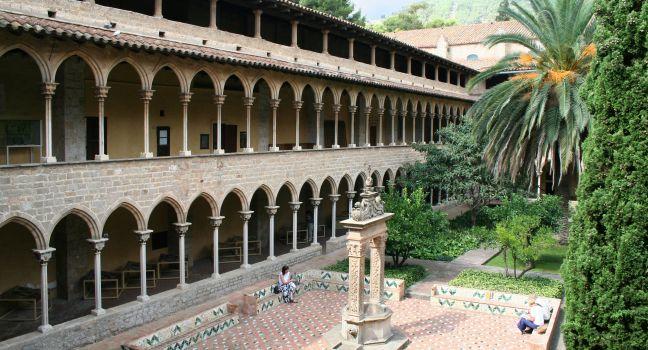
Pedralbes Fodor's Choice
Courtyard, Monestir de Pedralbes, Barcelona, Spain
Solodovnikova Elena / Shutterstock

This marvel of a monastery, named for its original white stones (pedres albes, from the Latin petras albas), is really a convent, founded in 1326 for the Franciscan order of Poor Clares by Reina (Queen) Elisenda. The three-story Gothic cloister, one of the finest in Europe, surrounds a lush garden. The day cells, where the nuns spent their mornings praying, sewing, and studying, circle the arcaded courtyard.

The Capella de Sant Miquel, just to the right of the entrance, has murals painted in 1346 by Catalan master Ferrer Bassa. Look for the letters spelling out "No m’oblidi/ digui-li a Joan/ a quatre de setembre de 1415” ("Do not forget me / tell John / September 4, 1415") scratched between the figures of St. Francis and St. Clare (with book and quill). While the true meaning of the message is unknown, one theory is that it was written by a brokenhearted novice.

The nuns' upstairs dormitory contains the convent's treasures: paintings, liturgical objects, and seven centuries of artistic and cultural patrimony. Temporary exhibits are displayed in this space. The refectory, where the Poor Clares dined in silence, has a pulpit used for readings, while wall inscriptions exhort Silentium ("Silence"), Audi tacens ("Listen carefully"), and Considera morientem ("Consider, we are dying"). Notice the fading mural in the corner, and the broken paving tiles—according to unsubstantiated legend, the result of the heavy cannon positioned here during the 1809 Napoleonic occupation.

The monastery is now a museum, housing permanent exhibitions on its own art and legacy as well as third-party special exhibitions from time to time. There are occasional open-air concerts in the cloister, especially of Medieval music; check local event listings and book a seat if you can.

Baixada del Monestir 9, Barcelona, 08034, Spain
93-256–3434
Sight Details
€5; free for visitors under 16, and with the Barcelona Card; free Sun. after 3 pm, and 1st Sun. of every month
Closed Mon.

Something incorrect in this review?

Baixada de Santa Eulàlia

Barri Gòtic

Down Carrer Sant Sever from the side door of the cathedral cloister, past Carrer Salomó ben Adret and the Esglèsia de Sant Sever, is a tiny shrine, in an alcove overhead, dedicated to the 4th-century martyr Santa Eulàlia, former patron saint of the city (before she was replaced by current patron saint Mare de Deu de la Mercè). Down this hill, or baixada (descent), Eulàlia was rolled in a barrel filled with—as the Jacint Verdaguer verse in ceramic tile on the wall reads—glavis i ganivets de dos talls (swords and double-edged knives), the final of the 13 tortures to which she was subjected before her crucifixion at Plaça del Pedró.

Carrer Sant Sever s/n, Barcelona, 08002, Spain

Something incorrect in this review?

Basílica de la Mercè (Basilica of Our Lady of Mercy)

Barri Gòtic

This Gothic-style basilica is dedicated to La Mare de Déu de la Mercè (Our Lady of Mercy), who was proclaimed as the second patron saint of Barcelona in 1687 (the first being Santa Eulàlia). The curved Baroque facade is unlike anything you will see in other parts of the city. On the top of the basilica is a stone figure of Our Lady holding a baby Jesus and with her arms outstretched. Her feast day is on September 24 and is celebrated with the festival of Mercè (otherwise known simply as "La Mercè").

Recommended Fodor's Video