4 Best Sights in Italy

Background Illustration for Sights

We've compiled the best of the best in Italy - browse our top choices for the top things to see or do during your stay.

Biblioteca Nazionale Marciana
Piazza San Marco
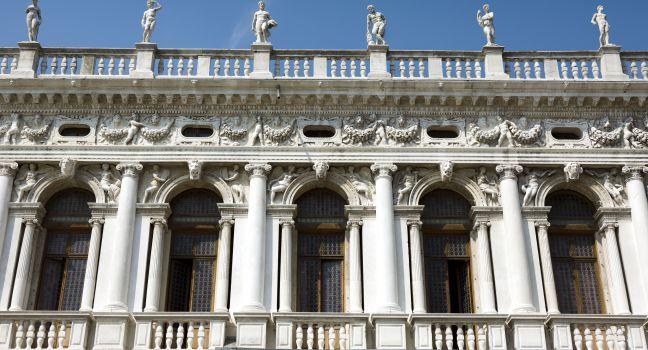
Facade of the National Library (Biblioteca Nazionale Marciana) in St Mark's Square. ; Shutterstock ID 157845704; Project/Title: World's 20 Most Stunning Libraries; Downloader: Fodor's Travel
Myroslava/Shutterstoc

There's a wondrous collection of centuries-old books and illuminated manuscripts at this library, located across the piazzetta (small square) from Palazzo Ducale in two buildings designed by Renaissance architect Sansovino, Libreria Sansoviniana (Sansovinian Library) and the adjacent Zecca (Mint). The complex was begun in 1537, and the Zecca was finished in 1545. Facing the Bacino (San Marco basin), the Zecca along with the Palazzo Ducale form Venice's front door. The Palazzo Ducale, built during a period of Venetian ascendance and self-confident power, is light and decidedly unmenacing. The Zecca, built in a time when the Republic had received some serious defeats and was economically strapped, is purposefully heavy and stresses a fictitious connection with the classical world. The library is, again, much more graceful and was finished according to Sansovino's design only after his death. Palladio was so impressed by the Biblioteca that he called it "beyond envy."

The books can only be viewed by written request and are primarily the domain of scholars. But the Monumental Rooms in the Sansoviniana are worth visiting for the works of Veronese, Tintoretto, and Titian that decorate its walls. You reach the Monumental Rooms, which often host special exhibits, through the Museo Correr.

Piazza San Marco 7, Venice, 30124, Italy
041-2407211
Sight Details
Museums of San Marco Pass €30 (€25 when booked online at least 30 days in advance), includes Museo Correr, Museo Archeologico, Biblioteca Nazionale Marciana, and Palazzo Ducale. Museum Pass €41, includes all four museums plus seven civic museums

Something incorrect in this review?

Biblioteca Medicea Laurenziana

San Lorenzo

Michelangelo the architect was every bit as original as Michelangelo the sculptor. He was interested in experimentation, invention, and the expression of a personal vision that was at times highly idiosyncratic. It was never more idiosyncratic than in the Laurentian Library, begun in 1524 and finished in 1568 by Bartolomeo Ammannati. Its famous vestibolo, a strangely shaped anteroom, has had scholars scratching their heads for centuries. In a space more than two stories high, why did Michelangelo limit his use of columns and pilasters to the upper two-thirds of the wall? Why didn't he rest them on strong pedestals instead of on huge, decorative curlicue scrolls, which rob them of all visual support? Why did he recess them into the wall, which makes them look weaker still? The architectural elements give the room a soft, rubbery look that is one of the strangest effects ever achieved by 16th-century architecture.

Piazza San Lorenzo 9, Florence, 50123, Italy
055-2937911
Sight Details
Check ahead on admission price for special exhibitions, opening days and times as this site has seen temporary closures

Something incorrect in this review?

Oratorio dei Filippini

Piazza Navona

Housed in a Baroque masterwork by Borromini, this former religious residence named for Saint Philip Neri, founder in 1551 of the Congregation of the Oratorians, now contains Rome's Archivio Storico. Like the Jesuits, the Oratorians—or Filippini, as they were commonly known—were one of the religious orders established in the mid-16th century as part of the Counter-Reformation. Neri, a man of rare charm and wit, insisted that the members of the order—most of them young noblemen whom he had recruited personally—not only renounce their worldly goods, but also work as common laborers in the construction of Neri's great church of Santa Maria in Vallicella.

The Oratory itself, built between 1637 and 1662, has a gently curving facade that is typical of Borromini, who insisted on introducing movement into everything he designed. The inspiration here is that of arms extended in welcome to the poor. The building houses the Vallicelliana Library founded by Philip Neri, and the courtyard is usually accessible during the library's opening hours. Otherwise, guided visits, usually in the mornings, can be booked by email.

Piazza della Chiesa Nuova (Corso Vittorio Emanuele), Rome, 00186, Italy
06-6893868
Sight Details
Closed weekends

Something incorrect in this review?

Recommended Fodor's Video

Palazzo Zuccari

Piazza di Spagna

This amusing palazzo was designed in 1591 by noted painter Federico Zuccari (1540–1609), who frescoed the first floor of his custom-built home. Typical of the outré Mannerist style of the period, the two windows and the main door are designed to look like monsters with mouths gaping wide. Zuccari—whose frescoes adorn many Roman churches, including Trinità dei Monti just up the block—sank all his money into his new home, dying in debt before his curious memorial, as it turned out, was completed.

Today, it is home to the German state-run Bibliotheca Hertziana, a prestigious fine-arts library. Access is reserved for scholars, but the pristine facade can be admired for free. Leading up to the quaint Piazza della Trinità del Monti, the nearby Via Gregoriana is quite charming and has long been one of Rome's most elegant addresses, home to such residents as 19th-century French painter Ingres; Valentino also had his first couture salon here.

Via Gregoriana, 28, Rome, 00187, Italy
06-69993201-Bibliotheca Hertziana
Sight Details
The Bibliotheca occasionally offers guided tours. Otherwise, request a visit by email.

Something incorrect in this review?