95 Best Sights in Italy

Background Illustration for Sights

We've compiled the best of the best in Italy - browse our top choices for the top things to see or do during your stay.

Parco Archeologico della Neapolis

Archaeological Zone Fodor's Choice

 Siracusa is most famous for its dramatic set of Greek and Roman ruins, which are considered to be some of the best archaeological sites in all of Italy and should be combined with a stop at the Museo Archeologico. If the park is closed, go up Viale G. Rizzo from Viale Teracati to the belvedere overlooking the ruins, which are floodlit at night.

Before the park's ticket booth is the gigantic Ara di Ierone (Altar of Hieron), which was once used by the Greeks for spectacular sacrifices involving hundreds of animals. The first attraction in the park is the Latomia del Paradiso (Quarry of Paradise), a lush tropical garden full of palm and citrus trees. This series of quarries served as prisons for the defeated Athenians, who were enslaved; the quarries once rang with the sound of their chisels and hammers. At one end is the famous Orecchio di Dionisio (Ear of Dionysius), with an ear-shape entrance and unusual acoustics inside, as you'll hear if you clap your hands. The legend is that Dionysius used to listen in at the top of the quarry to hear what the enslaved people were plotting below.

The Teatro Greco is the chief monument in the Archaeological Park. Indeed it's one of Sicily's greatest classical sites and the most complete Greek theater surviving from antiquity. Climb to the top of the seating area (which could accommodate 15,000) for a fine view: all the seats converge upon a single point—the stage—which has the natural scenery and the sky as its backdrop. Hewn out of the hillside rock in the 5th century BC, the theater saw the premieres of the plays of Aeschylus, and Greek tragedies are still performed here every year in May and June. Above and behind the theater runs the Via dei Sepulcri, in which streams of running water flow through a series of Greek sepulchres.

The well-preserved and striking Anfiteatro Romano (Roman Amphitheater) reveals much about the differences between the Greek and Roman personalities. Where drama in the Greek theater was a kind of religious ritual, the Roman amphitheater emphasized the spectacle of combative sports and the circus. This arena is one of the largest of its kind and was built around the 2nd century AD. The corridor where gladiators and beasts entered the ring is still intact, and the seats (some of which still bear the occupants' names) were hauled in and constructed on the site from huge slabs of limestone.
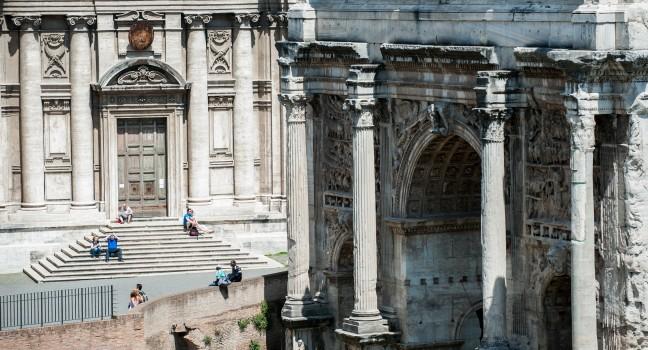
Arco di Settimio Severo

Campitelli Fodor's Choice
Arco di Settimio Severo, Rome, Italy
© Ross Brinkerhoff / Fodor’s Travel

One of the grandest triumphal arches erected by a Roman emperor, this richly decorated monument was built in AD 203 to celebrate Severus's victory over the Parthians. It was once topped by a bronze statuary group depicting a chariot drawn by four (or perhaps as many as six) life-size horses. Masterpieces of Roman statuary, the stone reliefs on the arch were probably based on huge painted panels depicting the event, a kind of visual report on his foreign campaigns that would have been displayed during the emperor's triumphal parade in Rome to impress his subjects (and, like much statuary then, were originally painted in florid, lifelike colors).

West end of Foro Romano, Rome, 00186, Italy
Sight Details
€18 24-hr ticket required

Something incorrect in this review?

Colosseum

Colosseo Fodor's Choice
Colosseum, Rome, Italy
© Ross Brinkerhoff / Fodor’s Travel

The most spectacular extant edifice of ancient Rome, the Colosseum has a history that is half gore, half glory. Once able to house 50,000 spectators, it was built to impress Romans with its spectacles involving wild animals and fearsome gladiators from the farthest reaches of the empire. Senators had marble seats up front, the vestal virgins took the ringside position, the plebs sat in wooden tiers at the back, and the masses watched from the top tier. Looming over all was the amazing velarium, an ingenious system of sail-like awnings rigged on ropes and maneuvered by sailors from the imperial fleet, who would unfurl them to protect the arena's occupants from sun or rain.

From the second floor, you can get a bird's-eye view of the hypogeum—the subterranean passageways that were the architectural engine rooms that made the slaughter above proceed like clockwork. In a scene prefiguring something from Dante's Inferno, hundreds of beasts would wait to be launched via a series of slave-powered hoists and lifts into the bloodthirsty sand of the arena above.

Designed by order of the emperor Vespasian in AD 72 and completed by his son Titus in AD 80, the arena has a circumference of 573 yards, and its external walls were built with travertine from nearby Tivoli. Its construction was a remarkable feat of engineering, for it stands on marshy terrain reclaimed by draining an artificial lake that formed part of the vast palace of Nero. Originally known as the Flavian amphitheater (Vespasian's and Titus's family name was Flavius), it came to be known as the Colosseum thanks to a colossal gilded bronze statue that once stood nearby.

The legend made famous by the Venerable Bede says that as long as the Colosseum stands, Rome will stand; and when Rome falls, so will the world . . . not that the prophecy deterred medieval and Renaissance princes and popes from using the Colosseum as a quarry. In the 19th century, poets came to view the arena by moonlight; today, mellow golden spotlights make the arena a spectacular sight at night, and evening visits are possible with guided tours from May through October. To enter, book a combination ticket (with the Roman Forum and Palatine Hill) in advance online, though if you have a Roma Pass, you can use it.

Tickets cost €18. Aim for early or late slots to minimize lines, as even the preferential lanes get busy in the middle of the day. Alternatively, you can book a tour online with a company (do your research to make sure it's reputable) that lets you skip the line. Avoid the tours sold on the spot around the Colosseum; although you can skip the lines, the tour guides tend to be dry, the tour groups huge, and the tour itself rushed. To see the arena or the underground, you must purchase a special timed-entry ticket with those features, though the arena is included if you buy the Roman Forum–Palatine complex €24 two-day Full Experience ticket.

Piazza del Colosseo, Rome, 00184, Italy
Sight Details
Requires either the €18 24-hr ticket or the €24 Full Experience ticket (can include the arena, the underground, and/or the attic for no additional fee, but it must be specified during the purchase)

Something incorrect in this review?

Recommended Fodor's Video

Area Archeologica di Akrai

Fodor's Choice

One of Sicily’s best-kept secrets, the archaeological park of Akrai is home to what is said to be Siracusa’s first inland settlement, built to defend its overland trading route from other Greek colonies. You can access the site by a steep but steady 20-minute walk or a five-minute drive. Today, the site contains mainly ruins, but it is well worth visiting simply to see the Teatro Greco, originally constructed in the 3rd century BC to seat 600. Around the site, you'll also find two old stone quarries used to build the settlement, then converted into burial chambers as well as a remarkably well-preserved portion of the stone road into the area. Mount Etna may be seen rising majestically in the distance.

Casa di Augustus

Campitelli Fodor's Choice

First discovered in the 1970s and open to the public only since 2006, this was the residence of Octavian Augustus (27 BC–AD 14) after his victory at Actium. (Archaeologists have recently found two courtyards rather than one, though, in the style of Rome's ancient Greek kings, suggesting Augustus maintained this house after his ascension to prominence.) Four rooms have exquisite examples of decorative frescoes on the walls; startlingly vivid and detailed are the depictions of a narrow stage with side doors, as well as some striking comic theater masks. An exquisitely painted upper room has been identified as the Emperor's study.

Northwest crest of Palatine Hill, Rome, 00184, Italy
Sight Details
€22 2-day Full Experience ticket required
Closed Mon.

Something incorrect in this review?

Castello di Mola

Fodor's Choice

In all of Sicily there may be no spot more scenic than atop this crumbling hilltop fortification reached by a set of steep staircases rising out of the town center. From here you can gaze upon two coastlines, smoking Mount Etna, and the town spilling down the mountainside. Mention of its foundations go back to the 4th-century Hellenistic Siceliote inhabitants; it was remodeled by 9th-century Byzantines and then the Normans, but all that stands today are remains of the 16th-century castle walls. Come during daylight hours to take full advantage of the vista.

Himera Archeological Area and Museum

Fodor's Choice

Not far from Termini is the hamlet of Buonfornello, a fascinating archaeological site that includes the remains of the ancient city of Himera, founded by Greek settlers in 648 BC. Hannibal later destroyed ancient Himera in 409 BC, and the surviving population moved to the nearby thermal springs, which later became Termini Imerese. The outdoor archaeological area houses the ruins of many Roman temples and buildings. The more important items recovered from the excavations are housed in the on-site museum and in another rather neglected museum located across the SS113 road. Artifacts include bronze and ceramic vases and intricate artworks made with other precious metals.

Buonfornello, Palermo, 90018, Italy
091-8140128
Sight Details
€5
Closed Mon.

Something incorrect in this review?

LAPIS Museum

Centro Storico Fodor's Choice

The beautifully restored 17th-century Basilica di Pietrasanta, a Cosimo Fanzago Baroque masterpiece built on the site of the Roman Temple of Diana, hosts regular multimedia exhibitions, but the star attraction here is the underground visit to a section of Naples’s oldest aqueduct. Four tours a day descend 40 meters (131 feet) below the busy Via dei Tribunali to large lavishly illuminated cisterns hewed from excavated tuff two millennia ago, still filled with running water (thanks to a collaboration with the city’s waterworks).

Piazzetta Pietrasanta 17/18, Naples, 80138, Italy
081-19230565
Sight Details
€10
Reservations essential on weekends

Something incorrect in this review?

Museo e Parco Archeologico Nazionale di Capo Colonna

Fodor's Choice

Il Santuario di Hera Lacinia (Sanctuary of Hera Lacinia) was once one of the most important shrines of Magna Graecia. Only one column remains standing, but the site (known as Capo Colonna because of that single pillar) occupies a stunning position on a promontory 11 km (7 miles) south of the town of Crotone. The ruins are part of a vast park, which also contains a well-appointed museum documenting finds from prehistory to the Roman era. The sanctuary itself, which dates from the 7th century BC, is fenced off for safety reasons, but a walkway allows viewing.

Palatine Hill

Monti Fodor's Choice

Just beyond the Arco di Tito, the Clivus Palatinus—the road connecting the Forum and the Palatine Hill—gently rises to the heights of the Colle Palatino (Palatine Hill), the oldest inhabited site in Rome. Now charmingly bucolic, with pines and olive trees providing shade in summer, this is where Romulus is said to have founded the city that bears his name, and despite its location overlooking the Forum's traffic and attendant noise, the Palatine was the most coveted address for ancient Rome's rich and famous. During the Roman Republic it was home to wealthy patrician families—Cicero, Catiline, Crassus, and Agrippa all had homes here—and when Augustus (who had himself been born on the hill) came to power, declaring himself to be the new Romulus, it would thereafter become the home of emperors. The Houses of Livia and Augustus (which you can visit with the S.U.P.E.R. ticket, for the same price as the Roman Forum admission) are today the hill's best-preserved structures, replete with fabulous frescoes. If you only have time for one, the House of Augustus is the more spectacular of the two. After Augustus's relatively modest residence, Tiberius extended the palace and other structures followed, notably the gigantic extravaganza constructed for Emperor Domitian which makes up much of what we see today.

Entrances at Piazza del Colosseo and Via di San Gregorio 30, Rome, 00184, Italy
06-39967700
Sight Details
€16 combined ticket, includes single entry to Palatine Hill–Forum site and single entry to Colosseum (if used within 2 days); S.U.P.E.R. ticket €16 (€18 with online reservation) includes access to the Houses of Augustus and Livia, the Palatine Museum, Aula Isiaca, Santa Maria Antiqua, and Temple of Romulus
Jan.–Feb. 15, daily 8:30–4:30; Feb. 16–Mar. 15, daily 8:30–5; Mar. 16–last Sat. in Mar., daily 8:30–5:30; last Sun. in Mar.–Aug., daily 8:30–7:15; Sept., daily 8:30–7; Oct. 1–last Sat. in Oct., daily 8:30–6:30; last Sun. in Oct.–Dec., daily 8:30–4:30

Something incorrect in this review?

Pausilypon Archaeological Park

Posillipo Fodor's Choice

Atop Posillipo's hill, this small yet magical complex has a 1st-century villa and two amphitheaters; access is though the Grotta di Seiano, a 2,500-foot tunnel cut though the tufa rock over two millennia ago. Guided tours (in Italian, book ahead) are given at 11 weekdays, 10:30 and 12:15 on weekends and holidays. Evening concerts are often held here in the summer.

Discesa Coroglio 36, Naples, 80124, Italy
081-2403235
Sight Details
Free, or €7 with guide
Closed Mon. Apr.–Sept., closed Mon.–Thurs. Oct.–Mar.

Something incorrect in this review?

Porta dei Borsari

Fodor's Choice

As its elegant decoration suggests, this is the main entrance to ancient Verona—dating, in its present state, from the 1st century. It's at the beginning of the narrow, pedestrianized Corso Porta Borsari, now a smart shopping street leading to Piazza delle Erbe.

Corso Porta Borsari, Verona, 37121, Italy

Something incorrect in this review?

The Roman Forum

Monti Fodor's Choice

Whether it's from the main entrance on Via dei Fori Imperali or by the entrance at the Arch of Titus, descend into the extraordinary archaeological complex that is the Foro Romano and the Palatine Hill, once the very heart of the Roman world. The Forum began life as a marshy valley between the Capitoline and Palatine hills—a valley crossed by a mud track and used as a cemetery by Iron Age settlers. Over the years, a market center and some huts were established here, and after the land was drained in the 6th century BC, the site eventually became a political, religious, and commercial center: the Forum.

Hundreds of years of plunder reduced the Forum to its current desolate state. But this enormous area was once Rome's pulsating hub, filled with stately and extravagant temples, palaces, and shops and crowded with people from all corners of the empire. Adding to today's confusion is the fact that the Forum developed over many centuries; what you see today are not the ruins from just one period but from a span of almost 900 years, from about 500 BC to AD 400. Nonetheless, the enduring romance of the place, with its lonely columns and great broken fragments of sculpted marble and stone, makes for a quintessential Roman experience.

There is always a line at the Colosseum ticket office for the combined Colosseum/Palatine/Forum ticket, but in high season, lines sometimes also form at the Forum and Palatine entrances. Those who don't want to risk waiting in line can book their tickets online in advance, for a €2 surcharge. Choose the print-at-home option (a PDF on a smartphone works, too) and avoid the line to pick up tickets. Your ticket is valid for one entrance to the Roman Forum and the Palatine Hill which are part of a single continuous complex. Certain sites within the Forum require a S.U.P.E.R. ticket .

Entrance at Via dei Fori Imperiali, Rome, 00186, Italy
06-39967700
Sight Details
€16 (combined ticket with the Colosseum and Palatine Hill, if used within 2 days); audio guide €5
Jan.–Feb. 15, daily 8:30–4:30; Feb. 16–Mar. 15, daily 8:30–5; Mar. 16–last Sat. in Mar., daily 8:30–5:30; last Sun. in Mar.–Aug., 8:30–7:15; Sept., daily 8:30–7; Oct. 1–last Sat. in Oct., daily 8:30–6:30; last Sun. in Oct.–Dec., 8:30–4:30

Something incorrect in this review?

Scavi di Ostia Antica

Fodor's Choice

At its peak, the ancient port town at this site was home to a cosmopolitan population of rich businessmen, wily merchants, sailors, slaves, and their respective families. Great warehouses were built here in the 2nd century AD to handle goods that passed through, notably huge shipments of grain from Africa. Indeed, the port did so much business that it necessitated the construction of insulae (apartment buildings) to provide housing for the city's growing population.

The increasing importance of nearby Portus and the inexorable decline of the Roman Empire eventually led to the port's abandonment. In addition, the coastline retreated over the millennia, and a 16th-century flood diverted the course of the Tiber. Tidal mud and windblown sand buried the ancient port town until the 19th century, when it was extensively excavated.

You can wander through the massive archaeological site and explore its curious corners, mosaic floors, fallen columns, and huge Roman amphitheater. The on-site Museo Ostiense has been newly remodeled and displays sculptures, mosaics, and objects of daily use that were found here. There's also an on-site cafeteria.  The recently excavated ports of Tiberius and Claudius are nearby and included in the ticket.

Su Nuraxi

Fodor's Choice

The most extensive of the island's 7,000 discovered nuraghi, Su Nuraxi is on the UNESCO World Heritage list. Concentric rings of thick stone walls conceal dark chambers and narrow passages in a central beehive-shape tower. In the ruins of the surrounding village there are benches, ovens, wells, and other Bronze Age remnants. Tours start every 30 minutes and last about an hour. The same ticket includes entry to a museum and exhibition center in Barumini. If you're driving from SS131, don't be misled to other, lesser nuraghi—follow the signs all the way to Barumini.

Teatro Greco

Fodor's Choice

 The Greeks put a premium on finding impressive locations to stage their dramas, such as Taormina's hillside Teatro Greco. Beyond the columns, you can see the town's rooftops spilling down the hillside, the arc of the coastline, and Mount Etna in the distance. The theater was built during the 3rd century BC and rebuilt by the Romans during the 2nd century AD. Its acoustics are exceptional: even today a stage whisper can be heard in the last rows. In summer, many music and dance performances are held in the Teatro Greco after sunset, when the marvelous vistas of the sparkling Ionian Sea are shrouded in darkness, but the glow of Sicily's most famous volcano can sometimes be seen in the distance.

Terme del Foro

Fodor's Choice

These forum baths contained separate sections for men and women. Here you can see most of the architectural aspects of thermae (baths): the apodyterium, or changing room, with partitioned shelves for depositing togas and a low podium to use as seating space while in line to use the facilities; a round frigidarium, or a cool pool; a tepidarium, a semi-heated room; and a calidarium, or heated room with pool. For more attractive mosaics, go around into the women's baths, which had no frigidarium. The heating system in the tepidarium was also different—no hot air piped through or under, only braziers. Note the small overhead cubbies in which bathers stored their belongings.

Villa Adriana

Fodor's Choice

Set below the ancient settlement of Tibur, this astonishingly grand 2nd-century villa was an exclusive retreat, where the marvels of the classical world were reproduced for a ruler's pleasure. Hadrian, who succeeded Trajan as emperor in AD 117, was a man of genius and intellectual curiosity, fascinated by the accomplishments of the Hellenistic world. From AD 125 to 134, architects, laborers, and artists worked on his dreamy villa, recreating some of the monuments and sights that the emperor had seen on his travels in Egypt, Asia Minor, and Greece.

During the Middle Ages, the site was sacked by barbarians and Romans alike, and many of the statues and architectural features ended up in the Vatican Museums. Nonetheless, the colossal remains are impressive: the ruins rise in a garden setting of green lawns framed with oleanders, pines, and cypresses. Not surprisingly, Villa Adriana is a UNESCO World Heritage site, and it's one that has not yielded up all its secrets. Archaeologists recently discovered the site of the Temple of Isis, complete with several sculptures, including one of the falcon-headed god Horus.  A visit to the villa, which sits outside town, takes at least two hours (carry water on hot days); maps dispensed at the ticket office will help you get your bearings.

Villa Jovis

Fodor's Choice

Named in honor of the ancient Roman god Jupiter, or Jove, the villa of the emperor Tiberius is riveted to the towering Rocca di Capri like an eagle's nest overlooking the strait separating Capri from Punta Campanella, the tip of the Sorrentine Peninsula. Lying near the easternmost point of the island, Villa Jovis is a powerful reminder of the importance of the island in Roman times. What makes the site even more compelling are the accounts of the latter years of Tiberius's reign from Capri (AD 27–37), written by authors and near-contemporaries Suetonius and Tacitus. This villa was famous for its sybaritic living, thus sounding a leitmotif whose echo can be heard at the luxurious hotels of today.

There are remarkably few discrepancies between the accounts of the two historiographers. Both point to Tiberius's mounting paranoia in Rome, while Tacitus outlines his reason for choosing Capri (Annals, Book IV): "Presumably what attracted him was the isolation of Capreae. Harborless, it has few roadsteads even for small vessels; sentries can control all landings. In winter the climate is mild, since hills on the mainland keep off gales. In summer the island is delightful, since it faces west and has open sea all round. The bay it overlooks was exceptionally lovely, until Vesuvius's eruption transformed the landscape." Capri in Roman times was the site of 12 spacious villas, but Villa Jovis is both the best preserved and must have been the largest, occupying nearly 23,000 square feet.

The entrance to the site lies just beyond the pharos (lighthouse) built under Tiberius and used until the 17th century to warn ships away from the narrows between Capri and the mainland. Pick up a site map at the ticket office, which gives a useful breakdown of the various areas of the villa to be visited. Nearby, you can find Salto di Tiberio (Tiberius's Leap), the place where ancient gossips believed Tiberius had enemies—among them his discarded lovers and even unfortunate cooks—hurled over the precipice into the sea some 1,000 feet below. After taking stock of this now-harmless viewing platform and its information panels, take the upper path past the baths complex around the palace residential quarters to view the heavily restored Chapel of Santa Maria del Soccorso and its large bronze statue of the Madonna, a gift to the island from the Caprese painter Guido Odierna in 1979. The walk around the perimeter of the site gives an idea of the overall layout of the palatial residence, which in places rose to five stories in height. From here descend some steps and then a ramp to the ambulatio (walkway), which offers additional spectacular views and plenty of shade, as well as a triclinium (dining room) halfway along. The center of the site is a complex devoted to cisterns. Unlike in Pompeii, there was no aqueduct up here to provide fresh running water, so the cisterns next to the bath complex were of prime importance. From La Piazzetta allow 45 minutes each way for the walk alone.

TIP Just before Villa Jovis enjoy some spectacular views from the multiterraced Parco Astarita and return to Capri Town via Villa Lysis to wander its beautiful gardens and eclectic Stile Liberty interiors, built in 1905.

Via A. Maiuri, Capri, 80073, Italy
Sight Details
€6, with audio guide
Closed Mon., Jan. and Feb., and weekdays in Mar.

Something incorrect in this review?

Aenaria

In 1972 local divers found fragments of Roman ceramics in the Bay of Cartaromana, just across from the castle, leading to the 2011 discovery of Aenaria, a Roman settlement destroyed in a volcanic eruption around AD 150 (aenum is the Latin for metal), and referred to in records by Pliny the Elder. The excavations that began in 2011 are still ongoing, and Il Borgo del Mare organizes a tour in a glass-bottom boat as well as snorkeling tours.

Via Luigi Mazzella 68, Ischia Ponte, 80077, Italy
081-2304911
Sight Details
from €30
Closed Nov.--late Apr.

Something incorrect in this review?

Anfiteatro Flavio

Despite the wear and tear of the millennia and the loss of masonry during the Middle Ages, this site is one of the Campi Flegrei area's Roman architectural marvels. The amphitheater (seating capacity 40,000) was probably built under Vespasian (AD 70–AD 79), although some historians maintain that work started under Nero (AD 54–AD 69) and was merely completed later. As you approach, note the exterior's combination of volcanic stone masonry, arranged in a net-shape pattern, and horizontal bands of brick. This technique, typical of the late 1st and early 2nd centuries, was designed to reduce stress and minimize damage during seismic events. Despite this precaution, much of the superstructure has been lost: the outside part consisted of three stories surmounted by a decorative attic, while the sitting area would have had a portico above the top row of seats, decorated with statues and supported by columns. A surviving passageway near the ticket office leads into a complex underground network of carceres (cells), which is well worth a visit.

In classical times, the entertainment here consisted mainly of animal hunts, public executions, and gladiator fights. The hunts often involved lions, tigers, and other exotic animals imported from far-flung corners of the Roman Empire. The fossa, or large ditch in the arena's middle, may have contained the permanent stage setting, which could be raised when necessary to provide a scenic backdrop. According to tradition, several early Christians—including the Naples protector St. Januarius, or San Gennaro—were condemned to be savaged by wild beasts here under the Fourth Edict, passed in AD 304 by Diocletian, but the sentence was later commuted to a less spectacular decapitation, carried out farther up the hill in the Solfatara. The amphitheater is near the Pozzuoli Metropolitana railway station and a 15-minute walk from the Solfatara: the bubbling volcanic crater has been closed to the public since the tragic death of a family there in 2017. The Pozzuoli tourist office has event and other information.

Via Terracciano 75, Pozzuoli, 80078, Italy
081-5266007
Sight Details
€5; €10 includes 4 sights of the Circuit Flegreo: Anfiteatro Flavio, Cumae and Museo Archeologico dei Campi Flegrei, and site of Baia

Something incorrect in this review?

Anfiteatro Romano

Periodic excavations since 1950 have brought to light segments of Arezzo's Roman amphitheater, which was probably built during the early 2nd century AD. The entire perimeter has been exposed, and you can see some of the entrance passages and the structures that supported the amphitheater's central arena. The ticket price includes admission to the Museo Archeologico.

Via Margaritone 10, Arezzo, 52100, Italy
0575-1696258
Sight Details
€9, combined ticket with the Museo Archeologico

Something incorrect in this review?

Anfiteatro Romano

The beautifully preserved, 2,000-seat Anfiteatro Romano, near the Duomo, dates from the 1st century BC and is still used for summer concerts. To the right of the amphitheater are the remains of the Terme Romani (Roman Baths), where you can see the gymnasium, hot and cold baths, and rectangular chamber where the water was heated. Admission here also gets you access to the attached archaeological museum and the small Bandini Museum, which showcases sacred art including several Luca della Robbia ceramics.

Via Portigiani 1, Fiesole, 50014, Italy
055-5961293
Sight Details
€12, includes access to archaeological park and museum and Bandini Museum
Check website for seasonal closure days

Something incorrect in this review?

Anfiteatro Romano

This substantial amphitheater arena dating from the 2nd century AD attests to the importance of Karalis (modern-day Cagliari) to the Romans. Used for gladiatorial and animal contests, its squeezed, elliptical shape is due to the constrictions of the surrounding calcareous rock, but it could still hold up to 10,000 spectators---about half of Cagliari's population at the time. At time of writing, the site can be viewed from a raised walkway, but plans are afoot to allow visitors to enter the seating area and underground passages. If you don't want to enter the site, good views can be had from the adjacent Viale Sant'Ignazio.

Viale Sant'Ignazio da Laconi, Cagliari, 09124, Italy
070-6777900
Sight Details
€3

Something incorrect in this review?

Aquileia Archaeological Site

Roman remains of the forum, houses, cemetery, and port are surrounded by cypresses here, and the little stream was once an important waterway extending to Grado. Unfortunately, many of the excavations of Roman Aquileia could not be left exposed, because of the extremely high water table under the site, and had to be reburied after archaeological studies had been conducted; nevertheless, what remains aboveground, along with the monuments in the archaeological museum, gives an idea of the grandeur of this ancient city. The area is well signposted.

Near basilica, Aquileia, 33051, Italy
0431-917619
Sight Details
Free

Something incorrect in this review?

Arco dei Gavi

This stunning structure is simpler and less imposing, but also more graceful, than the triumphal arches in Rome. Built in the 1st century by the architect Lucius Vitruvius Cerdo to celebrate the accomplishments of the patrician Gavia family, it was highly esteemed by several Renaissance architects, including Palladio.

Corso Cavour, Verona, 37121, Italy

Something incorrect in this review?

Arco di Costantino

Colosseo

This majestic arch was erected in AD 315 to commemorate Constantine's victory over Maxentius at the Milvian Bridge. It was just before this battle, in AD 312, that Constantine—the emperor who converted Rome to Christianity—legendarily had a vision of a cross and heard the words "In this sign thou shalt conquer." Many of the costly marble decorations for the arch were scavenged from earlier monuments, both saving money and placing Constantine in line with the great emperors of the past. It is easy to picture ranks of Roman centurions marching under the great barrel vault.

Piazza del Colosseo, Rome, 00184, Italy

Something incorrect in this review?

Arco di Tito

Campitelli

Standing at the northern approach to the Palatine Hill on the Via Sacra, this triumphal arch was erected in AD 81 to celebrate the sack of Jerusalem 10 years earlier, after the First Jewish–Roman War. The superb view of the Colosseum from the arch reminds us that it was the emperor Titus who helped finish the vast amphitheater, begun earlier by his father, Vespasian. Under the arch are two great sculpted reliefs, both showing scenes from Titus's triumphal parade along this very Via Sacra. You still can make out the spoils of war plundered from Herod's Temple, including a gigantic seven-branched candelabrum (menorah) and silver trumpets. During his sacking of Jerusalem, Titus killed or deported most of the Jewish population, thus initiating the Jewish diaspora—an event that would have far-reaching historical consequences.

East end of Via Sacra, Rome, 00186, Italy
Sight Details
€18 24-hour ticket required

Something incorrect in this review?

Area Archeologica di Eraclea Minoa

Splendidly set on a promontory above a long stretch of cliff-backed sandy beach that runs right down to Scala Dei Turchi, Eraclea Minoa was once an ancient Greek city. Today, archaeology enthusiasts will enjoy the path along the mostly buried circuit of its walls to get a sense of its strategic position above a fertile river valley that appealed to the west coast Greeks. Located approximately halfway between Selinunte and Agrigento, it was founded by the former but fought over by both for most of the 5th century BC. Its fortune barely improved over the following centuries: Eraclea’s position on the west coast made it a desirable target for the armies of Carthage. Warfare, landslides, and a propensity to use ancient sites as quarries for ready-cut stone mean that little is left of the city today, and mistakes have been made in attempts to preserve what does remain.

The perspex roof added to the theater in the 1960s created warm, damp conditions perfect for the growth of abundant weeds that further damaged the stone, and a "temporary" roof erected in the early 2000s is still in place, but severely damaged. That said, the site is atmospheric, especially in spring when covered with wildflowers. There is also a small museum, with lots of finds relating to everyday life and death in the town, including a broken pot with the fragment of someone’s name written on the side, several votive statuettes, and some beautifully decorated lidded pots (pyxis) for jewels or cosmetics found in graves.

Arena di Verona

Only Rome's Colosseum and Capua's arena would dwarf this amphitheater, built for gymnastic competitions, choreographed sacrificial rites, and games involving hunts, fights, battles, and wild animals. Although four arches are all that remain of the arena's outer arcade, the main structure is complete and dates from AD 30. In summer, you can join up to 16,000 for spectacular opera productions and pop or rock concerts (extra costs for these events). The opera's the main thing here: when there is no opera performance, you can still enter the interior, but the arena is less impressive inside than the Colosseum or other Roman amphitheaters.

Piazza Bra 5, Verona, 37100, Italy
045-8005151-performance tickets
Sight Details
€12 (free with VeronaCard)

Something incorrect in this review?