131 Best Sights in Italy

Background Illustration for Sights

We've compiled the best of the best in Italy - browse our top choices for the top things to see or do during your stay.

Cappella Sistina

Vatican Fodor's Choice
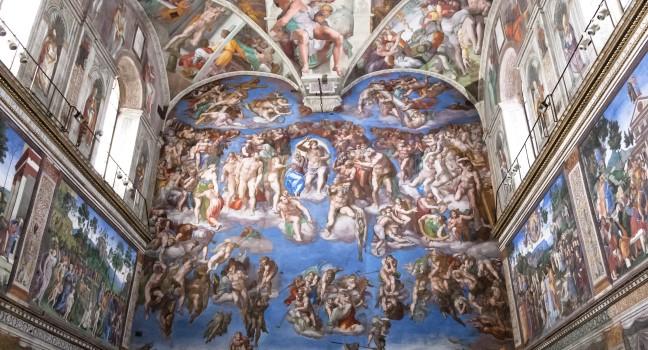
The Last Judgement, Sistine Chapel, Vatican, Rome
(c) Anitasstudio | Dreamstime.com

In 1508, the redoubtable Pope Julius II commissioned Michelangelo to fresco the more than 10,000 square feet of the Sistine Chapel's ceiling. (Sistine, by the way, is simply the adjective form of Sixtus, in reference to Pope Sixtus IV, who commissioned the chapel itself.) The task took four years, and it's said that, for many years afterward, Michelangelo couldn't read anything without holding it over his head. The result, however, was the greatest artwork of the Renaissance. A pair of binoculars helps greatly, as does a small mirror—hold it facing the ceiling and look down to study the reflection.

More than 20 years after his work on the ceiling, Michelangelo was called on again, this time by Pope Paul III, to add to the chapel's decoration by painting the Last Judgment on the wall over the altar. By way of signature on this, his last great fresco, Michelangelo painted his own face on the flayed-off human skin in St. Bartholomew's hand. 

The chapel is entered through the Musei Vaticani, and lines are slightly shorter after 2:30 (reservations are always advisable)—except free Sundays, which are extremely busy and when admissions close at 12:30.

Galleria Borghese

Villa Borghese Fodor's Choice
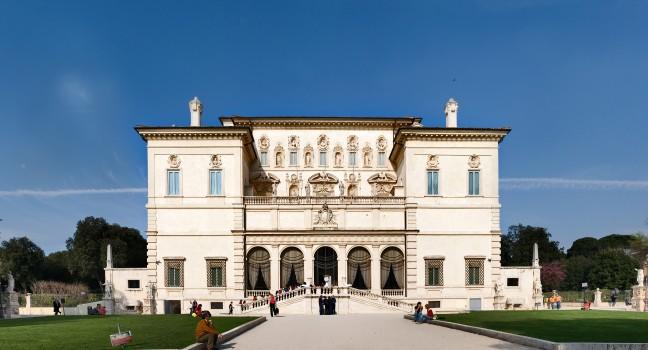
Villa Borghese, Galleria Borghese, Roma, Italy.
Khirman Vladimir / Shutterstock

It's toss-up as to which is more magnificent: the museum or the art that lies within it. The luxury-loving Cardinal Scipione Borghese had the museum custom built in 1612 as a showcase for his collection of both antiquities and more "modern" works, including those he commissioned from the masters Caravaggio and Bernini. Today, it's a monument to Roman interior decoration at its most extravagant.

One of the collection's most famous works is Canova's neoclassical sculpture Pauline Borghese as Venus Victorious. The next three rooms hold three key early Baroque sculptures: Bernini's David; Apollo and Daphne; and The Rape of Persephone. All were done when the artist was in his twenties and all illustrate his extraordinary skill. Apollo and Daphne shows the moment when, to aid her escape from the pursuing Apollo, Daphne is turned into a laurel tree. Leaves and twigs sprout from her fingertips as she stretches agonizingly away from Apollo. In The Rape of Persephone, Pluto has either just plucked Persephone (or Proserpina) from her flower-picking or is in the process of returning to Hades with his prize. Note the realistic way his grip causes dimples in Persephone's flesh. This is the stuff that makes the Baroque exciting—and moving. Other Berninis on view include a large, unfinished figure called Verità, or Truth.

Room 8 contains six paintings by Caravaggio, the hotheaded genius who died at age 37. All of his paintings, even the charming Boy with a Basket of Fruit, have an undercurrent of darkness. The disquieting Sick Bacchus is a self-portrait of the artist who, like the god, had a fondness for wine. David and Goliath, painted in the last year of Caravaggio's life—while he was on the run, murder charges hanging over his head—includes his self-portrait in the head of Goliath. Upstairs, the Pinacoteca (Picture Gallery) boasts paintings by Raphael (including his moving Deposition), Pinturicchio, Perugino, Bellini, and Rubens. Probably the gallery's most famous painting is Titian's allegorical Sacred and Profane Love, a mysterious image with two female figures, one nude, one clothed.  Admission to the Galleria Borghese is by reservation only. Visitors are admitted in two-hour shifts 9–5. Prime-time slots sell out days in advance, so reserve directly (and early) through the museum's website.

Piazzale Scipione Borghese, 5, Rome, 00197, Italy
06-32810-reservations
Sight Details
€15, including €2 reservation fee; increased fee during temporary exhibitions
Closed Mon.
Reservations essential

Something incorrect in this review?

Gallerie dell'Accademia

Dorsoduro Fodor's Choice
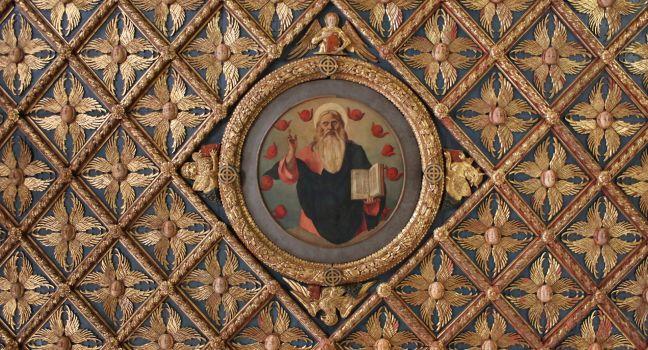
Ceiling of Accademia, Venice
Antoine Motte dit Falisse [CC BY-SA 3.0], via Wikimedia Commons

The largest collection of Venetian paintings in the world hangs in these galleries founded by Napoléon in 1807 on the site of a religious complex he had suppressed. The galleries were carefully and subtly restructured between 1945 and 1959 by the renowned Venetian architect Carlo Scarpa.

Jacopo Bellini is considered the father of the Venetian Renaissance, and in Room 2 you can compare his Madonna and Child with Saints with such later works as Madonna of the Orange Tree by Cima da Conegliano (circa 1459–1517) and Ten Thousand Martyrs of Mt. Ararat by Vittore Carpaccio (circa 1455–1525). Jacopo's more accomplished son Giovanni (circa 1430–1516) attracts your eye not only with his subject matter but also with his rich color. Rooms 4 and 5 have a good selection of his Madonnas. Room 5 contains The Tempest by Giorgione (1477–1510), a revolutionary work that has intrigued viewers and critics for centuries. It is unified not only by physical design elements, as was usual, but more importantly by a mysterious, somewhat threatening atmosphere. In Room 10, Feast in the House of Levi, commissioned as a Last Supper, got Veronese summoned to the Inquisition over its depiction of dogs, jesters, and other extraneous and unsacred figures. The artist responded with the famous retort, "Noi pittori ci prendiamo le stesse libertà dei poeti e dei pazzi" ("We painters permit ourselves the same liberties as poets and madmen"). He resolved the problem by simply changing the title, so that the painting represented a different, less solemn biblical feast. Don't miss the views of 15th- and 16th-century Venice by Carpaccio and Gentile Bellini, Giovanni's brother—you'll easily recognize places you have passed in your walks around the city.

Booking tickets in advance isn't essential but helps during busy seasons. A free map notes art and artists, and the bookshop sells a more informative English-language booklet. In the main galleries, a €6 audio guide saves reading but adds little to each room's excellent annotation.

Dorsoduro 1050, Venice, 30123, Italy
041-5222247
Sight Details
€15; subject to increases for special exhibitions
Closed Mon. afternoon

Something incorrect in this review?

Recommended Fodor's Video

MAXXI—Museo Nazionale delle Arti del XXI Secolo

Flaminio Fodor's Choice
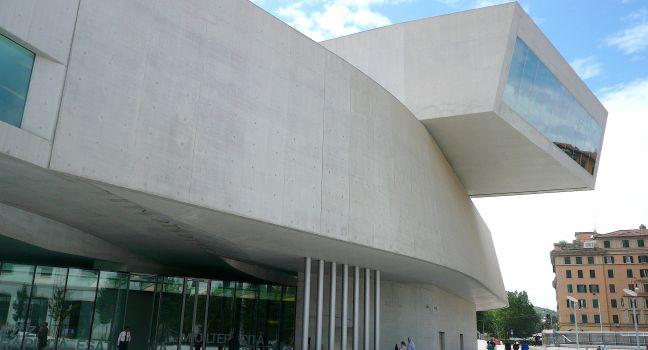
MAXXI, national museum of arts of XXI century by Zaha Hadid architect in Rome, Italy.
(c) Enrysacc | Dreamstime.com

Designed by the late Iraqi-British architect Zaha Hadid, this modern building plays with lots of natural light and has curving and angular lines, big open spaces, glass ceilings, and steel staircases that twist through the air—all meant to question the division between "within" and "without." The MAXXI hosts temporary exhibitions of art, architecture, film, and more. The permanent collection, displayed on a rotating basis, has more than 350 works from modern and contemporary artists, including Andy Warhol, Francesco Clemente, and Gerhard Richter.

Via Guido Reni, 4/A, Rome, 00196, Italy
06-3201954
Sight Details
€15
Closed Mon.

Something incorrect in this review?

Musei Capitolini

Campitelli Fodor's Choice
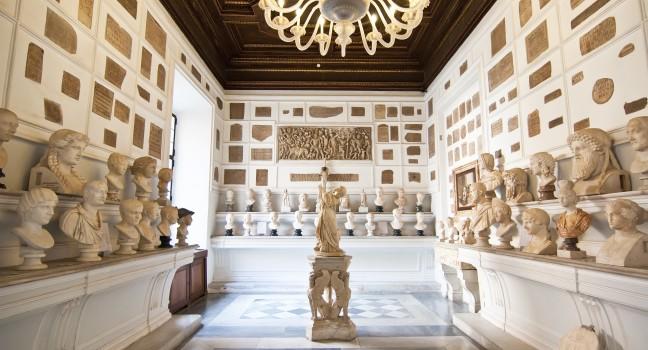
Inside one of the rooms of the Capitoline Museums in Rome, Italy  The museum was opened to the public at the wish of Pope Clement XII in 1734.
Chanclos/Shutterstock

Surpassed in size and richness only by the Musei Vaticani, the world's first public museum—with the greatest hits of Roman art through the ages, from the ancients to the Baroque—is housed in the Palazzo dei Conservatori and the Palazzo Nuovo, which mirror one another across Michelangelo's famous piazza. The collection was begun by Pope Sixtus IV (the man who built the Sistine Chapel) in 1473, when he donated a room of ancient statuary to the people of the city. This core of the collection includes the She Wolf, which is the symbol of Rome, and the piercing gaze of the Capitoline Brutus.

Buy your ticket and enter the Palazzo dei Conservatori, where in the first courtyard, you'll see the giant head, foot, elbow, and imperially raised finger of the fabled seated statue of Constantine, which once dominated the Basilica of Maxentius in the Forum. Upstairs is the resplendent Sala degli Orazi e Curiazi (Hall of the Horatii and Curatii), decorated with a magnificent gilt ceiling, carved wooden doors, and 16th-century frescoes depicting the history of Rome's legendary origins. At each end of the hall are statues of two of the most important popes of the Baroque era, Urban VIII and Innocent X.

The heart of the museum is the modern Exedra of Marcus Aurelius (Esedra di Marco Aurelio), which displays the spectacular original bronze statue of the Roman emperor whose copy dominates the piazza outside. To the right, the room segues into the area of the Temple of Jupiter, with the ruins of part of its vast base rising organically into the museum space. A reconstruction of the temple and the Capitoline Hill from the Bronze Age to the present day makes for a fascinating glimpse through the ages. On the top floor, the museum's pinacoteca, or painting gallery, has some noted Baroque masterpieces, including Caravaggio's The Fortune Teller and St. John the Baptist.

To get to the Palazzo Nuovo section of the museum, take the stairs or elevator to the basement of the Palazzo dei Conservatori, where the corridor uniting the two contains the Epigraphic Collection, a poignant assembly of ancient gravestones. Just over halfway along the corridor, and before going up into the Palazzo Nuovo, be sure to take the staircase to the right to the Tabularium gallery and its unparalleled view over the Forum.

On the stairs inside the Palazzo Nuovo, you'll be immediately dwarfed by Mars in full military rig and lion-topped sandals. Upstairs is the noted Sala degli Imperatori, lined with busts of Roman emperors, and the Sala dei Filosofi, where busts of philosophers sit in judgment—a fascinating who's who of the ancient world. Within these serried ranks are 48 Roman emperors, ranging from Augustus to Theodosius. Nearby are rooms filled with sculptural masterpieces, including the famed Dying Gaul, the Red Faun from Hadrian's Villa, and a Cupid and Psyche.

Piazza del Campidoglio, 1, Rome, 00186, Italy
06-0608
Sight Details
€13 (€15.50 with exhibitions); €13.50 with access to Centrale Montemartini; €4 audio guide

Something incorrect in this review?

Musei Vaticani

Vatican Fodor's Choice
A double spiral staircase in Vatican, Italy.
Fedor Selivanov / Shutterstock

Other than the pope and his papal court, the occupants of the Vatican are some of the most famous artworks in the world. The Vatican Palace, residence of the popes since 1377, consists of an estimated 1,400 rooms, chapels, and galleries. The pope and his household occupy only a small part; most of the rest is given over to the Vatican Library and Museums.

Beyond the glories of the Sistine Chapel, the collection is extraordinarily rich: highlights include the great antique sculptures (including the celebrated Apollo Belvedere in the Octagonal Courtyard and the Belvedere Torso in the Hall of the Muses); the Stanze di Raffaello (Raphael Rooms), with their famous gorgeous frescoes; and the Old Master paintings, such as Leonardo da Vinci's beautiful (though unfinished) St. Jerome in the Wilderness, some of Raphael’s greatest creations, and Caravaggio’s gigantic Deposition in the Pinacoteca ("Picture Gallery").

For those interested in guided visits to the Vatican Museums, tours start at €40, including entrance tickets, and can also be booked online. Other offerings include a regular three-hour guided tour of the Vatican gardens; call or check online to confirm. For more information, call  06/69884676 or go to  www.museivaticani.va. For information on tours, call  06/69883145 or  06/69884676; visually impaired visitors can arrange tactile tours by calling  06/69884947.

Viale Vaticano, Rome, 00165, Italy
06-69883145
Sight Details
€20
Closed Sun. (except the last Sun. of each month) and Roman Catholic holidays

Something incorrect in this review?

Museo Nazionale Etrusco di Villa Giulia

Villa Borghese Fodor's Choice
Museo Etrusco di villa giulia
(c) Mariocarbone | Dreamstime.com

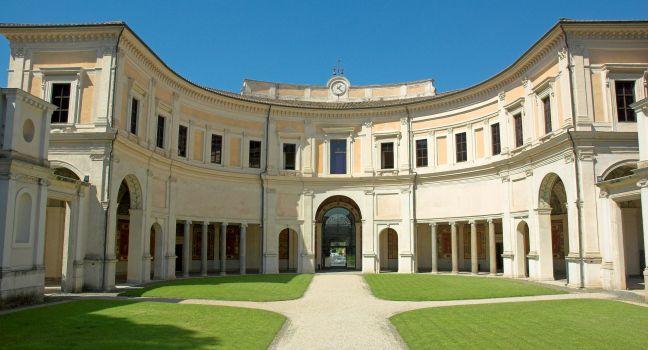
The world's most outstanding collection of Etruscan art and artifacts is housed in Villa Giulia, built around 1551 for Pope Julius III. Among the team called in to plan and construct the villa were Michelangelo and fellow Florentine Vasari. Most of the actual work, however, was done by Vignola and Ammannati. The villa's nymphaeum—or sunken sculpture garden—is a superb example of a refined late-Renaissance setting for princely pleasures.

No one knows precisely where the Etruscans originated, but many scholars maintain they came from Asia Minor, appearing in Italy about 2000 BC and creating a civilization that was a dazzling prelude to that of the ancient Romans. Among the most striking pieces are the terra-cotta statues, such as the Apollo of Veii and the serenely beautiful Sarcophagus of the Spouses. Dating from 530–500 BC, this couple (or Sposi) look at the viewer with almond eyes and archaic smiles, suggesting an openness and joie de vivre rare in Roman art. Other highlights include the cinematic frieze from a later temple (480 BC) in Pyrgi, resembling a sort of Etruscan Elgin marbles in terra-cotta; the displays of Etruscan jewelry; and the beautiful gardens.

Piazzale di Villa Giulia, 9, Rome, 00196, Italy
06-3226571
Sight Details
€12
Closed Mon.

Something incorrect in this review?

Palazzo Massimo alle Terme

Repubblica Fodor's Choice
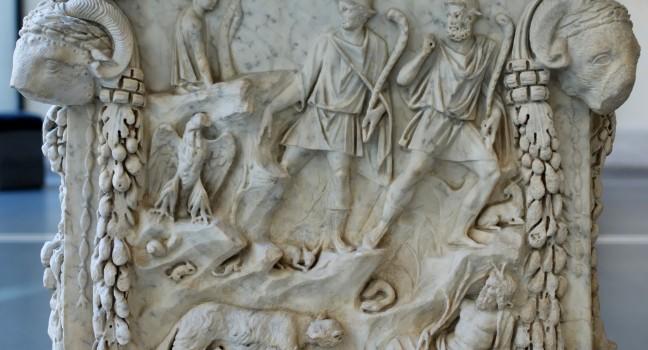
Representation of the lupercal: Romulus and Remus fed by a she-wolf, surrounded by representations of the Tiber and the Palatine. Panel from an alter dedicated to the divine couple of Mars and Venus. Marble, Roman artwork of the end of the reign of Trajan
By Marie-Lan Nguyen (2006) [Public domain], via Wikimedia Commons

The Museo Nazionale Romano, with items ranging from striking classical Roman paintings to marble bric-a-brac, has four locations: Palazzo Altemps, Crypta Balbi, the Museo delle Terme di Diocleziano, and this, the Palazzo Massimo alle Terme—a vast structure containing the great ancient treasures of the archaeological collection and also the coin collection. Highlights include the Dying Niobid, the famous bronze Boxer at Rest, and the Discobolus Lancellotti.

Among the museum's most intriguing attractions, however, are the ancient frescoes on view on the top floor. They're stunningly set up to "recreate" the look of the homes they once decorated, and their colors are remarkably preserved. You'll see stuccoes and wall paintings found in the area of the Villa Farnesina (in Trastevere), as well as those depicting a garden in bloom and an orchard alive with birds that once covered the walls of cool sunken rooms at Empress Livia's villa in Prima Porta, just outside the city.

Largo di Villa Peretti, 2, Rome, 00185, Italy
06-39967700
Sight Details
€8, or €12 for a combined ticket including access to Crypta Balbi, Museo delle Terme di Diocleziano, and Palazzo Altemps (valid for 1 wk)
Closed Mon.

Something incorrect in this review?

Scuola Grande di San Rocco

Fodor's Choice
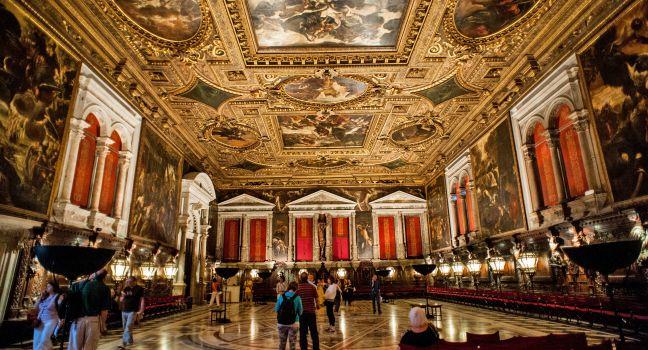
Room, Scuola Grande di San Rocco, Venice, Italy
© Ross Brinkerhoff / Fodors Travel

This elegant example of Venetian Renaissance architecture was built between 1516 and 1549 for the essentially secular charitable confraternity bearing the saint's name (one of the six "Great Scuole" and the only one that Napoléon did not expunge). The Venetian scuole were organizations that sometimes had loose religious affiliations, through which the artisan class could exercise some influence upon civic life. San Rocco was venerated as a protector against the plague, and his scuola was one of the city's most magnificent. While the building is bold and dramatic outside, its contents are even more stunning—a series of more than 60 paintings by Tintoretto. In 1564, Tintoretto edged out competition for a commission to decorate a ceiling by submitting not a sketch but a finished work, which he moreover offered free of charge, calculating correctly that a gift could not be rejected. Moses Striking Water from the Rock, The Brazen Serpent, and The Fall of Manna represent three afflictions—thirst, disease, and hunger—that San Rocco, and later his brotherhood, sought to relieve.

Archaeological Museum of Aidone

Fodor's Choice

A vast archaeological site in a remote location, Morgantina long provided rich pickings for illegal excavators: when Italian detectives raided an 18th-century villa in Enna belonging to a Sicilian art dealer, they discovered more than 30,000 ancient artifacts, most of them plundered from Morgantina. In 1986, American archaeologist Malcolm Bell, director of Princeton University’s excavations at Morgantina, established that the heads, hands, and feet of 6th-century BC Greek statues of goddesses from a private collection exhibited at the Getty museum outside of Los Angeles also derived from Morgantina. Identified as Demeter and Persephone, the statues were acroliths, with wooden bodies (long rotted away) and marble extremities. Returned to Sicily in 2009 after a lengthy legal battle, they are currently displayed at a small museum in the village of Aidone, beautifully lit and hauntingly "dressed" by Sicilian fashion designer Marella Ferrara.

Equally powerful is the so-called Aphrodite Getty, or Venus of Malibu, bought by the Getty in 1987 for $18 million on the basis of provenance documents that were later proved to have been forgeries. Returned to Sicily in 2011, the hefty maturity of her body, revealed by wind-blown drapery, has led most scholars to identify her as the mother goddess Demeter. Other objects returned from the Getty include the Eupolmos Silver, a set of ritual dining ware, and a head of Hades, identified as belonging to Morgantina when a student working in the site archives discovered a terra-cotta curl of blue-tinted "hair" and suspected that it belonged to a head on display in the Getty. When the curl was sent to the museum, it was found to be a perfect fit, and in 2016 the head was returned to Sicily.

Bargello

Bargello Fodor's Choice

This building started out in the Middle Ages as the headquarters for the capitano del popolo (captain of the people) and was later a prison. It now contains the Museo Nazionale, which has one of Italy's finest collections of Renaissance sculpture. The remarkable masterpieces by Michelangelo (1475–1564), Donatello (circa 1386–1466), and Benvenuto Cellini (1500–71) are distributed amid an eclectic collection of arms, ceramics, and miniature bronzes, among other things.

In 1401, Filippo Brunelleschi (1377–1446) and Lorenzo Ghiberti (circa 1378–1455) competed to earn the most prestigious commission of the day: the decoration of the north doors of the Baptistery in Piazza del Duomo. For the contest, each designed a bronze bas-relief panel depicting the sacrifice of Isaac; the panels are displayed together in the room devoted to the sculpture of Donatello, on the upper floor. According to Ghiberti, the judges chose him, though Brunelleschi maintained that they were both hired for the commission. See who you believe after visiting.

Via del Proconsolo 4, Florence, 50122, Italy
055-0649440
Sight Details
€10
Closed Tues. and 2nd and 4th Sun. of the month

Something incorrect in this review?

Castello di Rivoli Museo d'Arte Contemporanea and Villa Cerutti

Fodor's Choice

The Baroque castle of Rivoli now houses a fascinating museum of contemporary art. The building was begun in the 17th century and then redesigned, but never finished, by architect Filippo Juvarra in the 18th century; it was finally converted into a museum in the late 20th century by the minimalist Turin architect Andrea Bruno. Its sister museum, Villa Cerutti, houses 300 paintings (including works by Renoir and Kandinsky) and sculptures, plus rare books and furnishings, in a 20th-century villa not far from the castle; visits are only by prior reservation and guided tour on weekends for adults and children ages 10 and up, with individual nonguided visits offered one Saturday each month.

Piazzale Mafalda di Savoia, Rivoli, 10098, Italy
011-9565222
Sight Details
Castello €10, Villa Cerutti and Castello €26.50
Castello closed Mon. and Tues., Villa Cerutti closed weekdays

Something incorrect in this review?

Centrale Montemartini

Testaccio Fodor's Choice

A decommissioned early-20th-century power plant is now this intriguing exhibition space for the overflow of ancient art from the Musei Capitolini collection. Getting here is half the fun. A 15-minute walk from the heart of Testaccio will lead you past walls covered in street art to the urban district of Ostiense. Head southwest and saunter under the train tracks passing buildings adorned with four-story-high murals until you reach the often-uncrowded Centrale Montemartini, where Roman sculptures and intricate mosaics are set amid industrial machinery and pipes.

Unusually, the collection is organized by the area in which the ancient pieces were found. Highlights include the former boiler room filled with ancient marble statues that once decorated Rome's private villas, such as the beautiful Esquiline Venus, as well as a large mosaic of a hunting scene. A purchase of the Capitolini Card will allow entry into Musei Capitolini and Centrale Montemartini.

Via Ostiense, 106, Rome, 00154, Italy
06-0608
Sight Details
€11.50; admission included with the purchase of the Capitolini Card (€14.50)
Closed Mon.

Something incorrect in this review?

Fondazione Prada

Porta Romana Fodor's Choice

New structures of metal and glass and revamped buildings once part of a distillery from the 1910s now contain this museum's roughly 205,000 square feet. The modern art showcased here is not for the faint of heart. Permanent pieces, such as Haunted House, featuring works by Louise Bourgeois and Robert Gober, are avant-garde and challenging, and temporary exhibitions highlight cutting-edge Italian and international artists. Don't hesitate to ask one of the helpful, knowledgeable staffers for guidance navigating the expansive grounds, which can be confusing. And don't miss the Wes Anderson–designed café, Bar Luce, for a drink or snack, or the restaurant Torre for an aperitivo or a full meal with panoramic views from on high. The Fondazione is a hike from the city center; expect a 10-minute walk from the metro station to the galleries.

Galleria degli Uffizi

Piazza della Signoria Fodor's Choice

The venerable Uffizi Gallery occupies two floors of the U-shape Palazzo degli Uffizi, designed by Giorgio Vasari (1511–74) in 1560 to hold the uffici (administrative offices) of the Medici Grand Duke Cosimo I (1519–74).

Among the highlights is the Battle of San Romano by Paolo Uccello (1397–1475). Gloriously restored in 2012, its brutal chaos of lances is one of the finest visual metaphors for warfare ever captured in paint. Equally noteworthy is the Madonna and Child with Two Angels in which Fra Filippo Lippi (1406–69) depicts eye contact established by the angel that would have been unthinkable prior to the Renaissance. In Sandro Botticelli's (1445–1510) Birth of Venus, the goddess seems to float in the air, and in his Primavera, a fairy-tale charm demonstrates the painter's idiosyncratic genius at its zenith.

Other significant works include the portraits of the Renaissance duke Federico da Montefeltro and his wife, Battista Sforza, by Piero della Francesca (circa 1420–92); Raphael's (1483–1520) Madonna of the Goldfinch, which is distinguished by the brilliant blues of the sky and the eye contact between mother and child, both clearly anticipating the painful future; Michelangelo's Doni Tondo; the Venus of Urbino by Titian (circa 1488/90–1576); and the splendid Bacchus by Caravaggio (circa 1571/72–1610). In the last two works, the approaches to myth and sexuality are diametrically opposed (to put it mildly).

Late in the afternoon is the least crowded time to visit. For a €4 fee, advance tickets (recommended) can be reserved by phone, online, or, once in Florence, at the Uffizi's reservation booths ( Uffizi presale booth, Piazza Pitti  055/294883), at least one day in advance of your visit. Keep the confirmation number, and take it with you to the door marked "reservations." In the past, you were ushered in almost immediately. But overbooking (especially in high season) has led to long lines and long waits even with a reservation. Taking photographs in the Uffizi is illegal, and this has contributed to making what ought to be a sublime museumgoing experience more like a day at the zoo.

Piazzale degli Uffizi 6, Florence, 50100, Italy
055-294883
Sight Details
From €23
Closed Mon.

Something incorrect in this review?

Galleria dell'Accademia

San Marco Fodor's Choice

The collection of Florentine paintings, dating from the 13th to 18th century, is largely unremarkable, but the sculptures by Michelangelo are worth the price of admission. The unfinished Slaves, fighting their way out of their marble prisons, were meant for the tomb of Michelangelo's overly demanding patron, Pope Julius II (1443–1513). But the focal point is the original David, moved here from Piazza della Signoria in 1873. It was commissioned in 1501 by the Opera del Duomo (Cathedral Works Committee), which gave the 26-year-old sculptor a leftover block of marble that had been ruined 40 years earlier by two other sculptors. Michelangelo's success with the block was so dramatic that the city showered him with honors, and the Opera del Duomo voted to build him a house and a studio in which to live and work.

Today, David is beset not by Goliath but by tourists, and seeing the statue at all—much less really studying it—can be a trial. Save yourself a long wait in line by reserving tickets in advance. An iron railing surrounds the sculpture, following a 1991 attack on it by a self-proclaimed hammer-wielding art anarchist who, luckily, inflicted only a few minor nicks on the toes. The statue is not quite what it seems. It is so poised and graceful and alert—so miraculously alive—that it is often considered the definitive sculptural embodiment of High Renaissance perfection. But its true place in the history of art is a bit more complicated.

As Michelangelo well knew, the Renaissance painting and sculpture that preceded his work were deeply concerned with ideal form. Perfection of proportion was the ever-sought Holy Grail; during the Renaissance, ideal proportion was equated with ideal beauty, and ideal beauty was equated with spiritual perfection. But David, despite its supremely calm and dignified pose, departs from these ideals. Michelangelo didn't give the statue perfect proportions. The head is slightly too large for the body, the arms are too large for the torso, and the hands are dramatically large for the arms.

The work was originally commissioned to adorn the exterior of the Duomo and was intended to be seen from below and at a distance. Michelangelo knew exactly what he was doing, calculating that the perspective of the viewer would be such that, in order for the statue to appear proportioned, the upper body, head, and arms would have to be bigger, as they would be farther away. But he also sculpted it to express and embody, as powerfully as possible in a single figure, an entire biblical story. David's hands are big, but so was Goliath, and these are the hands that slew him. Music lovers might want to check out the Museo delgli Instrumenti Musicali, also within the Accademia; its Stradivarius is the main attraction.

Galleria Estense

Fodor's Choice

Modena's principal museum, housed in the Palazzo dei Musei and located just a short walk from the Duomo, has an impressive collection assembled in the mid-17th century by Francesco d'Este (1610–58), Duke of Modena. The Galleria Estense is named in his honor and contains masterpieces by Bernini, Correggio, El Greco, Tintoretto, Velázquez, Veronese, and Salvator Rosa among others. The Biblioteca Estense here is a huge collection of illuminated manuscripts, of which the best known is the beautifully illustrated Bible of Borso d'Este (1455–61). 

Galleria Nazionale d'Arte Moderna e Contemporanea

Villa Borghese Fodor's Choice

This massive white Beaux-Arts building, built for the 1911 World Exposition in Rome, contains one of Italy's leading collections of 19th- and 20th-century works. It's primarily dedicated to the history of Italian modernism, examining the movement's development over the last two centuries, but crowd-pleasers Monet, Rodin, Van Gogh, and Warhol put in appearances, and there's also an outstanding Dadaist collection. You can mix coffee and culture at the mid-century-inspired Caffè delle Arti in a columned alcove.

Galleria Nazionale dell'Umbria

Fodor's Choice

The region's most comprehensive art gallery is housed on the fourth floor of the Palazzo dei Priori. The collection includes work by native artists—most notably Pintoricchio (1454–1513) and Perugino (circa 1450–1523). In addition to paintings, the gallery has frescoes, sculptures, and some superb examples of crucifixes from the 13th and 14th centuries.

Galleria Sabauda

Centro Fodor's Choice

Housed in the restored Manica Nuova (new wing) of the Palazzo Reale, the gallery displays some of the most important paintings from the vast collections of the house of Savoy. The collection is particularly rich in Dutch and Flemish paintings: note the Stigmate di San Francesco (St. Francis Receiving the Stigmata) by Jan van Eyck (1395–1441), in which the saint receives the marks of Christ's wounds while a companion cringes beside him.

Piazetta Reale 1, Turin, 10122, Italy
011-19560449
Sight Details
€15, includes the Royal Museums (Palazzo Reale, Armeria Reale, Cappella della Sindone, Museo di Antichità, Giardini Reali, and Biblioteca Reale)
Closed Wed.

Something incorrect in this review?

LETS Museum Literature Trieste

Fodor's Choice

Opened in 2024, Trieste's newest museum brings together various collections exploring multifarious facets of the written word and the lives of literary figures who have become synonymous with the city. Sections include the introductory "History Kiosk," a wonderful space dedicated to cinematic adaptations, and immersive exhibitions dedicated to James Joyce, Italo Svevo, and poet Umberto Saba. If you fancy a leaf through 1,000 books, there's the "Writers' Bookstore," and listening stations allow visitors to enjoy audiobooks while gazing through picture windows with city views.

Lumen Museum

Fodor's Choice

Take a cable car to the top of Kronplatz to reach this 19,375-square-foot museum dedicated to mountain photography (actually, you have your choice of eight different cable cars, two from the town of Brunico). Once inside, you’ll find pictures from Alpine photography’s early days all the way to the present, taken by photographers from mountainous regions throughout the world and displayed across four floors. Lumen also houses AlpiNN, a casual restaurant from critically acclaimed chef Norbert Niederkofler of St. Hubertus fame. Note that the museum can be difficult to access in winter if you’re not a skier; it's down a slight, rather terrifying incline from the top of the mountain. Be aware that the museum closes at 4 pm (last admission at 3:30), so that you won't miss the last cable car back down.

Kronplatz–Plan de Corones Mountain Station, Brunico, Italy
0474-431090
Sight Details
€17
Closed mid-Apr.–May and mid- to late Nov.

Something incorrect in this review?

MACRO

Repubblica Fodor's Choice

Formerly known as Rome's Modern and Contemporary Art Gallery, and before that as the Peroni beer factory, this redesigned industrial space has brought new life to the gallery and museum scene of a city hitherto hailed for its "then," not its "now." The collection here covers Italian contemporary artists from the 1960s through today. The goal is to bring current art to the public in innovative spaces and, not incidentally, to support and recognize Rome's contemporary art scene, which labors in the shadow of the city's artistic heritage. After a few days—or millennia—of dusty marble, it's a breath of fresh air.  Check the website for occasional late-night openings and events.

MAMbo and Museo Morandi

Fodor's Choice

The museum—the name stands for Museo d'Arte Moderna di Bologna, or Bologna's Museum of Modern Art—houses a permanent collection of modern art. All of this is set within the sleek minimalist structure built in 1915 as the Forno del Pane, a large bakery. Seek out the powerful Arte e Ideologia section for Guttuso's Funerali di Togliatti (1972), a charged symbol of pride and pain for many Bolognesi and Italiani. The work of Bologna's celebrated abstract painter Giorgio Morandi (1890–64), known for his muted still life paintings of domestic objects and landscapes, can be viewed at the Museo Morandi here. The fab bookshop and MAMbo Cafè complete the complex.

Messner Mountain Museum Firmian

Fodor's Choice

Perched on a peak overlooking Bolzano, the 10th-century Castle Sigmundskron is home to one of six mountain museums established by Reinhold Messner—the first climber to conquer Everest solo and the first to reach its summit without oxygen. The Tibetan tradition of kora, a circular pilgrimage around a sacred site, is an inspiration for the museum, where visitors contemplate the relationship between human and mountain, guided by images and objects Messner collected during his adventures. The museum is 3 km (2 miles) southwest of Bolzano, just off the Appiano exit on the highway to Merano.

Messner Mountain Museum Juval

Fodor's Choice

Since 1983 this 13th-century castle in the hills above the hamlet of Stava has been the summer home of the South Tyrolese climber and polar adventurer Reinhold Messner—the first climber to conquer Everest solo. Part of the castle has been turned into one of six in Messner's chain of mountain museums, where visitors can view his collection of Tibetan art and masks from around the world. You can download an app to use as a self-guided tour. It's a 10-minute shuttle ride from the parking lot below, plus a 15-minute walk up to the castle, or a 60- to 90-minute hike on local trails; wear sturdy shoes, even if you take the shuttle, as the paths are uneven.

Museo Canova

Fodor's Choice

The most significant cultural monument in the Asolo area is this museum dedicated to the work of the Italian neoclassical sculptor Antonio Canova (1757–1822), whose sculptures are featured in many major European and North American cultural institutions. Set up shortly after the sculptor's death in his hometown, the village of Possagno, the museum houses most of the original plaster casts, models, and drawings made by the artist in preparation for his marble sculptures. In 1957 the Museo Canova was extended by the Italian architect Carlo Scarpa.

Museo d'Arte Sacra e Archeologico Palazzo Corboli

Fodor's Choice

Palazzo Corboli, a magnificent palace dating from the 12th century, has been refurbished and houses the Museo d'Arte Sacra e Archeologico. The collection of Etruscan artifacts is worth a visit, though the real highlight is the collection of lesser-known 13th- and 14th-century paintings from the Sienese school.

Corso Matteotti 122, Asciano, 53041, Italy
0577-714450
Sight Details
€5
Closed Mon. and Tues. Apr.–Oct. Closed weekdays Nov.–Mar.

Something incorrect in this review?

Museo del Satiro Danzante

Fodor's Choice

In 2005, after four years of painstaking restoration in Rome (and several attempts to keep it there in the capital), the Dancing Satyr, the ancient Greek statue found by fishermen off the town's coast, found its permanent home here in the deconsecrated church of Sant’Egidio. Exquisitely lit and larger than life, it is a truly extraordinary work (despite missing both arms and a leg) caught mid-air, mid-dance in the throes of ecstasy, with the musculature and grace of movement associated nowadays with contemporary ballet. Scholars think it probably formed part of a group with other dancing maenads, lost when the ship carrying them capsized in the Sicilian Channel. Ancient Greek bronze statues are extremely rare—only five have survived—as bronze was precious, and most were melted down. The satyr was created using the lost wax process, a technology designed to use as little bronze as possible: a clay model of the statue was made and fired, and when it cooled, it was covered with a layer of wax, followed by another layer of clay, this time with several holes. Then liquid bronze (heated to something like 1800°F) was poured through the holes. The melted wax then ran out, and the clay core turned to sand, leaving a bronze shell that would then have been polished. Other finds from under the sea are displayed in the museum, the most intriguing of which is the bronze foot of an elephant.

Piazza Plebiscito, Mazara del Vallo, 91026, Italy
0923-933917
Sight Details
€6

Something incorrect in this review?

Museo del Vetro (Glass Museum)

Fodor's Choice

This compact yet informative museum displays glass items dating from the 3rd century to today. You’ll learn all about techniques introduced through the ages (many of which are still in use), including 15th-century gold-leaf decoration, 16th-century filigree work that incorporated thin bands of white or colored glass into the crystal, and the 18th-century origins of Murano's iconic chandeliers. A visit here will help you to understand the provenance of the glass you’ll see for sale—and may be tempted to buy—in shops around the island.

Fondamenta Marco Giustinian 8, 30141, Italy
041-2434914-tickets
Sight Details
€10; Island Museums Ticket €12 (also includes Burano Lace Museum); free with Museum Pass

Something incorrect in this review?