137 Best Sights in Saxony, Saxony-Anhalt and Thuringia, Germany

Background Illustration for Sights

We've compiled the best of the best in Saxony, Saxony-Anhalt and Thuringia - browse our top choices for the top things to see or do during your stay.

Semperoper

One of Germany's best-known and most popular theaters, this magnificent opera house saw the premieres of Richard Wagner's Rienzi, Der Fliegende Holländer, andTannhäuser as well as Richard Strauss's Salome, Elektra, and Der Rosenkavalier. The Dresden architect Gottfried Semper built the house in 1838–41 in Italian Renaissance style, then saw his work destroyed in a fire caused by a careless lamplighter. Semper had to flee Dresden after participating in a democratic uprising, but his son Manfred rebuilt the theater in the neo-Renaissance style you see today, though even Manfred Semper's version had to be rebuilt after the devastating bombing raid of February 1945. On the 40th anniversary of that raidFebruary 13, 1985the Semperoper reopened with a performance of Der Freischütz, by Carl Maria von Weber, the last opera performed in the building before its destruction. There is a statue of Weber, another artist who did much to make Dresden a leading center of German music and culture, outside the opera house in the shadow of the Zwinger. Even if you're no opera buff, the Semper's lavish interior can't fail to impress. Velvet, brocade, and well-crafted imitation marble create an atmosphere of intimate luxury (it seats 1,323). Guided tours (must be reserved in advance) of the building are offered throughout the day, depending on the opera's rehearsal schedule. Check the website for schedules. Tours begin at the entrance to your right as you face the Elbe River.
Bastei Bridge

The Bastei is one of the most famous landmarks in Germany's national park system, offering stunning panoramic views over the Elbe River and surrounding sandstone formations. Towering roughly 540 feet above the river, the rock formation has been a popular destination for centuries. Its main highlight is the Bastei Bridge, a stone structure that connects the jagged cliffs, providing an unforgettable viewpoint. Initially, in 1824, a wooden bridge was constructed to connect the steep sandstone formations, allowing visitors to more easily explore the breathtaking heights. As the area’s popularity grew, attracting more tourists drawn by the dramatic landscape and views over the Elbe River, the wooden structure was replaced.

In 1851, the current stone bridge was built, designed to be more durable and capable of withstanding the elements. The bridge stretches 250 feet and seamlessly blends into the surrounding rocks, providing a sturdy and iconic pathway for travelers while preserving the natural beauty of the area. A shuttle bus runs from the first (most distance) parking lot to the bridge.

Schrammsteine

The Schrammsteine offers one of the more adventurous experiences in Saxon Switzerland National Park. To access some of the most spectacular viewpoints, such as the Schrammsteinaussicht, you’ll need to navigate steep paths that often involve climbing ladders and metal railings fixed to the rocks. While the effort adds a bit of thrill, it rewards you with sweeping panoramic views of the Elbe Valley and the surrounding sandstone peaks. These routes are not overly technical but are best suited for hikers comfortable with a bit of scrambling and heights. The full route takes about 2.5 hours and can be traversed by older kids who are able to climb on their own.

Recommended Fodor's Video

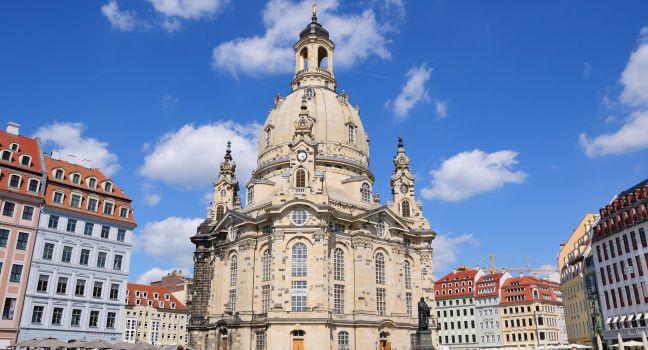
Frauenkirche

Fodor's Choice
Frauenkirche - Dresden, Germany;
Scirocco340 / Shutterstock

This masterpiece of Baroque church architecture was completed in 1743. The huge dome set on a smaller square base, known as the Stone Bell, was the inspiration of George Bähr, who designed the church to be built \"as if it was a single stone from the base to the top.\" On February 15, 1945, two days after the bombing of Dresden, the burned-out shell of the magnificent Stone Bell collapsed. For the following five decades, the remains of the church, a pile of rubble, remained a gripping memorial to the horrors of war. In a move shocking to the East German authorities, who organized all public demonstrations, a group of young people spontaneously met here on February 13, 1982, for a candlelight vigil for peace.

\n

Although the will to rebuild the church was strong, the political and economic situation in the GDR prevented it. It wasn't until German unification that Dresden seriously began to consider reconstruction. In the early 1990s a citizens' initiative, joined by the Lutheran Church of Saxony and the city of Dresden, decided to rebuild the church using the original stone. The goal of completing the church by 2006, Dresden's 800th anniversary, seemed insurmountable. Money soon started pouring in from around the globe, however, and work began. The rubble was cleared away, and the size and shape of each stone were cataloged. Computer-imaging technology helped place each recovered stone in its original location.

\n

During construction, guided tours and Frauenkirche concerts brought in donations. The biggest supporter of the project in the United Kingdom, the Dresden Trust, is centered in the city of Coventry, itself bombed mercilessly by the German Luftwaffe during the war. The Dresden Trust raised more than €600,000 and donated the gold pinnacle cross that now graces the church dome.

\n

On Sunday, October 30, 2005 (almost a year ahead of schedule), Dresden's skyline became a little more complete with the consecration of the Frauenkirche. Leading the service was the bishop of Coventry. Although the church is usually open to all, it closes frequently for concerts and other events. There is usually a short organ service at noon every day. Check the English-language schedule next to Entrance D.

Georg-Treu-Platz 3, Dresden, D–01067, Germany
0351-656–06100
Sight Details
Free; cupola and tower €10; audio guides in English €3

Something incorrect in this review?

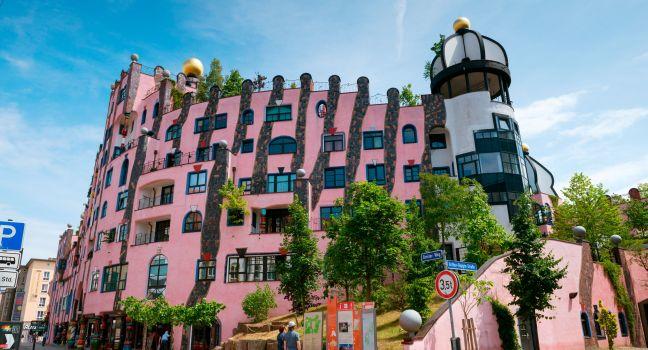
Green Citadel of Magdeburg

Fodor's Choice
Hundertwasser House (Green Citadel) - one of the most famous landmarks in Magdeburg, Germany.
(c) Lexan | Dreamstime.com
Like an exuberant painting come to life, the Green Citadel is the last, and many say greatest, building by the late Austrian artist and architect Friedensreich Hundertwasser, who designed the citadel as an "oasis for humanity and nature within a sea of rational houses." Renowned throughout Germany and beyond, this ensemble of baroque façades and colorful modern buildings displays the architect's characteristic irregular windows, skewed towers, colorful mosaics, and joyous flourishes. The vast complex also incorporates bustling restaurants and enticing boutiques.

Krämerbrücke

Fodor's Choice
Merchants Bridge. Erfurt
(c) Plotnikov | Dreamstime.com

Behind the predominantly neo-Gothic Rathaus, Erfurt's most outstanding attraction spans the Gera River. This medieval bridge, comparable to the Ponte Vecchio in Florence, is the longest of its kind in Europe and the only completely preserved and inhabited bridge of that era. Built in 1325 and restored in 1967–73, the bridge served for centuries as an important trading center. Today antiques shops, bistros, and more fill the majority of the timber-frame houses built into the bridge, some dating from the 16th century. The city is determined to keep the bridge as a site for traditional handicrafts, so look for the marionette maker and the pigment merchant. The bridge comes alive on the third weekend of June for the Krämerbrückenfest.

Erfurt, Germany

Something incorrect in this review?

Wartburg Castle

Fodor's Choice
Landscape with Wartburg Castle in Eisenach, Germany.
(c) Plotnikov | Dreamstime.com

Begun in 1067 (and expanded through the centuries), this mighty castle has hosted a parade of German celebrities. Hermann I (1156–1217), count of Thuringia and count palatine of Saxony, was a patron of the wandering poets Walther von der Vogelweide (1170–1230) and Wolfram von Eschenbach (1170–1220). Legend has it that this is where Walther von der Vogelweide, the greatest lyric poet of medieval Germany, prevailed in the celebrated Minnesängerstreit (minnesinger contest), which is featured in Richard Wagner's Tannhäuser.

\n

Within the castle's stout walls, Frederick the Wise (1463–1525) shielded Martin Luther from papal proscription from May 1521 until March 1522, even though Frederick did not share the reformer's beliefs. Luther completed the first translation of the New Testament from Greek into German while in hiding, an act that paved the way for the Protestant Reformation. You can peek into the simple study in which Luther worked. Be sure to check out the place where Luther supposedly saw the devil and threw an inkwell at him. Pilgrims have picked away at the spot for centuries, forcing the curators to \"reapply\" the ink.

\n

Frederick was also a patron of the arts. Lucas Cranach the Elder's portraits of Luther and his wife are on view in the castle, as is a very moving sculpture, the Leuchterengelpaar (Candlestick Angel Group), by the great 15th-century artist Tilman Riemenschneider. The 13th-century great hall is breathtaking; it's here that the minstrels sang for courtly favors. Don't leave without climbing the belvedere for a panoramic view of the Harz Mountains and the Thuringian Forest. You can wander the grounds of the Wartburg for free, but the only way into the interior of the castle is to take a guided tour. The English tour takes place every day at 1:30, though a self-guided audio tour is allowed after 3:20 pm daily.

Auf der Wartburg 1, Eisenach, 99817, Germany
03691-2500
Sight Details
€13, includes guided tour

Something incorrect in this review?

Zwinger mit Semperbau

Fodor's Choice
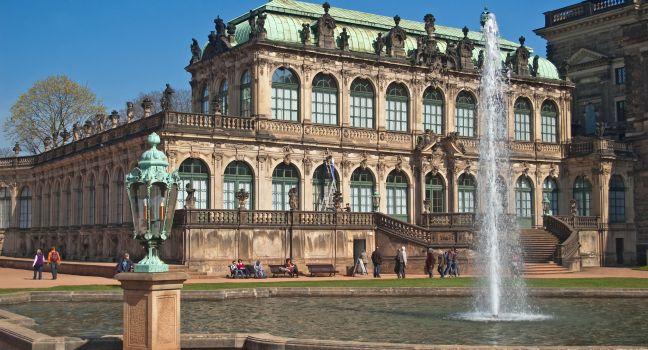
Inside the "Zwinger" Palace of Dresden, Germany; Shutterstock ID 61655509; Project/Title: Fodors; Downloader: Melanie Marin
clearlens / Shutterstock

Dresden's magnificent Baroque showpiece is entered by way of the mighty Kronentor (Crown Gate), underneath the crown of Poland, off Ostra-Allee. It contains three different museums.

\n

Augustus the Strong hired a small army of artists and artisans to create a \"pleasure ground\" worthy of the Saxon court on the site of the former bailey, part of the city fortifications. The artisans worked under the direction of the architect Matthäus Daniel Pöppelmann, who came reluctantly out of retirement to design what would be his greatest work, begun in 1707 and completed in 1728. Completely enclosing a central courtyard filled with lawns, pools, and fountains, the complex is made up of six linked pavilions, one of which boasts a carillon of Meissen bells, hence its name: Glockenspielpavillon.

\n

The Zwinger is quite a scene—a riot of garlands, nymphs, and other elaborate ornamentation and sculpture. Wide staircases beckon to galleried walks and to the romantic Nymphenbad, a coyly hidden courtyard where statues of nude women perch in alcoves to protect themselves from a fountain that spits unexpectedly. Stand in the center of this quiet oasis, where the city's roar is kept at bay by the outer wings of the structure. Normal people were allowed onto the balcony and could watch all of the raucous festivities

\n

The Gemäldegalerie Alte Meister, in the northwestern corner of the complex, was built to house portions of the royal art collections. Among the priceless paintings are works by Dürer, Holbein, Jan Van Eyck, Rembrandt, Rubens, van Dyck, Hals, Vermeer, Raphael, Titian, Giorgione, Veronese, Velázquez, Murillo, Canaletto, and Watteau. On the wall of the entrance archway you'll see an inscription in Russian, one of the few amusing reminders of World War II in Dresden. It rhymes in Russian: \"Museum checked. No mines. Chanutin did the checking.\" Chanutin, presumably, was the Russian soldier responsible for checking one of Germany's greatest art galleries for anything more explosive than a Rubens nude. The highlight of the collection is Raphael's Sistine Madonna, whose mournful look is slightly less famous than the two cherubs who were added by Raphael after the painting was completed, in order to fill an empty space at the bottom.

\n

Stretching from the curved gallery that adjoins the Glockenspielpavillon to the long gallery on the east side, this collection of the Porzellansammlung is considered one of the best of its kind in the world. The focus, naturally, is on Dresden and Meissen china, but there are also outstanding examples of Japanese, Chinese, and Korean porcelain.

\n

Holding medieval and Renaissance suits of armor and weapons, the Rüstkammer also has a branch in the Residenzschloss.

Theaterplatz 1, Dresden, D–01067, Germany
0357-4914–2000
Sight Details
€14
Closed Mon.

Something incorrect in this review?

Goethe Nationalmuseum

Fodor's Choice

Goethe spent 57 years in Weimar, 47 of them in a house two blocks south of Theaterplatz that has since become a shrine attracting millions of visitors. The Goethe Nationalmuseum consists of several houses, including the Goethehaus, where Goethe lived. It shows an exhibit about life in Weimar around 1750 and contains writings that illustrate not only the great man's literary might but also his interest in the sciences, particularly medicine, and his administrative skills (and frustrations) as minister of state and Weimar's exchequer. You'll see the desk at which Goethe stood to write (he liked to work standing up) and the modest bed in which he died. The rooms are dark and often cramped, but an almost palpable intellectual intensity seems to illuminate them.

Hartenfels Castle

Fodor's Choice
A masterpiece of Renaissance architecture, Castle Hartenfels was constructed as a residential palace in the late 15th and early 16th centuries by the Ernestine line of nobles who ruled the Electorate of Saxony. The castle and its occupants played a central role in the support and dissemination of Martin Luther 's ideas, and therefore a pivotal role in the Protestant Reformation. Up the castle's impressive stone stairway, unsupported by any central structure, you'll find the oldest statue of Martin Luther, who designed the castle's church himself to convey his idea of bringing the word of God to the common people via a central alter meant to evoke Christ's last supper among his disciples. Nine sketches decorating the pulpit were created by Lucas Cranach the Elder (a tenth is missing). The church is also the birthplace of Protestant church music by the composer Johann Kenntmann, the originator of the genre. Concerts of his music are performed here weekly. A permanent exhibition in the castle's Albrecht wing traces Torgau's history.

Lutherhaus

Fodor's Choice

Within Lutherhhaus is the Augustinian monastery where Martin Luther lived both as a teacher-monk and later, after the monastery was dissolved, as a married man. Today it's a museum dedicated to Luther and the Reformation. Visitors enter through a garden and an elegant door with a carved stone frame; it was a gift to Luther from his wife, Katharina von Bora. Be sure to visit the monks' refectory, where works by the painter Lucas Cranach the Elder, Luther's contemporary, are displayed. The room that remains closest to the original is the dark, wood-paneled Lutherstube. The Luthers and their six children used it as a living room, study, and meeting place for friends and students. Prints, engravings, paintings, manuscripts, coins, and medals relating to the Reformation and Luther's translation of the Bible into the German vernacular are displayed throughout the house. It's closed for renovations until 2026.

Museum der Bildenden Künste

Fodor's Choice

The city's leading art gallery is modernist minimalism incarnate, set in a huge concrete cube encased in green glass in the middle of Sachsenplatz Square. The museum's collection of more than 2,700 paintings and sculptures represents everything from the German Middle Ages to the modern Neue Leipziger Schule. Especially notable are the collections focusing on Lucas Cranach the Elder and Caspar David Friedrich. Be sure to start at the top and work your way down. Don't miss Max Klinger's Beethoven as Zeus statue.

Katharinenstr. 10, Leipzig, D–04109, Germany
0341-216–990
Sight Details
€10
Closed Mon.

Something incorrect in this review?

Schlosskirche

Fodor's Choice

In 1517 an indignant Martin Luther nailed his Ninety-Five Theses, which attacked the Roman Catholic Church's policy of selling indulgences, to this church's doors. Written in Latin, the theses might have gone unnoticed had not someone—without Luther's knowledge—translated them into German and distributed them. In 1521 the Holy Roman Emperor Charles V summoned Luther to Worms when Luther refused to retract his position. On the way home from his confrontation with the emperor, Luther was \"captured\" by his protector, Elector Frederick the Wise, and hidden from papal authorities in Eisenach for the better part of a year. Today the theses hang in bronze on the door, while inside, simple bronze plaques mark the burial places of Luther and his contemporary, Philipp Melanchthon.

Thomaskirche

Fodor's Choice

The stained-glass windows attest to the fact that Johann Sebastian Bach served as choirmaster at this Gothic church for 27 years, and Martin Luther preached here on Whitsunday 1539, signaling the arrival of Protestantism in Leipzig. Originally the center of a 13th-century monastery, the tall church (rebuilt in the 15th century) now stands by itself. Bach wrote most of his cantatas for the church's famous boys' choir, the Thomanerchor, which was founded in the 13th century. Today, the church continues to serve as the choir's home as well as a center of Bach tradition.

\n

The great music Bach wrote during his Leipzig years commanded little attention in his lifetime, and when he died he was given a simple grave, without a headstone, in the city's Johannisfriedhof (St. John Cemetery). It wasn't until 1894 that an effort was made to find where the great composer lay buried, and after a thorough, macabre search, his coffin was removed to the Johanniskirche. That church was destroyed by Allied bombs in December 1943, and Bach subsequently found his final resting place in the church he would have selected: Thomaskirche. You can listen to the famous boys' choir during the Motette, a service with a special emphasis on choral music.

\n

Bach's 12 children and the infant Richard Wagner were baptized in the early-17th-century font; Karl Marx and Friedrich Engels also stood before this same font, godfathers to Karl Liebknecht, who grew up to be a revolutionary as well. In front of the church is a memorial to Felix Mendelssohn, rebuilt with funds collected by the Leipzig Citizens Initiative. The Nazis destroyed the original in front of the Gewandhaus.

Thomaskirchhof, Leipzig, D–04109, Germany
0341-222–240
Sight Details
Free; Motette €2

Something incorrect in this review?

The Bauhaus Building

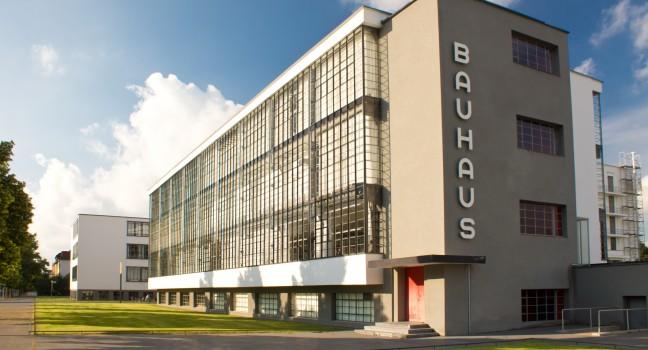
Dessau, Germany; Bauhaus - complex of modern architecture on April 23, 2011, Dessau, Germany. This iconical piece of architecture was designed in 1925 by Walter Gropius and is in UNESCO;
Leonid Mylnikov / Shutterstock

The architecture and design school is still operating in this building, where artists conceived styles that influenced the appearance of such cities as New York, Chicago, and San Francisco. Other structures designed by Gropius and the Bauhaus architects, among them the Meisterhäuser, are also open for inspection off Ebertallee and Elballee.

Gropiusallee 38, Dessau, D–06844, Germany
0340-650–8251
Sight Details
€8.50 per site

Something incorrect in this review?

Dom St. Peter und Paul

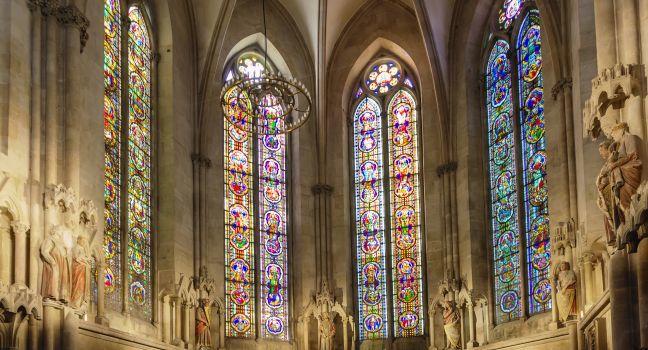
Naumburger Cathedral, Germany
(c) Borisb17 | Dreamstime.com

Perched high above the city and dominating the skyline, this cathedral is the symbol of Naumburg. For the most part constructed during the latter half of the 13th century, it's considered one of the masterpieces of the late Romanesque period. What makes the cathedral unique, however, is the addition of a second choir in the Gothic style less than 100 years later. The Gothic choir is decorated with statues of the cathedral's benefactors from the workshop of the Naumburger Meister. The Master, now thought to be French, also created a relief depicting the passion with each scene cut from one stone and more than 30 cm (11 inches) deep—a masterpiece, as reliefs at the time were usually 10 cm (4 inches) deep. Be sure to find Neo Rauch's red triptych windows in the St. Elisabeth Chapel. The most famous statues are of Uta and Ekkehard, the city's most powerful patrons. Uta's tranquil face is everywhere, from postcards to city maps.

Dompl. 16, Naumburg, D–06618, Germany
03445-2301133
Sight Details
€9.50

Something incorrect in this review?

Domplatz

The historic square Domplatz in Erfurt at night, Germany.
(c) Alexsleepy | Dreamstime.com

Erfurt's most picturesque square is bordered by houses dating from the 16th century and dominated by twin churches. The daily market is a great place to get a Thuringian bratwurst from one of the many stands.

Domplatz, Erfurt, Germany

Something incorrect in this review?

Gedenkstätte Buchenwald

The Holocaust Memorial near the concentration camp of Buchenwald. The camp is located close to the city of Weimar in Germany.
(c) Dennis_dolkens | Dreamstime.com

Just north of Weimar, amid the natural beauty of the Ettersberg hills that once served as Goethe's inspiration, sits the blight of Buchenwald, one of the most infamous Nazi concentration camps. Fifty-six thousand men, women, and children from 35 countries met their deaths here through forced labor, starvation, disease, and gruesome medical experiments. Each is commemorated by a small stone placed on the outlines of the barracks, which have long since disappeared from the site, and by a massive memorial tower. In an especially cruel twist of fate, many liberated inmates returned to the camp as political prisoners of the Soviet occupation; they are remembered in the exhibit Soviet Special Camp #2. Besides exhibits, tours are available. To reach Buchenwald by public transportation, take Bus 6 (in the direction of Buchenwald, not Ettersburg), which leaves every 10 minutes from Goetheplatz in downtown Weimar. The one-way fare is €2.70.

Weimar, 99427, Germany
03643-430–200
Sight Details
Free
Closed Mon.

Something incorrect in this review?

Goethes Gartenhaus

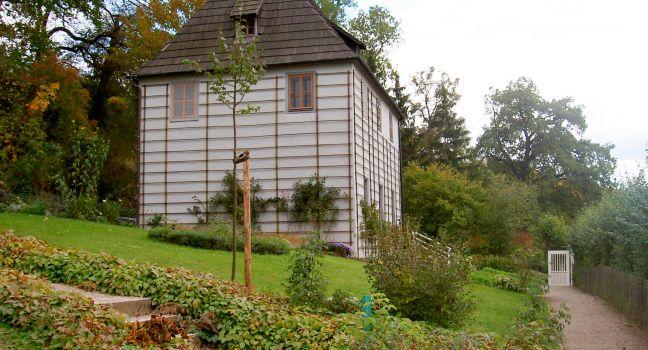
Goethe's garden house on the Ilm, Weimar, Germany, 2014 In the garden house on the Ilm the poet Goethe lived and worked in the early years in Weimar.
(c) Kehli01 | Dreamstime.com

Goethe's first house in Weimar, the beloved Gartenhaus, is a modest country cottage where he spent many happy hours, wrote much poetry, and began his masterly classical drama Iphigenie. The house is set amid meadowlike parkland on the bank of the River Ilm. Goethe is said to have felt very close to nature here, and you can soak up the same rural atmosphere on footpaths along the peaceful little river.

Hans-Wahl-Str. 4, Weimar, 99425, Germany
03643-545–400
Sight Details
€7
Closed Mon.

Something incorrect in this review?

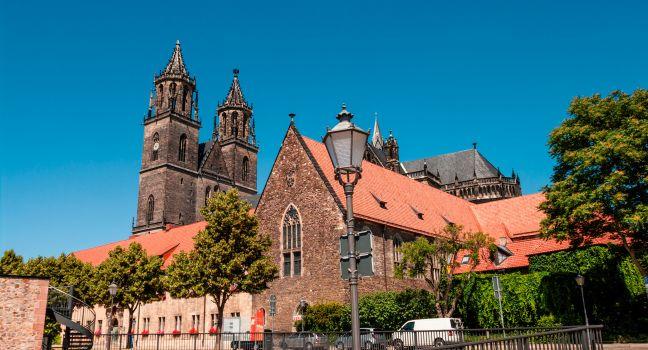
Magdeburg Cathedral

Cathedral of Magdeburg at river Elbe, Germany
(c) Neurobite | Dreamstime.com
The city's major landmark and Germany's first Gothic cathedral, the impressive Magdeburg Cathedral's magnificent towers are visible from miles around. Constructed on the site of an ancient abbey, the cathedral took over 300 years to build, beginning around 1200, with the completion of the steeples—Germany's tallest—in 1520. Filled with important statuary, paintings, and artifacts that date from the Gothic to the present day, the bright, soaring space is a pleasure to behold.
Am Dom 1, Magdeburg, 39104, Germany
0391–541–0436
Sight Details
€3.50 for a guided tour; €5 for cathedral tower tour
Apr.–Oct, daily 10–5; Nov.–Mar., daily 10–4

Something incorrect in this review?

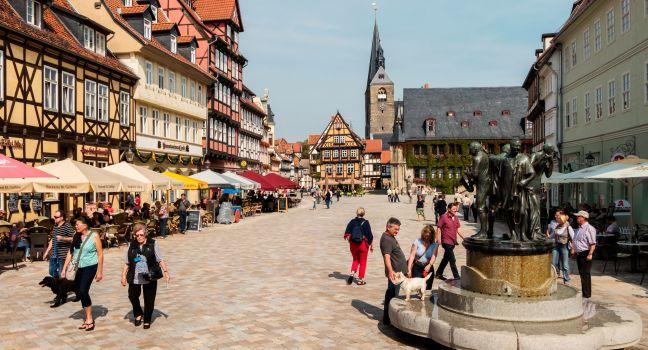
Marktplatz

The Market Square in the UNESCO world heritage town of Quedlinburg in Germay.
(c) Deniskelly | Dreamstime.com

The Altstadt (Old Town) is full of richly decorated half-timber houses, particularly along Mühlgraben, Schuhof, the Hölle, Breite Strasse, and Schmale Strasse. Notable on the Marktplatz are the Renaissance Rathaus, with a 14th-century statue of Roland signifying the town's independence, and the baroque 1701 Haus Grünhagen. Street and hiking maps and guidebooks (almost all in German) are available in the information office near the Rathaus.

Markt 4, Quedlinburg, D–06484, Germany
03946-905624

Something incorrect in this review?

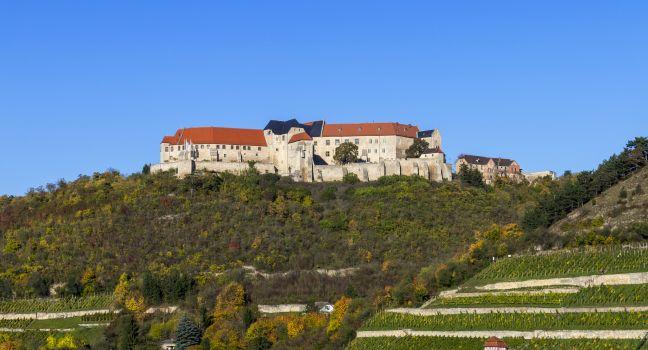
Schloss Neuenburg

Schloss Neuenburg, Freyburg (Unstrut), Germany, Deutschland.
(c) Fleckus | Dreamstime.com

Since its foundation was laid in 1090 by the Thuringian Ludwig I, this castle has loomed protectively over Freyburg. The spacious residential area and huge towers date from the 13th century, when Neuenburg was a part of Thuringia's eastern defenses. The spartan Gothic double-vaulted chapel from 1190 is one of the few rooms that evoke an early medieval past, since most of the castle was renovated in the 15th century.

Schloss 1, Freyburg, D–06632, Germany
34464-35530
Sight Details
€6.50
Closed Mon.

Something incorrect in this review?

Albertinum

Named after Saxony's King Albert, who between 1884 and 1887 converted a royal arsenal into a suitable setting for the treasures he and his forebears had collected, this massive, imperial-style building houses one of the world's great galleries featuring works from the romantic period to the modern. The Galerie Neue Meister (New Masters Gallery) has an extensive collection ranging from Caspar David Friedrich and Gauguin to Ernst Kirchner and Georg Baselitz.

Tzschirnerpl. 2, Dresden, D-01067, Germany
0351-49849–14973
Sight Details
€14

Something incorrect in this review?

Albrechtsburg

The story of Meissen porcelain actually began high above Old Meissen. Towering over the Elbe River, this 15th-century castle is Germany's first truly residential one, a complete break with the earlier style of fortified bastions. In the central Schutzhof, a typical Gothic courtyard protected on three sides by high rough-stone walls, is an exterior spiral staircase, the Wendelstein, a masterpiece of early masonry hewn in 1525 from a single massive stone block. The ceilings of the castle halls are richly decorated, although many date only from a restoration in 1870. Adjacent to the castle is an early Gothic cathedral. It's a bit of a climb up Burgstrasse to the castle, but a bus runs regularly up the hill from the Marktplatz.

Alte Wasserkunst

Erected in 1558, the Alte Wasserkunst served as part of the town's defensive fortifications, but its true purpose was to pump water from the Spree into 86 cisterns spread throughout the city. It proved so efficient that it provided the city's water supply until 1965. It is now a technical museum.

Altes Brauhaus

Near the Frauenkirche, the Altes Brauhaus dates to 1460 and is graced by a Renaissance gable.

An der Frauenkirche 3, Meissen, 01662, Germany

Something incorrect in this review?

Altmarkt

Although dominated by the nearby brutalist Kulturpalast (Palace of Culture), the Altmarkt is a fascinating concrete leftover from the 1970s (check out the \"workers and peasants\" GDR mosaic), and the broad square and its surrounding streets are the true center of Dresden. The colonnaded beauty (from the Stalinist-era architecture of the early 1950s) survived the efforts of city planners to turn it into a huge outdoor parking lot. The rebuilt Rathaus (Town Hall) is here (go around the front to see bullet holes in the statuary), as is the yellow-stucco, 18th-century Landhaus, which contains the Stadtmuseum Dresden im Landhaus

Dresden, Germany

Something incorrect in this review?

Andreasviertel

A relatively affluent quarter developed behind the church of St. Andreas and extended toward the river during the middle ages. Though the houses were smaller than those of the exceptionally wealthy woad traders, this quarter was home to successful craftsmen and other laborers in small narrow houses built on small alleys. All through the Old City look for decorative house names like Haus zum kleinen Apfel (House at the Small Apple). Before street names and house numbers, buildings were given names that served as a postal address; there are signs like these on many of Erfurt’s buildings.

Andreasstr. 14, Erfurt, 99084, Germany

Something incorrect in this review?

Anhalt Art Gallery Dessau

The Anhalt Art Gallery Dessau, housed in the Georgium Palace, traces its origins to several older Anhalt collections, primarily of princely heritage. The gallery's painting collection highlights Dutch works from the 15th to 18th centuries, along with German paintings spanning the 15th to early 19th centuries, featuring significant pieces by Lucas Cranach the Elder. Its extensive graphic collection includes drawings and prints from the 14th century to modern times.

The Anker

The city's main transportation hub and pedestrian zone, the Anker had already been part of medieval Erfurt with the continent's largest woad market. The area saw change as a result of urban expansion due to the growth of the railroad in Thuringia in the early 19th century. With some exceptions, the houses are all architecturally historicized, making them look much older than they really are. The Hauptpostgebäude was erected in 1892 in a mock Gothic style.

Anker, Erfurt, Germany

Something incorrect in this review?