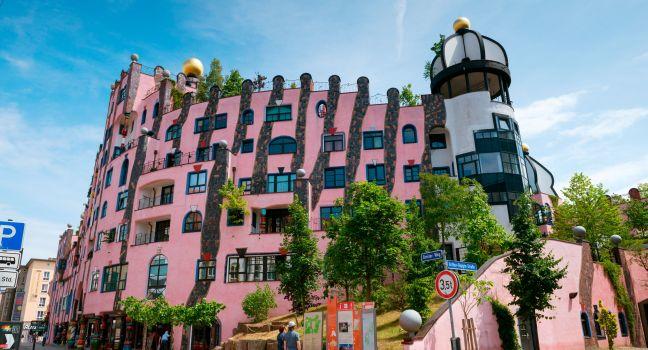
Green Citadel of Magdeburg
We've compiled the best of the best in Saxony, Saxony-Anhalt and Thuringia - browse our top choices for the top things to see or do during your stay.
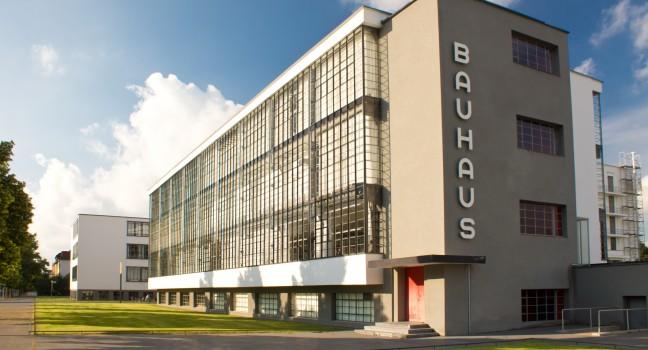
The architecture and design school is still operating in this building, where artists conceived styles that influenced the appearance of such cities as New York, Chicago, and San Francisco. Other structures designed by Gropius and the Bauhaus architects, among them the Meisterhäuser, are also open for inspection off Ebertallee and Elballee.
Near the Frauenkirche, the Altes Brauhaus dates to 1460 and is graced by a Renaissance gable.
Although the current name, Bauhaus University, only dates from 1996, Walter Gropius renamed the former Great Ducal Saxon Art School as the Bauhaus in 1919. His goal was to challenge the status quo and create a more humanized modernity that fused art and design into architecture and city planning. Henry van de Velde, who suggested Gropius for his position in Weimar, completed what is now the main administrative building of the university in 1911. Although it was conceived as an Art Nouveau structure, Van de Velde’s studio is one of the best-preserved Bauhaus buildings in Germany—be sure to look for the free-standing staircase in the foyer of the building. Van de Velde also designed the horseshoe-shape gable of the Art Faculty in 1906.
This house is interesting for its Renaissance facade decorated with sandstone reliefs depicting biblical stories. The Catholic Church banned religious depictions on secular buildings, but by the time the house was rebuilt after a fire in 1526, the Reformation had Görlitz firmly in its grip.
This modest, cubical structure designed by Georg Muche for the 1923 Bauhaus exhibition is the first structure constructed using the Bauhaus’s new philosophy of functional modernity. The house is a small cubist structure comprised of concrete and stone walls with a flat roof and is a model for the Meisterhäuser in Dessau. All of the furniture was created specifically for the house by students of the Bauhaus design school.
Below the waterworks and outside the walls, this reddish-brown house was one of the only structures to survive all the city's fires—leading Bautzeners to conclude that it could only be occupied by witches. There's an exhibition, open every on the 1st and 3rd Sunday every the month.
Built in 1912–13, Germany's only original Art Nouveau department store has a main hall with a colorful glass cupola and several stunning freestanding staircases that may look familiar to those who have seen the film The Grand Budapest Hotel, since the building stood in the hotel's grand lobby. The store dominates the Marienplatz, a small square outside the city center that serves as Görlitz's transportation hub. It's next to the 15th-century Frauenkirche, the parish church for the nearby hospital and the poor condemned to live outside the city walls. In 2013 a private investor purchased the building with plans to renovate it and open a high-end department store. At this writing, the building is still being restored, but there is no concrete date to reopen it. It may be possible to look around the inside during the renovation.
Supported by seven Gothic gables, the Kaysersches Haus the carved oak doorway is from the Renaissance.
Naumburg was once ringed by a defensive city wall with five gates. The only remaining one, the Marientor, is a rare surviving example of a dual-portal gate, called a barbican, from the 14th century. The museum inside the gate provides a brief history of the city's defenses. A pleasant walk along the remaining city walls from Marienplatz to the Weingarten is the easiest way to explore the last intact section of Naumburg's wall, moat, and defensive battlements.
Naumburg's town hall, rebuilt in 1523, incorporates the remnants of the original building destroyed by fire.
Bautzen's city walls have a number of gates and towers. This one, at the end of Reichenstrasse, is the most impressive. Although the tower base dates from 1490, it was damaged in four city fires (in 1620, 1639, 1686, and 1747) and rebuilt, hence its baroque cupola. The reconstruction caused the tower to lean, however, and its foundation was further damaged in 1837. The "Leaning Tower of Bautzen" currently sits about 5 feet off center. The view from the top is a spectacular vista of Bautzen and the surrounding countryside.
The Schlösschen houses the offices of Naumburg's first and only Protestant bishop, Nikolaus von Amsdorf, who was consecrated by Martin Luther in 1542.