116 Best Sights in Berlin, Germany

Background Illustration for Sights

We've compiled the best of the best in Berlin - browse our top choices for the top things to see or do during your stay.

DDR Museum

Mitte Fodor's choice
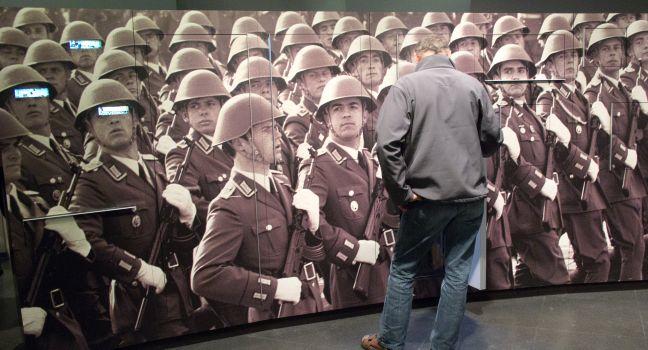
The DDR Museum, is an interactive museum in the centre of Berlin. Its exhibition shows the daily life in East Germany.
Konstantinos Papaioannou | Dreamstime.com

Half museum, half theme park, the DDR Museum is an interactive and highly entertaining exhibit about life during communism. It’s difficult to say just how much the museum benefits from its prime location beside the Spree, right across from the Berliner Dom, but it's always packed, filled with tourists, families, and student groups trying to get a hands-on feel for what the East German experience was really like. Exhibitions include a re-creation of an East German kitchen, all mustard yellows and bilious greens; a simulated drive in a Trabi, the only car the average East German was allowed to own; and a walk inside a very narrow, very claustrophobic interrogation cell.
East Side Gallery

Friedrichshain Fodor's choice
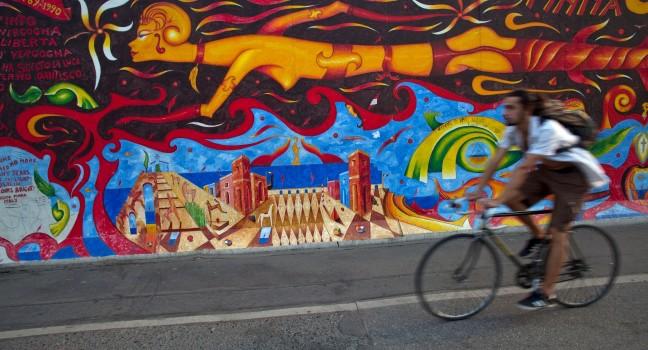
Bicycle rider, East Side Gallery, Berlin, Germany
© Halie Cousineau/ Fodor’s Travel

This 1-km (½-mile) stretch of concrete went from guarded border to open-air gallery within three months. East Berliners breached the wall on November 9, 1989, and between February and June of 1990, 118 artists from around the globe created unique works of art on its longest remaining section. One of the best-known works, by Russian artist Dmitri Vrubel, depicts Brezhnev and Honecker (the former East German leader) kissing, with the caption \"My God. Help me survive this deadly love.\" The stretch along the Spree Canal runs between the Warschauer Strasse S- and U-bahn station and Ostbahnhof. The redbrick Oberbaumbrücke (an 1896 bridge) at Warschauer Strasse makes that end more scenic.

Kulturforum

Potsdamer Platz Fodor's choice
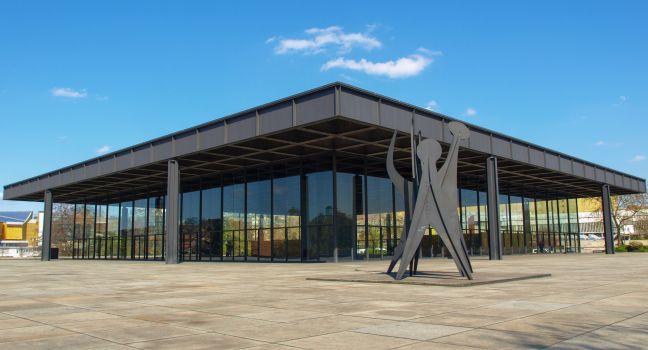
BERLIN, GERMANY - APRIL 23, 2010: The Neue Nationalgalerie art gallery is a masterpiece of modern architecture designed by Mies Van Der Rohe in 1968 as part of the Kulturforum;
Claudio Divizia / Shutterstock

This unique ensemble of museums, galleries, and the Philharmonic Hall was long in the making. The first designs were submitted in the 1960s and the last building completed in 1998. Now it forms a welcome modern counterpoint to the thoroughly restored Prussian splendor of Museum Island, although Berliners and tourists alike hold drastically differing opinions on the area's architectural aesthetics. Whatever your opinion, Kulturforum's artistic holdings are unparalleled and worth at least a day of your time, if not more. The Kulturforum includes the Gemäldegalerie (Picture Gallery), the Kunstbibliothek (Art Library), the Kupferstichkabinett (Print Cabinet), the Kunstgewerbemuseum (Museum of Decorative Arts), the Philharmonie, the Musikinstrumenten-Museum (Musical Instruments Museum), the Staatsbibliothek (National Library), and the Neue Nationalgalerie (New National Gallery).

Recommended Fodor's Video

Neues Palais

Fodor's choice
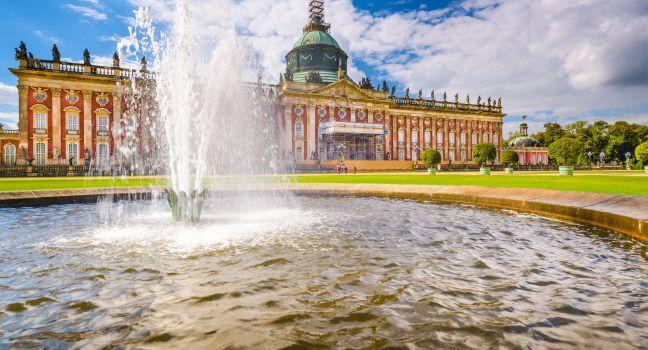
The New Palace Neues Palais in Potsdam, Germany.
(c) Sepavo | Dreamstime.com

A larger and grander palace than Sanssouci, the New Palace stands at the end of the long avenue that runs through Sanssouci Park. It was built after the Seven Years' War (1756–63). Impressive interiors include the Grotto Hall with walls and columns set with shells, coral, and other aquatic decorations, and the luxurious Lower Royal Suite. You can only visit Neues Palais with a guided tour at scheduled times; stop at the Visitor's Center at Neues Palais or the Historic Windmill to pick up a timed ticket (free with the sanssoci+ combined ticket). During the summer months, you can also visit the grandly furnished King's Apartment (closed at the time of this writing for restorations) and rococo-style Palace Theatre (only open on non-performance days and tours in German only).

Potsdam, 14469, Germany
0331-969–4200
Sight Details
Palace grand tour €12; King's Apartment tour €8; grand tour and King's Apartment tour €14; Palace Theatre €8
Closed Tues. King's Apartment and Palace Theatre closed Nov.–Mar.

Something incorrect in this review?

Schloss Sanssouci

Fodor's choice
Unidentified people in front of Sanssouci Palace in Potsdam. Sanssouci Palace is former summer palace of Frederick the Great, King of Prussia, opened at 1747.
(c) Eterovic | Dreamstime.com

Prussia's most famous king, Friedrich II—Frederick the Great—spent more time at his summer residence, Schloss Sanssouci, than in the capital of Berlin. Executed according to Frederick's impeccable French-influenced taste, the palace, which lies on the northeastern edge of Sanssouci Park, was built between 1745 and 1747. It is extravagantly rococo, with scarcely a patch of wall left unadorned. Visits to the palace are only allowed at fixed times scheduled when tickets are purchased. During peak tourist months, timed tickets can sell out before noon, so book online in advance. From Schloss Sanssouci, you can wander down the extravagant terraced gardens, filled with climbing grapevines, trellises, and fountains to reach the Italianate Friedenskirche, or \"Peace Church,\" which was completed in 1854, and houses a 13th-century Byzantine mosaic taken from an island near Venice.

Potsdam, 14469, Germany
0331-969–4200
Sight Details
Schloss Sanssouci €14; Friedenskirche free
Schloss Sanssouci closed Mon. Friedenskirche closed weekdays Nov.–mid-Mar.

Something incorrect in this review?

Tempelhofer Feld

Neukölln Fodor's choice
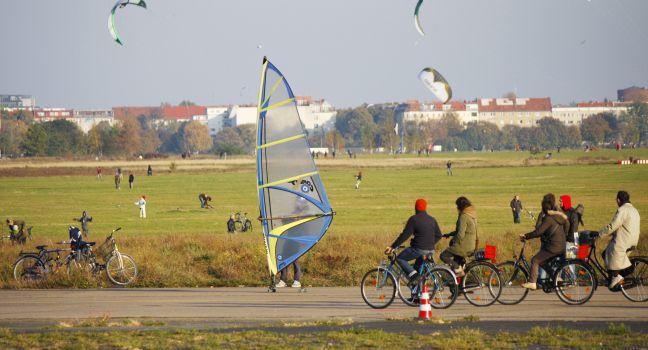
CIRCA OCTOBER 2011 - BERLIN: the Tempelhofer Feld, the former airport of Berlin-Tempelhof which has been redesigned as a public park, Berlin.
(c) Markwaters | Dreamstime.com

Of all Berlin’s many transformations, this one—from airport to park—might be the quickest. The iconic airport (it was the site of the 1948–49 Berlin airlift) had its last flight in 2008. Only two years later, it opened as a park, complete with untouched runways. It's now one of the city’s most beloved and impressive outdoor spots, where bikers, skaters, kite flyers, urban gardeners, picnickers, and grillers all gather. You can explore the Nazi-era airport buildings on a two-hour tour (book online), and there are also frequently rotating exhibitions and lectures on the airport's history at the visitor center to the left of the main entrance. You can also visit the former traffic control tower (THF Tower) for city views along with the exhibition \"100 Years of Tempelhof Airport.\"

Bordered by Columbiadamm and Tempelhoferdamm, Berlin, 12101, Germany
030-2474–9888-guided tours
Sight Details
Park and visitor center exhibitions free; airport building guided tour €17.50; THF Tower €6
Visitor center closed and no guided tours Tues. THF Tower closed Mon. and Tues.

Something incorrect in this review?

Alte Nationalgalerie

Mitte Fodor's choice

The permanent exhibit here is home to an outstanding collection of 18th-, 19th-, and early-20th-century paintings and sculpture, by the likes of Cézanne, Rodin, Degas, and one of Germany's most famous portrait artists, Max Liebermann. Its collection has masterpieces from such 19th-century German painters as Karl Friedrich Schinkel and Caspar David Friedrich, the leading members of the German Romantic school.

Bodestr. 1–3, Berlin, 10178, Germany
30-2664–24242
Sight Details
€12 (combined ticket for all Museum Island museums €24)
Closed Mon.

Something incorrect in this review?

Berlinische Galerie

Kreuzberg Fodor's choice

Talk about site-specific art: all the modern art, photography, and architecture models and plans here, created between 1870 and the present, were made in Berlin (or in the case of architecture competition models, intended for the city). Russians, secessionists, Dadaists, and expressionists all had their day in Berlin, and individual works by Otto Dix, George Grosz, and Georg Baselitz, as well as artists' archives such as the Dadaist Hannah Höch's, are highlights. Special exhibitions are usually well attended and quite worthwhile.

Fotografiska Berlin

Mitte Fodor's choice

Inside the former Tacheles art collective, contemporary photography museum Fotografiska has retained all the former inhabitants’ graffiti on the walls in the hallways and stairwells. Regularly rotating exhibitions range across several floors, showing a mix of photography and videos from both well-known artists, such as Andy Warhol, but also younger emerging artists. You won’t go hungry (or thirsty) here, as there’s a restaurant, two bars (including Bar Clara, on the rooftop), a café, and a bakery; visitors are even encouraged to peruse the artworks with drink in hand. The museum is open till 11 pm every day (last entry at 10 pm), making it perfect for an evening wander.

Gemäldegalerie

Potsdamer Platz Fodor's choice

The Kulturforum's Gemäldegalerie reunites formerly separated collections from East and West Berlin. It's one of Germany's finest art galleries, and has an extensive selection of European paintings from the 13th to 18th centuries. Seven rooms are reserved for paintings by German masters, among them Dürer, Cranach the Elder, and Holbein. A special collection has works of the Italian masters—Botticelli, Titian, Giotto, Lippi, and Raphael—as well as paintings by Dutch and Flemish masters of the 15th and 16th centuries: Van Eyck, Bosch, Bruegel the Elder, and Van der Weyden. The museum also holds the world's second-largest Rembrandt collection.

Matthäikirchpl., Berlin, 10785, Germany
030-2664–24242
Sight Details
€16; €20 for Gemäldegalerie, Kunstgewerbemuseum, and Neue Nationalgalerie
Closed Mon.

Something incorrect in this review?

Gropius Bau

Kreuzberg Fodor's choice

This magnificent palazzo-like exhibition hall first opened in 1881, and once housed Berlin's Arts and Crafts Museum. Its architect, Martin Gropius, was the great-uncle of Walter Gropius, the Bauhaus architect who also worked in Berlin. The international, changing exhibits on art and culture have included Painting in the US and USSR 1960–1990; a Yayoi Kusama retrospective; Art, Craft, and Concept in Berlin; and fabric-based works from Louise Bourgeois.

Hamburger Bahnhof—Museum für Gegenwart

Mitte Fodor's choice

This light-filled, remodeled train station is home to a rich survey of post-1960 Western art. The permanent collection includes installations by German artists Joseph Beuys and Anselm Kiefer, as well as paintings by Andy Warhol, Cy Twombly, Robert Rauschenberg, and Robert Morris. An annex presents the Friedrich Christian Flick Collection, featuring a selection of the latest in the world's contemporary art. The more than 1,500 works rotate, but you're bound to see some by Bruce Naumann, Rodney Graham, and Pipilotti Rist.

Invalidenstr. 50–51, Berlin, 10557, Germany
030-2664–24242
Sight Details
€14
Closed Mon.

Something incorrect in this review?

Humboldt Forum

Mitte Fodor's choice

This reconstruction of the former 15th-century palace that once stood on this site now houses a range of globally focused collections, including the Ethnological Museum and Asian Art Museum, which display more than 500,000 cultural objects from around the world; Humboldt University Lab, which explores science and society; and Berlin Global, which looks at Berlin's connection to the rest of the world through such topics as entertainment, fashion, war, and boundaries. The Forum also includes regularly changing temporary displays, such as the history of ivory and a children’s exhibit. Controversial from the start, due to the razing of the ‘70s-era East German Palast der Republik that formerly stood on the site and the display of colonial-era objects (some of which will be repatriated to their countries of origin), this sprawling museum makes a fascinating day out to see both the building itself and the exhibits inside. Note that you will need to buy individual timed tickets for each exhibit either online or on-site at the ticket office; it isn’t currently possible to buy one ticket to see everything. Though there are several cafés, make a reservation for Baret, the restaurant on the rooftop, if only to see one of the finest panoramic views of Berlin; otherwise, seeing the roof requires buying a ticket.

Schlosspl., Berlin, 10178, Germany
030-9921–18989
Sight Details
Berlin Global €7; temporary exhibits €12 (children’s exhibits free); Ethnological Museum, Asian Art Museum, and Humboldt Lab free, with timed ticket; roof visit €5
Closed Tues.

Something incorrect in this review?

Museum Barberini

Fodor's choice

On the site of the Barberini Palace, destroyed by a bombing in 1945, this elegant art museum features an extensive permanent collection of Impressionist and Post-Impressionist paintings, including the largest collection of Monet's paintings in Europe outside of France. The Barberini also hosts up to three large-scale temporary exhibitions a year, focusing on such artists as Gerhard Richter, Pablo Picasso, and Wassily Kandinsky.

Neue Nationalgalerie

Potsdamer Platz Fodor's choice

Bauhaus member Ludwig Mies van der Rohe originally designed this glass-box structure for Bacardi Rum in Cuba, but Berlin became the site of its realization in 1968; it closed in 2015 for a freshening up by British architect David Chipperfield, finally reopening in August 2021. Highlights of the collection of 20th-century paintings, sculptures, and drawings include works by expressionists Otto Dix, Ernst Ludwig Kirchner, and Georg Grosz, along with a fine collection of East German art plus works from the likes of Francis Bacon, Paul Klee, and Pablo Picasso. Temporary exhibitions, such as Alexander Calder's mobiles, dominate the top floor, while the excellent permanent collection sprawls over the bottom floor.

Potsdamer Str. 50, Berlin, 10785, Germany
030-2664–24242
Sight Details
€16 permanent and special exhibitions; €12 special exhibitions; €20 for Neue Nationalgalerie, Kunstgewerbemuseum, and Gemäldegalerie
Closed Mon.

Something incorrect in this review?

Neues Museum

Mitte Fodor's choice

Originally designed by Friedrich August Stüler in 1843–55, the building housing the Neues Museum was badly damaged in World War II and has only in the 21st century been elaborately redeveloped by British star architect David Chipperfield. Instead of completely restoring the Neues Museum, the architect decided to integrate modern elements into the historic landmark, while leaving many of its heavily bombed and dilapidated areas untouched. The result is a stunning experience, considered by many to be one of the world's greatest museums. Home to the Egyptian Museum, including the famous bust of Nefertiti (who, after some 70 years, has returned to her first museum location in Berlin), it also features the Papyrus Collection and the Museum of Prehistory and Early History.

Bodestr. 1–3, Berlin, 10178, Germany
030-2664–24242
Sight Details
€14 (combined ticket for all Museum Island museums €24)
Closed Mon.

Something incorrect in this review?

Palais Populaire

Mitte Fodor's choice

The reconstructed 18th-century Prinzessinnenpalais (Princesses’ Palace) now houses selections of Deutsche Bank’s contemporary art holdings, which rotate several times a year. Past exhibitions include Ways of Seeing Abstraction, works from German figurative painter K.H. Hödicke, and international photography from the 1970s to the present, along with shows featuring Deutsche Bank's “artists of the year.” Though the art selections may be compact, they’re most often provocative and worthwhile. Take an art break at the attached LePopulaire café, which serves up salads, sandwiches, and heartier mains for lunch or snacks.

Pergamonmuseum

Mitte Fodor's choice

The Pergamonmuseum is one of the world's greatest museums and its name is derived from its principal display, the Pergamon Altar, a monumental Greek temple discovered in what is now Turkey and dating from 180 BC. The altar was shipped to Berlin in the late 19th century. Equally impressive are the gateway to the Roman town of Miletus, the Ishtar Gate, and the Babylonian processional way. The entire museum is closed for refurbishment until 2027, when parts of it will reopen, including the famed altar; the rest of the museum isn't scheduled to reopen until 2037. Until then, visitors can see Das Panorama, 360-degree visuals of the ancient city of Pergamon designed by artist Yadegar Asisi and combined with a selection of original sculptures, in a temporary pavilion on Am Kupfergraben, across from Museuminsel.

Bodestr. 1–3, Berlin, 10178, Germany
030-2664–24242
Sight Details
Das Panorama €12 (combined ticket with all Museum Island museums €24)
Closed Mon.

Something incorrect in this review?

Sammlung Boros

Mitte Fodor's choice

Both an historic and a modern Berlin attraction all at once, the unique Sammlung Boros houses a private contemporary art collection inside a renovated World War II bunker. Visits are only possible by 90-minute guided tour, which are extremely popular and must be booked online weeks in advance. Tours include both detailed descriptions of the artists and artwork on display, and also the fascinating history and architecture of the bunker itself, which at varying times was used as a war prison, fruit storage facility, and notorious nightclub.

Staatsoper Unter den Linden

Mitte Fodor's choice

Frederick the Great was a music lover and he made the Staatsoper Unter den Linden, on the east side of Bebelplatz, his first priority. The lavish opera house was completed in 1743 by the same architect who built Sanssouci in Potsdam, Georg Wenzeslaus von Knobelsdorff. The house reopened in late 2017 after a major seven-year renovation. There are guided 90-minute tours of the opera house's interior on weekends (book online), but they are offered in German only.

Urban Spree

Friedrichshain Fodor's choice

A sprawling arts and event space, Urban Spree includes an exhibition gallery, workshop, art store, beer garden, and outdoor food court. Largely focused on urban graffiti, photography, and street art, the space also hosts a number of Berlin's alternative events.

Sammlung Boros

Mitte Fodor's choice

This private collection has become one of Berlin’s star attractions, thanks to its unusual location inside a hulking WWII bunker in Mitte. Contemporary art collector Christian Boros bought the bunker in 2003 to house his art, and built a glass penthouse on top to house his family. The best works are those created specifically for the space by well-known artists such as Ai Weiwei, Olafur Eliasson, and Tomás Saraceno. Since this is a private home, admission is only allowed on guided tours, which take place Thursday to Sunday and can booked online. The tours are popular, so book as early as you can (months in advance).

Alexanderplatz

Mitte
© Halie Cousineau/ Fodor’s Travel

This bleak square, bordered by the train station, the Galeria Kaufhof department store, and the 37-story Park Inn by Radisson Berlin Alexanderplatz hotel, once formed the hub of East Berlin and was originally named in 1805 for Czar Alexander I. German writer Alfred Döblin dubbed it the \"heart of a world metropolis\" (a quote from his 1929 novel Berlin Alexanderplatz is written on a building at the northeastern end of the square). Today it's a basic center of commerce and the occasional festival. The unattractive modern buildings are a reminder not just of the results of Allied bombing but also of the ruthlessness practiced by East Germans when they demolished what remained. A famous meeting point in the south corner is the World Time Clock (1969), which even keeps tabs on Tijuana.

Berlin, Germany

Something incorrect in this review?

Alter Markt

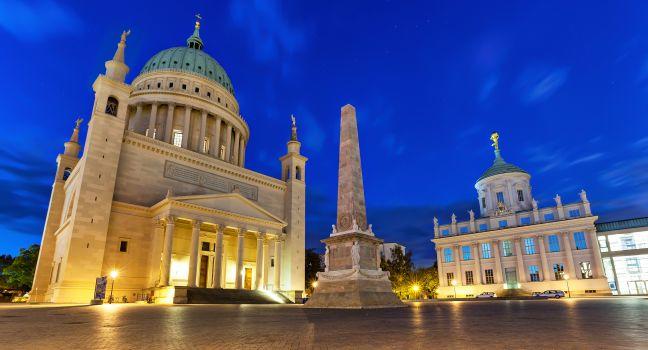
St. Nicholas Church and old city hall on Alter Markt square in Potsdam, Germany.
(c) Bbsferrari | Dreamstime.com

The hub of Potsdam's historical center was home to the city's baroque palace for three centuries. The area was heavily damaged by Allied bombing in World War II and then further destroyed by the East German regime in 1960. After reunification, Potsdam decided to rebuild its palace, and the re-created structure, with a combination of modern and historic elements, has housed the state parliament since 2013. Thanks to private donors, a magnificent replica of the Fortunaportal, or Fortune's Gate, now stands proudly at the center of the square. A gilded figure of Atlas tops the tower of the Altes Rathaus (Old Town Hall), built in 1755 in the model of an Italian palazzo, its dome meant to mimic the Pantheon's in Rome. The Potsdam Museum contains a large collection of paintings, photographs, and historical objects. Karl Friedrich Schinkel designed the Alter Markt's domed Nikolaikirche (St. Nicholas Church), which was also heavily damaged in the war and only reopened in 1981 after extensive renovations.

Alter Markt, Potsdam, 14467, Germany

Something incorrect in this review?

Belvedere auf dem Pfingstberg

POTSDAM, GERMANY - AUG 8, 2015: view of the Belvedere, a palace in the New Garden on the Pfingstberg hill in Potsdam, Germany. Frederick William IV constructed the castle in 1847.
(c) Meinzahn | Dreamstime.com

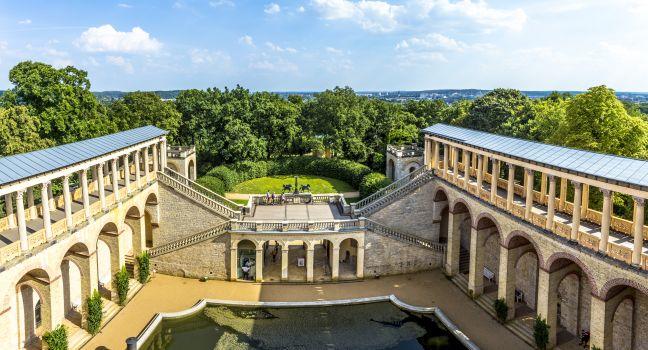
Commissioned by King Friedrich Wilhelm IV, the Belvedere on Pfingstberg was built in the Italian Renaissance style with grand staircases, colonnades, and perfect symmetry. It served as a pleasure palace and lofty observation platform for the royals, and the towers still offer one of the best views of Potsdam.

Potsdam, 14469, Germany
0331-2005–7930
Sight Details
€8
Closed Dec.–Feb. and weekdays Mar.–Nov.

Something incorrect in this review?

Berliner Dom

Mitte
The Berliner Dom, Berlin Cathedral, Berlin, Germany
© Halie Cousineau/ Fodors Travel

A church has stood here since 1536, but this enormous version dates from 1905, making it the largest 20th-century Protestant church in Germany. The royal Hohenzollerns worshipped here until 1918, when Kaiser Wilhelm II abdicated and left Berlin for Holland. The massive dome wasn't restored from World War II damage until 1982; the interior was completed in 1993. The climb to the dome's outer balcony is made easier by a wide stairwell, plenty of landings with historic photos and models, and even a couple of chairs. The 94 sarcophagi of Prussian royals in the crypt has been under restoration and will reopen in fall 2025 with new multimedia exhibitions. Sunday services include communion. Guided tours, bookable online, are usually offered only in German.

Am Lustgarten 1, Berlin, 10178, Germany
030-2026–9136
Sight Details
€10

Something incorrect in this review?

Brandenburger Tor, Jägertor, and Nauener Tor

Nauen Gate in the Old Town of Potsdam.
(c) Heiko119 | Dreamstime.com

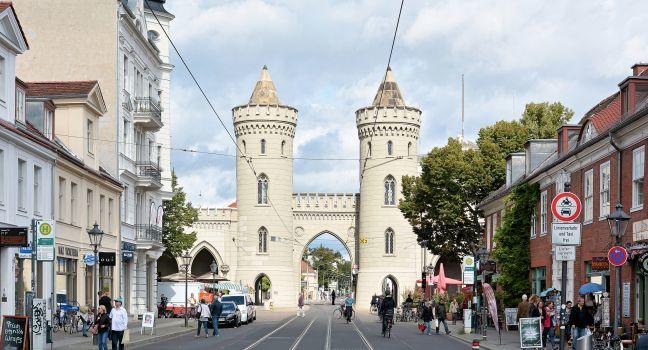
These gates (translated as the Brandenburg Gate, the Hunter's Gate, and the Nauen Gate) are three of the original seven gates that were incorporated into the old city walls. They were mostly ornamental, erected by noblemen to show off their prowess and accomplishments, and were meant to direct the eye along various axes from the center of the city to grand boulevards radiating outwards. If you follow the promenade that traces the now-demolished city walls, you can see all three of these gates in a 10-minute walk. The Brandenburger Tor sits at one edge of Luisenplatz, between the pedestrian streets of the old town and an entrance to Sanssouci Park. Commissioned by Frederick the Great to celebrate his victory in the Seven Years' War, it was built by Karl von Gontard as a Roman triumphal arch. The small Jägertor is really nothing more than a simple archway, crowned by a statue of a deer set upon by hunting dogs. Its diminutive size, however, belies its historical importance: it's the only gate in Potsdam still in its original form instead of a restored version. The sandstone Nauener Tor, which sits at the northern edge of the bustling, shop-filled main corridor Friedrich-Ebert-Strasse, is the oldest example of a neo-Gothic structure in continental Europe. It looks something like a mini-castle with its twin turrets.

The Center Potsdamer Platz

Potsdamer Platz
Sony Center at the Postdamer Platz in Berlin. Germany.
(c) Sylvaindeutsch | Dreamstime.com

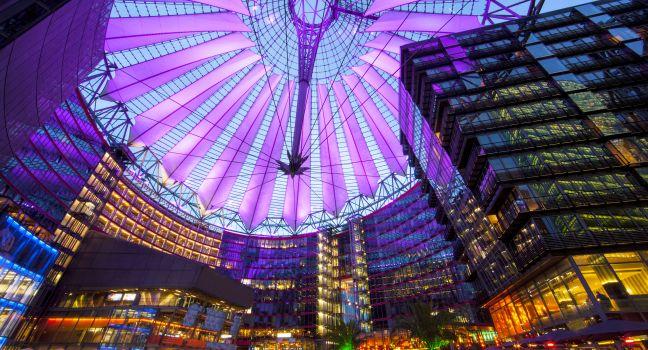
This glass-and-steel construction wraps around a spectacular circular forum. Topping it off is a tent-like structure meant to emulate Mt. Fuji. The architectural jewel, formerly the Sony Center, designed by German-American architect Helmut Jahn, is one of the most stunning public spaces of Berlin's new center, filled with restaurants, cafés, the Legoland Discover Museum, offices, and apartments.

Friedrichstrasse

Mitte
Friedrichstrasse, Berlin, Germany
© Halie Cousineau/ Fodor’s Travel

The once-bustling street of cafés and theaters of prewar Berlin has risen from the rubble of war and Communist neglect to reclaim the crowds with shopping emporiums. North of the train station you will see the rejuvenated heart of the entertainment center of Berlin's Roaring Twenties, including the Admiralspalast and the somewhat kitschy Friedrichstadt Palast.

Berlin, Germany

Something incorrect in this review?

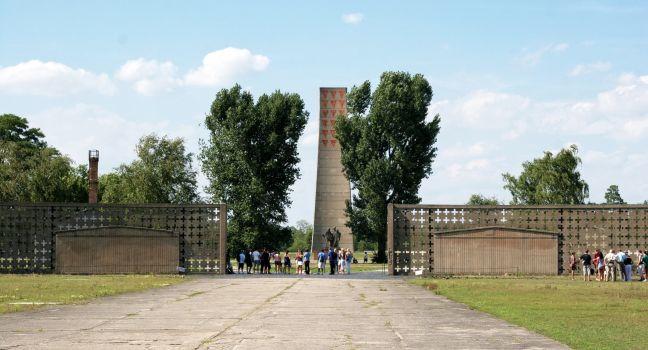
Gedenkstätte und Museum Sachsenhausen

Sachsenhausen-Oranienburg concentration camp with barracks and Soviet Liberation Memorial on the background, Germany.
(c) Wastesoul | Dreamstime.com

This concentration camp was established in 1936 and held 200,000 prisoners from every nation in Europe, including British officers and Joseph Stalin's son. It is estimated that tens of thousands died here, among them more than 12,000 Soviet prisoners of war. Between 1945 and 1950 the Soviets used the site as a prison, and malnutrition and disease claimed the lives of 20% of the inmates. The East German government made the site a concentration-camp memorial in April 1961. Many original facilities remain; the barracks and other buildings now hold exhibits. Allow three hours at the memorial, whose exhibits and sites are spread apart. Oranienburg is 35 km (22 miles) north of Berlin's center.

Str. der Nationen 22, Oranienburg, 16515, Germany
03301-200–200
Sight Details
Free; audio guide €3.50

Something incorrect in this review?