



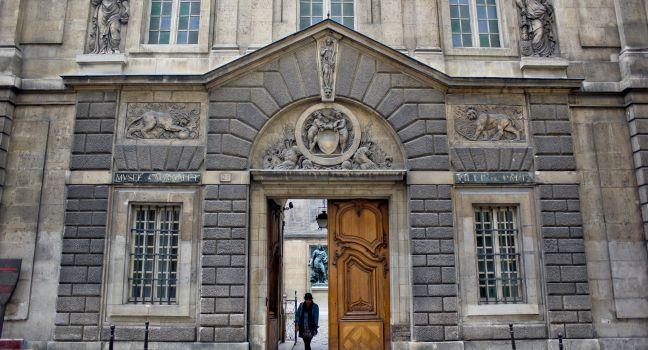
Musée Carnavalet
Get FREE email communications from Fodor's Travel, covering must-see travel destinations, expert trip planning advice, and travel inspiration to fuel your passion.

We've compiled the best of the best in France - browse our top choices for the top things to see or do during your stay.
On the site of a crucial fort at the summit of Mont Faron, this museum recounts the planning and execution of World War II's Operation Dragoon, a mission meant to resecure the French ports of Marseille and Toulon and cut off German reinforcements. The story unfolds via firsthand accounts in French and English from men and women who fought for the French Resistance, descriptions of life under the occupation, a detailed timeline, and an 11-minute film showing original footage of the August 15, 1944, invasion—and its vast destruction—which was a decisive turning point in the war.
The excellent Musée d'Art et d'Archéologie displays finds ranging from Gallo-Roman votive objects unearthed in the neighboring Halatte Forest to the building's own excavated foundations (visible in the basement); note the superb stone heads bathed in half light. Upstairs, paintings include works by Manet's teacher, Thomas Couture (who lived in Senlis), and charming naïve florals by the town's own Séraphine de Senlis.
This excellent museum traces the tempestuous backstory of French and European Jews through art and history. Housed in the refined 17th-century Hôtel St-Aignan, exhibits have good explanatory texts in English, but the free English audio guide adds another layer of insight; guided tours in English are also available on request (€4 extra). Highlights include 13th-century tombstones excavated in Paris; a wooden model of a destroyed Eastern European synagogue; a roomful of early paintings by Marc Chagall; and Christian Boltanski's stark two-part tribute to Shoah (Holocaust) victims in the form of plaques on an outer wall naming the (mainly Jewish) inhabitants of the Hôtel St-Aignan in 1939, and canvas hangings with the personal data of the 13 residents who were deported and died in concentration camps. The museum also mounts excellent temporary exhibitions, like the recent "Chagall, Modigliani, Soutine: Paris as a School, 1940." The rear-facing windows offer a view of the Jardin Anne Frank. To visit the garden, use the entrance on Impasse Berthaud, off Rue Beaubourg, just north of Rue Rambuteau.
With the Port Antique in front, this modern, open-space museum illuminates Massalia's history with a treasure trove of archaeological finds and miniature models of the city as it appeared in various stages of history. Best by far is the presentation of Marseille's Classical halcyon days. There's a recovered wreck of a Roman cargo boat, its 3rd-century wood amazingly preserved, and the hull of a Greek boat dating from the 4th century BC. The model of the Greek city should be authentic—it's based on an eyewitness description by Aristotle.
Mark this down as one of Paris's most distinctive—and fascinating—collections around the theme of "humans and nature." The museum, housed in the gorgeous 17th-century Hôtel de Guénégaud, features lavishly appointed rooms stocked with animal- and hunt-theme art and sculpture by the likes of Rubens and Gentileschi, as well as antique weaponry and taxidermy interspersed with contemporary works by artists such as Jeff Koons, Sophie Calle, and Walton Ford. In a tribute to Art Nouveau, the decor incorporates chandeliers and railings curled like antlers. Older kids will appreciate the jaw-dropping Trophy Room's impressive menagerie of beasts, not to mention the huge polar bear stationed outside. There is a lovely multimedia exhibit on the myth of the unicorn, as well as charming interactive displays on antique weaponry and bird calls. Temporary exhibits take place on the first floor, with works scattered throughout the permanent collection. There's also a spacious café.
The newest museum in Nîmes is impossible to miss: first for its location, just opposite the Arènes, and second for its exterior featuring a gleaming, translucent facade meant to evoke a Roman toga. Exhibits inside this luminous edifice showcase the city's Roman past with more than 5,000 artifacts, as well as touch screens, interactive displays, and other state-of-the art features that will delight both adults and kids. Highlights include intact mosaics discovered during recent excavations, a model of a domus (Roman house), and a green roof with panoramic views of the amphitheater and all the city's major sites. The sidewalk café is great for a quick lunch or afternoon drink, and the upstairs La Table du 2—which also has impressive views—is a Michelin-starred brasserie that serves lunch and dinner.
The château on the hill above town is reached from the ticket office via escalator or 131 steps. Once a prison, the castle now contains the Musée Pyrénéen, a provincial museum devoted to the popular customs, arts, and history of the Pyrénées. There are splendid views over the rooftops of Lourdes and the sanctuary area.
Though there are no actual Millet works, the Atelier Jean-François Millet is cluttered with photographs and mementos evoking his career. It was here that the painter produced some of his most renowned pieces, including The Gleaners.
During World War II, Lyon played an important role in the Resistance movement against the German occupation of France. Displays include equipment, such as radios and printing presses, photographs, and exhibits re-creating the clandestine lives and heroic exploits of Resistance fighters.
In 1985, diver Henri Cosquer discovered a mostly submerged cave with chambers containing more than 500 evocative images of bison, horses, deer, ibex, aurochs, seals, jellyfish, and human hands. On this simulated visit at Marseille's Villa Mediterranée, groups of six, equipped with headsets, are taken by cable car though a near-perfect replica of the cave to learn the story of these mysterious drawings, the original artists, and their relationship to the animals they depicted some 33,000 years ago.
This 19th-century water tower at the far end of the Pont Neuf, originally used to store water and build water pressure, is now the oldest public institution in France dedicated to photographic exhibits. It was built in 1822, the same year Nicéphore Nièpce created the first permanent photographic images.
At the top of the Panier district lies this superb ensemble of 17th- and 18th-century architecture, which was originally designed as a hospice for the homeless by Marseillais artist-architects Pierre and Jean Puget and which now houses two museums. While visiting the complex, be sure to walk around the inner court to study the retreating perspective of triple arcades and to admire the baroque chapel with its novel, egg-peaked dome.
The larger of the two museums is the Musée d'Archéologie Méditerranéenne (Museum of Mediterranean Archaeology), with a sizable collection of pottery and statuary from classical Mediterranean civilization; unfortunately, descriptions of these items are rudimentary (e.g., "pot"). There's also an exhibit on the mysterious Celt-like Ligurians who first peopled the coast; alas, displays focus more on the digs than the finds. However, the Egyptian collection—the second-largest in France after the Louvre's—is evocative, with mummies, hieroglyphs, and sarcophagi exhibited in a tomblike setting.
Displays in the upstairs Musée d'Arts Africains, Océaniens, et Amérindiens (Museum of African, Oceanic, and American Indian Art) are theatrical: spectacular masks and sculptures are mounted along a black wall, lighted indirectly, and labeled across the aisle. The complex also has changing exhibitions that might focus on fine art, photography, filmmaking, or cultural anthropology, among other things.
Bertrand Duguesclin built this home for his wife Tiphaine in 1365. The former was a general fierce in his allegiance to the cause of French independence; the latter was a famed astrologer. Now a museum, the logis traces the couple's marital life through small rooms filled with period furnishings and artifacts—including a medieval chastity belt, armor, and astrological tools. It's an interesting stop, even if it can't offer the same return on investment as some of the Mont's more spectacular sights.
Since 1933, systematic excavations have unearthed vestiges of Lyon's opulent Roman precursor. The statues, mosaics, vases, coins, and tombstones are excellently displayed in this partially subterranean museum next to the Roman theaters. The large, bronze Table Claudienne is inscribed with part of Emperor Claudius's address to the Roman Senate in AD 48, conferring senatorial rights on the Roman citizens of Gaul.
Old-time Jacquard looms are still in action at this historic house in La Croix Rousse, and the weavers are happy to show children how the process works. The boutique is a great place to stock up on a colorful range of silk, wool, and linen scarves—all made in Lyon.
Louis XVI transferred the royal Mint to this imposing mansion in the late 18th century. It was moved again (to Pessac, near Bordeaux) in 1973; however, weights and measures, medals, and limited-edition coins are still made here, and the site houses a museum devoted to currency. There is an extensive collection of coins and related artifacts, plus workshops where you can watch artisans in action as they mint, mold, sculpt, polish, and engrave using century-old techniques. Public spaces host cultural programs and temporary contemporary art exhibitions. Check the website for Wednesday and Saturday afternoon craft workshops for children. The museum is also home to the three-star Guy Savoy restaurant (reservations required: [email protected]) and the simpler Café Frappé par Bloom.
Made up of three sites designed by Rudy Ricciotti, MuCEM (Museum of European and Mediterranean Civilizations) is all about new perspectives on Mediterranean cultures. Themes like "the invention of gods," "treasures of the spice route," or "at the bazaar of gender" are explored here. At one of the sites, you can access the 12th-century Fort St-Jean, built by Louis XIV with guns pointing toward the city to keep the feisty, rebellious Marseillais under his thumb.
If you're not the queasy type, walk across the suspended footbridge over the sea; it provides spectacular photo ops and unique panoramas. On the other side, you can visit a Mediterranean garden and a folk-art collection. A third building—the Center for Conservation and Resources, near the St-Charles train station—holds the museum's permanent collection of paintings, prints, drawings, photographs, and objects. The museum's terrace café and restaurant (reservations required), overseen by Michelin three-star chef Alexandre Mazzia, are excellent choices for a meal with a view.
Constructed behind the town church in 1964 in the form of an open parachute, this fascinating museum houses documents, maps, mementos, and one of the Waco CG4A gliders used to drop troops.
In this labyrinthine, half-timber home, where layers of carved balconies sag over a cobbled inner courtyard, local interiors have been faithfully reconstituted. The diverse activities of blacksmiths, clog makers, saddlers, and makers of artificial flowers are explained with the help of old-time craftsmen's tools and equipment.
Promenade Amiral-de-Grasse—a marvelous spot for pondering the mountains and tides—leads directly to the Bastion St-André, a squat Vauban fortress that now houses the Musée Archéologie. In its glory days, this 17th-century stronghold sheltered a garrison; the bread oven is still visible in the vaulted central hall. The museum collection focuses on Antibes's classical history, displaying amphorae and sculptures found in local digs as well as in shipwrecks from the harbor.
Next to the Musée Matisse, this museum has a large collection of objects extracted from digs around the Roman city of Cemenelum, which flourished from the 1st to the 5th centuries. Among the fascinating ruins are an amphitheater, frigidarium, gymnasium, baths, and sewage trenches, some dating from the 3rd century. It's best to avoid midday visits on warm days.
This museum, in the former abbey buildings of the church of St-Bénigne, outlines the history of the region through archaeological finds.
On the same quiet square as Église San Rafeu, this intimate museum has a fascinating collection of ancient amphorae gleaned from the shoals offshore, where centuries' worth of shipwrecks have accumulated. By studying this chronological progression of jars and the accompanying sketches, you can visualize the coast as it was in its heyday as a Greek and Roman shipping center. Take advantage of the temporary exhibitions held throughout the year (€4).
The handsomely designed and appointed Musée Basque on the right bank of the Nive offers an ethnographic history of the Basque Country and culture.
The small museum has relics from the town's medieval past, plus items uncovered during excavations of the 372-foot-deep Cordes Well.


