


Chapelle du Rosaire
Get FREE email communications from Fodor's Travel, covering must-see travel destinations, expert trip planning advice, and travel inspiration to fuel your passion.

We've compiled the best of the best in The French Riviera - browse our top choices for the top things to see or do during your stay.
This majestic basilica dominates the skyline of Menton. Beyond the beautifully proportioned facade—a 19th-century addition—the richly frescoed nave and chapels contain several works by Genovese artists plus a splendid 17th-century organ. Volunteers man the doors here, so you may have to wait for the church to open (usually from 3 pm to 5 pm) before visiting. The parvis is the site of concerts during the August Menton music festival.
In the center of the Old Town, the Cathédrale de la Nativité de la Vierge was built in the 11th and 12th centuries on the site of a Roman military drilling field and is a hybrid of Romanesque and Baroque styles. The smallest cathedral in France, it has been expanded and altered many times over the centuries. Note the rostrum added in 1499—its choir stalls are carved with particularly vibrant and amusing scenes of daily life in the Middle Ages. In the baptistery is a ceramic mosaic of Moses in the bulrushes by Chagall.
On a cliff top overlook at the Old Town's edge, this Romanesque cathedral contains no fewer than three paintings by Rubens, a triptych by the famed 15th-century Provençal painter Louis Bréa, and Lavement des Pieds (The Washing of the Feet) by the young Fragonard.
This magnificent Russian Orthodox cathedral was built in 1896 to accommodate the sizable population of Russian aristocrats who had adopted Nice as their winter home. This Byzantine fantasy is the largest of its kind outside the motherland, with six gold-leaf onion domes, rich ceramic mosaics on its facade, and extraordinary icons framed in silver and jewels. The benefactor was Nicholas II himself, whose family attended the inauguration in 1912. For six years the church was challenged over ownership, but in 2013 the French courts rejected a final appeal by ACOR, a niçois religious association that managed the property for 80 years. The Russian Archpriest rejoiced: "This ruling shows that it is history that has triumphed."
An ensemble of columns, cupolas, and symmetrical ornaments dominates the Vieille Ville, flanked by an 18th-century bell tower and glossy ceramic-tile dome. The cathedral's interior, completely restored to a bright palette of ocher, golds, and rusts, has elaborate plasterwork and decorative frescoes on every surface.
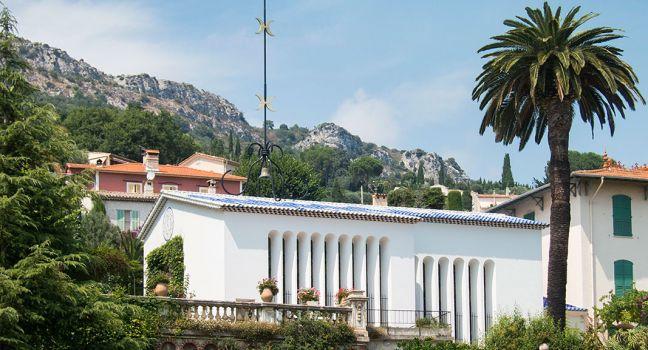
This eccentric chapel was the last designed by Jean Cocteau as part of an artists' colony that never came to be. It's an octagon built around a glass atrium and is embellished with stained glass and frescoes depicting the mythology of the first Crusades. Above the front door, note the tongue-in-cheek painting of the apostles—it features the faces of Coco Chanel, Jean Marais, and poet Max Jacob.
Just above Basilique St-Michel, the smaller Chapelle de l'Immaculée-Conception (aka Pénitents Blancs) answers the main church's grand gesture with its own pure baroque beauty. The sanctuary, dating from 1687, is typically closed to the public; however, on Wednesday between 2:30 pm and 3:15 pm, you can try and slip in to see the graceful trompe l'oeil over the altar and the ornate gilt lanterns early penitents carried in processions.
A superbly balanced pièce-montée (wedding cake) of half-domes and cupolas, this chapel is decorated within an inch of its life with frescoes, faux marble, gilt, and crystal chandeliers. A magnificent altarpiece by Renaissance painter Ludivico Brea crowns the ensemble. Visits are limited to 2:30 to 5:30 pm on Tuesday.
Jean-Michel Folon had a deep affection for the town of St-Paul-de-Vence, where he befriended artists such as César, so it seems fitting that the decoration of its 17th-century Chapelle des Pénitents Blanc was one of the Belgian artist's last projects before his death in 2005. The overwhelming sensations as you enter the chapel are of peace and clarity: eight oil paintings in pastel colors by Folon collaborator Michel Lefebvre line the walls on either side and four stained-glass windows reinforce the themes of generosity and freedom. Sculptures take the place of the traditional altar and font, and the back wall is covered with a mosaic of the town made up of more than 1 million pieces. The chapel demonstrates the versatility of this artist and reflects the town's ability to celebrate its past while keeping an eye on the future. The tourist office can arrange for a 50-minute visite of the chapel in English (€8.50) from Tuesday to Friday, but you'll need to reserve in advance.
Moustiers was founded as a monastery in the 5th century, but it was in the Middle Ages that the Chapelle Notre-Dame-de-Beauvoir (first known as d'Entreroches, or "between rocks") became an important pilgrimage site. You and other pilgrims can still climb the steep cobbled switchbacks, passing modern stations-of-the-cross panels in Moustiers faience. From the porch of the 12th-century church, remodeled in the 16th century, you can look over the roofs of the village to the green valley, a patchwork of olive groves and red-tiled farmhouse roofs. The forerunner of the star that swings in the wind over the village was first hung, it is said, by a crusader grateful for his release from Saracen prison. It takes about 20 minutes to climb the 262 steps, but remember, what goes up must come down—these worn stone steps yield little traction, so be careful.
Nearly hidden in the hillside and entered by an obscure side door, the grand Chapelle Notre-Dame-de-la-Protection, with its Italianate bell tower, was first built in the 14th century after the fortress had been destroyed; as a hedge against further invasion, they placed this plea for Mary's protection at the village edge. In 1936, the curé (priest) discovered traces of fresco under the bubbling plaster; a full stripping revealed that every inch of the apse had been decorated with scenes of the life of the Virgin and Jesus, roughly executed late in the 16th century. From the chapel's porch are sweeping sea views. Even if it's closed when you stop by (renovations are ongoing), be sure to note the trompe-l'oeil "shadows" delightfully painted on the bell tower portal.
Officially known as the Église de l'Annonciation, this 17th-century Carmelite chapel is a classic example of pure Niçoise Baroque, from its sculpted door to its extravagant marble work and the florid symmetry of its arches and cupolas.
So enamored was Jean Cocteau of this painterly fishing port that he decorated the 14th-century Chapelle St-Pierre with images from the life of St. Peter and dedicated it to the village's fishermen.
This sanctuary served as the region's cathedral until the bishopric was transferred to Grasse in 1244. The church's 18th-century facade, a marvelous Latin mix of classical symmetry and fantasy, has been restored in stunning shades of ocher and cream. Its stout medieval watchtower was built in the 11th century with stones "mined" from Roman structures. Inside is a Baroque altarpiece painted by the Niçois artist Louis Bréa in 1515.
If Nice's other chapels are jewel boxes, this is a barn. Broad, open, and ringing hollow after the intense concentration of sheer matter in the Miséricorde and Ste-Rita, it seems austere by comparison. That's only because the decoration is spread over a more expansive surface. If it's possible, this 17th-century Baroque chapel is even more theatrical and over-the-top than its peers. Angels throng in plaster and fresco, pillars spill over with extravagantly sculpted capitals, and from the pulpit (to the right, at the front) the crucifix is supported by a disembodied arm.
This 19th-century, neo-Byzantine church owes its warm, reddish hue to the pink sandstone native to the Estérel region. Its striking dome, reminiscent of Istanbul’s Hagia Sophia, watches over yachts and cruise ships as they glide into the harbor. Step inside, and you might be treated to the angelic strains of a choir rehearsal—or perhaps even a recital.
Next to the Museum of Archeology in the vieille ville, this 12th-century church (also known as Église St-Pierre-des-Templiers) is a miniature-scale Romanesque church. It was recently discovered that its foundations lie on top of two other churches dating from the Carolingian era (AD 800–888). Climb up the 129 steps of the 13th-century bell tower, the Tour San Rafeu, for 360-degree panoramic views, and snap away.
This serene Baroque structure at the foot of the château anchors the oldest church-parish in Nice. Built in 1405, it was here that Martin Luther preached in 1510 and Garibaldi was baptized in 1807.
This modest baroque church, above Rue Obscure, contains a movingly realistic sculpture of Christ carved in fig wood by an anonymous 17th-century convict.
Fréjus is graced with one of the most impressive religious monuments in Provence. The Groupe Épiscopal is made up of an early Gothic cathedral, a 5th-century Roman-style baptistery, and an early Gothic cloister, its gallery painted in sepia and earth tones with a phantasmagoric assortment of animals and biblical characters. Off the entrance and gift shop is a small museum of finds from Roman Fréjus, including a complete mosaic and a sculpture of a two-headed Hermès.
Just east of town on the Route de Fayence is the Romanesque chapel Notre-Dame-de-l'Ormeau, which contains a remarkable altarpiece dating from the 16th century. Sculpted portraits of the wise men and shepherds adoring the Christ child, strikingly real in emotion and gesture, contrast sharply with the simple ex-votos that pepper the walls. Guided visits (€5) take place throughout the year on Thursday at 4:30; you need to reserve with the tourist office (five-person minimum).
To find Picasso's final home, where he lived for 12 years until 1973, follow the D35 south of Mougins 2 km (1 mile) to the ancient ecclesiastical site of Notre-Dame-de-Vie. From his room, Picasso could see the 13th-century bell tower and arcaded chapel, a pretty ensemble once immortalized in a painting by Winston Churchill. The chapel, listed as a historical monument since 1927, is said to date from 1655. Approached through an allée of ancient cypresses, the former priory house Picasso shared with his wife, Jacqueline, overlooks the broad bowl of the countryside (now blighted with modern construction). Unfortunately, his residence was bought by a private investor and is now closed to the public.


 Sign up for Travel Tips & News
 Thank you for your interest!