
5 Best Sights in Paris, France

Background Illustration for Sights

We've compiled the best of the best in Paris - browse our top choices for the top things to see or do during your stay.

Rue Montorgueil

Grands Boulevards Fodor's choice
Shops, Rue Montorgueil, Paris, France
© Halie Cousineau/ Fodor’s Travel

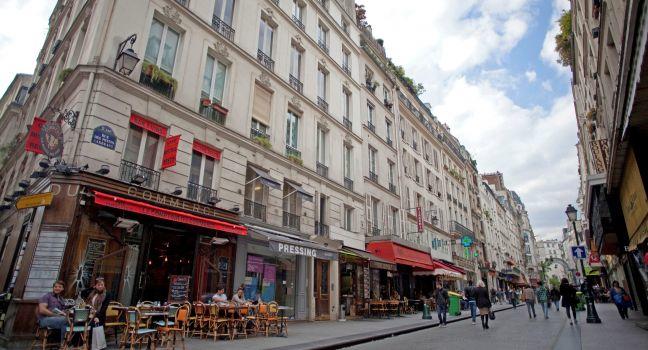
Rue Montorgueil was once the gritty oyster hub of Les Halles; now lined with food shops and cafés, the cobbled street—whose name translates to Mount Pride—is the heart of one of the city's most culinary neighborhoods. History runs deep here. Monet captured the scene in 1878, when Montorgueil was ablaze with tricolor flags during the World's Fair (see the painting in the Musée d'Orsay). Honoré de Balzac and his 19th-century band of scribes frequented Au Rocher de Cancale at No. 78, whose famously crumbling facade has been painstakingly restored with gilt panache. Stohrer at No. 51 has been baking elaborate pastries since 1730.

Indeed, it is pastries that reign over this small street these days, thanks to the arrivals of Fou de Pâtisseries at No. 45 and Jeffrey Cagnes at No. 73. The street extends onto Rue des Petits-Carreaux just before the Sentier métro, home to an outpost of excellent Breton crêperie Breizh Café at No. 14. Cross the boulevard to reach the diminutive Rue du Nil, a foodie haven home to Frenchie restaurant (No. 5) and wine bar (No. 6) as well as Terroirs d'Avenir's locavore shops and Plaq (No. 4), known for bean-to-bar chocolate. Even the area around Rue d'Aboukir, once far scruffier, is now a hipster fave thanks to the arrival of American-style baked goods like Boneshaker's doughnuts (No. 86) and Cookie Love's cookies (No. 84) as well as brunch spots Echo (No. 95) and Maafim (5 rue de Forges).
Rue Montorgueil, off Rue de Turbigo, Paris, 75002, France
Sight Details
Many shops closed Mon.

Something incorrect in this review?

Carrefour de Buci

St-Germain-des-Prés
Carrefour de Buci
© Ross Brinkerhoff / Fodor’s Travel

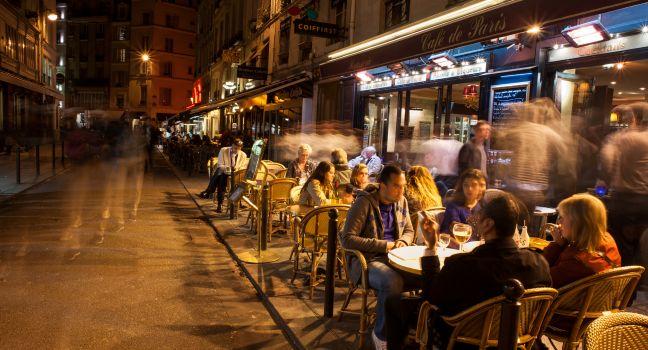
A short walk from the neighborhood's namesake St-Germain church, this lively crossroads (carrefour means "intersection") was once a notorious Rive Gauche landmark. During the French Revolution, the army enrolled its first volunteers here. It was also here that thousands of royalists and priests lost their heads during the 10-month wave of public executions known as the Reign of Terror. There's certainly nothing sinister about the area today, though: popular outdoor cafés brim with tourists and locals alike, and colorful coffee-table books are sold alongside take-out ice cream and other gourmet treats. Devotees of the superb, traditional bakery Carton ( 6 rue de Buci) line up for fresh breads and pastries (try the pain aux raisins, tuiles cookies, and tarte au citron).

Intersection of Rues Mazarine, Dauphine, and de Buci, Paris, France

Something incorrect in this review?

Cour du Commerce St-André

St-Germain-des-Prés
Cour du Commerce-Saint-Andre, Paris, france, Bistro, Restaurant
By Mbzt [CC-BY-3.0], via Wikimedia Commons

Like an 18th-century engraving come to life, this charming street arcade is a remnant of ancien Paris, with its uneven cobblestones, antique roofs, and old-world facades. Famed for its rabble-rousing inhabitants—journalist Jean-Paul Marat ran the Revolutionary newspaper L'Ami du Peuple at No. 8, and the agitator Georges Danton lived at No. 20—it is also home to Le Procope, Paris's oldest restaurant (which may seem like a tourist trap, but the food and service are very good). The passageway contains a turret from the 12th-century wall of Philippe-Auguste.

Linking Bd. St-Germain and Rue St-André-des-Arts, Paris, 75006, France

Something incorrect in this review?

Recommended Fodor's Video

Avenue des Champs-Élysées

Champs-Élysées

Marcel Proust lovingly described the genteel elegance of the storied Champs-Élysées (pronounced chahnz-el-ee-zay, with an n sound instead of m, and no p) during its Belle Époque heyday, when its cobblestones resounded with the clatter of horses and carriages. Today, despite unrelenting traffic and the intrusion of chain stores and fast-food franchises, the avenue still sparkles. There's always something happening here: stores are open late (and many are open on Sunday, a rarity in Paris); nightclubs remain top destinations; and cafés offer prime people-watching, though you'll pay for the privilege. Ater all, this is Europe's most expensive piece of real estate. Along the 2-km (1¼-mile) stretch, you can find marquee names in French luxury, like Cartier, Guerlain, and Louis Vuitton. Car manufacturers lure international visitors with space-age showrooms. Old stalwarts, meanwhile, are still going strong—including the Lido cabaret and Fouquet's, whose celebrity clientele extends back to James Joyce. The avenue is also the setting for the last leg of the Tour de France bicycle race (the third or fourth Sunday in July), as well as Bastille Day (July 14) and Armistice Day (November 11) ceremonies. The Champs-Élysées, which translates to "Elysian Fields" (the resting place of the blessed in Greek mythology), began life as a cow pasture and in 1666 was transformed into a park by the royal landscape architect André Le Nôtre. Traces of its green origins are visible toward the Concorde, where elegant 19th-century park pavilions house the historic restaurants Ledoyen and Laurent. The celebrated avenue has undergone positive changes in recent years—including a widening of pedestrian walks and the addition of cycling lanes—with more improvements planned for the future.

Paris, France

Something incorrect in this review?

Beaupassage Grenelle

St-Germain-des-Prés

This chic and sleek courtyard is home to a Thierry Marx bakery, Pierre Hermé café, and the very popular Certified Coffee where you'll usually find hipsters working on their laptops. There's also a nice collection of restaurants, a wine bar, outdoor seating, and contemporary artwork. Enjoy a gourmet snack or meal and soak in the modern contrast to the 19th-century limestone buildings on the street that hides this quiet haven of gastronomy. Enter from  83 rue du Bac or  14 bd. Raspail, which features a 79-foot-long cardboard and wood forest by artist Eva Jospin.

14 bd. Raspail, Paris, 75007, France

Something incorrect in this review?